Between the Lines

Larry Dignan, Andrew Nusca and Rachel King

Virgin Galactic unveils SpaceShipTwo; Plans open architecture spaceship

By | January 23, 2008, 7:42am PST

Virgin Galactic on Wednesday unveiled designs for SpaceShipTwo and the WhiteKnightTwo, two vehicles that are designed to usher in private spaceflight. The technology behind the system will have an open architecture “like Linux,” said officials.

In an event at the American Museum at Natural History in New York (see gallery right), Virgin Galactic unveiled the first product of venture to manufacture a reusable spacecraft and its launch craft. In July 2005, Burt Rutan, President of Scaled Composites and Sir Richard Branson, founder of the Virgin Group of companies, formed a company to manufacture and design SpaceShipTwo, a suborbital craft, and WhiteKnightTwo, a launch system.
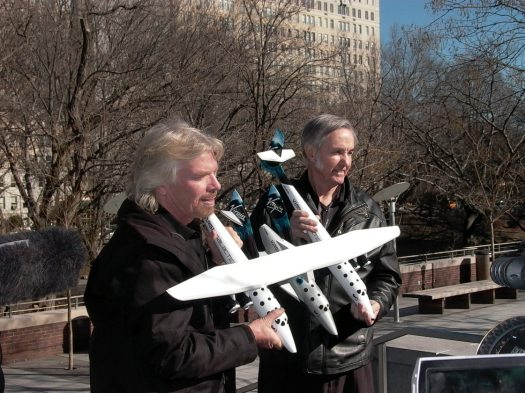
“Our vision of White Knight 2 would be part of a much longer development program. Have open architecture like Linux to allow other people to develop new vehicles and revolutionize new industrial uses of space,” said Will Whitehorn, president of Virgin Galactic, Virgin’s spaceline.

Whitehorn clarified the open architecture point a bit: He said that if interested parties come to Virgin and Scaled Composites they can use key points such as WhiteKnightTwo’s wing to build new aircraft. “We will work with people that come to work with us to do new things with the WhiteKnightTwo. If people come to us we’ll work with them.”

Whitehorn added that interested parties are already in discussions about building off of the properties of WhiteKnightTwo, but wasn’t going to name names. Overall, Virgin Galactic wasn’t detailing technical details behind the spaceship effort.

p1040152.JPG

Branson noted that the system has the architecture that could be developed into a passenger carrying system, launch payloads and further science. Branson and Rutan argue that space flight and commerce will be as big as telecommunications, the Internet and information technology in terms of innovation and economic gains.

The event is ongoing, but I thought I’d get the images up. The big model is the launch system. The smaller one is SpaceShipTwo. As Whitehorn notes: “The thing is covered with windows.”

SpaceShipTwo is 60 percent complete with test flights later this year. WhiteKnightTwo is 70 percent completed. Rutan said that WhiteKnightTwo will be the largest all carbon composite plane–he noted that Boeing’s 787 is 50 percent carbon composite.

The event featured a bevy of customers and a few Virgin Galactic astronauts, who were running around in black Puma jumpsuits.

p1040154.JPGp1040153.JPG
Key points in SpaceShipTwo, which has five ordered by Virgin Galactic:

  • Windows are 18 inches in diameter;
  • Two systems move landing gear or tail so if one fails there’s another system to pick up the slack;
  • Designed to be flown twice a day;
  • Roomy cabin with height roughly 7 feet;
  • The configuration is designed to reenter the atmosphere at any angle. “This vehicle is designed to go into the atmosphere in the worst case straight in or upside down and it’ll correct. This is designed to be at least as safe as the early airliners in the 1920s,” said Rutan. Later in the press conference, Rutan was asked to clarify that 1920s comment. He said: “Don’t believe anyone that tells you that the safety will be the same as a modern airliner, which has been around for 70 years.” Rutan also noted that SpaceShipTwo will have to be 100 times more safe than government space travel.
  • SpaceShipTwo and WhiteKnight are designed to be production vehicles. “If we can stay on schedule to build 40 or 50 they will reach 100,000s of people,” said Rutan. “This is not a small program.”

Virgin Galactic executives spent a lot of time talking about safety–how its astronauts of all ages could handle training, failsafe landings and other features. Why? Safety will be critical in luring the masses to take a spaceflight.

Kick off your day with ZDNet's daily e-mail newsletter. It's the freshest tech news and opinion, served hot. Get it.

Topics

Larry Dignan is Editor in Chief of ZDNet and SmartPlanet as well as Editorial Director of ZDNet's sister site TechRepublic.

Disclosure

Larry Dignan

Larry Dignan has nothing to disclose. He doesn’t hold investments in the technology companies he covers.

Biography

Larry Dignan

Larry Dignan is Editor in Chief of ZDNet and SmartPlanet as well as Editorial Director of ZDNet's sister site TechRepublic. He was most recently Executive Editor of News and Blogs at ZDNet. Prior to that he was executive news editor at eWeek and news editor at Baseline. He also served as the East Coast news editor and finance editor at CNET News.com. Larry has covered the technology and financial services industry since 1995, publishing articles in WallStreetWeek.com, Inter@ctive Week, The New York Times, and Financial Planning magazine. He's a graduate of the Columbia School of Journalism and the University of Delaware.

For daily updates, follow Larry on Twitter.

Talkback Most Recent of 42 Talkback(s)

  • Beautiful
    They are much better looking than the first ones. I hope that they accelerate space exploration and lunar landings. Unfortunately, the current goal is mostly space tourism, which is impractical. Maybe they'll raise enough money from it to fund the bigger picture, though.
    ZDNet Gravatar
    AbbydonKrafts
    23rd Jan 2008
  • Don't count on it.
    These craft are barely space craft. They get 60 miles up. They're not even close to
    achieving an orbit let alone escape velocity.
    ZDNet Gravatar
    frgough
    23rd Jan 2008
  • Small steps
    As the technology and experience improve, so will the craft. I would expect orbital capabilities within 10 years or so.
    ZDNet Gravatar
    itpro_z
    23rd Jan 2008
  • Astronauts get their wings only after 50 miles
    An astronaut gets their spaceflight wings only after exceeding 50 miles.

    So, 50 miles is considered spaceflight by NASA and the military.
    ZDNet Gravatar
    CMKRNL
    23rd Jan 2008
  • Hmm the term "sub-orbital"
    Ok, that's why this is called a "sub-orbital spacecraft." I am not sure what definition qualifies "space," but weightlessness would be a good start. And if you have followed the news, you will have seen that Spacecraft One attained this landmark, twice. This is no different than the US government claims in the sixties, and this was done at a lower adjusted cost, by private business.
    ZDNet Gravatar
    WookieFan
    23rd Jan 2008
  • Definition of Edge of Space
    The F?d?ration A?ronautique Internationale (FAI), which is an international standard setting and record-keeping body for aeronautics and astronauticinternationally accepted definition of the "edge of space" is the height of 100 km (62 miles). Since the 1950's it has been recognized as the altitude at which the air is too thin for aeronautical purposes.
    The U.S. military defines an astronaut as someone who has flow to an altitude of 50 miles resulted two X-15 pilots were awarded their astronaut wings in 2006, as they flew higher than 50 miles in the 1960s, but at the time they were not considered to be astronauts.
    Virgin Galactic is not going to be involved in this discussion as they will fly their passengers high enough to exceed either limit. The prototype, SpaceShipOne,in 2004 flew to a height of 112 kilometers twice in one week to win the $10 million Ansari X Prize. The tourist craft will also comfortably exceed the 100 km mark. If you are going to pay $200K you need bragging rights.
    Assuming you fly from Albuqurque, you will probably see Los Angeles on a clear day, but not as far as San Francisco. I think it will probably be much more interesting to take the flight out of Northern Sweden and see the Aurora Borealis. If you are shelling out $200K, who care about the cost of getting to Sweden. Of course, if that proves popular, they may just raise the price of flying out of Europe.
    There is discussion of developing orbital tourism flights (sub-orbital means you don't circle the earth), but a fight will initially cost several million dollars a seat.
    ZDNet Gravatar
    frankamartin@...
    23rd Jan 2008
  • "not even close"
    SHEESH! what a dimwit. Do you ever research anything before you naysay it? Check out just where in the 'getting onto space' process the heavy lifting is done. The first 50 miles eats most of the effort. It's not like a trip up a skyscraper where the effort to lift the elevator the last 10 floors is approximatly the same as the first 10.

    As for 'not even close', yer dead wrong wilbur. It's very close. It's not orbital, but it's a stone's throw from it.

    BobJ

    Here's a quote for you, I can't remember who said it but im not gonna take the credit. "When a learned man says that something is possible, he is almost always right. When a learned man says something is impossible, he is almost always wrong."

    Read yer history, we've been doing 'impossible' things for over 10000 years. Most of them in the last 200.
    ZDNet Gravatar
    plumnilly
    24th Jan 2008
  • Impractical? That makes no sense
    If space tourism is "impractical", exactly how will this venture serve to raise money for anything else?

    Although I seriously doubt they'll build 50 of these, I do expect that there will be some success from this venture.

    Remember, the Wright Brothers were a fringe private venture too, and look where that lead. Heck, only 30 years ago, the idea of the personal computer you are now using to read this post was considered an "impractical" by almost every "expert" in the field.

    Have a little faith.
    ZDNet Gravatar
    JohnMcGrew@...
    23rd Jan 2008
  • 30 years ago ...
    20 years ago 1988? I was using personal computers. The UK bretheren on this forum may remember BBC computers - you could do real WP and number crunching long before '88, and in 88 I was using ... what was it .. ah yes, Windows 1.03 - those were the days.

    30 years ago, 1978, I was playing with prototype kits and doing programming. Even then it was obvious which way things were going.

    To get real 'heads in the sand' you need to go a little further back than that. I think the definitive put-down came from Tom Watson, then IBM chairman, who said in 1958: "I think there is a world market for about five computers."' And by that he meant mainframes.
    ZDNet Gravatar
    dgrainge
    23rd Jan 2008
  • It may have been obvious to you...
    ...but it was not obvious to the "experts" of the time. HP turned away Jobs and Wozniak, seeing little future in the "toys" they were developing. Even only a few years later, the brain-trust at IBM still saw the PC as little more than a smart-terminal that would be slaved to their mainframe world. Even by 1983, execs at IBM assumed that most IBM-PCs were being used as little more than "game machines" because most of them went out their doors with the minimum 16K of RAM and no disk drives. Their myopia was such that they didn't realize that most sellers were buying them bare-bones, and then adding cheaper-but-superior components to build a more serious and powerful PC than IBM offered.

    The point is that at any time, the "experts" in any given field can by blinded by their own sense of what they think is possible and viable.
    ZDNet Gravatar
    JohnMcGrew@...
    23rd Jan 2008
  • Obvious
    When the head of the then giant Digital Equipment Corporation was approached by one of his subordinates on publishing a personal computer magazine (hot item then, remember how many there were?) his reply was: "Personal computer? Who would ever want a personal computer?"

    Any trace of DEC today? Only in museums.

    BobJ
    ZDNet Gravatar
    plumnilly
    24th Jan 2008
  • Don't think about space tourism...
    ... Think about international travel! This thing goes 70 miles up, then glides back down. I'm wondering how high they have to go in order to glide to London, or Japan, or Australia? Sub-orbital travel, getting you to your destination on the other side of the planet in two hours (or your next flight's free)... how many business executives would pay through the nose to make that happen?

    Remember, what killed the Concorde wasn't the cost, it was the fact that 9/11 killed all the people who made the choice to fly supersonic because they saw "getting there fast" as less expensive than spending the time a normal commercial flight takes.
    ZDNet Gravatar
    muzhik
    23rd Jan 2008
  • Actually...
    ...cost did kill the Concorde, and long before 911. It was never a money-making proposition from day-one. It was mostly a vehicle of European technological pride than anything else.

    The idea of intercontinental travel is far more intriguing. Years ago, the US government and the status-quo aerospace industry killed the ?Orient Express? because, like the Concorde, it was going to cost far too much to develop and build, and would never justify the many-tens-of-billions that it was going to cost. It would be a joy to see Rutan & Branson achieve an economically viable service for only a few hundred million.
    ZDNet Gravatar
    JohnMcGrew@...
    23rd Jan 2008
  • White Knight 2 = Pegasus launch platform?
    It seems to me that Orbital Sciences Corporation's Pegasus satellite launch vehicle (which now has to be lifted by an airliner to its launch altitude) would be a good payload for White Knight 2 - it would just about have to knock their cost to launch, wouldn't it? Not to mention possibly allowing larger Pegasus-type vehicles and/or larger payloads for the boosters themselves.
    ZDNet Gravatar
    jlafitte
    23rd Jan 2008
  • Launch Costs
    Hello,
    I was just wondering if you knew the launch costs.

    Thanks
    ZDNet Gravatar
    amillerone
    8th Mar 2008

Talkback - Tell Us What You Think

Formatting +
BB Codes - Note: HTML is not supported in forums
  • [b] Bold [/b]
  • [i] Italic [/i]
  • [u] Underline [/u]
  • [s] Strikethrough [/s]
  • [q] "Quote" [/q]
  • [ol][*] 1. Ordered List [/ol]
  • [ul][*] · Unordered List [/ul]
  • [pre] Preformat [/pre]
  • [quote] "Blockquote" [/quote]

The best of ZDNet, delivered

ZDNet Newsletters

Get the best of ZDNet delivered straight to your inbox

Facebook Activity

White Papers, Webcasts, & Resources