Where are you? Will anyone answer that question on the Internet?

Summary: Just a day after Facebook announced an enhanced mobile platform that offers more location-based services, a report by the Pew Internet and American Life Project (PDF) reported that the trend remains small - with only 4 percent of online Americans using location-based services.
Just a day after Facebook announced an enhanced mobile platform that offers more location-based services, a report by the Pew Internet and American Life Project (PDF) reported that the trend remains small - with only 4 percent of online Americans using location-based services.
But what does that mean? Are location-based services doomed? Will they never tap the mainstream? Are the business models built around location "check-ins" destined to fail?
Ummm... No.
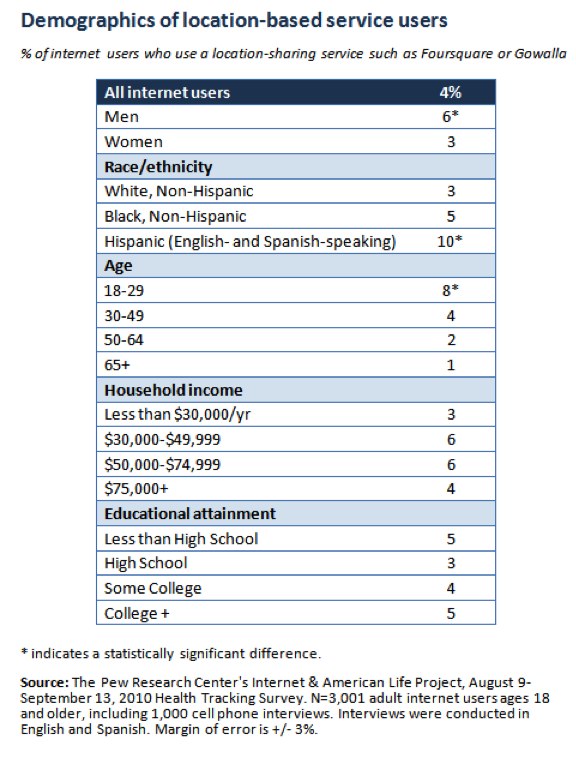
If that four percent number were bigger or the study was showing some sort of rapid growth, I might have to raise an eyebrow. But location-based services are exactly where I would expect them to be - still among the early-adopters and bigger among young people.
The same survey found that 8 percent of Internet users between ages 18 and 29 reported using a location service such as Foursquare or Gowalla. I can't help but wonder what the 13-18 numbers might have looked like if teens had been included in the survey. And I also can't wait to see how any of the numbers in the chart below change after Facebook's Deals Platform gains some momentum.
I say that because it goes to the heart of one of my posts earlier today - that older, "frugal" folks like me might find some value in engaging in location-based services if the result were some sort of financial incentive by a nearby business - such as a free drink with my sandwich at the deli down the street.
The numbers may be small now - but they'll grow. And that four percent number really isn't all that small when you consider that location-based services are just starting to gain some traction. Sure, the folks in tech circles around Silicon Valley may make you feel like you're behind the times if you're not checking in on Foursquare throughout the day. But, in reality, they're ahead of the times.
With every day that passes, kids from that unknown 13-18 demographic move up a notch into the next age group, bringing their tech habits with them. I have no doubt that today's kids - who don't see much difference between location-based services like Foursquare and a Facebook status update that tells friends where you're dining.
Through Facebook, we - me, the wife and kids - all told our kids that we were vacationing in Hawaii. Interestingly enough. my wife and I also were sure to share the fact that someone was house- and pet-sitting for us while we were gone - just in case some Internet wise guy was thinking about swinging by the house to see what might be inside.
Kick off your day with ZDNet's daily email newsletter. It's the freshest tech news and opinion, served hot. Get it.
Talkback
RE: Where are you? Will anyone answer that question on the Internet?
No way I would use this...
RE: Where are you? Will anyone answer that question on the Internet?
I'm picturing parental concerns, and another Craig's list solicitations
Years ago, parents were always worried about their children, about who they met online, and wondered what would happen if they would meet them in person. Now, Facebook is making it easier for these offenders of minors and can track their whereabouts just be befriending them on Facebook. A scary thought even when Facebook is on smartphones.
RE: Where are you? Will anyone answer that question on the Internet?
Kids are much more likely to be physically or sexually abused by a family member or real life friend of the family, and not a quasi-anonymous internet friend.
There isn't much to be "scared" about. Of course a parent should monitor their kids internet use and social circle, including facebook, according to their age and maturity level. But parents often don't consider much more dangerous activities for children to be involved in, while treating the internet as a boogie-monster.
RE: Where are you? Will anyone answer that question on the Internet?
It is strange, if you were to put a GPS chip in people's leg you would get all kinds of flaming responses.
Put the same chip in a phone and add a coupon, no problem.
Spot on
But you're absolutely right, this modern, consumerist society has really been dumbed down to the nth degree. It's sad that with a little marketing (.. and fool's gold) thrown into the mix, the average pleb will more often than not choose expedience over privacy. In many cases, these very same people also pay the ultimate price with the loss of all relative anonymity.
RE: Where are you? Will anyone answer that question on the Internet?
I for one have no need for advertisers to know who I am or where I am. I loathe commercials and ads anyway; why would I want to encourage more of the darned things on my phone!?
Because it ultimately didn't add anything worthwhile to my life, I abandoned Twitter recently. I've never had a Facebook account, so at least I don't have to deal with that particular privacy wonderland. As other social networks and similar services move into location-based services, I have a feeling I'll not be involving myself in them either.
Ultimately, privacy isn't so much about being anonymous, but choosing with whom and to what degree you want to be known. Different people, different generations, have varying ideas on what's useful and appropriate. My preference is for more anonymity. Not necessarily wrong, but it does seem to be going out of fashion.
Illusions
I don't get it. Oh no, a server in the cloud will know that you like coffee? Before the internet did people walk into coffee shops and scream "Don't look at me!"? Was the check cashing generation anonymous because check fraud was so rampant? Perhaps the notion was that your bar tab was just between you and you bartender? Or perhaps it's the notion that your bills are keenly protected by impenetrable walls of paper! After all, with the old model, a gradeschool drop out could steal your mail, discovering where you bank, your name, your address, your bank account and routing number, how much electricity you use(and consequently that you have stuff which uses it), etc. Perhaps the anonymity of which you speak is the anonymity of the minimum wager collecting your checks for the utility company, with full access to your address, name, account info, etc.
RE: Where are you? Will anyone answer that question on the Internet?
@nuttob there are far better ways; which do not require any technology to determine if someone is at home.
Don't get me wrong there are some real privacy and security concerns with location based services. Mostly with women and kids, these unfortunately deal more with where they are, not not with where they aren't. The key to minimizing the risks involve managing your social networks, and limiting how the information is networked out from the. Only share information with those who you really know and trust.
RE: Where are you? Will anyone answer that question on the Internet?
I do agree though, checking in for the sake of checking in seems to be wearing out it's welcome.
There needs to be something else in the backend to "quid pro quo" the desire to interact.
At http://www.livechatconcepts.com/ we "check in" users when they interact with one of our sites eg http://www.livefootballchat.com/ or http://www.livebasketballchat.com/ etc but at the end of the day checking in and posting a note out to your twitter and facebook accounts saying you just logged in secondary;The primary purpose is being on the site to chat live while watching the game.
Yes badge information is interesting but you need to provide more to keep your users coming back.
Cheers,
Dean
RE: Where are you? Will anyone answer that question on the Internet?
I might add that I have no problem with ANY store I use not having a finite, checkable address that even includes driving directions most of the time.
Therefore: I see no use for this except to be able to locate ME! Nuh,uh; ain't gonna allow it.
I want to see the WHOLE Internet, not localised.
RE: Where are you? Will anyone answer that question on the Internet?
dumb
RE: Where are you? Will anyone answer that question on the Internet?
So this begs the question: Why are these companies still allowing geeks to name products and services with vague, niche references?
Take 'Kindle'... This name only brings to mind book burning scenes from Fahrenheit 451 and Nazi historical footage - obviously not what Amazon intended, but would anyone call Kindle a success? Well, Bezos hasn't has he?
And then there's the security issue. I totally get that the business opportunity to offer a free drink to nearby customers is a no brainer. This thing will be lead by a combination of business opportunities and key demographic user take-up. But letting everyone know when you're away on holiday abroad? Are you serious? That's one of the dumbest things I've ever heard of. I don't even tell people where I've been.
I also filter associations that might be useful to an 'enemy'. But I'm guessing some of you don't even consider these things. Well, it's your security. It only needs to be breached once.
But before you leave this response, ask yourself this question: Would I post my travel plans on the notice board at work, a local bus, or shop window? No, well you just did, only the audience is much much wider.