Who falls first: RIM or Nokia?

It's clear that BlackBerry maker Research in Motion is in trouble. A lack of direction and innovation is coupled with a pinned-all hope that the company can turn its falling share price around with the upcoming BlackBerry 10 operating system.
But the limelight has been firmly on RIM and not on Nokia, the once cellphone market supergiant. Instead, the talk of the town has focused on Nokia's Lumia handset amid the company's falling U.S. smartphone market share instead of Nokia's crumbling company.
If we compare the two, Nokia has fared worse over the past half-decade than RIM has.
The value of RIM's shares has dropped by more than 70 percent in the past 12 months, with its market cap has tumbled from $78 billion to $6.3 billion in three years.
Nokia, on the other hand, has seen its shares drop by 90 percent in five years, and its market cap has dropped from $151 billion to $11.8 billion in four years.
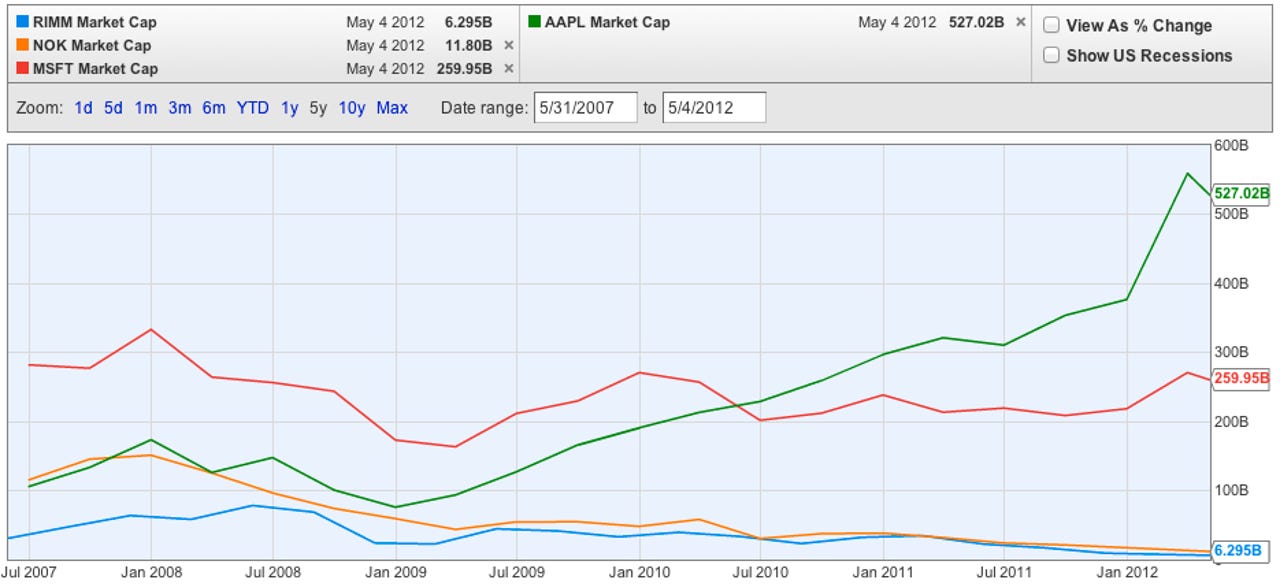
In comparison, Microsoft has remained mostly steady despite an expected hiccup during the 2008--2010 global financial crisis, while Apple was unfazed by the economic blip in which the company saw its worth rise by over five times.
While RIM's downfall has been quicker than Nokia's, the Finnish phone giant has lost more market cap and share value. Arguably, the slightly slower decline than RIM 's shows Nokia's reluctance in clawing its way back to the top.
Microsoft and Nokia's existing partnership on the smartphone front may force the Redmond-based technology company to come to its friend's rescue.
Last year, the two companies forged a partnership where Nokia smartphones would sell with the Windows Phone operating system, giving Nokia a boost in smartphone sales and Microsoft increased operating system market share options.
Reports suggest Nokia's chief executive Stephen Elop could reach out to his former employer Microsoft for financial help, reports Reuters, after two of the three major ratings agencies rated Nokia's debt to junk status.
One analyst believes a helping hand "to the tune of a couple of billion dollars" could be on the cards, but thinks a Microsoft buy-out remains unlikely. ZDNet's Mary Jo Foley does not think Microsoft would buy either RIM or Nokia, but it certainly doesn't rule out a strings-attached deal to keep Nokia in the black.
With Microsoft shelling out $1 billion each year to Nokia to use its Windows Phone, Microsoft has made clear its commitment to the smartphone market. It has vested interests and cannot see its mobile platform suffer at the hands of its Apple and Google rivals.
In the meantime, in spite of Apple's efforts to push to the top of the smartphone market, Samsung remains the leader in sales worldwide, though figures vary between analytical firms.
J.K. Shin, Samsung's mobile business president, said it had no plans to acquire the BlackBerry maker, according to the Wall Street Journal, despite reports in January suggesting Samsung could bailout the company. The rumour was quickly nipped in the bud by the Seoul-based smartphone giant within hours of the market rumblings.
The BlackBerry maker may be on its last legs but it has an exit strategy. If it can't recoup its losses with BlackBerry 10, it could put itself into the sale arena. The Canadian government said it would not block the sale if a foreign firm wanted to buy the company. RIM still has vast infrastructure operations, making the company a prospective candidate for Apple, which continues to push its iMessage platform.
But Nokia has only one fall-back plan: sale.
Image credit: ZDNet. Data source: YCharts.
Related:
- Can RIM bounce back? Take the long view, investor says
- Mary Jo Foley: Is Microsoft's next move buying Nokia or RIM? Nah...
- ZDNet: RIM has “lost it”: Shareholders call for company break-up, or sell-off
- RIM looking to Samsung for bailout?
- RIM: Open the competitive floodgates, end BlackBerry exclusivity
- BlackBerry maker denies consumer market retreat
- CNET: Is RIM's market share headed below 5 percent?
- Apple vs. Samsung: Who's the king of the smartphones?