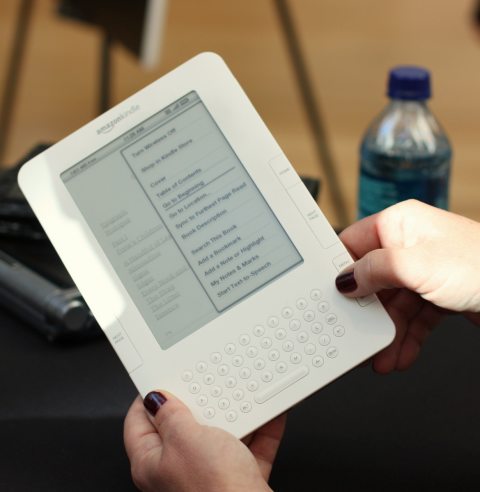
Why did Amazon downplay the most important part of Kindle 2?
Summary: Amid all of the hullaballoo about Amazon's Kindle 2--the cheesy Stephen King novella, a thinner design and software improvements--the most important feature was reduced to 51 words in a press release. Amazon CEO Jeff Bezos glossed over this feature in probably fewer words.
Amid all of the hullaballoo about Amazon's Kindle 2--the cheesy Stephen King novella, a thinner design and software improvements--the most important feature was reduced to 51 words in a press release. Amazon CEO Jeff Bezos glossed over this feature in probably fewer words.
That feature is called "Whispersync" and it syncs the Kindle 2 with the first version of the device and "a range of mobile devices."
The idea here is that you can read something on your Kindle, pick it up on your iPhone or BlackBerry and then hop back to the Kindle and keep your place.
Pretty neat eh? Then why did Amazon downplay it so much. Here's what Amazon said officially (Techmeme):
Automatically Syncs With Original Kindle, Kindle 2, and future devices
Amazon’s new “Whispersync” technology automatically syncs Kindle 2 and the original Kindle, which makes transitioning to the new Kindle 2 or using both devices easy for customers. Kindle 2 will also sync with a range of mobile devices in the future.
It would have been nice to hear about a few of those devices.
So why the terse mention? Amazon obviously wasn't ready for its iPhone app announcement yet. Clearly, the iPhone, which was referred to briefly but not mentioned by name, is an open question for Amazon.
And besides, if Amazon would have mentioned Whispersync and iPhone in the same sentence perhaps the attention would have gone to Apple.
In either case, Amazon's omission is telling. Amazon may be:
- Worried that it would cannibalize the Kindle with an iPhone app.
- Is trying to keep control of its book buying platform.
The most likely scenario is that Amazon didn't want to talk about its Kindle-iPhone connection, which may have people wondering why they need a Kindle in the first place. However, whispersync lays the groundwork for a few interesting possibilities.

Also see:
- Amazon's Kindle 2: 5 burning questions
- Jason Perlow: Kindle Economics 2: Why Amazon should not be Apple, and Jeff Bezos is not Steve Jobs
- Amazon Kindle 2 Up Close and Personal
- Jason O'Grady: Kindle 3 should be an iPhone app
- Matthew Miller: Existing Kindle owners to the front of the line please
- M-Edge announces Kindle 2.0 cases and booklight
- Live from New York: Amazon's Kindle 2.0
- Dana Blankenhorn: Time for Kindle to go open source
- Gallery: Amazon releases Kindle 2.0
- Techmeme
Kick off your day with ZDNet's daily email newsletter. It's the freshest tech news and opinion, served hot. Get it.
Amazon’s new “Whispersync” technology automatically syncs Kindle 2 and the original Kindle, which makes transitioning to the new Kindle 2 or using both devices easy for customers. Kindle 2 will also sync with a range of mobile devices in the future.
Talkback
Re: Kindle 2
Why a separate device?
The larger screen is much easier on the eyes. This becomes important when reading for hours at a time.
RE: Why did Amazon downplay the most important part of Kindle 2?
That said I don't think the masses agree with that argument--especially with the Kindle going for $359
Which masses?
The tech masses, the reader masses, or possibly even the college masses?
The people who do read 800 page WWII books probably spent a lot more than $360 for their entire collection. You could probably measure the cost of the books in the thousands.
College students especially could benefit if Amazon made all of the textbooks available for the Kindle.
By calculating the price difference between the printed and the Kindle books, I estimate the Kindle would pay for itself in three semesters for a full 12 credit load, assuming at least one book per class. Anybody getting a Bachelor's degree or better would be saving a lot of money that way.
Not to mention it would save a lot of space and weight in my backpack. My chemistry textbook alone weighs 4.6 lbs (2.1 kg)!
Alas, however, I was not able to find my textbooks for the Kindle. That's something they should work on - it would make a lot of sense to put textbooks on the Kindle.
Yeah, the "techy" masses are probably not going to buy the Kindle - but I think there are plenty of people outside the tech world that would see the sense in buying a Kindle.
If Amazon can push hard for it, the college market I think is the absolute best market for the Kindle. Each of us already pays thousands of dollars for textbooks for a degree. $359 would seem dirt cheap in comparison, and the math says we could potentially save a lot of money buying the Kindle versions instead of the physical versions - enough to cover the cost of the Kindle itself in less than 2 years. With 4+ degrees being the norm, that's an easy decision to make.
All they need to do is to work with the colleges and publishers to make the books available.
Colleges should be the market
They'd die first
has yet to happen, that's why....
Basically: So what?
exactly-- and will it for phones with most bluetooth disabled?
Agreed ...
announcements
The most upsetting part of the announcement...
The big announcement arrived via e-mail, and Amazon excitedly gave me the big news: if I upgrade with the next 24 hours (!), I could [i]go to the front of the line!![/i]
So naturally the next thing I looked for was the special upgrade price for current Kindle owners. Surely they would offer [i]some[/i] kind of incentive for people to [i]rush[/i] out there and make a purchase.
I guess they are looking to cash-in on the hardware itself, and not just on the books. (As opposed to the video game market, which makes all money from the software.)
Sans discount, I think I'll sit this out for a while.
What HW Co gives discounts for "upgrades?"
You decided to be a 1st gen adopter. Amazon doesn't think it's necessary to entice you any more than they already have.
I understand
I own the Kindle 1.0, and I'm expressing my opinion. Apparently many other Kindle 1.0 owners feel the same way, and if you read through the Amazon forums you will discover that too.
I see where you're coming from
Unfortunately, though, I think you're always going to be sadly disappointed in that regard.
Cell-phone providers, that's who
C'mon jerk, apples and oranges.
Perhaps you would prefer to get the kindle for free or near free and be put on a forced subscription plan?
Sorry, I would rather shell out the dollars for the device than be forced into purchasing X number of books in 2 years. I've had enough of that with the Cell Phone guys.
Cell companies
Sadly in the US they don't make money on the phones. They subsidize those and make money from the service. I wish it weren't so; I'd like the option to pay what the device is actually worth and not be forced to be on a contract. Some small (local) providers do that, but their service is not as good as the big 4 (I personally prefer Verizon), at least not where I live.
Cell phones without contracts
The last time I bought a phone was from a Verizon mall kiosk 3 years ago. It would've been free with contract, but was $140 without.
(we use "pay-as-you-go" billing, which works out to $15/month, given our usage)
I think this is a good comparison
Cell phones have same kind of closed-loop (proprietary) system, making the comparison valid.
I'm sure Amazon has analysis showing that Kindle owners will typically purchase "x" number of books per month, so although they don't [b]require[/b] the purchase of a certain number of books per year/month, they know that customers [b]will[/b] make certain levels of purchases.
Based on that knowledge, they can estimate with good accuracy the number of months it will take for them to recoup any loss from an upgrade discount for loyal 1.0 owners.
This is basic stuff. They really could/should have provided an upgrade discount.
The problem with your argument
Nevertheless, you can convert PDF files into the Kindle format. Here's how:
http://ireaderreview.com/2009/02/09/kindle-2-pdf-faq-pdf-kindle-20-conversion-questions/
So if Borders, or B&N sell e-books in PDF format then you can bring them in to Kindle. If they don't that's their problem, not Amazon's.
Of course, I bet Amazon would rather you buy the books from them. And I'm sure they've assumed a great deal of such purchases into their business plan. Nevertheless, you're not forced to do so.
I doubt you are a Kindle user
PDF support is more of an experimentation. So, as someone who actually knows what they're talking about through ownership of said Kindle, it is a proprietary system in which the user is limited in their ability to choose the book-seller, and thus the comparison to the cell phone market is good.