Microsoft copies BlueJ, admits it, then patents it

Summary: Michael Kölling is pretty ticked off right now. What would upset a mild mannered professor at the University of Kent? How about someone willfully using his work without attribution, and then filing for a patent on it that could prevent him from using it himself?
[Update: Microsoft is recalling the patent application, calling it a mistake. For a full update see the follow-up article. -Ed]
Michael Kölling is pretty ticked off right now. What would upset a mild mannered professor at the University of Kent? How about someone willfully using his work without attribution, and then filing for a patent on it that could prevent him from using it himself?
Kölling is one of the creators of BlueJ, an integrated development environment designed for teaching beginners how to program. It's based on an earlier language called Blue, which he, Bett Koch, and John Rosenberg came up with in 1994. One of the fundamental features of the system is an interactive way to instantiate and invoke objects called the "Object Bench". Here's one of the dialogs from BlueJ showing that feature:
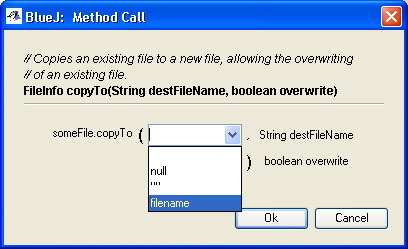
In May 2005, Kölling noticed that Visual Studio had added a new feature they called "Object Test Bench" which looked very similar:
The BlueJ team objected, but not to the copying of their idea, which is encouraged in academic circles. The objected to the fact that Microsoft didn't give them any credit for it. At that time, Kölling wrote:
I don't care that they copied BlueJ - good on them, and good luck to them. But I care about attribution. I work at a university, and I strongly believe in honest attribution of sources. ... So I decided to post these screenshots here so that people can at least see and make up their own minds.
Dan Fernandez, Lead Product Manager of Visual Studio Express, asked around inside Microsoft and confirmed that the VS feature was inspired by BlueJ. In June 2005 he quoted internal sources as saying:
Object Test Bench ... was influenced by feedback from teachers who were used to working with BlueJ. The Class Designer was also a planned feature of the new “Whitehorse” functionality. We did tweak both of these features based on teacher feedback, which borrows from several teaching concepts these teachers already enjoy with BlueJ.
Such an admission was likely all that Kölling et. al. were looking for, and the matter would have been dropped at that point were it not for something Microsoft did shortly thereafter: It has recently come to light that in October 2005, Microsoft filed for a patent on the technology.
When informed of this application, Kölling was furious. He writes:
Let’s get that clear: four months after management were clearly aware of our prior work (and with developers being aware from the start), Microsoft knowingly filed a patent application claiming original invention of this mechanism.
Of course, this is only an application and and it may not be approved. The BlueJ authors clearly have a claim to prior art, but if MS is granted the patent it will be up to the authors to challenge it before a court. This prospect has Kölling worried:
Carrying through a court case in a foreign country against a company with pockets as deep as Microsoft’s (and enough lawyers to win a tug-of-war against a small country) is not everyone’s idea of a good afternoon. Certainly not where I work - a university.
So was this simply a mistake, owing to the immense pressure on employees in large software companies to file patents? Or was it something more sinister? We may never know. But as Kölling writes:
The fact of the matter is that the application has been filed, Microsoft are trying to get control of this interaction style, and they do so while being blatantly aware that they have copied the functionality from elsewhere.
As a result, a product like BlueJ, developed for the education community, that has helped thousands of students to learn programming, may be muscled out of existence by corporate greed.
Related articles: (Updated)
Kick off your day with ZDNet's daily email newsletter. It's the freshest tech news and opinion, served hot. Get it.
Talkback
seems like always unhappy
Dont know much about BlueJ but I dont think it is a revolutionary improvement or way of programming. IBM, Amazon have all filed and have received patents on some even more petty stuff so I dont see any problems with Microsoft getting a patent on this one.
Unless the Patent Office becomes aware of the prior art?
Hopefully, this timely piece of publicity will do the trick.
Prior Art
That's not the USPTO's business. If the subject invention isn't already in their database, it's good to go.
Don't forget that the USPTO is a profit center for the Federal government. There's much more money in granting patents than denying them.
Inaccurate-- on both counts
Wrong. I worked there. We look at a lot more than a database.
[b]Don't forget that the USPTO is a profit center for the Federal government. There's much more money in granting patents than denying them.[/b]
The gov't charges the same to all patent apps. While the little guy filing a simple app may feel overwhelmed by the expense and procedure, the bigger guys abuse the system and cause the prices to skyrocket.
Net result? The gov't has to charge more for smaller apps rather than using a system where meets & bounds, definitions, diagrams and statements are counted and used in calculating total fees.
Basically, a broken system that is a give away to large corps.
Are you serious?
How about the fact that Microsoft is trying to patent someone else's idea? The fact that Microsoft didn't invent this, and admits that it is based on the other guy's work makes the filing of the patent just plain wrong.
If it does get approved, I have definitely lost all hope that the Patent Office can be changed.
M$ & patents
Just an observation ...
Just A Correction
from Xerox PARC and paid for that license with Apple stock.
Which is more than Microsoft did when they "borrowed" the user interface from
Apple.
Even more of a correction:
PARC and who had done work on his ideas at PARC and this guy sent Jobs to PARC to
get validation for his ideas. The ideas pre-date PARC and were thought up by the
guy Apple had hired.
I stand corrected, but my point was ...
Thanks for the correction.
Apple's idea?
knowledge that M$ used Apple as their R&D in the early
days. Apple innovates, M$ copies, same today only now
they have Linux to help also.
Come on ator1940
Oh I see, when everyone else copies something it's known as "stealing", when Apple copies something it's called "innovation"
Thanks for clearing that up.
ator1940, You didn't say it was their idea, but ...
Perhaps it would have just been called "Microsoft OS" ... but I digress.
J Zern... proof please
Apple saw an in-house, "experimental" GUI at Xerox, had permission (thru stocks & $$$) to use parts of it, Apple greatly enhanced, added to it and made it the first viable, usable, consumer friendly GUI.
MS had access to the Mac GUI while developing Mac apps. Gates saw it, loved it and basically threatened Apple ("give me the GUI crown jewels of no software for you!") and stole it (like MS does many other technologies) and still did a p_ss poor job of imitation.
Question of who copies who... which OS today looks more like the original (or other) of years past?
Does todays Mac GUI look more like the original Mac v1 or Windows v1 OR... does todays Windows (just rotated 180 degrees so as not to be completely obvious) look more like the original Mac (which has been fairly consistent thru the years)?
Even most Windows fanboys say WIndows 95 was the first decent, usable version (ie, it looked and worked most Mac-like).
Also, re the LG touch screen. When did photos of that model originally come out? I don't recall seeing any until after the "iPhone" launch.
There have been numerous ideas and "mock ups" of a potential Apple phone for months (years?) and many play off of the basic iPod shape and design (with wide (possibly touch)-screen).
Another question... does the "iPhone" and LG Prada model look more like any previous Apple product or more like any previous LG model (or design direction)? (see GUI question above)
Many have tried to cash in on Apple industrial design, particularly the various iPod models. The "iPhone" was a logical extension of the iPod and may be an indication of the actual (or rumoured) wide-screen iPod, along with the multi-touch GUI for navigation. (does the LG have similar functionality or just a touch screen?)
>>> Oh I see, when everyone else copies something it's known as "stealing", when Apple copies something it's called "innovation"
>>>
No, that would be "when MS copies something, they call it innovation" (see Vista and all the Apple/Mac envy behind much of it's development - see Iowa trial MS emails)
When it's usually a one-way street, that's how it goes :-)
It's Microsoft
However...
It doesn't matter that it's "nothing revolutionary", it's plain theft of other people's ideas. Are you Ok with that?
I dont see any problems with Microsoft getting a patent
MS admit that they copied the idea and then filed for a patent. Not something new in the MS book to patent, or use other peoples work and not paying unless it is dicovered and mentioned in the press, but certainly not honest.
Another tiny spear in the elephant.
Brave New World???
Why not ask them?
"Why ask them?" is a better question....
"Why yes Ed.... we took this man's idea because we are greedy little corporate weasels that will do whatever it takes to make money. We got caught stealing his idea though so we're throwing out the patent and pretending it was a mistake. We'll do better next time."