World heavyweight title fight; Motorola Droid X vs HTC EVO 4G

In just a couple more days we will see the official launch of the Verizon Motorola Droid X, the second 4.3 inch display Google Android device to launch on a US wireless carrier. You can check out several reviews of the Verizon Droid X and Sprint HTC EVO 4G (many listed on the last page of this post) and most every reviewer will give both about the same high ratings so you really need to look a bit closer at both devices to see which one fits your needs better. I am blessed to be a ZDNet writer who gets to spend time with many of these devices to evaluate them for myself first hand before committing to buy the ones I find best for me. In this post, I will walk through several aspects of each of these two super smartphones and let you know which one I picked for myself now that I have had some hands-on time with both. I also recommend that you take a look at MoTR podcast co-host James Kendrick's head-to-head article covering these two smartphones. You should check out my HTC EVO 4G and Motorola Droid X image galleries for a few photos of these two devices and sample photos taken with each of them, including a couple panoramic shots from the Droid X.
| Image Gallery: Here are a few photos of the Motorola Droid X (with sample photos from both) and HTC EVO 4G. | 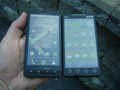 | |||||
Tale of the tape: Specifications
I know specifications don't tell the whole story, but it is a good place to start when comparing devices side-by-side so let's take a look at how these two superphones stack up on paper.
|
While they both run Google Android 2.1 and will both be upgraded to Android 2.2 (aka Froyo) there are some other differences in software and services. They both have the capability to share internet access and act as WiFi hotspots with the Droid X sharing on up to 5 devices while the EVO 4G can share with up to 8 devices. Surprisingly, Verizon included very few pieces of bloatware on the Droid X and instead gives you a Verizon tab in the Android Market where YOU can choose to install things such as V CAST Tones, V CAST Media Manager, My Verizon, and more V CAST Apps and selected 3rd party apps (including Kindle, Shazam, and more). The only custom apps and services I could find loaded on the Droid X are BlockBuster and City ID. Motorola also includes their new user interface, still called MOTOBLUR, that is essentially a few widgets and applications designed to give you quick access to social networks, news, and some other information. I like the new MOTOBLUR since it gives you more control and is not too overwhelming, but still much prefer HTC Sense.
Sprint also keeps the EVO 4G fairly clean with the following services and application preloaded on the HTC EVO 4G; NASCAR Sprint Cup Mobile, Sprint Football Live, Sprint Navigation, and Sprint TV. The great thing about Sprint is that all of these additional services are "free" and included in your monthly data fee. HTC has their Sense 2.5 user interface on the EVO 4G that gives you a special Home screen layout, widgets, keyboard, phone dialer, other utilities, and applications such as Peep, Friend Stream, and Footprints.
Let's check out the hardware in more detail »
Form factor
Let me start by saying that both devices are large smartphones that are much more focused on data rather than on phone calls. The phone call experience is good on both devices, but these are really two handed devices with a display focused on the data experience. The Droid X has two microphones for calls and one for video recording, but I held excellent calls with the EVO 4G as well and calling is secondary to most people using these large screen devices. While they both have 4.3 inch diagonal capacitive touchscreen displays, the Droid X is longer than the EVO 4G and also narrower. The narrower width actually makes the Droid X feel a bit more comfortable in my hand, but the web browsing experience is a bit less rich due to the page height being less in landscape orientation (I measured 2.2 vs 2.35 inches in viewable display difference.).Both devices feel very solid and appear to be able to withstand heavy daily usage. The Droid X does feel more dense to me than the EVO 4G, but I do like the rounded back of the EVO. They both have microUSB and micro HDMI ports, 3.5mm headset jacks, and volume buttons. The Droid X has an actual camera shutter button so this is a bit of an advantage if you take lots of photos with your device. There are four hardware buttons on the bottom of the front of the Droid X (the EVO has touch sensitive areas), but the Home and Menu buttons are swapped (compared to the EVO 4G and some other recent Android devices I have been using) so I kept hitting the wrong button while using the device. I would like to see Google require a standard across all Android devices when it comes to these four buttons.
I know some may find this to be silly, but I regularly use the integrated metal kickstand on the HTC EVO 4G to watch video content and video chat with the front facing camera. This kickstand makes lots of sense with such a large device and after watching video content on the Motorola Droid X you learn to appreciate the kickstand and ability to set the device down for extended viewing periods.
The 1.3 megapixel front facing camera on the EVO 4G is one of the best front facing cameras on any smartphone and while the video calling software is not the greatest at this time, I did enjoy making some video calls and think this is an area where we will soon see improvements. The Droid X has no front facing camera.
Battery life
I have seen several people complain about the HTC EVO 4G battery life, but I have seen it perform pretty much the same as any other smartphone and can get through a typical day with a single charged up battery. If a 4G connection is active, then I do see a major hit on battery life although you can still have it working as a 4G WiFi hotspot for about 3 hours. This is longer than I saw with the Sprint Overdrive so I can't really complain about the battery life in WiFi hotspot mode.I have been using the Motorola Droid X for about 5 days and with the same typical usage as the EVO 4G I am indeed seeing it go longer between charges when comparing both connected to a 3G data network. I expect to charge my smartphones up nightly since I am a fairly heavy data user so have no real concerns with battery life on both. It is nice to see the Droid X going longer than a day, but it is not an essential feature for me and since I cannot go two full days with a single charge it really doesn't matter if a device lasts longer than a day.
Wireless capabilities
One of the most promoted capabilities of the HTC EVO 4G is the WiMAX radio that Sprint promotes as 4G. While it is just 4G in marketing (although it is a different technology than 3G), it is indeed over double the speed I am seeing with 3G on the EVO and Droid X. It is still regularly slower than what I see on T-Mobile's HSPA network and much slower than T-Mobile's HSPA+ network (also a 3G technology). There are also limited areas of WiMAX coverage, but I do live and work in an area with decent coverage so I can appreciate the faster data speeds (especially when uploading data) and if I have a choice between having it or not at the same price then I am going to take the faster data.Something that you should know about the data features on the EVO 4G and Droid X are the data consumption limits and prices. You do pay a $10 premium data fee for the EVO 4G, but this removes ANY limits on the phone when connected via 3G or 4G (including when using the WiFi hotspot function) when on the Sprint network. With Verizon and the Droid X you will see a 5GB limit when connected with the phone (highly doubtful anyone will really exceed this), but only a 2GB limit when using it as a hotspot. This is a real limit since streaming and downloading video content could easily eat up that 2GB allowance. The cost for UNLIMITED data with the WiFi hotspot on the EVO 4G is $29.99 per month and for 2GB on the Droid X it is $20. Each additional GB on the Droid X is a whopping $50 (5 cents per megabyte) so your wireless tethering bill can add up quickly.
The Droid X spec sheet states it supports 802.11n WiFi networks (I don't have one to test with) and I understand the EVO 4G is 802.11n capable and will be enabled with the Android 2.2 update. They both support Bluetooth 2.1, AGPS, and FM radio as well. The Droid X supports sharing media over WiFi and DLNA, but since I have no DLNA devices I could not test this out. It looks like DLNA is becoming more popular and it is nice to see the Droid X supporting this now.
UI software and applications »
Motorola vs HTC software customizations
The Motoblur user interface on previous devices was a bit overwhelming and threw social network updates in your face. Motorola still calls their customization options Motoblur, but they are essential additional home screen widgets and social networking utilities that you have control over. There are some inconsistencies on the Droid X with Motoblur though that caused me to take additional steps to perform some tasks. For example, there is no share to Facebook option in the gallery app and I had to hunt around a bit to find the Facebook utility to then use to upload an image. On the EVO 4G I simply tapped share in the gallery and every application and utility with sharing capability appears in the list for me to choose from, including Facebook. The social networking app is also a bit limited in functionality and I never could find how to view replies or direct messages sent to me. This utility is more for just viewing status updates, posting status updates, and performing basic Twitter and Facebook interactions to other people's status updates.There are several Motorola widgets available on the Droid X, including wireless managers, news, photo slideshow, sticky note, and weather. The home screen on the Droid X is similar to HTC Sense in that there are seven available displays you can customize. As you move right or left you will see the bottom phone, apps, and contacts icons disappear dynamically and be replaced by a home icon and six sets of dots so you can more quickly jump to other home screen displays. After a couple seconds, this home icon and dot row disappears and the phone, apps, and contacts icons reappear automatically. This is a nice way to navigate the home screens, but the HTC Sense thumbnail method is more attractive and functional to me since it lets me see what is on each panel before I jump to it.
Another Motorola element I found was the multi-touch keyboard. With this QWERTY keyboard you can do things like hold the shift button and then tap a letter to enter it at the same time. While this is pretty slick, I am not sure it is necessary unless you are a very fast two thumb typist. You have to tap to open a second keyboard for numbers and other characters. You can tap and hold the period/comma button to open up a pop-up screen for the most common punctuation (such as @ ? / : ;). There is also a mic button on the keyboard for quick voice to text entry. I personally prefer the HTC keyboard where I can tap and hold on the main keyboard to enter numbers, punctuation, and alternative characters without having to open up another keyboard and find this to be a faster text entry keyboard. The great thing is that Swype is also an option on the Droid X and installed out of the box. If you signed up in time for the public beta you can also use Swype on your EVO 4G.
Motorola includes support for Exchange email, contacts, and calendar, but it is not as good of an experience as what you get with HTC Sense. I love the way I can view my email in multiple ways (by favorites, conversations, attachments, etc.) on the HTC EVO 4G and on the Droid X you just get standard folder views. Neither device currently supports searching the server for email, which is why I use a 3rd party client called TouchDown for a richer Exchange experience. I do like that the Droid X supports privacy settings in the calendar, along with the ability to create appointments with attendees and this is one area where Sense is lacking. Contacts appear to be about the same on both. So in regards to Exchange, the EVO 4G wins in Email, the Droid X wins in Calendar, and they tie when it comes to Contacts.
The HTC phone utility is better than the Motorola one since it supports smart dialing of your contacts where you just start spelling a name and have the dialer autofilter your contact list. The Droid X does have quicker access to your favorites/speed dial with a tab dedicated to that on the dialer while the HTC phone utility requires you to press the menu button to select your speed dial
Camera comparison
Both the Droid X and EVO 4G have 8 megapixel auto-focus cameras with dual LED flash lights and as you can see in my image gallery the photos from both are quite good. The few I took with each at the soccer game showed the Droid X had a bit darker color while the EVO 4G were a bit more washed out, but with more detail. I haven't had the chance to shoot much video with each yet to compare, but since the photos are similar in quality I would think the 720p video would be as well. Neither is as good as a stand alone camera, but for my needs I can carry either of these and be satisfied.Software on both devices is quite feature rich with support for you to manage brightness, contrast, effects, ISO settings, quality, and much more. The Droid X also supports more scene modes and very cool panoramic modes. Panorama modes include moving up or down and moving right or left. You line up your first shot and press the capture button and then an icon on the bottom prompts you to move (right, left, up, or down) and as you move you see the square line up and then when it does it turns green and the next image is captured automatically. You repeat this five times and then the software stitches the photos together. I included two panoramic shots in my image gallery, but had to resize down to 1200 pixels wide for the gallery. The software on the Droid X is definitely more optimized for those desiring to take photos with their device than the EVO 4G.
Enjoying video content
Similar to the HTC HD2 I owned for a while, the Droid X comes preloaded with support for BlockBuster on Demand service. You can rent (generally $3.99) or buy (starting at $9.99) movies to enjoy on the Droid X and they do look great. You can only download the movies via WiFi, but since I am camping in my trailer I just used my EVO 4G WiFi hotspot capability to download a test movie to the Droid X. DLNA support is also provided on the Droid X so you can view video content you have stored on your DLNA-enabled device, but as I stated earlier I do not have any DLNA devices to test this with. You can also watch YouTube videos in HD mode and view movies you convert to mobile format or capture with your Droid X. Apps such as SlingPlayer and Engadget can also be used to view video content on the device.I watch quite a bit of content on the EVO 4G using the free Sprint TV service, YouTube, TV.com application, SlingPlayer, and Engadget application. I really enjoy Sprint TV and my daughters are loving it for longer road trips where they can watch their favorite shows.
Video looks great on both devices, but they are slightly better looking on the Droid X with the slightly higher resolution and 16:9 display design. Flash support will be coming to both in the next few months via the Android 2.2 update.
How useful is this micro HDMI port?

The EVO 4G played everything on my LCD TV via the HDMI cable, except for Sprint TV content. The Droid X only played videos and photo slideshows from the gallery and Engadget videos. I could not get videos from YouTube, Qik, BlockBuster, or IMDB to play out via the HDMI port on the Droid X. I was surprised because the Droid X has a bit better on device viewing experience and also supports DLNA so I thought they would be focused on the full media experience. I also found that the Droid X offers a great on device experience when video out works with large media control buttons appearing right on the display (see image on this page). If playing lots of content out from the HDMI port is important to you then you might want to look to the EVO 4G.
Is Android gaming finally competitive?
Verizon put a couple of games on the Motorola Droid X, Nova and Need for Speed Shift, so I launched them and played them on the device. Gaming has been pretty lame on Android devices until now so my expectations were pretty low. Thus, I was surprised by how good it was with these games on the Droid X and found gameplay to be pretty flawless. There was smooth graphics as you raced and good accelerometer support.I then loaded up the Raging Thunder racing game on my EVO 4G and purchased the Nova game from Gameloft. I launched and played both of these games on the EVO 4G and found the gaming experience to also be quite good. I then went on to purchase and install more games on my EVO 4G and think Android gaming is getting to be almost as good as what you can find on the iPhone and Palm webOS devices.
Which one do I prefer and what do others think? »
Which of these two have I chosen for myself?
When the Motorola Droid X was first announced I asked you all which you would choose and most comments recommended the HTC EVO 4G. I bought the Sprint HTC EVO 4G on launch day, but since I just recently canceled my Verizon account I still had the option of returning to Verizon and getting my ETF credited back. After testing both of these devices in a head-to-head environment I can say that my choice of the Sprint HTC EVO 4G is the best one for me and I am sticking with this device.I personally chose the HTC EVO 4G because I prefer the functionality of HTC Sense, I enjoy the included Sprint services (primarily Sprint Navigation and Sprint TV), I like that I have true unlimited data and never have to worry about limits while streaming content, I like the EVO 4G bottom button placement and find the touch sensitive areas to be easier to work with than hardware buttons, I like using the front facing camera (and the possibility of better future support is present) and I like having the option to connect via 4G. I do think the Droid X is a fantastic device and it would be tough for me to choose between it and the HTC Droid Incredible if I was a Verizon customer. I do think the Droid X will be a very hot seller for Verizon and Motorola, but the HTC EVO 4G, combined with Sprint, really sets the bar for Android smartphones and is the Heavyweight Champion of the World.
More reviews and coverage of both devices
For more coverage of the Verizon Motorola Droid X, make sure to check out these articles:- Andrew Nusca's Droid X review
- Mobile Tech Review
- Android Central
- Laptop Magazine
- PC Magazine
- Engadget
- Phone Scoop
- SlashGear
For more coverage of the Sprint HTC EVO 4G, make sure to check out these articles:
- ZDNet Smartphones and Cell Phones
- Mobile Tech Review
- Android Central
- Laptop Magazine
- PC Magazine
- Engadget
- Phone Scoop
- SlashGear
[poll id="16"]