ie8 fix
madison

Arguing About the Collaboration Toolkit: Cisco's Enterprise Collaboration Platform

By | November 8, 2009, 11:27pm PST

Summary: In the aftermath of last week’s San Francisco Enterprise 2.0 conference there’s been some lively debate about what constitutes ‘2.0′, including some great comments on my previous post. Meanwhile Cisco have literally just announced their Enterprise Collaboration Platform, which will be broad set of new tools for instant messaging, e-mail, social networking, videoconferencing, document and video [...]

In the aftermath of last week’s San Francisco Enterprise 2.0 conference there’s been some lively debate about what constitutes ‘2.0′, including some great comments on my previous post.

Meanwhile Cisco have literally just announced their Enterprise Collaboration Platform, which will be broad set of new tools for instant messaging, e-mail, social networking, videoconferencing, document and video sharing.  John Chambers will present Cisco’s Vision for Collaboration and ‘its power to transform business and the future of work’ online on the 10th at the ‘Cisco Collaboration Summit’.

More on these new developments, which appear to go head to head with Microsoft’s (Live Meeting, Exchange messaging) and IBM’s enterprise collaboration tools when we’ve had a chance to digest the details this week.

This announcement, along with the Sharepoint 2010 launch last month, throws into sharp focus the realities of business users deploying Enterprise 2.0 technologies to solve their problems and increase efficiency.

Where the industrial strength solutions above from Microsoft, IBM and now Cisco are rolled out internally after serious executive level strategic planning and budgeting, agile Enterprise 2.0 solutions are in danger of being relegated to useful gadgets used to do busy work in executive minds.

The reality is that to senior management what tools are selected from the toolkit to solve a problem is the final execution step of a logical planning process. While big ticket items will be expected to perform as advertised, the cute 2.0 gadget syndrome may well render the best of 2.0 thinking invisible to all but operations folks working with them.

This would be a shame because there is real business value in strategising around these more agile and modular concepts, not least around financial cost.

As my colleague Sameer Patel states

The problem is that, in the context of E2.0, there’s little discussion around performance objectives where social computing constructs and technologies can move the needle on discrete but large scale business solutions. Equally bad is that there’s little thought and discussion around the optimal solutions architecture and combination of process + social that can solve large scale problems that keeps the c-suite awake at night. Instead, the discussion is dominated by suites vs. platform debates, more technical gobbldygook (to an executive at least) about feature superiority, endless back-to-the-drawing-board definition debates, and post deployment adoption difficulties that in actuality might not have been so bad had the requisite execution planning been considered in the first place.

A comment on my previous post by Scott Quick:

Quoting you: “…E20 is very valuable for capturing unstructured data,
typically the exceptions to repeatable process. This can be a hard
concept for people to get since it’s highly experiential…”

Let’s debunk that notion for a moment and look at a real world use
case for a moment:

Situation: The CMO for a HUGE athletic apparel/equipment
manufacture located in the Pacific Northwest is given the mandate:
Grow U.S. Sales x2 within 5 years without significantly increasing costs
to the Global Brand Organization. GBO for this corporation is
geographically dispersed, a highly matrix internal organization and
relies on a network of agency partners from a myriad of disciplines. It
across nearly every line of business and interacts with multiple IT
departments.

Challenge: The creative staff that serves the GBO (internal and
external) is awash in unstructured data located on desktops,
departmental servers and outside the firewall on their partners’ IT
systems. Inefficiencies include multiple re-working of final artwork
(labor costs), courier and shipping fees, and missed deadlines for
important product launches.

I won’t dive down into the solution for NDA reasons but the scenario is
real … and several years old. The magic to “selling” this multi-million
dollar software and services engagement was to connect the corporate
imperative to the tactical realities backed by a solid ROI analysis.

The situation for E2.0 implementations haven’t changed. The
consultants just aren’t deep enough into the corporate woodwork to
credibly connect the dots for the execs who authorize the funding.

And from Bob Thomson

…To gain a competitive advantage, you have to deliver something that more innovative or operate much more efficiently than competitors or create better experiences that create an emotional bond with customers.

I’m sure that collaborative technologies can help, but the approach that E2.0 evangelists are using is along the lines of 1) implement the tools and therefore 2) magic will happen. Doesn’t anyone remember what happened with ERP and CRM?

The strategic value of E2.0 lies in its ability to make the value chain work better. I really don’t see how “saving 30% of email messages” is going to do that.

Three hard hitting comments from Sameer, Scot and Bob all focused around realizing business value. One of the challenges around Enterprise 2.0  ‘grass roots adoption’ is that informal usage is effectively below the radar, and worse case scenario used by mid level staff who are regularly moved around and reorganized. To senior execs the technology is often as expendable as office supplies, even if those ring binders actually contain pure gold for competitive advantage. Add to this the usual middle ranks career advancement self promotional behavior and it’s easy to see why in some cases modern Web 2.0 technologies are merely viewed like a free Facebook account with little tactical value by the steerers of enterprises.

Back to Cisco’s announcement: you can bet the new products will be considered as a strategic business solution from day one, just as Sharepoint 2010 is being planned for in countless businesses as I write this. I’m in Germany keynoting the Enterprise 2.0 Summit this week and I’ll be beating the drum for those of us who see the business value of high level strategizing processes around these tools and technologies.

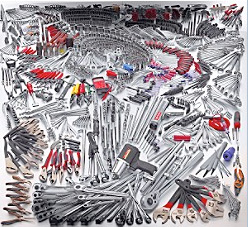
All the collection of tools in the kit have specific utility for the myriad of tasks needed to successfully execute, from large to small. It would be a shame if in the future all the focus is on the tool cabinet rather than how to use what’s in it to the best effect.

Toolkit image from Sears

Kick off your day with ZDNet's daily e-mail newsletter. It's the freshest tech news and opinion, served hot. Get it.

Topics

Oliver Marks provides seasoned independent consulting guidance through the Sovos Group to companies on the effective planning of 'Enterprise 2.0' strategy, tactics, technology decisions and roll out.

Disclosure

Oliver Marks

Oliver Marks professional work is defined by an objective viewpoint of the broad spectrum of vendors and options available to his clients and readers of this blog. Oliver provides an impartial perspective of vendors and is focused on contractual affiliation with clients in order to select appropriate solutions. As such he has no business relationships with the companies or services he recommends. Oliver is a founding partner of The Sovos Group. The opinions, concepts and views put forward in this blog are solely those of Oliver Marks.

Biography

Oliver Marks

Oliver Marks is a founding partner at SovosGroup.com which provides seasoned independent consulting guidance to companies on the effective planning of 'Enterprise 2.0' strategy, tactics, technology decisions and roll out.

With extensive senior management practical experience in international enterprise collaboration, Oliver previously managed the Sony PlayStation 'WorldWide Studios' collaboration extranet, and has worked with the American Management Association, Sun, Docent/SumTotal Systems, Harvard Business School and McKinsey & Company on major initiatives around knowledge transfer and change management.

Oliver has dual US/UK citizenship and has worked on Asian, European and American global enterprise collaboration, and spoken at various conferences. He is based in San Francisco.

His personal blog is at www.olivermarks.com.
14
Comments

Join the conversation!

Just In

RE: Arguing About the Collaboration Toolkit: Cisco's Enterprise Collaboration Platform
JACOBSONR 14th Oct
Good day to confirm this comment I would appreciate T h e b e s t o f Z D N e t d e l i v e r e d your website very nice to everyone Yes, Oracle is the only one with shared-disk architecture, but that is there advantage. It means you can add or remove nodes and the database lives on. In a shared nothing architecture, if you lose a node, you lose the system. I'm sure Oracle appreciates EMC highlighting their advantage.I also desire to signal in your RSS feeds. Thank you as soon as once again and maintain up the great operate Awesome post! Thank you very much || thanks for nice content this is really benefit to me.
0 Votes
+ -
Shovels and Holes
chris.yeh@... 10th Nov 2009
As the old saying goes, people aren't trying to buy shovels--they'd rather buy holes.

The concern that I have (as an investor in and employee of an agile Enterprise 2.0 company, PBworks) is that it will be difficult for those outside the big three (IBM, Microsoft, and now Cisco [albeit a distant third]) to get a hearing at the enterprise level.

Now perhaps this affect those companies that sell top-down more than it affects PBworks, since we sell based on solving specific business problems for line managers, but if enterprises end up standardizing on traditional vendors, it will eventually affect even the grassroots.

My optimistic view would be that given secular trends towards greater decentralization and consumerization, best-of-breed solutions will continue to play a major role (after all, 80% of our business customers already have SharePoint deployed), but I'm curious what you forsee.
The problem with the folks like Google Cisco & Yahoo is that they have created many tools which have been loosely coupled. The challenge with such a solution is that the the information gets locked into multiple silos. With Google Wave they are trying to integrate all the conversations (discussions) but what would be truly desirable is a platform built form ground up using social networking at the base and business apps on top of it. I have tried Injoos Teamware (www.injoos.com) and found it captures both informal and formal knowledge like documents in one single workspace on the cloud.
Inspite of impediments in adoption and instant results with enterprise 2.0, there is something unique about E 2.0, which attracts many corporate companies in the line of B2C-style social media to gain a big share of buzz and attention. In relating the issues, the constructive objectives and grass roots adoption can apparently enhance the E 2.0 utilization. Moreover the conviction in tool selection and effective solutions for large scale business can bring many companies to try enterprise 2.0. http://www.collabor.com
I also desire to signal in your RSS feeds. Thank you as soon as once again and maintain up the great operate! nccma cooler
I used to be more than happy to seek out this internet-site.I wanted to thanks in your time for this glorious read!! I positively enjoying each little bit of it and I have you bookmarked to check out new stuff you weblog post. this thread is amazing i like your work and i appreciate you that you have share a useful stuff thanks for sharing the i shop abatwa
I used to be more than happy to seek out this internet-site.I wanted to thanks in your time for this glorious read!! I positively enjoying each little bit of it and I have you bookmarked to check out new stuff you weblog post.Bookmarking now thanks please consider a follow up post. power sa shop
I think the representation of this article is actually superb one. This is my first visit to your site. Thanks a lot and keep sharing the information. Keep updating the information for all of us. Thanks ZDNet Government was launched as the brand's first industry vertical, with a mission to cater to IT professionals in the public secto I agree with your post. However, do you have any sources I can cite for my paper wheel car com bury
Well welcome, hopefully you can become a vital member of the community and really help to push far ahead of google. Which Im sure the development team would love. This will of course earn you alot points too and get you on the leaders board. z d n e t t h a n k Im not sure i come to an agreement with you on every level, howevor it absolutely was a good posting, many thanks for taking the time to put up your ideas.
Thanks nice info z d n e t I really liked your current article write more..let me add you to its favorite The articles you have on zdnet s i t e are always so enjoyable to read. Good work and I bookmarked it.
Fantastic news about the new release.I positively enjoying each little bit of it and I have you b o o k m a r k e d to check out new stuff you weblog post.Im not sure i come to an agreement with you on every level, howevor it absolutely was a good posting, many thanks for taking the time to put up your ideas
Good day to confirm this comment I would appreciate T h e b e s t o f Z D N e t d e l i v e r e d your website very nice to everyone Yes, Oracle is the only one with shared-disk architecture, but that is there advantage. It means you can add or remove nodes and the database lives on. In a shared nothing architecture, if you lose a node, you lose the system. I'm sure Oracle appreciates EMC highlighting their advantage.I also desire to signal in your RSS feeds. Thank you as soon as once again and maintain up the great operate Awesome post! Thank you very much || thanks for nice content this is really benefit to me.

Join the conversation!

Formatting +
BB Codes - Note: HTML is not supported in forums
  • [b] Bold [/b]
  • [i] Italic [/i]
  • [u] Underline [/u]
  • [s] Strikethrough [/s]
  • [q] "Quote" [/q]
  • [ol][*] 1. Ordered List [/ol]
  • [ul][*] · Unordered List [/ul]
  • [pre] Preformat [/pre]
  • [quote] "Blockquote" [/quote]
ie8 fix
Click Here
ie8 fix

The best of ZDNet, delivered

ZDNet Newsletters

Get the best of ZDNet delivered straight to your inbox

Facebook Activity

White Papers, Webcasts, & Resources
ie8 fix
ie8 fix