madison

Why Is Change So Hard for Some People (Especially Older Ones?)


By | February 6, 2009, 7:34am PST

Summary: So it seems it is broadly true, young people really are more open and older ones more set in their ways, according to a fascinating article in the Scientific American. • Studies of personality development often focus on traits such as extroversion, conscientiousness, agreeableness, neuroticism and openness to new experiences. In most people, these traits change [...]

teaser

So it seems it is broadly true, young people really are more open and older ones more set in their ways, according to a fascinating article in the Scientific American.

• Studies of personality development often focus on traits such as extroversion, conscientiousness, agreeableness, neuroticism and openness to new experiences. In most people, these traits change more during young adulthood than any other period of life, including adolescence.

Openness typically increases during a person’s 20s and goes into a gradual decline after that.

• This pattern of personality development seems to hold true across cultures. Although some see that as evidence that genes determine our personality, many researchers theorize that personality traits change during young adulthood because this is a time of life when people assume new roles: finding a partner, starting a family and beginning a career.

• Personality can continue to change somewhat in middle and old age, but openness to new experiences tends to decline gradually until about age 60. After that, some people become more open again, perhaps because their responsibilities for raising a family and earning a living have been lifted.

The above is a huge generalization, like the current 2008 worldwide average life expectancy of 66.1 across all cultures and countries, but it is revealing nonetheless.

The ‘big five’ personality traits of extroversion, conscientiousness, agreeableness, neuroticism and openness are all very much on display in people’s communication on micro blogging site Twitter & social networks such as Facebook regardless of age of participants it seems.

Personal Science Project
I’ve got a little social experiment of my own I recently set up for friends from my early teenage years. I set up a private username and password protected Ning site and furnished it with period perfect photos, videos and music. I found it’s amazing the resistance many people aged over 40 have to participating in this type of thing.

I couched the site in terms of organizing a major reunion event, rather than an ongoing social networking experience in order to encourage reluctant potential participants. Lots of lurkers, and it’s interesting to realize some have apparently never uploaded a photo to the internet, and have no intention of learning since they feel it is a generational thing.

The friends who are on Facebook jumped in, uploaded content and participated in discussions, but I’ve learnt to never underestimate the closed mentality of many of those who are not familiar with socializing on the internet. I’ve experienced this in enterprises of course, but personal friends are different.

The best case scenario to successfully roll out a collaboration initiative is with top down direction combined with grass roots adoption. It doesn’t matter if it’s organizing a group of old friends and colleagues for a night out or a sober enterprise collaboration initiative.

Specific organizational goals and objectives are key (play David Bowie songs: drink Guinness… or coordinate three business unit silos: increase cross pollination). But so is grass roots buy in, that momentum that gives a party a buzz or the sense of engagement in a business meeting where you can feel people are firing on all cylinders and working together.

Motivation Starts With Clarity of Purpose
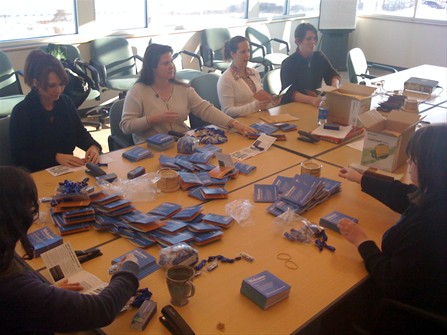
Volunteers assembling 1500 welcome kits for launch day
Motivating involvement from a top down perspective is all about clear communication. There’s a great example of this on Thoughtfarmer’s blog this week describing the launch of their intranet product within Penn State.

The launch materials are visually beautifully realized (great typography!) and comprise a teaser internal launch advertising campaign, clear mission statement, some extremely well presented invitations to training classes for people ‘feeling overwhelmed with technology’, physical welcome kits with thumb drives - everything needed to get involvement stoked up and people engaged and focused.

The fact is, even for those with generational change issues or a personality type that doesn’t take well to collaboration or openness, well organized hand holding sessions to introduce them to next generation collaboration technology with specific objectives demystifies and empowers them to participate.

To bring this back to the Scientific American magazine’s observations about openness to new experiences tending to decline gradually in some, inclusiveness is a key to successful culture change. The challenge is to motivate people and get them engaged by helping them to participate, and some sizzle to sell the steak often really helps.

The after launch enthusiastic Penn State feedback below puts the icing on the cake for me, making it clear this is a shared space owned by users not technologists:

“One of the great reasons that this project has come to this point, and why we are sharing in the success of this launch today, is that our.outreach is an intranet project which is not ‘owned’ by the technologists within the organization (and that would be by my unit, Outreach Technology Services). Everyone ‘owns’ the content and we as the technology unit facilitate its use and availability. We all now have the ability to share our stories, and it truly is a shared business venture!”

Kick off your day with ZDNet's daily e-mail newsletter. It's the freshest tech news and opinion, served hot. Get it.

Topics

Oliver Marks provides seasoned independent consulting guidance through the Sovos Group to companies on the effective planning of 'Enterprise 2.0' strategy, tactics, technology decisions and roll out.

Disclosure

Oliver Marks

Oliver Marks professional work is defined by an objective viewpoint of the broad spectrum of vendors and options available to his clients and readers of this blog. Oliver provides an impartial perspective of vendors and is focused on contractual affiliation with clients in order to select appropriate solutions. As such he has no business relationships with the companies or services he recommends. Oliver is a founding partner of The Sovos Group. The opinions, concepts and views put forward in this blog are solely those of Oliver Marks.

Biography

Oliver Marks

Oliver Marks is a founding partner at SovosGroup.com which provides seasoned independent consulting guidance to companies on the effective planning of 'Enterprise 2.0' strategy, tactics, technology decisions and roll out.

With extensive senior management practical experience in international enterprise collaboration, Oliver previously managed the Sony PlayStation 'WorldWide Studios' collaboration extranet, and has worked with the American Management Association, Sun, Docent/SumTotal Systems, Harvard Business School and McKinsey & Company on major initiatives around knowledge transfer and change management.

Oliver has dual US/UK citizenship and has worked on Asian, European and American global enterprise collaboration, and spoken at various conferences. He is based in San Francisco.

His personal blog is at www.olivermarks.com.

Talkback Most Recent of 20 Talkback(s)

  • I'm no expert, but...
    ...maybe the older people would rather spend their time actually being with a group of people...you know...in reality, than posting pictures and chatting in a faceless virtual forum.

    Perhaps it's not resistance to change, but a resistance to the move towards impersonalisation that they are resisting?
    ZDNet Gravatar
    ccrashh2@...
    6th Feb 2009
  • ZDNet Gravatar
    Userama
    6th Feb 2009
  • RE: Why Is Change So Hard for Some People (Especially Older Ones?)
    Completely they be able to around almost this is chance at just approximate to also act equal better
    Adipex / phentermine online
    ZDNet Gravatar
    cheap phentermine 37.5
    24th Sep
  • Can't be
    Every young person knows that history began with them, that nothing worthwhile existed before their generation came along, and every brilliant idea they have has never been thought of before. It couldn't have been, or the world would be perfect already. Old people are just getting in the way of young people doing things right.

    There, how's that for generalization?

    Carl Rapson
    ZDNet Gravatar
    rapson
    6th Feb 2009
  • Have to disagree
    The point about us older folks (I'm one of those forty something year old's) having more "real" interactions is a misnomer. Yes, we may have get-together's and what-not's but these "social" events are merely excuses to drink alcohol and then talk about superficial fluff. I think when we older folks poo poo new ideas, we are only limiting ourselves new experiences. That in itself isn't very healthy IMHO.
    ZDNet Gravatar
    nothingness
    6th Feb 2009
  • Wisdom and experience
    Observing my own experience aging (I'm in my early 40's), I remember in my 20's being open to try anything and everything, just out of sheer curiosity.

    Then I got a career and responsibility. Suddenly I had to start judging the *value* and merits of a given thing (at home or at work) because each thing could take away valuable time or resources from things that I've already established as more important (like my job, or my bills).

    Furthermore, having run around enough after every shiny object, I've found that often there's no real benefit or improvement, other than newness itself (yes there's excitement to newness in and of itself).

    When one retires, I've seen people seem to have less time than during their careers (oddly enough), but at the same time with their income secure and families gone, they are free to again explore. Going here or there, doing this or that, doesn't impinge on much responsibility or obligations anymore.

    So, your article does seem to spot a real pattern, although the reason behind it may be more one of practicality than arbitrary stubborness.
    ZDNet Gravatar
    Zathros
    6th Feb 2009
  • Amen to that
    Very well said. When I was young, all things were possible, and I believed I would live forever.

    Then along comes marriage, family, a mortgage, and suddenly you realize that actions now have consequences. You want your kids and spouse safe, warm, and free from hunger; you want to hang onto your job even if that means kissing up to the boss from time to time and/or doing work you never intended to be doing; you realize that you don't run as fast, and your vision and hearing are gradually changing. And, like the previous poster said, you come to realize that a shiny new toy's attractiveness wears off pretty fast, and that your new toy now owns YOU. Go buy a big boat or an airplane, and see how many years it takes for you to dread seeing the thing and paying for its upkeep. Been there, done that.

    For me at 59, the essence of happiness is sharing life experiences with friends and loved ones. And yes, I am reluctant to "change" simply because I've done plenty of that over the years and have come to realize that not all "change" is "improvement." The new occupant in the White House will demonstrate that clearly over the next few years.
    ZDNet Gravatar
    riredale
    6th Feb 2009
  • RE: Why Is Change So Hard for Some People (Especially Older Ones?)
    Older folks most certainly do socialise but many of us prefer to do it in person rather than through the cold and dispassionate cyber way of so many young folk. I like to be able to shake hands or hug my friends and family and to look them in the eye when we are in conversation.
    As for being resistant to change, I use technology as a tool to achieve particular non-technical objectives, not as an objective in iteself. Sometimes change in these tools is good but all too often it is change for the sake of change (and the generation of more revenue for the manufacturer) that interferes unduly with what I am striving to achieve.
    I am no luddite but I am cynical about the real value of chnaging my cellphone every two years or having to upgrade my operating system and suite of applications because the manufacturer has decided to introduce new versions every two years or so and stops supporting the old one - while the system works just fine as a tool for my purposes.
    ZDNet Gravatar
    RichardFH
    6th Feb 2009
  • Well Said Richard
    Well said. Especially about the cell phone thing.
    As a piggyback and aside, someone needs to explain to me, why every time I read the features of these smart phones, how clear the phone sound is on them is never even mentioned.

    The number one feature on a phone should be whether it drops my calls every sec, and if I can hear the person on the other end without it sounding like one of us is near a mini trash compactor. Strangely enough the boobs at most of these smart phone companies seem to forget that cell phones began (and end in my opinion) with one main feature in mind . . . making PHONE CALLS.

    Also I've found that if we have texted back and forth 2-3 times in row, its time for one of us to pick up a freaking phone and I don't know, do something weird and out there. . . CALL AND TALK TO SOMEONE!
    ZDNet Gravatar
    golstat2003
    6th Feb 2009
  • Maybe it's YOU that doesn't understand
    I've rejected fad and fashion all my life. Marketing is all about trying to get you to pay more for something than it's worth, or buy something that's just crap.

    I don't fall for any of it. Whenever I see something new, I look at the pros and cons and decided whether I'm interested.

    Most of the time I conclude it's just a solution in search of a problem. I'm just NOT interested.

    FYI, that's allowed in the USA.
    ZDNet Gravatar
    ron.cleaver@...
    6th Feb 2009
  • Experience Says Otherwise
    Nice study...but my experience says otherwise. Those in their late 20s and 30s have the most to gain from the status quo. That's why so many GenXers are Microsoft Droids.

    The older people and very young (Gen M) are more likely to support Linux and want to supplant the old guard...
    ZDNet Gravatar
    jabailo1
    6th Feb 2009
  • Could it be that we're smart enough to know better?
    There's socializing and then there's putting your life out there for anyone and everyone to see. Perhaps we old codgers have just plain learned that verbal socialization with friends is fine but what is published is permanent and often comes back to haunt you.
    ZDNet Gravatar
    RoyKnis
    6th Feb 2009
  • Not a mystery at all
    The reason some people, predominantly older ones, are resistant to change is that they often have the benefit of a long-term perspective with which to base a like or dislike of a change.

    A simple example is digital photography. A lot of people over 50 dislike it, while everyone else loves it.

    The reason most older people dislike it is because once they understand the technology they see the problem of data storage.

    A 35mm film is it's own *storage and retrieval* mechanism. At it's simplest, you can just hold it up to the light to look at it. Now take the digital world: Floppy, CD, DVD, BluRay, HDDVD, CompactFlash, SD, miniSD, microSD, MemoryStick... Does anyone seriously think in 100 years you'll be able to retrieve photos from that SD card you find in the antique desk in the attic?

    Those resistant to change often apply a perspective to things that others don't. So before you treat resistance like some syndrome, maybe it would be worthwhile to understand the specific reasoning of those resistant without dismissing them.
    ZDNet Gravatar
    croberts
    6th Feb 2009
  • RE: Why Is Change So Hard for Some People (Especially Older Ones?)
    Now that I'm older (hopefully wiser), I see change as having to sacrifice some *thing*. Usually it is time that we have to sacrifice. If you don't have enough free time for your own interests, then the thought of giving up that time becomes harder to do.

    If there's a percieved loss of one's own enrichment, or enjoyment, then it becomes harder to say yes.
    ZDNet Gravatar
    Custard_over_2x_Pie
    6th Feb 2009
  • RE: Why Is Change So Hard for Some People (Especially Older Ones?)
    Wow. I know I shouldn't be shocked at the harshness of these comments, but I am. Probably because I like change, I like to grow, learn, and experience new things.

    It's probably also because there seems to be an assumption that those in the article's example are in their twenties. We're not. We're in our thirties, forties, and fifties. What we have in common is that we are passionate about communication and share the same personality traits as those mentioned above.

    Furthermore, one person on our team is single. The rest of us are married, some with kids, some without, some expecting. Some have mortgages, some don't. Some of us are in, or have been in, executive positions in previous lives. We're far from inexperienced.

    Mortgages, bills, kids, and workloads are excuses. People have the choice to change, or not; but that doesn't mean the world stop changing because they do. So I see it as a choice; one can continue to grow and enrich their life, or they can choose to stay behind. There's no right or wrong answer, just understand that it's a choice.

    The fact of the matter is, which seems to have been overlooked in these comments, is that change is hard. People naturally regress to their comfort zones when confronted with a change they don't understand or don't want.

    When an organization initiates change, most of the responsibility in communicating the why/how of the change rests with the organization; employees need to know what it means for them. However, as an employee of an organization, it's also your responsibility to get the information you need if you not getting it.

    Lastly, experience and wisdom are not age-related. I'd only expect an assumption like this to come from someone who's worked in the same job or for the same organization for the majority of their adult life.
    ZDNet Gravatar
    cmcneill
    6th Feb 2009

Talkback - Tell Us What You Think

Formatting +
BB Codes - Note: HTML is not supported in forums
  • [b] Bold [/b]
  • [i] Italic [/i]
  • [u] Underline [/u]
  • [s] Strikethrough [/s]
  • [q] "Quote" [/q]
  • [ol][*] 1. Ordered List [/ol]
  • [ul][*] · Unordered List [/ul]
  • [pre] Preformat [/pre]
  • [quote] "Blockquote" [/quote]
Click Here

The best of ZDNet, delivered

ZDNet Newsletters

Get the best of ZDNet delivered straight to your inbox

Facebook Activity

White Papers, Webcasts, & Resources