Laptops & Desktops

John Morris & Sean Portnoy

AMD bets on Bulldozer to take back the desktop

By | August 4, 2011, 1:48pm PDT

Summary: Starting this month, AMD will finally have a chip designed to go head-to-head with the fastest Core i5 and Core i7 Sandy Bridge processors. AMD has been working on Bulldozer for six years and it has a lot riding on the new chip design.

Chipmaker AMD has had a busy 2011. Its low-power E-Series and C-Series processors have found a niche in netbooks and ultra-thin laptops. The A-Series, its first 32nm processor, is just now finding its way into laptops bringing a new level of graphics performance to mainstream PCs without discrete GPUs. As a result, AMD has been regaining a little market share.

But even with the A-Series AMD’s CPU performance falls short of Intel’s second-generation Core processors. Starting this month, though, AMD will finally have a chip designed to go head-to-head with the fastest Core i5 and Core i7 Sandy Bridge processors.

The high-end processor, code-named Zambezi, has been the subject of steady leaks for months on everything from the name to model numbers and prices to early benchmark numbers (which turned out to be fake). AMD even created a comic book and video trailer to drum up excitement for the chip.

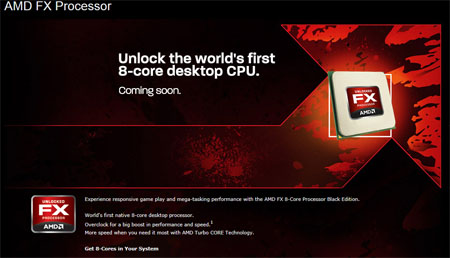
During AMD’s recent quarterly earnings call, executives confirmed that Zambezi would begin shipping this month. AMD will resurrect the FX enthusiast brand for the line, which will reportedly include four processors, the quad-core FX-4100, six-core FX-6100 and eight-core FX-8100 and FX-8150.

Though it uses the same 32nm manufacturing process as the A-Series, the FX Series is a very different product. For starters, the FX Series is a CPU, not an APU (or Accelerated Processing Unit) with an integrated graphics processor. The Scorpius high-end desktop platform will include an eight-core FX-Series processor, Radeon 6000 HD discrete graphics and AMD’s 9-series supporting chipset. AMD demonstrated the platform at the E3 Expo in June. Later this year AMD plans to release its Radeon 7000 series, or Southern Islands, which is likely to be the first 28nm GPU (though Nvidia now says it will begin shipping Kepler by the end of the year as well).

The FX Series is also based on an entirely new architecture, which AMD refers to as Bulldozer. Each Bulldozer module has two integer cores that share other components including the floating-point unit, instruction cache and front-end logic. AMD’s roadmaps refer to the integer cores as Bulldozer “cores,” which makes things a bit confusing. An eight-core FX Series processor actually has four Bulldozer modules with a total of eight integer cores and four floating-point units; a quad-core has two Bulldozer modules with four integer cores and two FPUs. Intel’s core, by comparison, has a single integer core and dedicated floating-point unit, but the integer core is capable of processing two threads simultaneously, a feature the company refers to as Hyper-Threading.

By the end of the quarter, AMD also plans to begin shipping server processors based on the same Bulldozer architecture. The Opteron 4200 (code-named Valencia) will have six or eight integer cores and the Opteron 6200 (Interlagos) mainstream server processor will have eight, 12 or 16 integer cores. Like the current 12-core Opteron 6100 (Magny-Cours), the 12- and 16-core Opteron 6200s are actually multi-chip packages with two processors. In a video posted this week, John Fruehe, AMD’s Director of Product Marketing for servers, showed a Supermicro single-socket server running a 16-core Opteron 6200.

How it will stack up to the Core i7 (or Xeon) Sandy Bridge depends on how you look at it. On a core vs. core basis, a single Bulldozer integer core is unlikely to be as fast as an Intel core with two threads. But by sharing the FPU and other components–and jumping to a more advanced 32nm manufacturing process–AMD was able to design a module with room for two separate integer cores in roughly the same space as the Phenom’s K10 core. That means AMD should be able to position an FX-8100 with four Bulldozer modules and eight integer cores against a Core i7-2600 with four cores and eight threads. In this scenario, the FX Series should be very competitive on multi-threaded applications since, all things being equal, eight physical cores should outperform eight threads. (This positioning would also make sense given that the FX series is rumored to cost up to $300 and the Core i7-2600 lists for $294.) AMD also claims that the shared components help to reduce overall power consumption.

AMD has been working on Bulldozer for six years and it is arguably the first major change since the introduction in 2003 of the K8 architecture, which brought 64-bit instructions and an integrated memory controller. The high-end desktop market may be shrinking, but for AMD it’s still an important audience, and the company needs to regain some ground in the lucrative server market. On top of this, AMD plans to use Bulldozer in its Trinity APUs for mainstream laptops and desktops next year. In short, AMD has a lot riding on Bulldozer.

Kick off your day with ZDNet's daily e-mail newsletter. It's the freshest tech news and opinion, served hot. Get it.

Topics

John Morris is a former executive editor at CNET Networks and senior editor at PC Magazine.

Disclosure

John Morris

John Morris is a former executive editor at CNET Networks and senior editor at PC Magazine. He now works for a private investment firm, which may at any time invest in companies whose products are discussed in this blog, and no disclosure of securities transactions will be made. No investment advice is offered in this blog. All duties are disclaimed.

Biography

John Morris

John Morris is a former executive editor at CNET Networks and senior editor at PC Magazine. He now works for a private investment firm, which may at any time invest in companies whose products are discussed in this blog, and no disclosure of securities transactions will be made. No investment advice is offered in this blog. All duties are disclaimed.

39
Comments

Join the conversation!

Just In

aqffbnt 93 wql
bdsfwrryd5501-24379014088513250486224451995495 22nd Nov
hjnrft,fdkwavmh91, mcvev.
0 Votes
+ -
If we continue this evolution of moving chipset components onto the CPU (which makes perfect sense IMO), what will we have when the Southbridge (or MCH, as they like to call it) functionality is embedded in the main processor? An SoC? Wouldn't that give us the ability to have an extremely fast storage subsystem though?
0 Votes
+ -
@Joe_Raby Moores Law still has tricks left over till quantum computers come into the picture. At the moment he's laid up in a lab being poked a prodded. So we're stuck with the old man for right now. lol
When I first started as an engineering tech we had discrete components. Then packaged components and chips. Then chips with all of the above inside. Then the whole board inside a chip. Now the computer is starting to get stuffed into a chip.
I think it is cool.
0 Votes
+ -
Message has been deleted.
ParsonsJon Updated - 7th Aug
I am benchmarking my new intel 2.3 GHz i5 on parallel applications agains my old quad core 2.8 GHz phenom II - each intel core outperforms an AMD core, but 4 hyperthread cores perform like 2 real cores. The old Phenom is nearly 2 times faster.
@eegomez The only thing I'd note is that these are not Phenom CPUs or variants being released here soon.
Running circles around Intel's awful integrated graphics is not enough. AMD needs to find a way to get retailers and manufacturers to make/sell AMD products, despite the fact that Intel bribes and threatens manufacturers and retailers for exclusivity.
@mgcguy - Allegedly, Intel execs like to feature baby seal as a delicacy in their executive dining room. They also are singularly responsible for the disappearing rainforests and global warming...
0 Votes
+ -
All I see AMD doing is moving dies around and combining them. I don't see any real speed increases or formal performance gains. The e series made some video gains in the netbook lines. But its CPU still lacked any punch. AMD is still losing money and I don't see them making huge gains in a desktop market that already shrinking anyway?
@jscott418 So wait let me get this straight. AMD, despite gaining ground in the market share, is losing money? Not sure how that ones works.
@jscott418 - "moving dies around" That's a pretty terrible way to put it but the idea has some awesome benefits. By making the Bulldozer module have two integer and one floating point units, they can optimize die space for actual usage which really is more integer work. Optimizing die space causes manufacturing efficiency as well and results in reduced cost for better performance. There is real interest in this in server markets especially because they believe they can get a lot more integer performance and more efficiently in cost and power. This also makes a lot of sense in the context of integration with video components (GPUs) like we're seeing because eventually the on-die GPU will be taking on the floating point duties and doing it much better than a CPU can. It's conceivable AMD might just remove the floating point unit from the CPU portion entirely in the future. And the GPU is a place where AMD has a an edge on Intel so it's an advantage for it to have things moving that way.
@jscott418 - (cont.) ...As for the "real speed increases", they are moving to the smaller process so they can put in more transistors and still reduce power consumption and heat. They aren't just using cores from existing processors and mashing them together in a new way. AMD's Turbo Core is really taking shape also. Have you read about that? It's pretty exciting and leads to quite a large increase in performance based on CPU thermal performance. Overclockers will be losing a bit of their niche because it will do the overclocking on its own to some degree. Since Turbo Core bases its activity on current usage and heat measurement, you could actually boost your CPU (or allow it to boost itself more in other words) by getting a better heatsink. In addition to Turbo Core, they are adding more cores themselves and there will be an 8 core enthusiast desktop CPU for sale which is pretty exciting.

@jscott418 - ...As for the desktop market shrinking, yes it is, but AMD is basing their future designs on these ideas. Their integrated APUs will also soon use this architecture and will probably have a big boost in performance in the process.
Next we'll have 16 cores, then 32 cores, 64 cores, 128 cores; we know where this is going.
@Aboleyn Well, we already got commercial quantum computers from Dwave capable of chewing through the most complicated algorithms in less than n to the nth time it takes silicon based computers to compute and chew the data. Eight to ten years from now, some of us may have quantum desktop computers. Also, silicon-based computer knowledge may be replaced by quantum mechanics, quantum computer engineering, quantum programming, quantum information technology, etc. But before this happens, Moore's theory predicts that from 20XX-2020/2030 we will experience obsolescence with semiconductors and related products. In other words, we may experience a time when computer manufacturers manufacture increased CPU cores from every 6 months to every month. With Intel or AMD releasing new and more powerful processors every month or even maybe every 2 weeks, the processors that we buy at a certain point in time will be quickly outdated a few weeks after. The question now is, "How will we, the consumers, deal with that?" The answer would be quantum computing.
The introduction of quantum computer?s will be when things really take off. Many scientists are now saying that even quantum computers will hit a barrier too, physics.
@vinax89 Trolling much? Designing new processors tends to take longer than 2 weeks. Also, making your own product obsolete in only 2 weeks makes for poor retail distribution.
@vinax89 I'm not sure from where you've gotten your faulty predictions about Moore's Law, but the idea behind it is that the number of transistors that can be crammed onto a semiconductor substrate at minimum cost per transistor doubles about every 12 months. That's the number of transistors, mind you, and not performance. However, it also carries with it a timescale of 1 year. Therefore Moore's Law does not predict that anybody's going to be releasing truly new silicon-based processors every 6 months, and certainly not every other week. That's just nonsense. It took 6 *years* for Bulldozer to arrive, and high-end desktop chips are becoming more complicated, not less so. Just being able to put more components on a substrate (at lower cost) does not mean that one knows how to make effective use of them.

Also, D-Wave's first commercially available quantum computer may not be quantum after all. AFAIK, it still hasn't been shown to support quantum entanglement. It's not very fast either.
I am eager to see how Bulldozer Stacks up in real world performance. I have been very happy with my Phenom II and do not plan to upgrade anytime soon but I have been a long time AMD Fan after witnessing first hand how Intel strong-armed OEMs and retailers to not use and bash AMD. Their processors have always given me a excellent computing experience and saved me money overall in my personal computer builds for my performance dollar.
@bobiroc I have been an Intel builder up until my last system which I made a Phenom II build and I'm very happy with it. It was the best performance I could get for what I wanted to spend. It does fantastic actually. The technology has really come a long way in a short time. I'm excited about AMD's future products and might be becoming an AMD fan now too.
"Running circles around Intel's awful integrated graphics is not enough. AMD needs to find a way to get retailers and manufacturers to make/sell AMD products, despite the fact that Intel bribes and threatens manufacturers and retailers for exclusivity."


I'm just curious as I have never heard of Intel threatening manufacturers or the retailers before, and I'm not sure which retailer your speaking of, (Walmart, bestbuy, target, radio Shack all deal in both) but what is your source material that intel is doing these things?
@RadioShark

From working at Best Buy and Gateway Intel Reps would come in and bring their promotional material and if they say an AMD Based Machine on an end cap they would say that it had to be replaced with an Intel one. They told store managers that they would pull sponsorship funding if AMD Logos were not removed and even demanded that the stock boxes be turned or have the logos covered up on the upper shelves.

Also having being involved in many sessions with Intel on how to promote their products they would feed false information to the sales and service tech reps saying that AMD, Cyrix (Remember them), and another non-intel chip was NOT fully compatible with all applications and that they were prone to higher failure rates and ran slower. This started around when the K6-x series were coming out and starting to gain ground and then was even worse when AMD released the original Athlon.

I am sure if you put your mind to it you can search and see that there have been many lawsuits against Intel for this and Intel was found guilty of such practices.

I do not think that they do this now at least on any grand level but back when they did AMD was on par with the Pentium 3's with their Athlon and Beat the pants off the Pentium 4's with Athlon XPs and Athlon 64's. Intel has since stepped up to the plate when they released their "core" lines after the P4 but I cannot help to imagine how things could have been different if Intel's bully tactics were not stopped sooner.
@bobiroc
Well as I said I haven't seen or heard anything. I've personally been in retail for nearly ten years now, and I've never had the same experiences that you have mentioned, that's why I asked for source material, the things you've described are things Apple and Microsoft both do, heck I've seen Coke and Pepsi vendor go at it, but I just haven't seen Intel behave as was suggested. My Intel Vendor was an awesome guy never pulled that kind of stuff.
@RadioShark I've read a lot about Intel's bribery and illegal rebates. In a nutshell, Intel provided massive rebates to OEM's like Dell and HP with the stipulation that they not sell AMD based system, or severely limit the amount of AMD systems they sell. Additionally, Intel threatened to CUT shipments to the OEM's if they did not agree. That is a serious threat, considering that the only other competitor, AMD, would not have been remotely capable of meeting demand should Intel pull the rug out from under a major OEM, meaning the OEM's didn't really have any choice, and with the massive incentives, they probably did not care much either way. This occurred a while back when AMD had a technological lead with the Athlon XP, and thus a brief window to capture vital market share. Due to these dealings, they never really got the fair shake they deserved. Recently, Intel settled for 1.25 Billion dollars as a result of these anti-trust practices. Intel has been accused of these same charges by entities other than AMD as well, such as the EU.

Hopefully, there are enough eyes on Intel to prevent them from doing something like this again, but the damage may be irreparable.
@RadioShark And you may not have personally seen this type of behavior from Intel, but you are probably too low in the chain. These actions took place at the OEM level, where companies like Dell and HP make deals with Intel and AMD for thousands upon thousands of processors at a time.
@RadioShark AMD sued Intel for this and won. Look it up, it's an interesting read. Here is a small blurb about it - http://en.wikipedia.org/wiki/AMD_v._Intel
So I'm building a high-end computer for gaming pretty soon. Should I be picking up one of these, or the 1090T Black Phenoms that Adrian's been endorsing?

I guess I'll just have to wait for the benchmarks.
@Aerowind 1090T? Those have been out a while. Should be plenty of benchmarks for you to see. Build for your needs and budget. If video gaming is your main concern, the Video card should take the bulk of your attention. There are very few games that would be CPU limited by a Phenom II. There ARE some though, such as Civilization 4, so read up on your favorite games as well. If money is irrelevant, go Intel. If you have a limited budget, I'd go AMD unless you DEFINITELY needed the added CPU power for a specific game or application. The savings can be then transferred to getting a stronger video card, which will make a much bigger difference in gaming 99 times out of 100.
@GaMEChld This is exactly what I did in January. I got a an awesome Radeon 6950 2GB video card after saving a bit on my still awesome Phenom II X4 965 over a comparable Intel CPU. Intel has the high end bigtime but you need to check what's best for your price. Might want to wait until mid-September to see how that shakes out.
I would love to see a computer with that chip in it and has always been an AMD fan for years. Most of those upgrading computers has used AMD processors because of their dependability and I was one of those.
I have been waiting for the damn Bulldozers forever! Give me my 8-core monster CPU!!!
0 Votes
+ -
From my understanding of Intel's Hyper-Threading, two threads are processed in a queue-like fashion. However, in AMD's Bulldozer design, it looks like both threads (provided that they require integer processing) are done at the same time. I think we might get a little surprise here when it comes to parallelism and latency between these two architectures.
Quantum computing hits a Barrier ..?? yes but... Technology will make use of all things even in the post barrier state.. Quantum computing may open the door to a new type of networking resembling consciousness and possibly utilize entangled atoms for communication making the computer and the network secure and difficult to imagine as separate as they are now. ORRRRR NOT
I really hope that Bulldozer is as fast as its hyped up to be. I have been waiting a long time to upgrade.
I'll just wait to see how Bulldozer actually performs, and also how it's priced. Then there is Intel's response to Bulldozer to consider too. That will be coming soon after BD is out.
Myself, I like the idea of supporting the "little guy" AMD as much as possible. The fact that they are around keeps Intel's prices out of the stratosphere, so they deserve to be supported as I see it.
0 Votes
+ -
aqffbnt 93 wql
bdsfwrryd5501-24379014088513250486224451995495 22nd Nov
hjnrft,fdkwavmh91, mcvev.

Join the conversation!

Formatting +
BB Codes - Note: HTML is not supported in forums
  • [b] Bold [/b]
  • [i] Italic [/i]
  • [u] Underline [/u]
  • [s] Strikethrough [/s]
  • [q] "Quote" [/q]
  • [ol][*] 1. Ordered List [/ol]
  • [ul][*] · Unordered List [/ul]
  • [pre] Preformat [/pre]
  • [quote] "Blockquote" [/quote]
ie8 fix

The best of ZDNet, delivered

ZDNet Newsletters

Get the best of ZDNet delivered straight to your inbox

Facebook Activity

White Papers, Webcasts, & Resources
ie8 fix