Computex 2011: Intel unveils ultrabook, talks Medfield tablets

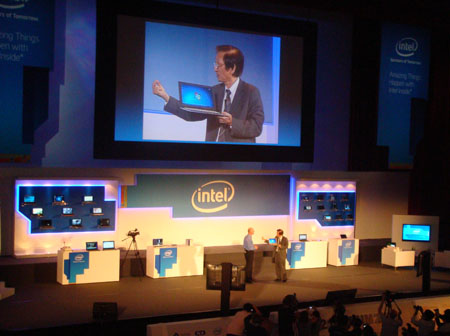
In a keynote speech at the Computex trade show in Taiwan, Intel Executive Vice President Sean Maloney said the company would borrow some "new ideas" from tablets to reinvent the PC, carving out a new category of laptops dubbed ultrabooks. Maloney also discussed Intel's progress with its own chips for tablets and smartphones. He demonstrated a Medfield tablet running Android 3.0, or Honeycomb, for the first time and said the first devices based on the 32nm SoC will be available in six to nine months.
The ultrabook is essentially a very thin ultraportable with a mainstream price. The first ultrabooks, which will be available later this year, will be based on Intel's second-generation Core processors (Sandy Bridge), measure less than 0.8 inches thick and cost less than $1,000. The size, performance and features of these ultrabooks will evolve over the next two to three years as Intel introduces new processor technology. In particular, Intel plans to introduce features that will make laptops more responsive--much like smartphones and tablets--and more secure.
"We need to find new ways to generate excitement around the PC," Maloney said.
The CEO of Asustek, Jonney Shih, came onstage to show one of the first ultrabooks. The Asus UX Series is an 11.6-inch laptop with an aluminum unibody design that measures only 0.67 inches at it thickest point but includes a second-generation Core processor. I got a closer look at the Asus UX at an Intel press event later in the day and the design looks great, but it is tough to say much more about it at this point since Intel was not allowing anyone to touch the notebook.
To illustrate how Intel plans to make notebooks, including ultrabooks, more responsive, Maloney demonstrated two features that he said will "be available in the market really soon." The first, Intel Smart Connect, lets your laptop receive system and application updates when it is in suspend. To do this, Smart Connect periodically wakes up your laptop, checks for updates and then puts it back to sleep. The second feature, Intel Rapid Start, uses a flash memory cache to store the system state so that it can recover from hibernation in about five to six seconds. This is useful because a system on standby only lasts about two to three days while one in hibernation has a battery life of 30 days, he said.
These will be useful features, but it doesn't appear that they are exclusive to ultrabooks. In fact, Maloney noted that "the beauty of these features is we don't have to wait, they can be deployed on PCs with Windows 7 now."
On paper, the ultrabook sounds a lot like the CULV laptops that Intel introduced in 2009. These never really caught on because the ultra-low voltage processors compromised performance but systems were still priced much higher than netbooks. This time Intel is promising that ultrabooks will be "no-compromise" notebooks thanks to its process technology. Next year Intel will introduce its first 22nm Ivy Bridge processors, which will increase battery life, improve performance and boost security. Maloney said that by the end of 2012 ultrabooks will account for 40 percent of all consumer laptops. But the real breakthrough, he said, will occur in 2013 with the release of Haswell, a new microarchitecture that will cut the thermal design point in half (from 35 watts to 15 watts) reinventing the laptop PC.
Maloney also talked about Intel's efforts to get into other mobile devices. Cedar Trail, Intel's first 32nm netbook platform, will be used in systems running Windows, Google's Chrome OS and MeeGo. These netbooks will have more than 10 hours of battery life and will include Rapid Start, Smart Connect, Intel Wireless Display for displaying content on TVs (with a separate adapter) and PC Synch, which wirelessly synchronizes documents and media cross multiple devices.
For tablets, Maloney described the Atom Z670 platform (aka Oak Trail), which has been shipping since April, as a sort of stopgap solution. Intel has 35 design wins and it displayed several of them on the stage. But Medfield is really Intel's first Atom SoC platform that was "purpose-built" specifically for tablets and smartphones, Maloney said. Intel said that tablets based on Medfield will be less than 9mm thick and weigh less than 1.5 pounds. For comparison, Apple's iPad 2 is 8.8mm thick and weighs 1.4 pounds.