Advancing the prosthetic aesthetic

Experimental prosthetic arms in labs across the country will soon pave the way for commercial versions to antiquate the last major upgrade that took place almost a hundred years ago. That was the cable-operated prosthetic hook (for above-the-elbow amputees).
Thanks to the Defense Advanced Research Projects Agency’s (DARPA) $80 million program, Revolutionizing Prosthetics 2009 (RP2009), nationwide research is underway to develop a fully functional (motor and sensory) upper limb that responds to direct neural control.
Physicians at the Rehabilitation Institute of Chicago (RIC) developed an intuitive way for amputee patients to control a robotic arm by surgically rearranging the nerves that normally connect to the lost limb. This allows patients to control prosthetic arms simply by thinking about it. While the technique, targeted muscle reinnervation (TMR), was first demonstrated in 2007, they reported successful tests among several patients this month.
"This neural interface, used in combination with DARPA's new sophisticated prosthetics, is creating better patient independence and supporting RIC's vision to advance human ability," said Todd Kuiken, MD, PhD, director of the RIC Center for Bionic Medicine.
A study released by the Journal of the American Medical Association found that TMR can produce sufficient electromyogram (EMG) information for real-time control of advanced artificial arms.
Technology Review supplies additional coverage, including a video showing three patients performing complex tasks, such as picking up a cup and grasping a cracker without breaking it.
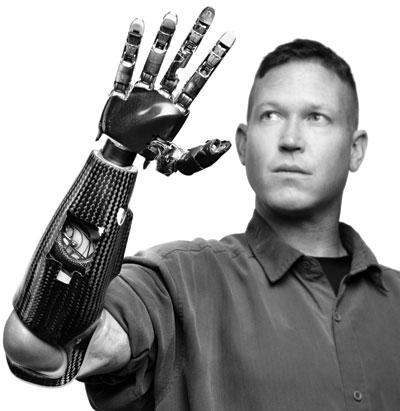
Credit: Mike McGregor
Chicago isn't the only hot spot for next gen prostheses. The DARPA program has been testing control technologies on volunteers at OrthoCare, in Oklahoma City and at the Johns Hopkins University Applied Physics Laboratory (APL), in Laurel, Md. According to a feature in IEEE Spectrum, last year, a Canadian hospital borrowed some of DARPA’s technology and made 'huge improvements' in commercially available prosthetic devices. Below is a quote from the article. It puts perspective on the challenge of the project and lists the latest progress from across the research centers involved:
Creating an arm that actually interfaces with an amputee requires an encyclopedic understanding of countless disciplines including power management, neural integration, and anatomy. APL built two mechanical prototypes, both of which were marvels of modern engineering. The Rehabilitation Institute of Chicago (RIC) developed surgical techniques to reroute existing nerves in amputees so that they interface with the electronics in the prosthetic arm. Chicago-based Sigenics developed implantable electrodes to wirelessly transmit the electrical signals from residual muscles directly to the prosthetic limb. Researchers at the University of New Brunswick, in Canada, developed signal-processing algorithms to decipher the noisy biopotentials from the reinnervated muscle in real time. Researchers at the University of Utah developed brain-penetrating electrodes to tap nerve impulses at their source. Johns Hopkins University has developed what it calls the Virtual Integration Environment, in which an amputee can practice by “driving” a virtual arm with nerve signals.
Meanwhile, high-tech leg prostheses, such as those that are carbon blades, have in some respects advanced much further due to greater demand. From the looks of it, form and function may eventually play an equal role in upgrades.
Credit: Fast Company