ie8 fix
Click Here

Googling Google

Christopher Dawson

Google wind farm investment: datacenters or diversification?

By | October 12, 2010, 7:20am PDT

Summary: Google’s investment in wind energy provide opportunities for diversification, but more importantly, priority access to clean power.

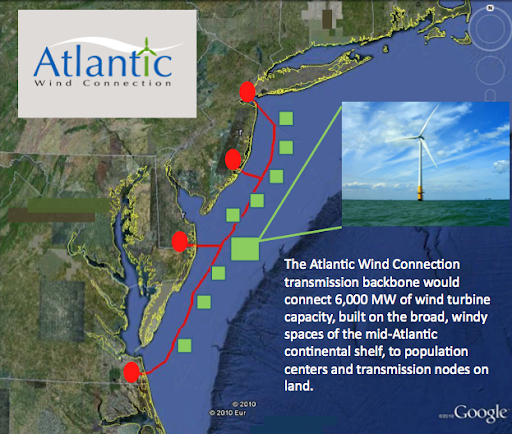
Google will be investing around $200 million dollars in the Atlantic Wind Connection, according to a blog post yesterday, acquiring approximately 35% of the company. The AWC will provide a secure, underwater transmission backbone for power obtained at distant off-shore wind farms.
According to Bloomberg,

The transmission network will span 350 miles and will be able to connect to 6,000 megawatts of power from wind turbines, according to the statement.

The group will set up a company to conduct a feasibility study by 2013 and plans to start the first phase in 2016

Analysts (and Google) hope that this wind project will meet fewer hurdles than previous off-shore wind projects that have been stalled due to environmental and aesthetic concerns since most of the turbines will sit much farther off-shore than those in controversial projects like Cape Wind. Google explained in its blog,

The Mid-Atlantic region is ideally suited for offshore wind. It offers more than 60,000 MW of offshore wind potential in relatively shallow waters that extend miles out to sea. These shallow waters make it easier to install turbines 10-15 miles offshore, meaning wind projects can take advantage of stronger winds and are virtually out-of-sight from land.

Google’s blog post also hinted at the company’s possible motivations for this particular investment:

We believe in investing in projects that make good business sense and further the development of renewable energy. We’re willing to take calculated risks on early stage ideas and projects that can have dramatic impacts while offering attractive returns. This willingness to be ahead of the industry and invest in large scale innovative projects is core to our success as a company.

The “attractive returns” would certainly suggest that diversification is in Google’s future. We’ve seen them expanding beyond search into a variety of areas of telecommunications and looking to trading and investments in energy. However, their dealings in energy have generally been more about carbon neutrality and/or finding inexpensive and renewable sources of energy for their massive datacenters.

It isn’t hard to imagine Google’s investment in AWC paying serious dividends long-term on priority access to clean energy on the east coast. Clearly, 5 years from now when the AWC is anticipated to actually begin bring projects on line, Google will have extraordinary power needs and will require datacenter growth in major population centers to ensure speed, redundancy, and security. This is where investments in the AWC will truly pay off, when a data center in Virginia or New York isn’t susceptible to summer blackouts, an inefficient power grid, or environmental criticisms. If Google is hooked directly into a clean energy backbone because of its investments, then the company will be well-positioned on many levels.

Kick off your day with ZDNet's daily e-mail newsletter. It's the freshest tech news and opinion, served hot. Get it.

Topics

Chris Dawson is a freelance writer and consultant with years of experience in educational technology and web-based systems. In 2011, he became the Vice President of Marketing for WizIQ, Inc., a virtual classroom and learning network SaaS provider.

Disclosure

Christopher Dawson

Christopher Dawson is the Vice President of Marketing for WizIQ, Inc., by day and a freelance writer and educational technology consultant by night. Well, most of his colleagues at WizIQ are based in India, so really he's working with them whenever he can stay awake. He has worked for his local school district as a teacher and technology director, for the Johns Hopkins University School of Public Health, and for Biogen, Inc. (now Biogen-IDEC, Inc.). He has also consulted with STATNet and Cytyc Corporation and retains close ties with X2 Development Corporation (now owned by Follett Software, the supplier of the student information system he administered for several years). Follett is paying him a monthly honorarium to act as a presenter for their "SIS Voices for Student Achievement" community (he produces occasional blog posts and hosts a monthly webinar on the use of student information systems to inform data-driven instruction and school-wide change. He regularly purchases and/or recommends Dell hardware. This is because Dell makes good hardware and has truly committed itself to education in innovative ways, particularly with their "Connected Classroom" initiative. It isn't because he has dealings with the company through his role at WizIQ (which he does) or because they have provided him with long-term loans of a variety of equipment for in-depth testing (which they have). Intel (reference designer for the Classmate PCs he has implemented in his local schools) has provided him with long-term loans of Classmate PCs for testing, as have Dell and Lenovo with their educational offerings. He may report on any of these companies as his experiences with them have direct bearing on educational technology; positive reports are not necessarily an endorsement and he receives no direct financial compensation from these companies or any others. Intel paid all expenses for his attendance at the 2009 Intel Classmate PC Ecosystem Summit which he attended as the sole representative of the technology press. He was invited to attend in 2010 but his wife would have killed him if he spent 3 days in Vegas geeking out and left her home alone with a new baby. Acer provided him with a 50% discount on an Aspire One netbook in early 2009 after he tested it for 30 days through their educational seed program. He liked the netbook at the time but it has since broken and sits unused in his office. Canonical sent him Ubuntu lanyards, t-shirts, and mousepads for his kids. He stole one of the lanyards and proudly hangs his keys from it and occasionally features his 8-year old wearing an oversized Ubuntu t-shirt on his Facebook profile. Gunnar Optiks sent him a pair of computer glasses to evaluate for a holiday gift guide. He is wearing them now as he types this because they never asked for them back and they rock out loud. Seriously - they work brilliantly and make it much easier to spend 20 hours a day staring at an LCD. If they ever asked for them back, he would fork over the $99 and buy a pair. Microsoft gave him 2 free copies of Office 2010 professional, a desktop clock, and a useless book on Office 2010 when he attended the launch of Office/Sharepoint 2010. He occasionally uses the SharePoint lanyard they gave him instead of the Ubuntu lanyard for his keys, but feels dirty afterwards. Adobe provided him with a pre-release version of the CS5 Master Collection for evaluation and ultimately provided a full, licensed copy for ongoing testing of educational applications of this admittedly expensive software. Like the Gunnars, if the license expires or they come out with CS6, he'd actually go out and buy it himself. Which is saying something, because he's actually pretty cheap. Any other companies wishing to send him cool things to evaluate, wear, or otherwise adorn his kids are more than welcome to; he promises to disclose it here if he keeps any of the stuff. Finally, because WizIQ is a virtual classroom and learning network provider, Chris, as VP of Marketing, frequently interacts with, seeks out deals with, and directly or indirectly competes with a whole lot of LMS, SIS, and other Education 2.0 companies. In general, he'll limit his reporting about these companies to news that does not impact his relationship with them or with WizIQ. If he reports on them, it's because what they are doing is newsworthy or worth the attention of his readers and not because he's trying to broker some deal, damage competition, or otherwise advance his position in his day job. LMS and SIS companies, along with other online learning communities, are a pretty important part of Ed Tech. If he stops reporting on them completely, there won't be a whole lot left. He'll be sure to call out any overt conflicts of interest if they are unavoidable. Finally, Follett Software Company pays him a little tiny honorarium every month to present on their SIS Voices webinars and to write the occasional blog or discussion thread for them. Since Follett recently bought X2 (maker of an awesome web-based SIS that Chris just happened to have used, served in advisory groups for, and frequently reported on), this is probably also worth disclosing.

Biography

Christopher Dawson

Christopher Dawson grew up in Seattle, back in the days of pre-antitrust Microsoft, coffeeshops owned by something other than Starbucks, and really loud, inarticulate music. He escaped to the right coast in the early 90's and received a degree in Information Systems from Johns Hopkins University. While there, he began a career in health and educational information systems, with a focus on clinical trials and related statistical programming and database modeling. This focus led him to several positions at Johns Hopkins, a couple-year stint in private industry, teaching high school math and technology, and 2 years as the technology director for his local school district. Most recently, he started his own consulting business and is now the Vice President of Marketing for WizIQ, Inc., a virtual classroom and learning network provider. He lives with his wife, five kids (yes, 5), 2 dogs, and a hateful cat in a small town in north-central Massachusetts. Although he is no longer teaching, his roles with WizIQ and ZDNet allow him to continue helping students and teachers add value to education with technology rather than merely adding to the bottom line.
6
Comments

Join the conversation!

Just In

RE: Google wind farm investment: datacenters or diversification?
alyruth 27th Oct 2010
@city_zen loll! grin
Google is willing to do it for the PR value, and of course because the founders have control of the company and renewable energy is important to them. Preparing to be completely carbon neutral right now, will be very good for them in the future. They understand that if they want to power all of their data centers from alternative energy, they have to take risks and learn. This is not just good for Google, it is good for the world.
0 Votes
+ -
What matters most is the location.
peter_erskine@... 12th Oct 2010
Does the proposed coast and sea area have really sustained wind? I say this because in the UK we're about to see a 30% price hike in electricity caused by wind turbines, AND in a couple of years time I think those off Essex, Kent and the Thames estuary are going to be seen as unproductive and eneconomic. There just isn't enough sustained wind power. We have lulls which last for weeks.
Good to see them spend their ill-gotten gains on something other than new spyware. Of course, wind is a terribly inefficient way to produce electricity. Who is going to pay for the backup power facilities that will supply electricity when the wind is not blowing. Not Google, I am sure.

And, who is going to monitor how many sea birds are killed by the vanes?

Another publicity stunt by Google in order to appear not evil.
0 Votes
+ -
Sea turtles flying in the air?
kd5auq Updated - 13th Oct 2010
High risk?
Anybody else got paper stones to throw?


My bad. It is BIRDS not turtles!
Sorry! sad
First goats ... now wind turbines ... makes sense ....
@city_zen loll! grin

Join the conversation!

Formatting +
BB Codes - Note: HTML is not supported in forums
  • [b] Bold [/b]
  • [i] Italic [/i]
  • [u] Underline [/u]
  • [s] Strikethrough [/s]
  • [q] "Quote" [/q]
  • [ol][*] 1. Ordered List [/ol]
  • [ul][*] · Unordered List [/ul]
  • [pre] Preformat [/pre]
  • [quote] "Blockquote" [/quote]
ie8 fix

The best of ZDNet, delivered

ZDNet Newsletters

Get the best of ZDNet delivered straight to your inbox

Facebook Activity

White Papers, Webcasts, & Resources
ie8 fix
ie8 fix