Android fragmentation is real

Summary: As much as Google's Dan Morrill, open source and compatibility program manager in the Android team, might want to argue that "fragmentation" of the Android platform is "bogeyman, a red herring, a story you tell to frighten junior developers," it's also very real.
As much as Google's Dan Morrill, open source and compatibility program manager in the Android team, might want to argue that "fragmentation" of the Android platform is "bogeyman, a red herring, a story you tell to frighten junior developers," it's also very real.
The problem with Android is two-fold. First, there have been six major releases of the platform in little more than a year and a half. No matter how you try to cut it, that's an awful lot of revisions for developers, OEMs and customers to deal with.
The second problem is that according to Google's own data, three of these revisions are still in wide use:
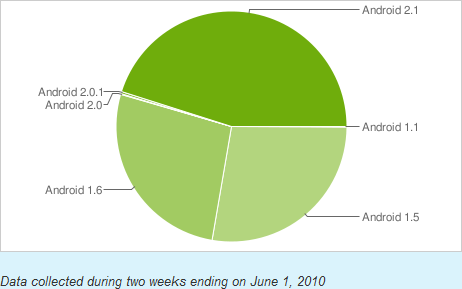
Android 2.1 is the dominant platform, but Android 1.5 and 1.6 makes up form more than half of those accessing the Android Marketplace, and this of itself means that there's already fragmentation of the platform.
But is this a problem? Well, I think that six major releases in the space of 19 months has been a problem. That pace of change speaks of Android's geeky origins. For Joe Average, this created an ultra-confusing marketplace where operating system versions changed every few months. It also meant that compatibility issues were inevitable.
But this rate of change is not sustainable. Android chief Andy Rubin outlines how the pace of change is slowing down:
Our product cycle is now, basically twice a year, and it will probably end up being once a year when things start settling down, because a platform that's moving — it's hard for developers to keep up. I want developers to basically leverage the innovation. I don't want developers to have to predict the innovation.
While this will help in the long term, in the short term it's not going to make much of a difference. Fragmentation will always be an issue, but with careful management, new versions of the Android platform shouldn't make the earlier version immediately obsolete.
As Android becomes more mainstream, the platform will have to offer owners, developers and OEMs more certainty - something that geeks won't be happy with.
Kick off your day with ZDNet's daily email newsletter. It's the freshest tech news and opinion, served hot. Get it.
Talkback
1st gen phones were too underpowered
Smart phone OEMs need to be forward thinking in that they need to anticipate that the phones will be in service at least 2 years and phones will need to be able to run the latest OS 2 years from now. And carriers need to be forward thinking enough to know they need to push the updates out.
Google causes deliberate fragmentation
Google, despite all the rhetoric on supporting choice and freedom, certainly cannot stand actions like that against their agenda to lock people in their cloud platform so they release constant upgrades or simply tweak a few APIs here and there to make the vendors branching off from Google dictated version suffer.
Delicate and evil.
RE: Android fragmentation is real
@vkelman
Not A Problem for Consumers
RE: Android fragmentation is real
I can see this as a valid point, to a certain degree.
With many different versions of an OS out in the wild, with differing versions of the API, developers might decide to try to get the largest user base by developing to the lowest widely used version. This would be a negative thing for Google's push for newer Android versions, as well as users getting newer versions of the OS with features that not many apps might take advantage of.
On the other side, when developers do take advantage of the new features what happens when a new Droid phone comes out on Verizons network running Android 2.3, and sports a fancy new software feature thats not bound to the hardware. Someone with a Moto Droid on 2.1 might have a friend with the Droid SuperTerrific on 2.3 with a fancy new feature that they can't get on their version.
Now this might not happen often, but it does have the potential to, and thats when consumers might notice.
RE: Android fragmentation is real
Then Linux is fragged too. This is 'much ado about nothing'.
Illogical comparison
Hello!
Most Windows 98 stuff won't run on Windows Vista or Windows 7 so what's your point? This happens with major releases and new APIs being added!
@Peter Lights are on, but nobody is home...
RE: Android fragmentation is real
The rate at which new software is released is extremely demanding and the only real way to keep on top of it is to pick one distribution's release schedule and try to follow it religiously. For Time Drive, I try and follow Ubuntu.
And, things become fragmented. Whenever I want to release a new version of Time Drive that takes advantage of new platform features (such as notifications, to cite a trivial example), I have to think long and hard about backwards compatibility/fragmentation. Will it still work on older versions (such as the previous LTS, that is still supported and in wide use)? Does it require people to upgrade other packages? Will it be stable?
That's a lot of QA for a guy who develops a program in his spare time; and is a really big problem.
RE: Android fragmentation is real
I'm sure that a necessity to "think long an hard" about backward compatibility and a way to implement new features makes your programs better, modular and loosens coupling between its subsystems.
There is no other way of developing for fast-evolving systems.
RE: Android fragmentation is real
Which brings me back to my main point: fragmentation is a problem for Linux and it's a problem for Android. It makes things more difficult than they need to be, and whenever a system is more complex than necessary, it results in problems with its adoption.
One of the major reasons that Linux isn't more widely adopted is due to poor professional application support. And there are few professional applications because of too many flavors of Linux.
Android risks going the same direction.
Fragmentation limits a platform
Why did MS have such an unroar with the "Ribbon" in Office? Because people like predictability and fragmentation leads to different groups getting a different experience.
Linux... too many different experiences.
Android: So far the argument has been different variations for different handsets. But at some point they will become incompatible enough that either developers get tired making their apps run everywhere, or the customers will get fed up than Version XXXX of the OS doesn't work with a particular app.
Not true
RE: Android fragmentation is real
Apple innovate at a slower rate.
Ribbon is just ugly and very inconvenient, very hard to find what you need. In an apartment building I live in, floor numbers in elevators are laid out into several rows. A result? Everyone has trouble trying to pick a floor. That's what MS did to a regular top menu.
Finally, Android "fragmentation" is going to be less, not more. System becomes to mature, it's getting more modular, decoupled, easier to upgrade.
RE: Android fragmentation is real