Apple just entered -- and quite possibly killed -- another market
Summary: A year from now the in-car GPS landscape is likely to be a very different place.
During the announcements coming from the Apple WWDC -- WorldWide Developer Conference -- 2012 keynote speech yesterday, I was keeping an eye on what effect the new hardware and software would have on existing markets.
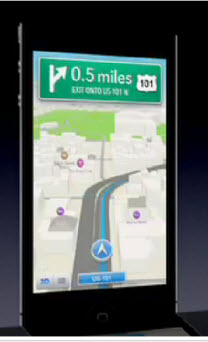
Buried in the usual WWDC keynote fanfare was, I believe, the most disruptive announcement made by Apple: updated maps and mapping features for the iOS platform.
Now, on the face of it, maps might not seem either all that sexy or disruptive, but the mapping platform built into the iPhone and iPad is quite a core feature that's leveraged throughout the platform. By replacing Google's mapping service with its own -- using data from companies such as TomTom and OpenStreetMaps and others -- Apple is putting itself at the center of the action.
However, there was more to the mapping announcement than just a change of provider. Apple also unveiled a new and highly requested feature -- turn-by-turn navigation. This is where the new mapping app starts to become disruptive.
By adding turn-by-turn navigation to iOS, Apple is allowing the iPhone and iPad to be used as in-car GPS systems right out of the box. Previously, the mapping app didn't offer the turn-by-turn navigation, and this meant that users had to purchase third-party apps to add this feature. This is no longer the case, and this has significant implications for the entire in-car GPS market.
And by implications, I mean casualties. And those casualties will be companies that sell in-car GPS receivers, companies such as TomTom and Garmin.
Apple sells millions of iPhones and iPads every quarter, and these people no longer need to buy a secondary device to get them from A to B. Yes, they might need a mount for their iPhone or iPad, and possibly a car cord for keeping it charged, but these two items are going to come in a lot cheaper than buying an entire in-car GPS unit.
In addition, vendors such as TomTom and Garmin also earn a significant revenue from selling annual map updates. iOS users will save money here because the maps will not need updating because Apple will be handling that at their end. This saves the owner a significant chunk of change, and will hurt the bottom line of the in-car GPS vendors.
But that's not all. The existing GPS vendors are going to get hit a third way. All the big names have apps which replicate their in-car GPS hardware experience on the iPhone or iPad. The business model for these apps replicate that of the hardware, in that the customer has to make an initial investment for the app, and then pay a fee for extras such as map updates and traffic information. iPhone and iPad owners would be crazy to be hemorrhaging this sort of money on a yearly basis to the likes of Garmin and TomTom when their iOS device offers similar functionality at no cost.
I'm not saying that there's no longer a market for dedicated in-car GPS receivers. Some people will always favor a dedicated device to a convergence device. It's the same reason you see people walking around with an iPhone but still using a compact camera to take photos.
Problem is, with iOS 6, Apple will put an in-car GPS receiver into the hands of millions of people, and that is going to have a very serious effect on the in-car GPS market. In some ways, TomTom has been fortunate, and maneuvered itself into an advantageous position by licensing maps to Apple, but it's unlikely that this will offset the negative effect from lost hardware, map upgrade and app sales.
A year from now the in-car GPS landscape is likely to be a very different place.
Image source: Apple.
Related:
- TomTom enters map agreement with Apple
- Apple CEO Cook: Ultrabooks are pretenders
- Apple granted MacBook Air design patent; problems ahead for Ultrabook makers?
- Possible iPhone 5 chassis appears on video
- Why chip names tell us very little about the iPhone 5
- Do these blueprints show the iPhone 5?
- iPhone 5 could feature a "Retina display killer" screen
- Apple's Tim Cook appears to ‘rules out' iPhone 5 with 4-inch screen
- Reuters: iPhone 5 to have 4-inch screen
- WSJ: iPhone 5 getting 4-inch+ screen
- Best earphones for your iPhone and iPad
Kick off your day with ZDNet's daily email newsletter. It's the freshest tech news and opinion, served hot. Get it.
Talkback
Already happened
iPhone had turn by turn when it launched...
But overall Adrian, I don't think you are seeing things clearly from TomTom's perspective... If anything, I suspect Apple just saved TomTom. Built in Nav systems in cars suck the big one. $200.00 for a friggin map update??? Seriously??? My iPhone has been able and capable since day one and it has always been up to date... I don't think TomTom has made that much money on the hardware since they don't sell enough volume to bring their hardware costs down. Now they have a way to make money from Apple's volume in more than just an App in the app store.
Now if car makers add an ipad dock on the dash so that the iPad is the new built in nav/backup cam monitor/stereo/movie player/etc... Well... that would be a game changer.
Umm not the same...
YOu called that turn by turn
I don't agree Adrian, and here's why:
#2. IMO, I happen to prefer having my Garmin GPS device, rather than using an expensive tablet that could come flying off the dash as I try to avoid a deer or moose. ( Very common here in Maine)
#3. A life time map subscription from Garmin is $100.00, + the $130.00 price of the GPS.
My oldest son who had the original droid razor, also had GPS on his phone, so Android has had this capability for awhile, and they're still selling GPS units for cars.
Matter of fact Radio Shack just had a sale for a Garmin 5" screen GPS for $115.00, so while I realize that the GPS market is getting smaller, I don't think these companies are going out of business too soon, as long as others such as myself prefer to have the GPS device itself, IMHO........
Thanks..
TW
Your points are not valid for the iphone
While your points may have some validity in regard to the iPad, it does not really apply to the iPhone which is not cumbersome and can easily be put in a carrier for in-car use. Since most people want the connectivity benefits of a smartphone for reasons other than geo-location services it is (in my opinion) a no brainer to save that $200.00 plus expense for a dedicated GPS device.
Agree
1.) Android's have been out-selling iPhones for a while now and I cannot think of the Android that does not have native, voice-dictated, navigation. For free (not through the carrier).
2.) While I am sure this has impacted the third-party GPS provider, it discounts that many more cars are coming standard with those devices and greatly exaggerates the impact the iPhone will have, considering that the Android has already made the most noticeable dent in that market.
Spell check!
Factual Corrections
$200 map updates: YES for built-in devices (which average around $1,500-$2,000 on the options list with AUTOMOBILE manufacturers). I don't know any add-on GPS systems that go for $2,000 and have $200 map updates that are made by TOMTOM. GARMIN makes a few for boats/commercial systems that cost in that price range, but I would respectfully point out that the author is not talking about any of that - he mentioned TOMTOM by name, a low-end foreign manufacturer that is known for FREE LIFETIME UPDATES with many of their products.
Bottom line, except for the few snobs that apparently are still buying $2,000 built-in navigation system, I can't see why anyone in their right mind would put a teeny-tiny 4" phone or a huge 8" IPAD device on their dashboard to navigate with, especially given the prices of either device vs. dedicated GPS systems.
You can put lipstick on a pig, but at the end of the day it's still a pig. Just like you can put GPS on a phone, but at the end of the day it's still just a phone. If you want to know where you are, I would put my money on a dedicated GPS with free lifetime updates - more bang for the buck, and these days they're outrageously affordable.
Android Phone > GPS Device
+ Blackbox video recording
not so fast (*ahem*slow) there
Works fine for me
Out of the many times I've used Google Maps, It's only fouled up 3 times.. and those were primarily due to a failure in understanding what I said in my noisy car. While my Garmin has re-routed me, taken me 100 miles out of my way and gotten me lost more times than I care to count.
@Peter Perry
Try again loser.
Really?
Phones don't compare to dedicated GPS devices
My experience with phones as GPS devices (several different smart phones) is that they simply fail. They have weak and inaccurate receivers and/or algorithms. I often get unusable turn-by-turn using a phone, whereas I get solid, accurate instructions from a dedicated GPS device.
There simply isn't space in a small device to put a really good GPS receiver, apparently - or maybe it's the antenna.
But let me be specific - I've yet to use any phone that doesn't have the following problems that I do NOT have with a dedicated GPS device:
1. Taking a long, long time to get a GPS lock (5 to 20 minutes, modern devices)
2. Easily losing that lock, especially in mildly cloudy weather (and I am in Los Angeles)
3. Locating me, almost always, two to three blocks away from my actual position. I can be driving on street X, and the phones keep asking me to make turns so as to GET to street X. All the time. Or I'm on the freeway and it thinks I'm on a side road, and keeps requesting various turns.
All this makes the phones useless for while-driving directions.
I really WANT to use my phone for this purpose. I've wanted to with the last 4 phones I've had, all major-manufacturer, highly-rated phones. But it just doesn't work.
So, given that I can get real time traffic (and the GPS device will actually suggest alternate routes while driving, if it will save time, and even gives a time-savings estimate), map updates for life, fast GPS lock, and dead-accurate location and directions, I don't see there's even a comparison.
Now, given the pace of technology, all that could change rapidly. But it hasn't for the last 3 years. Let's see if the new iPhone solves these problems.
Accuracy of the smartphone maps
I have not experienced any of the issues that you refer to in your post. My iphone gives me accurate locations( within about 20 feet) and does not take any longer than my old Tom Tom to locate my position 9actually, it is quicker since my phone is always on and has already determined my location). As to the real time traffic, I would not have a need for that information very often especially since I live in a rural area with little traffic.
Hmmm
Phones SUPERIOR To Dedicated GPS Services
Well...
Is there an Internet emoticon for "that doesn't suck !" ?
Not too shabby.