ie8 fix
madison

Hardware 2.0

Adrian Kingsley-Hughes

Could Windows 7 become the new Windows XP?

By | September 13, 2011, 12:46pm PDT

Summary: Could Microsoft have trouble getting desktop and notebook users to move to Windows 8?

Is Microsoft in danger of turning Windows 7 into the new Windows XP?

What do I mean by that? Well, take a look at the usage share statistics for Windows XP. Despite being two versions out of date it still commands an almost 50% usage share. People are holding onto XP for dear life rather than opening their wallets and upgrading to the latest and greatest.

Could this be a problem facing Microsoft when it tries to get people to upgrade to Windows 8? It could well be …

Here’s an interesting quote by PC Pro’s Barry Collins:

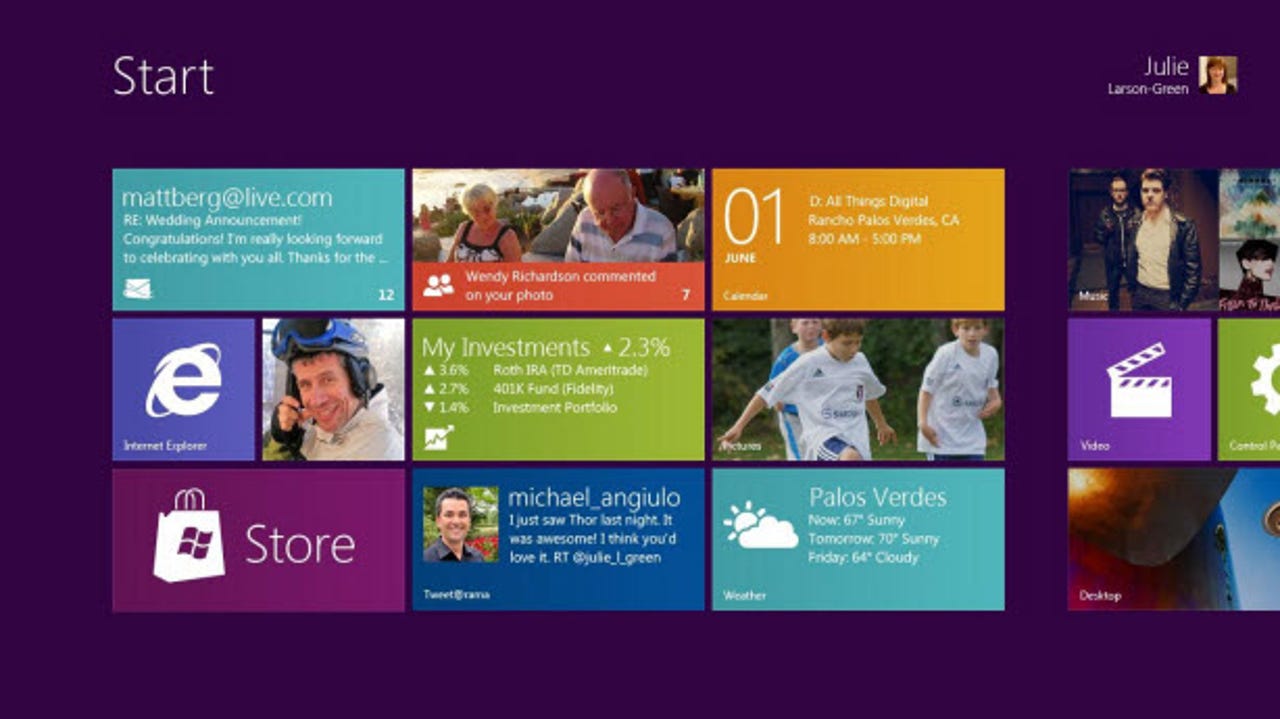
For desktop PC or laptop users, however, we’re struggling to see the appeal. The entire interface is so geared towards touch, that using a mouse or cursor keys to navigate around the Start screen just feels awkward. We suspect Windows 7 will remain the operating system of choice for conventional PC users.

It’s a good point.

While Jensen Harris, director of program management for the Windows Experience, says that “every screen needs to be touch. A monitor without touch feels dead,” the truth is that it’s hard to see touch becoming mainstream on the desktop for a number of reasons - one of the most obvious being that most people’s desktop environments aren’t set up in a way that makes them conducive to touch. Who wants to have their arms up in the air to point at stuff when they have a perfectly good pointing device on the desk? Why wants a fingerprint covered screen? What makes touch better on the desktop or a notebook? So far Microsoft is giving us hyperbole rather than concrete answers as to why this technology is needed outside of tablets.

Here’s another problem. Touch adds significant cost to a system at a time when people are watching the pennies. I can see OEMs offering touch panels as optional extras, but unless there’s a compelling case made for touch, tablets will be where most people get to experience this new input device.

And finally, it doesn’t seem like you’re going to be able to do everything using touch anyway, since the Metro UI is only a veneer over Windows. Imagine trying to control this with touch:

I like touch on a tablet, but the problem is that Microsoft has yet to make a compelling case for touch on a desktop or notebook PC which have more refined pointing devices as standard. I can understand if Microsoft took the Apple approach and pushed a device like the Magic Trackpad, but to push touch as touchscreen doesn’t make much sense to me on the desktop, and little sense on notebooks.

Touch is quite definitely a tablet feature, yet Microsoft is trying to shoehorn it onto the desktops and notebooks (maybe as a way to invigorate sales, because more PC sales means more money in Microsoft’s coffers), but the problem is that most of its customers will not be using touch, and will likely not want it or need it. And if they don’t want touch, why upgrade to Windows 8.

What to YOU think?

Kick off your day with ZDNet's daily e-mail newsletter. It's the freshest tech news and opinion, served hot. Get it.

Topics

Adrian Kingsley-Hughes is an internationally published technology author who has devoted over a decade to helping users get the most from technology.

Disclosure

Adrian Kingsley-Hughes

All opinions expressed on Hardware 2.0 are those of Adrian Kingsley-Hughes. Every effort is made to ensure that the information posted is accurate. If you have any comments, queries or corrections, please contact Adrian via the email link here. Any possible conflicts of interest will be posted below. [Updated: February 23, 2010] - Adrian Kingsley-Hughes has no business relationships, affiliations, investments, or other actual/potential conflicts of interest relating to the content posted so far on this blog.

Biography

Adrian Kingsley-Hughes

Adrian Kingsley-Hughes is an internationally published technology author who has devoted over a decade to helping users get the most from technology -- whether that be by learning to program, building a PC from a pile of parts, or helping them get the most from their new MP3 player or digital camera.

Adrian has authored/co-authored technical books on a variety of topics, ranging from programming to building and maintaining PCs. His most recent books include "Build the Ultimate Custom PC", "Beginning Programming" and "The PC Doctor's Fix It Yourself Guide". He has also written training manuals that have been used by a number of Fortune 500 companies.

Adrian also runs a popular blog under the name The PC Doctor, where he covers a range of computer-related topics -- from security to repairing and upgrading.

111
Comments

Join the conversation!

Just In

RE: Could Windows 7 become the new Windows XP?
zahidpi Updated - 23rd Nov
@Return_of_the_jedi
0 Votes
+ -
start the march Adrian.
After a few minutes use thought that a lot of folk are going to stay with Win 7.No start menu,to power off have to to get to settings,no way to lock on either tablet or desktop,all this adds up to general fustration.
But if you have a tablet it is probaly a good OS,if only the more speedy desktop over Win 7 could be properly be of use?
@morrig Yeah, Metro should have been tablet-only or at least not the default UI on the desktop. While the old-style Windows desktop is hidden underneath, there doesn't seem to be an option to make it the default. I certainly hope that changes prior to RTM. If not, I could easily see Windows 7 becoming the new XP.
0 Votes
+ -
@BillDem .. Agree completely
thx-1138_@... Updated - 17th Sep
with your assessment. +1

Metro should not be forced as the default - it needs to be the other way around.

If MS is to stay relevant to enterprise, it has to focus on not isolating them with this. If the W8 Team, however, make the traditional Aero-type desktop the default, they're onto a win-win scenario:

(1) the enterprise gets the platform familiarity (first and foremost)

and

(2) the domestic user gets an easily tweakable desktop environment to switch between work-mode and play/social-mode.

To echo your thoughts (again) - since it deserves reiteration: Metro as the default theme is a bad move. If it does, i have no doubt W7 is the next XP.
0 Votes
+ -
@BillDem I agree. +2
Auna 17th Sep
Microsoft must fix the interface and workings for desktop computers. Making desktop and laptop users feel obsolete for second class is not going to be a motivator for sale of windows 8. In-fact it may suggest to people that the product wasn't well thought out or rushed--another Vista.
0 Votes
+ -
There's a problem...
cosuna Updated - 23rd Sep
@thx-1138_@...

The new XAML apps are Metro only, that is, all the WinRT fanciness just doesn't work on the traditional desktop.

Microsoft can't essentially make Metro optional, as all the revenue model (App Store, one OS for all uses, no compromises, etc.) goes to pieces if you actually have TWO OS to maintain.

Ironically, that the path that Apple led and has given them quite a clout, but they chose it voluntarily. Microsoft is stating that they want a single OS for all.

Or it can get much worse. If Metro is made optional, MS will get stuck with FIVE OSs to maintain:

1. Metro only Windows 8 (on ARM)
2. Metro and Legacy Windows 8 (on x86)
3. Metro and Legacy Windows 8 (on x64)
4. Legacy-only Windows 8 (on x86) [basically Windows 7 x86]
5. Legacy-only Windows 8 (on x64)

Sounds like a mouthful.
@Return_of_the_jedi
So far Microsoft is giving us hyperbole rather than concrete answers as to why this technology is needed outside of tablets.
cheep wedding dress
@Return_of_the_jedi
Making desktop and laptop users feel obsolete for second class is not going to be a motivator for sale of windows 8. In-fact it may suggest to people that the product wasn't well thought out or rushed--another Vista.
cruise agency
0 Votes
+ -
@Return_of_the_jedi
The non-Metro, classical UI is there to stay in Windows 8 too--that is, except for applications written for Metro. You'll still run Office 2010 in Windows 8, there ain't going to be any Office Metro Edition.

However, some applications could benefit from the Metro UI even for non-touchy notebooks. Not to mention that I expect to have an increasing number of notebooks whose screen is touch-aware, yet the keyboard is also there--think of the latest BlackBerry 9900 or Nokia E6, which feature both a touchscreen *and* a QWERTY keyboard.

The only problem is whether people are really willing to pay for such an upgrade. OEM-installed on tablets and notebooks, Windows 8 will sell. But who's gonna pay to upgrade an existing Windows 7?
@beranger
Just how easy is Microsoft going to make for users to get to the "classical UI" on boot up? It has best be an option during installation--and changeable via the Control Panel.
0 Votes
+ -
@TsarNikky

On the preview the only thing i could find was to run an app that looked like the "classic" interface.
0 Votes
+ -
@beranger
IF MS would take a cue from Apple and offer the update for a reasonable price, say $30 a machine, or $75 per household, then they could probably push down the number of WinXP installations they have to support, and get most users onto the latest version. I think it would be more profitable, in the long run.
0 Votes
+ -
Yes
davebarnes 13th Sep
Maybe.
For sure if MS charges $120+ for Windows 8.
0 Votes
+ -
@davebarnes
You hit the nail on the head - had MS charged $50 per W7 copy XP would go away much quicker. I just got my first ever iMac. The extra hardware price is already compensated by software that I could get at AppStore.
0 Votes
+ -
I agree...
cfshine78 Updated - 13th Sep
I'm a technician in Indy and have been saying the above for quite some time now. While the touch screen of 8 is innovative and definitely where technology and interaction with users and their 'machines' is going, there still will be a majority of users in the world that aren't quite ready to jump on the reinvented wheel.

One major question I'd like to know is if Windows 8 will have a compatibility mode to where you can make the interface look and act like the familiar previous OS's (7, vista, xp)...structure wise that is.
@cfshine78 Of course it does! Here's the same Windows 8: http://www.flickr.com/photos/longzheng/6144682202/in/photostream

The BUILD keynote is online again, maybe you should watch it: http://www.buildwindows.com/
@Spock Impersonator
"History has proven that if a company where to offer anything other then Windows to their customers, they would not have enough sales to remain solvent at the end of their first month."

History has shown no such thing. Dell reported that its return rate for net-books was the same, regardless of whether they were running Windows or Linux:

http://www.theregister.co.uk/2009/08/12/dell_reality_linux_windows_netbooks/

""We are not seeing any technical reasons for why they are returning Linux machines so...we don't see a significant difference between the return rate for Windows versus the rate for Linux. We've been quite pleased with the stability and technical soundness of the Linux machines."

Dell is not insolvent either, of course.
0 Votes
+ -
@olePigeon

plain
@olePigeon

...exactly. I'm not ready for greasy, dirty smudges all over my monitor either...
0 Votes
+ -
No.
bmgoodman Updated - 13th Sep
Win XP became what it is due to (1) huge delays rolling out Vista and (2) rolling out the crappiness that was Vista. In this case, Microsoft isn't giving us over 5 years on Win 7 before rolling out Win 8. To me, that will make all the difference, in terms of inertia and investment in the old OS.

Plus, I suspect enterprises will use the "old" Win 7-style UI for most users and will therefore not see so much difference between Win 7 and Win 8, so there won't be a big "hell no, we won't go" moment.
Windows XP was the first bulletproof OS. As such there is little reason to "upgrade" to ANYTHING.

The only reason W7 has any market share is because Microsoft forced it on everyone via new hardware. Getting a new laptop today? You get W7, like it or not.
0 Votes
+ -
You are incorrect, again
Mister Spock 13th Sep
@Dorkyman
Microsoft forced nothing onto computer purchasers, instead the OEM's saw the logic into offering their PC'[s with Windows 7 installed, as if they did not, people would not purchase their systems.

And what operating system would you prefer on your new laptop? Linux?

History has proven that if a company where to offer anything other then Windows to their customers, they would not have enough sales to remain solvent at the end of their first month.

plain
0 Votes
+ -
@Dorkyman so what do you suggest microsoft do, just keep selling windows xp forever
0 Votes
+ -
@Dorkyman
I understand your point as WinXP is still a very good OS. However, Win7 is so much more........muscular. I really like Windows 7.
@Dorkyman
If that (no reason to move away from something that works) were the case, we would still be driving a Ford model -T, heck we would still be riding our horse carriages.

Though I will agree completely with you, Win XP is widely used only because of its distribution. But it is widely distributed because of it being widely used. It is a like chicken and egg problem. It goes in a cycle.

Think of it, it was the easiest OS out there to install and be ready out of the box. Plus the support for it from application developers and device vendors was overwhelming. And that when MS charged an arm and a leg for the IDE (Visual Studio) unlike the free Eclipse we are so used to now.

I know first hand of enterprises that have moved completely to Mac based machines and those that want to. In a recent developer meet, about 8 of the 30 something attendees were using Macs. They had the most trouble setting up the environment but they were using Macs. (I pity them). But I digress.

you can still get a WinXP from some hardware vendors if you chose to downgrade. but why would you, when Win 7 gives you all that and more.

Soon Win 8 will be able to say that.
0 Votes
+ -
@Dorkyman
I agree. Vista was as big a mistake/disaster as Windows ME. If Microsoft follows their usual pattern, Windows 8 will be ill-conceived, poorly designed, mismarketed, and mismanaged from the get-go.
@Dorkyman

XP is a bloated hog that uses six times the system resources now than it did when it was released! XP was good for a year or two. Then, SP1 was good for a year, SP2, etc. No OS is bulletproof. We're in the stone age of software development. Expecting an OS to remain valid and competitive for more than 5 years is absurd. Expecting it to be supported for 10 years is even worse. Ubuntu's Long Term Support release is only covered for 2 years.

In summary, given the choice between XP and Vista, more people than ever switched to Linux and Mac.
@Spock Impersonator
"History has proven that if a company where to offer anything other then Windows to their customers, they would not have enough sales to remain solvent at the end of their first month."

Oh really? Link, please! If you are referring to net-book returns, then Dell reported that the return rates were about the same for both Windows and Linux devices:

http://www.theregister.co.uk/2009/08/12/dell_reality_linux_windows_netbooks/

"We are not seeing any technical reasons for why they are returning Linux machines so...we don't see a significant difference between the return rate for Windows versus the rate for Linux. We've been quite pleased with the stability and technical soundness of the Linux machines."

Nor is Dell insolvent.
0 Votes
+ -
XP is bulletproof?
Lester Young 15th Sep
@Dorkyman

You're killing me.
@Dorkyman
I agree. New computer equals Windows 7. Most XP copies are OEM and are not suppose to be tied to new hardware under the terms and conditions. So when your machine (desktop, laptop, etc) dies you will get another OEM copy this time Win7.
Relatively speaking MS office 2007 and 2010 were a big productive changes for very little money for the consumer. That's why MS office is Microsoft's cash cow right now.
@bmgoodman
make sense except for the fact that "XP is still XP" and holds a significant share of Win users already. Add Win7 users who can't see the advantage in upgrading, and there's a prescription for low conversion rates.

I'm looking forward to trying out the preview though...on my HP Slate 500, which is a dog with Win7 but may be OK with Win8.
Yes probably. In our house I run three primary systems and three backup systems. Only one of the backup systems runs Win 7. That system was my wife's system before I got her a laptop. Of course my backup systems won't do everything I normally do on the main systems but reading mail, browsing the web and viewing movies still is possible. The cost in dollars and time to upgrade the two old systems that run Win XP is just too high so they stay as they were. The cost to upgrade our primary systems was not cheap as a number of apps etc had to also be upgraded. Thus I do not see moving to Win 8. Also Win 8 sounds like it contains a lot of new code and I would rather let it age for a while and then maybe upgrade to Win 9. A new laptop or pad could well run Win 8.

On the monitors for the main system I just hate finger prints so tough is not a real option. Sure I realize that for some applications touch is an improvement but I suspect that I don't spend much time in that kind of app.
Dave W
0 Votes
+ -
RE: Could Windows 7 become the new Windows XP?
Cylon Centurion Updated - 13th Sep
No. Windows 7 isn't going to be supported for 10+ years.

The Ribbon is not that bad with touch. Continuing to complain about it is beating a dead horse. Don't knock it till you tried it.

http://www.youtube.com/watch?v=IKaHFGQuHYI&feature=player_embedded#!
@Cylon Centurion
You are forgetting ergonomic factors with touch. With desktop and laptop your are directing your hand perpendicular to gravity. While doing his you are also impacting a scree with your finger times which can encourage sprains and bone spurs. While working on a tablet you have to have your head down. Working in that position for an extended period of time will cause neck and back problems. The the workman comp claims will cause some enterprises to pull away from touch.
It does seem like an odd time to bring out a new OS. I mean, after the Vista fiasco, companies are just now building up the confidence to dip their foot in the waters an upgrade their XP infrastructure to 7. For Microsoft to release a radically revamped successor OS now just adds another layer of uncertainty.
0 Votes
+ -
@dsf3g@... The thing is...there is no Windows 8. There is no Windows 7. It's all marketing. Vista was Windows 6. "7" is 6.1, and "8" is 6.2. Look at the build numbers. That discovery came as both a horror and a relief. A horror because we still are being forced to deal with Vista reincarnations, but also a relief in the sense that the underlying code probably HASN'T changed that much. It's just been re-skinned yet again.

Why? WHY?

Because consumers are suckers, and they're betting that this new bit of shiny will make them money.

I hope they fall flat on their faces.
@SilverPuppy
Good points. Yet another incarnation of the mess that was called "Vista". I keep playing with Windows 7 but the more I use it the more annoyed I get and I just keep going back to XP. I'm not really expecting a whole new experience from 8 but I'll wait and see...
0 Votes
+ -
Vista wasn't all that bad after SP1.

Being based on 6 instead of bumping up the kernel to 7 or 8 means nothing. 6 brought a lot of kernel level changes that were much needed. If you think that 7, and soon 8, are just "re-skinned Vista", you're ignorant.
0 Votes
+ -
@SilverPuppy Would it make you happy if they called Windows Lion, Windows Zebra, Windows Cougar, etc.?
If they embrace touch then they are : "Desperate to survive in a post-pc era by shoehorning touch into their legacy OS"

If they don't embrace touch they are: "A Dinosaur that is ignoring the future of modern computing."
@otaddy +1
don't buy Windows. They buy PCs. And the PCs they bought with WinXP still work well enough for them they don't want to drop $500 on a new machine.
0 Votes
+ -
The Ribbon UI is not all that bad with touch. Please don't knock it till you tried it. Continuing to complain about it is beating a dead horse. Would you rather have the drop down menus brought back?
@Cylon Centurion Are you commenting with a touch screen? I've seen this post so many times, I think you're a little entranced by the shiny colors on your tablet screen.
Windows 8 will become the de-facto "Windows 7: Tablet Edition"... and yes, MS will have a serious problem if they think people will jump all over it for non-touch computers.

MS is clearly hoping that Metro applications (which will only run on 8) will become a wedge to force Win 7 people to upgrade. I can see this being a problem for developers much like supporting vast numbers of corporate IE 6 users -- apps will need to be dual version or else large users that refuse to upgrade from 7 will be eliminated as potential customers.

A total mess that could have been eliminated if a new SKU was created, and it was simply Windows 7r2: Tablet Edition to make it clear that it, and it's tailored applications, were intended for tablets and not desktops.
0 Votes
+ -
RE: Could Windows 7 become the new Windows XP?
FrederickLeeson Updated - 13th Sep
@croberts

"MS will have a serious problem if they think people will jump all over it for non-touch computers."

I think that you are not taking into account that MS badly needs a presence in table space and Win7 (much as I like the os) ain't it. They are *not* (IMHO) expecting all Win7 owners to rush out and buy a new home-office pc. What they are however expecting is that light-weight mobile devices are going to get more and more powerful and that tablets may indeed become the "only" computer you have at home in the medium term (for many although not all). In addition they are also aware that those business folks who turn up to meetings with their obligatory iPose tablet have to haul along a 2 kg lappie as well if they want to be able to make a serious contribution to the meeting (Excel, Powerpoint etc). For the mobile businessman a *real* pc in tablet form may be seen as a boon and given that it will readily integrate into existing company network systems, what's not to like? Win8 is a transition os designed to ensure that Windows has a future whichever way the cookie crumbles with regard to how we interact with our devices.
0 Votes
+ -
@FrederickLeeson That's a very interesting analysis, and I must say you're likely right. I still hate it. I use a desktop PC for everything I can. I own several laptops. I hate them. I hate tablets with a smash-it-on-the-ground passion.

I'm a dinosaur. I'm not alone. I have a customer base that's loaded with them. M$ will lose with my people. The vast majority of my customers are still on XP. Exactly ZERO upgraded to Vista or 7. The only customers I have with either bought the computer with it.

Oh, and I can think of only 1 or 2 that would even try the Metro thing. It's like metrosexual......all form, no function.
0 Votes
+ -
They absolutely will have trouble, I don't want all that junk on my desktop! Surely, I cannot be alone.

Join the conversation!

Formatting +
BB Codes - Note: HTML is not supported in forums
  • [b] Bold [/b]
  • [i] Italic [/i]
  • [u] Underline [/u]
  • [s] Strikethrough [/s]
  • [q] "Quote" [/q]
  • [ol][*] 1. Ordered List [/ol]
  • [ul][*] · Unordered List [/ul]
  • [pre] Preformat [/pre]
  • [quote] "Blockquote" [/quote]
ie8 fix
Click Here
ie8 fix

The best of ZDNet, delivered

ZDNet Newsletters

Get the best of ZDNet delivered straight to your inbox

Facebook Activity

White Papers, Webcasts, & Resources
ie8 fix
ie8 fix