ie8 fix
madison

Hardware 2.0

Adrian Kingsley-Hughes

Facepalm of the Day: Intel charges customers $50 to unlock CPU features

By | September 19, 2010, 5:46am PDT

Sometimes it seems that companies do something so monumentally bone-headed you have to wonder whether anyone is awake at the helm and OKing these crazy moves. Today brings word that chip giant Intel is allowing OEMs to sell CPUs with certain features locked - that the customer can unlock by paying $50 for a software code.

The CPU is a Pentium G6951 and the scheme works like this. OEMs sell suckers consumers a computer featuring a CPU that has some features disabled (in the case of the G6951, 1MB of L3 cache and HyperThreading is disabled). Customers buy a card that contains an unlock code, visit Intel’s website, enter the code, download some software, run the software and the locked features are unlocked.

Note: In the case of the G6951, it’s upgraded to a G6952, which is roughly equivalent to a Core i3 520.

Intel seems to be marketing the Intel Upgrade Service as a way for system builders and OEMs to increase margins:

System builders: Build upgradable desktop PCs that enable your resellers to upgrade CPU performance down-the-wire.

Resellers: You can configure CPU performance down-the-wire at your point of sale, and increase your margins while doing so.

Intel currently seems to be testing this upgrade mechanism at the budget end of the market in selected markets.

Thanks to an eagle-eyed Engadget reader for spotting the upgrade cards at a Best Buy store:
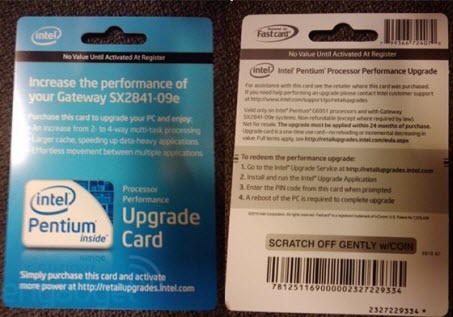
Now, it’s common knowledge that chip makers already tune and de-tune CPUs to create different models in a line-up. CPUs are tested after manufacture and the speed, cache and cores and so on are locked to create the different models depending on the performance and flaws of the individual piece. The process is called binning. Over the years I’ve seen processors that can have features unlocked on them using a variety of means - for example, via the BIOS, or by careful soldering, or with a pencil line. Then there’s the whole overclocking business which revolves around squeezing as much as you can from hardware by taking it way beyond the tolerances that the manufacturer deems acceptable. Silicon nowadays is so reliable that an overclocked part can last just as long as one running at stock speeds as long as a little care is taken.

However, this arbitrary software lock is odd in that Intel is offering to remove it for a fee. Basically it seems processors have become so powerful and so cheap, and the failure rates so low, that the only way that Intel can supply the low end demand is through artificially downgrading chips. Doing that brings with it the opportunity to upgrading the hardware … for a fee …

The software world abounds with similar examples. An easy example is Windows, where the features that a user has access to is determined by the key that is used to unlock the software, which is in turn determined by how much the user is willing to pay. Games are another are where this happens, but the practice is rife in the entire software industry.

This seems like a plan by Intel to simplify its CPU lineup and allow some sort of “dial-a-power” mechanism so that a single CPU could be set into a series of different configurations depending on price paid by the consumer and the unlock code entered. Imagine a scenario where Intel could make one CPU, sell that one CPU to OEMs who could them configure it through the use of unlock codes. It would undoubtedly streamline inventories. Sure, it’s a trick that can only work at the budget end because not even Intel could afford to ship Core i7s and have them downgraded to cheaper chips. But the budget end is dominated by people who don’t really know what they want.

But, despite the upsides, this is still a bone-headed move for Intel to make for a variety of reasons.

  • First and foremost, it’s more than likely that the upgrade mechanism here is a basic one, and so it won’t be long until the process is hacked.
  • Secondly, it’s highly confusing for the consumer. I really don’t see consumers parting with $50 given the description on the upgrade card. People clever enough to know what they want and what the upgrade means aren’t buying from Best Buy.
  • The flipside is that it is Best Buy we are talking about here as an example. I can see salespeople pressing this on customers, much like warranties pushed. Intel is selling out customers for the sake of $50 …
  • It’s a crap upgrade. To be honest, It’s not really worth the $50 and customers could spend their money better.
  • It makes Intel look cheap. Remember, the features are already packed into all the CPUs, it doesn’t matter if they are switched on or not. The cost of adding these features is obviously insignificant, but Intel is still willing to charge people $50 to switch the feature on.
  • It’s an enormous stick for AMD PR to batter Intel around the head with. Going to such lengths to double-dip customers isn’t good PR.

Note: Let’s be clear here - I’m not saying this is a scam because users aren’t being deceived at any point.

That said, I’m not surprised. In fact, I’m surprised it took this long coming. Much of the hardware business revolved around artificial market segmentation already. The cost different between low-end and high-end hardware is nowhere near the price difference that consumers pay.

Thoughts?

Kick off your day with ZDNet's daily e-mail newsletter. It's the freshest tech news and opinion, served hot. Get it.

Topics

Adrian Kingsley-Hughes is an internationally published technology author who has devoted over a decade to helping users get the most from technology.

Disclosure

Adrian Kingsley-Hughes

All opinions expressed on Hardware 2.0 are those of Adrian Kingsley-Hughes. Every effort is made to ensure that the information posted is accurate. If you have any comments, queries or corrections, please contact Adrian via the email link here. Any possible conflicts of interest will be posted below. [Updated: February 23, 2010] - Adrian Kingsley-Hughes has no business relationships, affiliations, investments, or other actual/potential conflicts of interest relating to the content posted so far on this blog.

Biography

Adrian Kingsley-Hughes

Adrian Kingsley-Hughes is an internationally published technology author who has devoted over a decade to helping users get the most from technology -- whether that be by learning to program, building a PC from a pile of parts, or helping them get the most from their new MP3 player or digital camera.

Adrian has authored/co-authored technical books on a variety of topics, ranging from programming to building and maintaining PCs. His most recent books include "Build the Ultimate Custom PC", "Beginning Programming" and "The PC Doctor's Fix It Yourself Guide". He has also written training manuals that have been used by a number of Fortune 500 companies.

Adrian also runs a popular blog under the name The PC Doctor, where he covers a range of computer-related topics -- from security to repairing and upgrading.

157
Comments

Join the conversation!

Just In

RE: Facepalm of the Day: Intel charges customers $50 to unlock CPU features
linasmith 24th Aug
@RationalGuy this is the price for function to the cost. Assignments | Dissertation Writing
0 Votes
+ -
Intel should be ashamed of themselves.
0 Votes
+ -
No shame in what they are doing.
RationalGuy 20th Sep 2010
You pay for features, not hardware. This is a good way for someone to pay a low price for an item, and then upgrade it down the line without having to open up the hardware and change something out by hand.

EMC will ship you cabinet of SAN disks and charge you when you spin them up.

Fibre-channel switches can be purchased with, say, 24 ports, but you buy a license that only turns on 8 of them. Then if down the line you need more ports, you buy another license and turns on another 8 or 16 or whatever.

The only real mystery is why anyone would use the dipsh-t word "facepalm".
0 Votes
+ -
Yes there is
ahh so 20th Sep 2010
The features should be turned on by default. If that means paying a little more upfront, then I might consider buying into it. But to have them disabled before the fact only smacks of greed and nickle and dimeing people.
0 Votes
+ -
I agree
lindsay.whitbread@... 21st Sep 2010
@RationalGuy
I agree. Any opinion that what Intel is doing is in some way greedy, underhanded or new would be purely naive. The only reason I read this article was to find out if in fact there was a facet to what Intel was doing which strayed from other, similar, soft locking approaches...which appears not to be the case.

Sure, there are some risks around what Intel are doing, but equally, it's nice to see a bit of innovation in how the technology is making its way into peoples homes.

Facepalm of the day? Highly unlikely.
@RationalGuy
Are you one of those dipsh-t guys who would pay the money?
@RationalGuy It doesn't cost them anything different. The EMC model is not apt because EMC's business is primarily derived from support... The reason EMC is so successful isn't that they sell disk drives it's that they sell best-in-class support. Intel on the other hand is not.

Intel's cost to produce those CPUs is no different, those features have already been paid for at a fixed cost (hardware developer hours) and the silicon is paid for. The only thing they're doing is artificially inflating the price, why would they sell the lower end chip at a loss? They wouldn't, so they could sell the higher end chip for the same price and just not sell the lower end chip.
0 Votes
+ -
No, I pay for hardware...
jasonp@... 21st Sep 2010
that can support the features of the software I purchase.
0 Votes
+ -
@snoop0x7b: You are under the delusion ...
RationalGuy 21st Sep 2010
... that price is a function of cost.
@RationalGuy You are a total IDIOT, it's thinking like yours that has people paying out the nose for things that should be in one bundle,
@RationalGuy I agree completely, pretty much with everything you said. I have mixed feelings about this and at this point am not sure which way to go with it.

The mystery you speak of, I don't think we want to hear the truth. Just a "blogger" being a douche and planting words to get us to read his garbage thoughts.
@RationalGuy this is the price for function to the cost. Assignments | Dissertation Writing
@sismoc

I grow tired of corporations and their corrupt ways to increase profits! I'm done buying into the product hype and supporting the punks that run these companies!
@rob.sharp@...
Well said wink
@rob.sharp@...
+1

Best wishes, G.
@rob.sharp@... Very well said i am very impressed to you comment and appreciate to you also. essays | term papers | research papers
This is nothing new to the computing industry. In the mid 1960's GE slowed down their GE225 systems by slowing it down and selling a GE215 for less price. When our workload increased and we needed more speed we could pay for an upgrade and they would remove the board that slowed down the processor. We had to pay for this upgrade.
I know this ages me but it was done all the way back in the 1960's.
0 Votes
+ -
"Governors" anyone? Nanny McFee ??
KnowBuddy 21st Sep 2010
@Harry Hardin "
Yeah, one must admit that for many generations running now, putting "governors" on engines of all sorts, to throttle back and blockade off the "hi revs" top-end capabilities from us drivers/owners has been common practice, ...of course it's just to altruistically protect us from ourselves,... right? Thanks Big Bro! How would we consumers ever have survived past 1984 without you? Please won't someone put a length limit governor on these data entry boxes to protect me from carpal tunnel syndrome? My keyboard is just too fast for my own good! I'll be willing to pay $50 some time down the line, when I'm ready to learn to use all these extra extended shift characters on this fancy keyboard. I promise. Meanwhile, save me from all this technology! Too much... too fast... can't throttle back... losing con scious nesssss... aggh!
I find this practice penny-wise and pound foolish. Thanks Intel for treating the customer like a second class consumer. Did the mob take Intel over in some merger with an offer they can't refuse? Well, it is an offer I can refuse and my next chip set purchase will be an AMD until Intel gets its corporate act together.
@jmp_omaha@... AMD sort of does this as well with the black-edition CPUs. It doesn't cost AMD anything to unlock the multiplier on the CPU.
0 Votes
+ -
Freeware CPUs please! My Linux world needs some.
KnowBuddy Updated - 22nd Sep 2010
@jmp_omaha@... Amen & Awoman. Me too. As a life-long Wintel sheep, I've just converted to Linux, and the multiverse of freeware.
I feel the Wintel cartel has overstepped the bounds of techno-decency. I too am ready to jump ship and move to AMD CPUs for the foreseeable future, until some visionary NonProf.Org creates and gives the world a freeware series of CPU hardware. Please! Computing Peoples' Unit (CPU) for the masses! Any charitable foundations listening out there at the gates of FREEdom?
@sismoc
I only buy AMD, best move I ever done.
0 Votes
+ -
No surprise - Intel are a corrupt company.
peter_erskine@... 19th Sep 2010
Intel conspired with Microsoft over the "Vista Ready" sticker, which defrauded shoppers into buying indequate PCs. Then Intel bribed Dell not to use better faster cheaper AMD CPUs. (As a result I am still stuck with the crappiest-ever work PC). And now this. There is only one conclusion: Intel are a bunch of corrupt fraudsters.
@peter_erskine@...

Funny... every PC I saw with 'Vista-Ready' stickers on them WERE period and done with.... VISTA-READY!
That was a big scam that Intel was pushing chips and computers that were labeled Vista-Ready when they really weren't. It was a LIE!
0 Votes
+ -
Except that
DevGuy_z 21st Sep 2010
@peter_erskine@... What Intel is doing here isn't corrupt or wrong. All publicly traded corporations must operate at a profit. They assign a value to their product so that they make a profit. Devaluing a product by turning off features isn't wrong it is a good business practice. I would be attracted to an 8 core processor being sold to me as a 4 core for $200 less. 2 years down the road, I can fork over $200 and double my cores.

This has been done for years by server providers like IBM, HP, SUN (Oracle) where you could buy a de-featured server or mainframe and enable additional horsepower as needed. It is simply cheaper to manufacture that way. If they didn't do this they would simply have to charge more.
Beside in a day where you can buy a laptop for $400 who's complaining. Not that long ago PC's generally cost well over $1000. I can remember a 300 MByte HD selling for $3000.
0 Votes
+ -
This is why I only buy AMD
Cylon Centurion 19th Sep 2010
Powered by an AMD Phenom II x4 920 happy
@NStalnecker
As long as consumers have a choice, no individual company can get away with inappropriate behavior for too long. If this scheme ends up making Intel CPUs more expensive than AMD CPUs then consumers (and builders) will use AMD CPUs. If this scheme ends up making Intel CPUs more cost effective at the low end with the $50 savings then consumers (and builders) will use Intel CPUs.

Ain't choice grand!
@NonZealot Who said your savings was going to be $50? Remember, that $50 has to include some profit to everyone handling the transaction, from BB to Intel. So your savings are almost certainly going to be substantially less than $50 - maybe more like $10???
0 Votes
+ -
Sounds a bit Apple like:(
James Quinn Updated - 19th Sep 2010
As many know I'm a huge Apple fan. Over all I like Apples way better. Yes even the "walled garden" or "control" because with control you gain reliability it's a simple fact the more control the greater the reliability. Your car looses control on the road it's not reliable now is it? Still with that said Apple can and does go too far at times. I don't want Apple to become another MS I do want Apple to have better control over it's products to ensure reliability to me the user so I don't want Apple to adopt MS way of doing things cause who needs two MS's!?! Still Apple has shown at times that it's focus on control can go overboard and some of it's policies have been and continue to be destructive rather than helpful. I do worry about that.

Pagan jim
0 Votes
+ -
As an Apple customer, ask for AMD then.
peter_erskine@... 19th Sep 2010
The situation will only get worse if these "Bad" companies are allowed to get away with it. But customer demands, and customer money, give us some say.
0 Votes
+ -
@peter_erskine@... Apple was rumored to be partnering with AMD long before they surprised people with the Intel partnership. I'm sure somewhere on Apple's hard drives, they've got a copy of OS X source code that compiles optimized for AMD processors. It was just a business decision of "Which company will do the most for us?".

Intel designed the whole motherboard used in the first Intel Mac Pros ... They didn't just sell Apple one of their Xeon CPUs for it. By all accounts, they're still doing development of complete boards and chipsets for various Apple products too. Not sure AMD had the resources or interest in going that far for them?
@James Quinn

It sure does. I have a macbook with a wireless N capable card but Apple wants to charge for the firmware update that unlocks that. Intentionally disabling a feature in hardware just to make money later by allowing it to be unlocked with driver or a piece of software/firmware. I understand why CPU makers disable cores as usually it because the core(s) affected may not be stable but this is ridiculous.
0 Votes
+ -
Important issue:
Economister Updated - 19th Sep 2010
Is this done via a CPU micro code update of via a driver. If it is via a driver, then if you have to reinstall the OS you are screwed. If it is via micro code, what are the chances of this killing the occasional CPU?

I agree though, bone headed indeed. Go AMD. And maybe you should consider including AMD HW when you write your regular HW column?
0 Votes
+ -
Because I thought that MS was already trying to double-dip the netbook market with Windows 7 Starter. I can't imagine any consumer being happy to pay Intel $50 on top of whatever MS charges to upgrade from Win7 Starter.

On the other hand, hacking your own CPU cannot possibly be a crime. So are proprietary OSs going to (try to) spot "jail-broken" CPUs and refuse to run on them instead?
The way I figure it is this...

-A customer buys a processor with X amount of processing power.
-The customer is able to use X amount of processing power for as long as they so desire.
-Should the customer desire to upgrade to get 1.3X processing power, they can do so without switching out hardware.

I'd have a problem if Intel was misleading in the process (i.e. "16 cores at 1.5GHz/core!*" "*only 8 cores at 1GHz are available at purchase; extra cores and clock cycles are available after a $100 unlocking upgrade"). But giving Intel grief for selling a processor at an advertised performance point that delivers said performance, then why is it a problem that there's more etch silicon?

Joey
0 Votes
+ -
Your figuring is wrong
Letophoro 19th Sep 2010
@voyager529
Here's how it actually goes:
-A customer buys a processor with 1.3 X amount of processing power.
-The customer is able to use only X amount of processing power for as long as they so desire.
-Should the customer desire to actually use the 1.3X processing power that they already own , they can do so without switching out hardware, but only by paying an additional fee.

To use yet another car analogy:
1. You buy a Ford Focus.
2. You drive it around for a while.
3. You decide that you want to drive around at speeds in excess of 55MPH and get there in less than 15 seconds, so you pay Ford an additional $2,000 US to disable the governor on the engine in your car.

I'll agree that Intel isn't being misleading. They are telling you that you are purchasing better performance than you will be permitted to use.
@Letophoro
Are you saying I should have to purchase the high-end capabilities even if I don't need them? Why not let me pay a little less and get what I need. If in the future I need more, I can upgrade very easily without having to upgrade hardware. Seems like a no-brainer to me.
0 Votes
+ -
LMGTFY.com
irvin_9906 19th Sep 2010
@Letophoro So you're claiming that they are advertising the G6951 to have Hyper-Threading and the L3 Cache and not mentioning that it's locked? Please link to this so I can see, because I apparently suck at Googling.
0 Votes
+ -
Here is your mistake
NonZealot 19th Sep 2010
@Letophoro
Should the customer desire to actually use the 1.3X processing power that they already own

No, they don't own the extra 0.3X power because they didn't pay for it. They own exactly what they paid for: a processor that performs with X processing power.

That it can perform at 1.3X is irrelevant.
  • Flagged
0 Votes
+ -
What's the problem with it?
patibulo 20th Sep 2010
@Letophoro
Your car analogy is commonly done within the automotive industry. BMW sells their "sports package" or something like that, which simply enables higher acceleration in their engine. Purely SW based. Door auto-lock on rolling, sigle push electric window full-open/close, etc. There are countless of examples.

I don't see the problem with this. You need to differentiate products. That the production cost is similar shouldn't be a fact.
@razzledazzle

Are you saying I should have to purchase the high-end capabilities even if I don't need them? Why not let me pay a little less and get what I need. If in the future I need more, I can upgrade very easily without having to upgrade hardware. Seems like a no-brainer to me.

No, I'm saying that if you purchase this chip, you will purchase the high-end capabilities that are part of the chip. You will then have to pay extra to actually use them. The capabilities are part of the chip and are then disabled.


@irvin_9906
So you're claiming that they are advertising the G6951 to have Hyper-Threading and the L3 Cache and not mentioning that it's locked? Please link to this so I can see, because I apparently suck at Googling.

I'm not saying that Intel is advertising this to the end-users. They are not attempting to hide it either. They may be advertising it to OEMs directly, but that's between Intel and the OEMs.


@NonZealot
No, they don't own the extra 0.3X power because they didn't pay for it. They own exactly what they paid for: a processor that performs with X processing power.

That it can perform at 1.3X is irrelevant.

Actually, they do own the extra 0.3X power. It's part of the chip.

That it can perform at 1.3X once you pay more to unlock the power that has been intentionally disabled by the manufacturer is indeed relevant. Let's say you buy a 4 bedroom - 3 bath house, but can only use 1 bedroom and one bathroom unless you pay an extra 40K to unlock the extra rooms that already exist as part of the house. Would you think that's somehow a good deal for you?


@ patibulo
Your car analogy is commonly done within the automotive industry. BMW sells their "sports package" or something like that, which simply enables higher acceleration in their engine. Purely SW based. Door auto-lock on rolling, sigle push electric window full-open/close, etc. There are countless of examples.

I don't see the problem with this. You need to differentiate products. That the production cost is similar shouldn't be a fact.

Your example is no big issue. Those simply offer some people little tweaks that they want. It's not like BMW said "Let's make our cars run like cr@p unless customers pay us more."

The issue with these chips is that the manufacturer incurs extra cost to disable capabilities that are fundamental parts of the chip. The manufacturer then charges you extra to enable the features that are fundamental parts of the chip.
Are you saying I should have to purchase the high-end capabilities even if I don't need them? Why not let me pay a little less and get what I need. If in the future I need more, I can upgrade very easily without having to upgrade hardware. Seems like a no-brainer to me.

The rationale for that is ridiculous. Why not buy a cheaper machine with a lower end chip up front if you don't need those capabilities?

As Letophoro already said, you already bought the chip. It is already a physical part of your machine. You should already be able to use those capabilities as stated without being nickled & dimed after the fact.
0 Votes
+ -
A clearer analogy
Common+Sense 20th Sep 2010
@Letophoro's analogy is more to the point...IF Intel (and Ford) are upfront about current vs "future" performance. Adrian's bullet 2 addresses the other concern: the typical consumer of this product will not know/understand the performance differences, so the upgrade will appear to be just more marketing snake oil.
0 Votes
+ -
@Letophoro: house example
NonZealot Updated - 21st Sep 2010
Let's say you buy a 4 bedroom - 3 bath house, but can only use 1 bedroom and one bathroom unless you pay an extra 40K to unlock the extra rooms that already exist as part of the house. Would you think that's somehow a good deal for you?

Wow, thanks for picking a FANTASTIC example... for me that is.

Say there are two 4 bedroom - 3 bath houses for sale in a neighborhood, both for $200,000. I am looking for a 1 bedroom 1 bathroom house in that neighborhood. The owners of the first house tell me that the price is $200,000 firm. The owners of the second house tell me that they'll sell me their house for $160,000 but that I can only use 1 bedroom and 1 bathroom. Since that is all I need, I take it and save myself $40,000! What a deal!

So thanks for providing a fantastic example of why this is a good deal for people who don't need hyperthreading or an extra MB of L3 cache in their CPUs. I couldn't have picked a better example myself. happy

The issue with these chips is that the manufacturer incurs extra cost to disable capabilities that are fundamental parts of the chip.

No, as the author of the blog pointed out, there could be significant savings for Intel since they only need to fabricate 1 type of chip to serve 2 markets. You assume this costs Intel money but it could actually be saving them money. And if it is saving them money, and since there is competition in the marketplace (AMD), a portion of those savings are going to be passed on to the consumer. Ahhhh, the free market at work! Ain't it grand? happy
  • Flagged
@voyager529 I pity Intel and the loss of reputation they're sure to suffer if consumers don't experience a major performance enhancement for their $50. In many cases, that $50 could have gotten them a better model from the start.

If someone buys a PC and is unhappy with the performance, and if that turns out to be caused by the 5400 RPM hard drive or the 1 GB of memory on a system that needs 2 GB, Intel is going to catch the blame after this $50 upgrade has no noticeable impact. Whether I agree or not, I understand the arguments in support of this, but I would bet it doesn't last long, and that Intel ends up regretting having tried it.
@DaveN_MVP is so right. I can't see how unlocking a couple of extra cores or increasing the clock speed slightly will make any noticeable difference for most folks. Intel are going to cop a lot slack when the "upgrade" makes no difference to the speed of the machine when the cause is of it being slow are in fact a slower drive, not enough memory, slow gfx card, etc. I mean, heck, running my core 2 duo at 4.0 ghz instead of its "rated" 2.66 ghz makes no noticeable difference in daily use anyway.
@Letophoro
"Let's say you buy a 4 bedroom - 3 bath house, but can only use 1 bedroom and one bathroom"

As long as I initially pay a 1 bedroom / 1 bathroom price for the house then I don't care how many extra rooms there are that I can't use.

The economics of silicon is such that budget processor purchasers are already getting higher spec CPUs that have disabled features. This just enables you to disable the disabling!
@pjcordell

As long as I initially pay a 1 bedroom / 1 bathroom price for the house then I don't care how many extra rooms there are that I can't use.

There's the issue. If you buy the house, you have already paid for the cost of the extra rooms that you can't use as well as the manufacturer's cost to lock you out of them. The manufacturer is not going to build all that extra stuff and not make any profit on it in the hopes that you might one day want to use it. That profit is built into the original price. Or in other words, you are still paying for a 4 bedroom - 3 bath house even though you only get to use one bedroom and one bathroom. Sure, it might be a little cheaper than a house where you can access all the rooms, but all that means is that the manufacturer is making even more profit on the house where you can access every room.

The economics of silicon is such that budget processor purchasers are already getting higher spec CPUs that have disabled features. This just enables you to disable the disabling!

Yes and no. Generally speaking, many budget CPUs are higher spec CPUs that have components that fail to perform to specification and are subsequently disabled. Re-enabling those features/cores means that you are taking a risk because they may not function at all. In the case of what Intel is doing, they are taking functions/circuits that perform to full specifications and intentionally disabling them. They then charge you extra to enable them again.
0 Votes
+ -
Generally speaking, many budget CPUs are higher spec CPUs that have components that fail to perform to specification and are subsequently disabled.

The problem is that there are fewer and fewer higher spec CPUs that have components that fail to perform to specification. So what should Intel do? They could simply charge the higher price (including the $50) to everyone and the people who don't need hyperthreading and the extra MB of L3 cache end up paying more. They could spend R&D to design a brand new chip that doesn't perform as well and then pass those R&D costs on to the consumers of the lower end chip. That may end up costing more than the $50 you are hoping to save on the less expensive chip though.

Or, they could disable the extra functionality, give those who don't want to pay for hyperthreading and the extra MB of L3 cache a $50 discount, and everyone is happy. Great deal!!! happy
  • Flagged

Join the conversation!

Formatting +
BB Codes - Note: HTML is not supported in forums
  • [b] Bold [/b]
  • [i] Italic [/i]
  • [u] Underline [/u]
  • [s] Strikethrough [/s]
  • [q] "Quote" [/q]
  • [ol][*] 1. Ordered List [/ol]
  • [ul][*] · Unordered List [/ul]
  • [pre] Preformat [/pre]
  • [quote] "Blockquote" [/quote]
ie8 fix
Click Here
ie8 fix

The best of ZDNet, delivered

ZDNet Newsletters

Get the best of ZDNet delivered straight to your inbox

Facebook Activity

White Papers, Webcasts, & Resources
ie8 fix
ie8 fix