Ten top issues in adopting enterprise social computing

Last week ZDNet's Larry Dignan wrote an insightful post that analyzed the recent report from Charlene Li and the Altimeter Group/Wetpaint about early data that seems to show an intriguing correlation between social media engagement and corporate financial performance. The key finding was this:
To be specific, companies that are both deeply and widely engaged in social media surpass their peers in terms of both revenue and profit performance by a significant difference.
This report (details and copy here) is encouraging news for those embarking on applying social software to various parts of their business. But, as Larry points out, these numbers can be interpreted a number of ways. Many organizations would rather wait for best practices to solidify before climbing very far up the social computing adoption curve. So while there's increasingly less question that there is genuine ROI in social media, the question still remains whether it can directly drive fundamental, bottom line performance in the average organization today.
This highlights a key conversational thread that came out of last month's Enterprise 2.0 conference: Does social computing really deliver significantly better business performance? Or is it merely a minor incremental improvement?
Unfortunately, despite an growing body of encouraging case studies, evidence, and research, the jury is still out on total impact social computing will have on businesses. This return will even vary widely for many organizations for a number of reasons will explore below. At present, the uncertainty is simply because that there are not enough organizations that have incorporated social computing approaches (which encompasses the full range of social software as applied to business that include social networks and Enterprise 2.0 to things like crowdsourcing and social CRM) across their lines of business for us to get a complete enough picture. Even the ones that have done it, haven't done it long enough to see what the results actually are.
Instead, as companies begin pilots and initiatives, we are seeing the first wave of issues cropping up as the larger cultural, IT, and business impact of social tools begins to be felt.
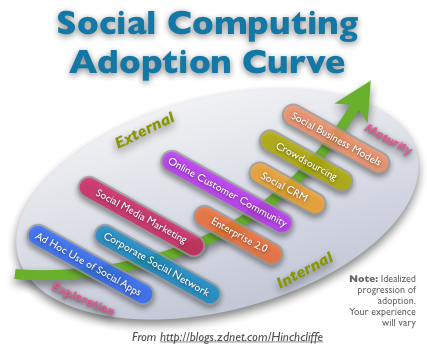
Sidebar: What is social computing? It's the use of social software within and between organizations and any interested parties such as employees, customers, and partners. Social computing, as explained here, can usher in significant large-scale shifts in where productive forces and innovation come from. Organizations will all adopt enterprise social computing tools in slightly different ways and will generally proceed from ad hoc usage, often by applying widely available consumer tools at first, to more evolved open business models. As of this year, about half of all large organizations now have social computing tools deployed in some manner.
The following is a summary of the issues I'm hearing from practitioners in the field as well as from our clients and industry contacts.
Ten top issues with social computing in business
- Lack of social media literacy amongst workers. Anecdotally, the farther a business is from the technology industry, the less likely that line workers will be familiar with the latest software innovations. Those who haven't been maintaining blogs, updating wiki sites, using social networks, sharing information socially, etc. will require more education than those who do. Even the basics of netiquette as well as key techniques to get the most from social computing platforms such as encouraging the building of links between data, tagging information, or establishing weak ties over the network are often poorly understood even by frequent users of social computing tools. In short, social computing requires some literacy efforts in most organizations to achieve effectiveness, just like personal computing skills did a few decades ago.
- A perception that social tools won't work well in a particular industry. There is often an assumption in many specialized industries -- such as medicine or manufacturing, just to cite two random examples -- that social tools won't be a good fit for their specific vertical; that they are unique in some way that makes social business models inappropriate or a non-starter in some way. While many enterprise Web 2.0 advances have spread rather unevenly in many industries -- with media and financial services often leading the way in early adoption -- more and more evidence is accumulating that social computing tools have use in most, if not all, industries. However, more than five years after social software became common in private life, it's still surprisingly common encounter a culture of resistance (though often to change in general, and not just enterprise social tools) in organizations that have fewer competitive pressures, are highly specialized, or are unusually late adopters of technology.
- Social software is still perceived as too risky to use for core business activities. There is still a broad sense with many that I talk to that social computing applications are more suitable for knowledge workers isolated from the mission critical functions of an organization or in more fungible areas such as marketing and advertising. There's a sense that social computing is not for operations or key business capabilities. This can be ascribed variously to concerns about unpredictability, loss of control, or worries of introducing potential distractions to activities that directly and immediately affect the conditions of the business, including the bottom line. Interestingly, in my analysis of case studies and discussions with implementers, this is the very place where social tools have the most impact when deployed, usually by improving decisions, making key data (or potential experts with the information you need) more accessible and discoverable, and so on. In fact, no case that I can find has emerged of social tools disrupting the workplace in any significant manner, and almost all reports, some of which are indeed integrating social tools into key business processes, are positive. This concern will likely persist for a while yet, pending the arrival of a preponderance of research and internal results belies it.
- Can't get enough senior executives engaged with social tools. I've been known to say that most senior executives in large organizations are often read-only users of their IT systems, whether it's Outlook, their Blackberry, or operational dashboards. Despite even the earliest Enterprise 2.0 case studies confirming that social tool adoption is greatly improved by an organization's top personnel leading by example, these are often the folks that have the least time to participate and little practical experience in doing so. (Note: Enterprise 2.0 is just part of the enterprise social computing spectrum, though a very important one.) It's something I'm beginning to hear often, and that is lack of engagement by senior executives in most social computing efforts, public or private. I'm personally torn by whether this is critical for success in the long term, since social computing is largely about tapping into the cognitive surpluses within an organization and across the network, but it certainly is a key factor in the short term by slowing the effectiveness of adoption internally.
- There is vapor lock between IT and the social computing initiative. The famous IT/business divide is often holding up social computing initiatives, often by months -- and in some cases for a year or more -- as IT tries to find (and sometimes build) social computing applications that meet requirements for internal software, architecture, security, and governance standards, while still exhibiting the latest best practices on the social computing side. That many of the best social computing applications come from newer, smaller firms that often don't focus on traditional enterprise requirements only exacerbates the issues. IT shops also tend to have limited understanding of the business side of social computing and try to shoehorn existing solutions on hand to solve business needs. While this isn't automatically a bad practice, the classic example of SharePoint and Enterprise 2.0 illustrates how this can often become a charged issue and hold up efforts while it is resolved.
- Need to prove ROI before there will be support for social software. This is a classic anti-pattern for enterprise software acquisition in general (and Enterprise 2.0 in particular), and while there are certainly twists that are unique to social computing, the ROI proof objection has increasingly fallen by wayside with the growing number of successful case studies.
- Security concerns are holding up pilot projects/adoption plans. Because social tools make many things that were normally private much more public -- including policies, procedures, critical methods, corporate data, and intellectual property -- many organizations would rather wait for best practices in dealing with this important issue to solidify before climbing very far up the social computing adoption curve. We've seen a surprisingly increase and friendly reception lately for tools that address security as well as governance with social computing tools. I'll explore some of these in an upcoming post.
- The needs around community management have come as a surprise. Social tools create participant audiences with a shared understanding and sense of community, as well as an internally guided direction. Without suitable management (help, support, guidance, moderation, administration, and planning) communities will (and should) eventually take on a life of their own, but perhaps without your involvement. Community management is the facility through which they stay connected to the organization and its goals/needs while satisfying their own internal requirements. The staffing skills, team sizes, techniques, and tools of community management for the full spectrum of enterprise social computing needs is still something that we're learning as an industry. This is also an emerging story that I'll be covering this year as social computing matures in more and more organizations.
- Difficulties sustaining external engagement. As I discussed last year in covering 12 best practices for online customer communities, many organizations have trouble engaging the broader world using their own social computing initiatives. They build communities but their target audiences often ends up preferring the ones they built for themselves, especially if they perceive too cynical an approach or one that is too narrow for their needs (focusing on just a product from one company instead of an entire vertical or niche). Creating thriving social computing environments is still as much an art as a science and while engagement can always be generated through expensive traditional marketing and PR channels, learning the emerging rules for social business can really help.
- Struggling to survive due to unexpected success. More and more frequently lately I'm coming across enterprise social computing stories that had considerable and unexpected early success. This led to attention and scrutiny from across the organization and a subsequent struggle to fund a fast growing venture amid internecine turf wars, battles over control, and the battles with competing efforts. With social computing a foreign way of doing business for many organizations, the rapid growth of new effort can spell disaster without careful oversight, planning, and expectation setting. Building a strong network of friendly and well-respected sponsors internally can help this issue in particular.
With a large number of organizations starting to explore some of the more advanced forms of social computing this year, this list is only the tip of the iceberg. As part of this and to learn from the social computing community as a whole about what challenges are being faced, I'd love to build a more complete view of what's taking place on the enterprise social computing landscape. Consequently, I'd like to ask that you please leave your additions to this list below in Talkback. I'll summarize them in a future post.
Please leave your enterprise social computing adoption issues below. I will try to respond to all comments and questions as well.