ie8 fix
madison

The enterprise implications of Google Wave

By | May 30, 2009, 3:21pm PDT

Summary: Google announced their forthcoming service known as Wave this week to widespread coverage in both the press and blogosphere. Created by many of the same team members that created the highly successful Google Maps, the preview of the service itself on Thursday was quite compelling, resulting in a rare standing ovation at a tech conference according to ZDNet’s own Sam Diaz. Its egalitarian and federation-friendly design is intended to create an entire open ecosystem for communication and collaboration that Google is not-so-modestly touting as the reinvention of digital interaction circa 2009.

Google has launched many communication services since its inception yet none of these have had such obvious business utility or attempted to reinvent the collaborative process from the ground-up.Google announced their forthcoming service known as Wave this week to widespread coverage in both the press and blogosphere.

Created by many of the same team members that developed the highly successful Google Maps, the preview of the service itself on Thursday was quite compelling, resulting in a rare standing ovation at a tech conference according to ZDNet’s own Sam Diaz. Its egalitarian and federation-friendly design is intended to create an entire open ecosystem for communication and collaboration that Google is not-so-modestly touting as the reinvention of digital interaction circa 2009.

This is clearly a tall order, but the Internet leader provides plenty of substance to back up this vision despite growing evidence that individual companies may be losing the capacity to drive the agenda for the world when it comes to establishing successful new Internet standards and technologies. While the ultimate destiny of Wave itself is far from clear, it’s both intriguing and open enough that it will likely emerge on the radar of businesses large and small when it becomes widely available later in the year.
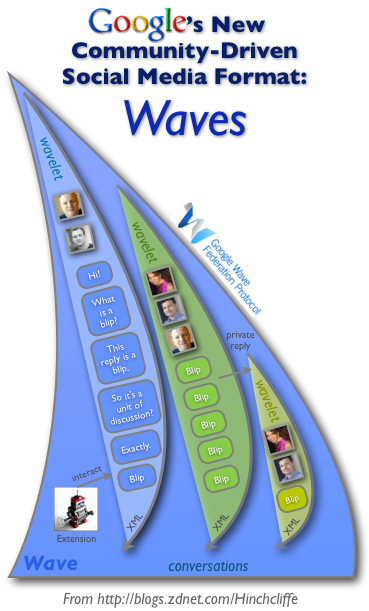
Google Wave

Wave’s relevance to the enterprise might seem premature with so many of the early and current Web 2.0 applications (blogs, wikis, social networks, Twitter-style social messaging, mashups, etc.) still — often arduously — making their way into the workplace years after their inception. Though we seem to finally be hitting a tipping point with 2.0 tools at work, Wave itself seems credible enough to get on our watchlists, at least to understand the implications.

The real question is whether there are really such significant gaps in the current state of Web-based communication that we need something new like Wave. With Google’s tendency to emphasize the consumer world first and the enterprise later, it’s also valid to ask if Wave will really have much impact on businesses. Interestingly, you might be surprised at some of the answers, so let’s take a look.

Wave: A communication and collaboration mashup

Google Wave itself consists of a dynamic mix of conversation models and highly interactive document creation via the browser. Using simple, open Web technologies (Google makes much of the fact that most of Google Wave is a open set of formats and architectures that is jointly developed with the Web community) Wave combines many of the key features of e-mail, instant messaging, media sharing, and social networking into a seamless experience and data set that are eponymously known as waves. All of this is opened up to developers via the Google Wave API.

The demonstration at the introduction of Google Wave (link below) showed how users can interact in real-time, collaboratively creating structured conversations that contain rich media, instant notifications, simultaneous user editing of the conversation, and live integration with server-side resources such as spell-checking and language translation. Most interestingly, while waves are relatively self-contained and use their own types of servers and data formats, they are easy to embed elsewhere or to build extensions for, enabling virtually infinite options for distribution over the Web or within the firewall, as well as rapid integration with existing applications and data. In fact, a wave is almost a form of social glue between people and the information they care about. And as we’ll see, this has implications for the enterprise world, not only with SOA but also with social communication in general as well as Enterprise 2.0 specifically.

See Waves in action: Watch the introduction keynote at Google I/O on Thursday.

What Google has done with the Wave protocol is essentially create a new kind of social media format that is distinctively different from blogs, wikis, activity streams, RSS, or most familiar online communication models except possibly IM. Both blogs and wikis were created in the era of page-oriented Web applications and haven’t changed much since. In contrast, Google Wave is designed for real-time participation and editing of shared conversations and documents and is more akin to the simultaneous multiuser experience of Google Docs than with traditional blogs and wiki editing. Though Google is sometimes criticized for missing the social aspect of the Web, that is patently not the case with waves, which are fundamentally social in nature. Participants can be added in real-time, new conversations forked off (via private replies), social media sharing is assumed to be the norm, and connection with a user’s contextual server-side data is also a core feature including location, search, and more.

The result is stored in a persistent document known as a wave, access to which can be embedded anywhere that HTML can be embedded, whether that’s a Web page or an enterprise portal. Users can then discover and interact with the wave, joining the conversation, adding more information, etc. Google has also leveraged its investments in Google Gadgets and OpenSocial, two key technologies for spreading online services beyond the original boundaries of the sites they came from. All in all, Google Wave is a smart and well-constructed bundle of collaborative capabilities with many of the modern sensibilities we’ve come to expect in the Web 2.0 era including an acutely social nature, rapid interaction, and community-based technology.

As the original announcement post explained, to fully understand Google Wave, one should appreciate the separation of concerns between the product Google is offering and the protocols and technologies behind it, which are open to the Web community:

Google Wave has three layers: the product, the platform, and the protocol:

  • The Google Wave product (available as a developer preview) is the web application people will use to access and edit waves. It’s an HTML 5 app, built on Google Web Toolkit. It includes a rich text editor and other functions like desktop drag-and-drop (which, for example, lets you drag a set of photos right into a wave).
  • Google Wave can also be considered a platform with a rich set of open APIs that allow developers to embed waves in other web services, and to build new extensions that work inside waves.
  • The Google Wave protocol is the underlying format for storing and the means of sharing waves, and includes the “live” concurrency control, which allows edits to be reflected instantly across users and services. The protocol is designed for open federation, such that anyone’s Wave services can interoperate with each other and with the Google Wave service. To encourage adoption of the protocol, we intend to open source the code behind Google Wave.

The key here is that Google is expecting many more front-ends for creating and editing waves, depending on the individual requirements of various entities. Google Wave is their own front-end application for doing so and using HTML 5 in their wave client shows they are planning more for the future than present.

An enterprise perspective of Google Wave

But Google’s point is well taken: The hodge podge of 1990s era (and often older, in the case of e-mail) Internet communication methods were created in another time. Blogs, wikis, IM, and so on are all useful modes of communication but there are better ways and new requirements in today’s high social, interactive, and highly integrated times. That’s not to say that many companies haven’t tried to do this already, but virtually none of them have the ability to drive the modern development community or use their existing online market share to foster adoption in the end-user marketplace like Google does. In the end, barring a major misstep from Google, chances are good that organizations will have to deal with business data in the Wave Protocol format in the future.

Using Google Wave in the Enterprise

Let’s take a closer look at what enterprises need to know about Google Wave:

  • Google Wave largely complements and doesn’t replace existing communication and collaborative applications. Google Wave creates a healthy synthesis of existing application types by providing integration across channels already in place. The early demos in fact showed how Twitter and existing social networks can play very well with Google Wave, enhancing the experience and allowing broader participation in a wave through other applications. Google Wave won’t (necessarily) replace existing apps like e-mail, IM, blogs, or wikis, and can actually make the latter two stronger through embedding. Groupware and other simultaneously collaborative apps, however, are more at risk of displacement.
  • Enterprise 2.0 is well supported by Google Wave. The general capabilities of FLATNESSES, my mnemonic for all the things that a capable Enterprise 2.0 platform should do, is well embodied in Google Wave. While blogs and wikis are the fundamental Enterprise 2.0 platforms, the basic capabilities of social interaction, emergence, and freeformedness are all there, though a wave presupposes a bit more structure and situated use than the more tabula rasa blog or wiki.
  • New protocols, servers, data formats, and client applications are required to use wave. Unfortunately, Google Wave brings a lot of baggage with it, though it’s mostly straightforward. You will require new software, though not on the client since that all runs in a zero-footprint browser client. This means more integration code, management, and monitoring. The best news is that everything is well-documented, open, and any organization can participate in directing the wave community, so lock-in, while always possible, seems largely avoidable and Google takes great pains to draw us to that conclusion. Google is also pushing hard for alternative implementations of the client and server components, including on-premise implementations, with the former on display at their announcement.
  • Waves are a natural integration point for many enterprise services including ECM, SOA, mashups, and more. By defining a strong protocol for continuous server-side processing of live conversations, Google has enabled an entire world where our IT systems are connected to the work we do every day. Literally while participants are busy typing and collaborating, a wave can be receiving support from back-end systems such as HRM, CRM, ERP, and so on to provide data, context, and other just-in-time support. Many businesses could benefit enormously from seamless business data integration such as customers, orders, and so on, never mind the deeper possibilities of contextual business processes leveraged directly in the collaborative activities of workers. I’ve written many times about the convergence of our IT systems and Web 2.0, and this seams one of the more natural environments for it that I’ve seen in a while.
  • Embedding and extensions will enable widespread distribution and consumption of waves. Google brings ease-of-development for creating server-side extension as well as simple models for user-distribution of waves. While the first will enable easy integration with local data sources and will create a large aftermarket for useful extensions such as the aforementioned language translation capabilities, the second will virtually ensure that enterprises will have interaction with waves one way or another. Since the premise of the product is also one of the dominant activities in the business world (enabling teamwork) and combined with the increasing consumerization of the workplace, it’s highly likely that organizations will encounter waves in their work with external entities, especially with partners and clients. At the very least, organizations will need to understand how waves will make their organizations even more porous on the Internet, and have policies about participating in them, just like SaaS services, social networks, and other external applications. Security will also be an issue with waves though things like integration of Web 2.0 tools and ECM will actually be easier than ever before since a corporate archive robot could ensure every wave conversation is backed up in the formal ECM system.

Google has launched many communication services since its inception including Gmail, Gtalk, Blogger to name just three, yet none of these have had such obvious business utility or attempted to reinvent the collaborative process from the ground-up. While it’s always possible that Google Wave will never broadly take off (see Mary Jo Foley’s analysis of Wave here), I’m betting that it’s likely to be one of the most interesting offerings to businesses that the company has created yet. With the open positioning, early outreach to the world, and the clarity of purpose and design, Google Wave has a good shot at helping take Enterprise 2.0 to the next level in many organizations.

It’s much too soon to really decide anything about Google Wave yet, but are you putting it on your watch list? Put your comments in Talkback below.

Kick off your day with ZDNet's daily e-mail newsletter. It's the freshest tech news and opinion, served hot. Get it.

Topics

Dion Hinchcliffe is an expert in information technology, business strategy, and next-generation enterprises.

Disclosure

Dion Hinchcliffe

Hinchcliffe & Company's Current Clients:

AIIM
AOL
Alcatel-Lucent
Best Buy
CBS
JackBe
ING
Intuit
Microsoft
Nexplore
Qualcomm
T. Rowe Price
Techweb
The World Bank
1105 Media
Reply Italy

Hinchcliffe & Company's Current Strategic Partners:

Asuret
O'Reilly Media
LG CNS
LMI
Social Computing Journal
Socialtext
Twiki

Hinchcliffe & Company's Past Clients:

Accenture
2BeWise
4Sports LLC
Gucci
IBM
Incubeta
Kapow Technologies
Mansueto Digital
Near-Time
nGenera
Swisscom
Sys-Con
Viscape

Biography

Dion Hinchcliffe

Dion Hinchcliffe is an expert in information technology, business strategy, and next-generation enterprises. He is currently Executive Vice President of Strategy at Dachis Group. A veteran of enterprise IT, Dion has been working for two decades with leading-edge methods to bridge the widening gap between business and technology. He has extensive practical experience with enterprise technologies and he consults, advises, and writes prolifically on social business, IT, and enterprise architecture. Dion still works in the trenches with clients in the Fortune 1000, government, and Internet startup community. He is also a sought-after keynote speaker and is co-author of several books on 2.0 subjects including Web 2.0 Architectures from O'Reilly as well as the upcoming Social Business By Design (due Spring, 2012.)

Related Discussions on TechRepublic

Did you know you can take part in these discussions with your ZDNet membership?
45
Comments

Join the conversation!

Just In

RE: The enterprise implications of Google Wave
seocu 28th Aug
a joint ownership might be best, so that all participants have equal rights to share it, like an email conversation right now. Hava Perdeleri
Hava Perdesi Fiyatlari
Hava PerdesiThat might mean that all end up with a cached copy on their service, in case the person that started the wave deletes his copy. But, you need one master storage location so you can interact in real-time.
0 Votes
+ -
Waves will also be used as mashups
DirkRoehrborn 30th May 2009
Thanks for this detailed analysis, Dion! I would like to add another arrow to your chart. In my opinion, one important application of waves will be mashups. Waves will use gadgets that integrate information, messages and features from business application just like portlets in todays portals. This will help to bring business apps right to the users "inbox".
Like a simple documentation project. You start the wave, add the people like tech writer, sales, engineer, etc, with the combined knowledge necessary.There are discussion threads that are not part of the final documentation. You have a number of go-arounds, and finally get the content how you like it. The tech writer does a final clean up, a graphical artist adds logos, etc, and it is then linked to off of the website. Now that it is live on the website, with any edits, you use a working copy, and only re-publish when you are finished. Simple corrections could go live right away.
0 Votes
+ -
Because.
magallanes 1st Jun 2009
you don't want to customer(users) uses two separates system, you don't want to train twice and you don't want double the work of the system administrator.
mashups can be fine for some specific projects, otherwise it can become a mess.
0 Votes
+ -
@magallanes

Hi Dion, I've just re-read this article and agree with the 8 core patterns - have things changed since 2006? araba oyunlari
  • Flagged
0 Votes
+ -
How about workflows
prof123 1st Jun 2009
A wave can be used as a workflow where different people
perform tasks and update the status. The video shows
that you can use forms in a wave so this will have many
uses.... Simple and ingenious.
0 Votes
+ -
There is more than meets the eye. http://www.corvalius.com/blog/?p=40
problems are EXTREMELY complicated!!! Google needs to open source it ASAP and let all of the big brains in the world help to make it better. I can imagine an explosion of university research based on this.

Wave could turn into a platform to create all kinds of different collaborative applications.

They need some kind an Apache modules approach (dynamically loading shared objects) to allow adding the syncing of different file types, or whatever way that makes sense for functionality to be added.
@DonnieBoy you don't want to customer(users) uses two separates system, you don't want to train twice and you don't want double the work of the system administrator.
mashups can be fin orjin kreme for some specific projects, otherwise it can become a mess.
  • Flagged
0 Votes
+ -
What the . . . .
CobraA1 30th May 2009
"despite growing evidence that individual companies may be losing the capacity to drive the agenda for the world when it comes to establishing successful new Internet standards and technologies."

What in the world does this mean? Who else is there to create the standards and technologies?
0 Votes
+ -
Clear to me, read it again. (nt)
Economister 30th May 2009
nt
If you open source the base code, open all protocols, and involve a large swath of companies and organizations, release control, and it is compelling, you will have a good shot, otherwise, NO.
0 Votes
+ -
Not so clear
CobraA1 31st May 2009
"If you open source the base code, open all protocols, and involve a large swath of companies and organizations, release control, and it is compelling, you will have a good shot, otherwise, NO."

I wouldn't say it's quite so clear cut. Even with all of this open source stuff, there's still often a large business behind it.

Sometimes it's proprietary software running on open protocols and file formats. After all, protocols and file formats don't say that you have to use open source software to use them, even if the protocol or file format is open.

Sometimes even something totally open is a big business - after all, there is a Red Hat Inc behind Red Hat!

Also, a lot of protocols, even if open, have a lot of proprietary backing. Go through the W3C membership list - a lot of companies that develop proprietary software are behind the open formats we enjoy on the Internet. Including Microsoft!

So - the end of businesses having a say in formats and protocols? Nah.
open source is by no means a requirement, but, an royalty free standard that all con implement is. It is just that an open source implementation really greases the skids and makes it easy for anyone to rapidly create an implementation, including smaller players.
0 Votes
+ -
this is what i see.....
bluh bluh wave server bluh bluh what do you think bluh bluh, what are waves?
0 Votes
+ -
Pros & Cons
linuser 30th May 2009
Waves REALLY looks promising!

Perhaps it exists already but, if not, it might be useful to see a comparision (pros/cons) between the current communication model & the Wave communication model.
0 Votes
+ -
Biggest cons may be security and privacy. Doesn't look like it has much in terms of security or privacy.
should assume anything you write could become public one day.
0 Votes
+ -
Not an excuse.
CobraA1 31st May 2009
Not an excuse. It's a newer technology - it should have the latest and best in security and privacy.
0 Votes
+ -
never take off?
CobraA1 30th May 2009
"While it?s always possible that Google Wave will never broadly take off (see Mary Jo Foley?s analysis of Wave here)"

I think you're jumping the gun a bit here, and kinda misrepresenting what she said. It was sorta a partial criticism of Google acting a bit like Microsoft.

Which means, frankly, that it has a good chance of taking off. Whether you like them or hate them because of their actions, the truth is that what Microsoft does works. Microsoft succeeded.

So just because you may not like Microsoft's actions doesn't mean that what they did was ineffective, okay? Google actually has a good chance with this, and just because you may see their actions as being a bit "too much like Microsoft" doesn't mean that what they are doing is going to be ineffective.

. . . and now that I read it, I'm wondering if Mary Jo really said anything to the effect of what you are implying. Where did she say at all that this might not take off?
0 Votes
+ -
I don't quite agree...
storm14k 31st May 2009
While I agree that he may be jumping the gun on what Foley said on her blog....MS stuff does not take off anymore. They certainly haven't done anything recently that has taken off like say Android or the way Wave most likely will. I think MS had its hay day with Windows Office and Exchange. Quite honestly Wave appears to be a threat not only to Exchange but Office as well.
0 Votes
+ -
Android and predictions
CobraA1 31st May 2009
Android? That has taken off among geeks, but I think the biggest takeoff has been the iPhone among regular consumers.

Of course, neither is Microsoft.

So - the question is, can Microsoft make something that takes off?

Sure.

Coming up with a new product that everybody uses is hard to do and extremely difficult to predict. Both Microsoft and Google are trying new things, and it's anybody's guess what will happen.

BUT - it's not as if Microsoft is a failing company. They're still doing very well. What they do works.

Frankly, the new invention market is about as unpredictable as it gets. Nintendo, which people dismissed out of hand after the GameCube didn't do so well, pulled off a huge surprise with the Wii.

Anything's possible, frankly. The general public has proven to be nowhere near as predictable as we tend to think it is.
0 Votes
+ -
Evidently...
MikeyTheUnderdog 1st Jun 2009
You've never heard of a little product called SharePoint! However, Wave looks to have the potential to threaten it too.
0 Votes
+ -
I just feel unsafe to use all products (web) from one company. I'd rather spare my information in stead of integrating it.
0 Votes
+ -
The products one be from one company.
storm14k 31st May 2009
Their product is actually an open protocol that anyone can implement. There will be multiple vendors of Wave servers. Thats really the reason it stands to take off. Everyone will want their chance to be the leader in services and servers on this new protocol. Its like having the chance to be in on the ground floor of something as big as search or email all over again.
There is a standard protocol, and anybody can make their own wave server or wave client.

I am hoping that Google will go farther than releasing the protocol, and will also open source the wave server, so that all providers can get wave servers up and running quickly, even small ISPs should be able to play. And, of course large companies will want to have their own wave server and retain control. I would like to see the server turned over to Apache (if they are willing).

Of course we also need an open source wave client.
0 Votes
+ -
Who owns the wave?
doehlman 31st May 2009
Just finished writing a similar article myself on my blog. I was primarily focused on how corporates would feel about the single shared communication and collaboration object.

http://conceptualadvantage.com/as-seen-on-the-web/google-wave-who-owns-the-wave/

Whilst, I think corporates will be nervous about it, the security implications of wave are probably less nerve wracking than the situation with email right now...
owner, and it is hosted on his service. But, corporations will probably want to add a legal statement to the Wave saying that they own it and it can not be distributed without permission, no copying allowed. Maybe similar to the legal statement many now add to the bottom of all emails.

For personal waves, a joint ownership might be best, so that all participants have equal rights to share it, like an email conversation right now. That might mean that all end up with a cached copy on their service, in case the person that started the wave deletes his copy. But, you need one master storage location so you can interact in real-time. Other copies would be read only and sync with the master. Of course if you wanted to fork, you could take your read-only copy and make it a live wave with new participants.

All very interesting . . . .
not connected, and then have them synched when we are connected again. This can also be used to speed access when you have a slow or flaky connection. It would also reduce the bandwidth requirements from the server. It would also allow you to make major changes and only sync them when you are ready.

Corporations may want to turn this feature off so that there are no extra copies that live on local hard drives outside of their control.
0 Votes
+ -
This is going to change higher education as we know it -- not just for online instruction!

Mark my words.
0 Votes
+ -
Excellent overview article, as usual, Dion. In my view, Wave is a welcome and giant step towards full multimedia application convergence. This will enable organizations to become far more digital and it will make several existing applications moot. Convergence under Wave will enable major leveraging of digital value propositions in any networked entity. And imagine what kinds of plug-ins the developers are going to create. The mind boggles in eager anticipation. Thanks again! Frank Feather
0 Votes
+ -
I have just read the entire article and have not got the vagest idea what this thing is or how or where it may be useful!
0 Votes
+ -
we need more protocols!
magallanes Updated - 1st Jun 2009
yay for add more over complex the now flooded world of protocols and paradigms.

Anyways, Wave looks like a half-baked CMS with some shareable service (wow!), why doesn't google develop a full cms?.


The printing press amplified and extended the
communication of ideas across space and time.

Google-Wave turns communication into a living,
evolving, organic system of actionable
community consciousness. Google Wave
implements a very simple metaphor with very
excess-able methods that anyone can easily
master.

This will enable an open ended, scalable, neural
net buildout of nested, participatory, organic
community nodes(INTERCONNECTED WAVES)
that are both collaborative and actionable. This
is a historic quantum leap for human social
organization through non-linear, actionable,
collaborative communication. It is the first
practical tool on which we can build the
foundations for living, evolving, organic groups,
organizations, communities, and democracies.

James G. Miller and Marshall McLuhan are
dancing on the head of a pin over this one ! And
to Douglas R. Hofstadter. Your tool kit for
building STRANGE LOOPS into social debate and
evolution has just arrived. Kevin Kelly take note!

To the corporate enterprise! Zoom out.... Zoom
way out! This is not about your continued
dominance over social capital and production
systems. This is a tool that tilts power back
towards the center where you will be forced to
partner with consumers, the citizenry, your work
force and your suppliers. This new business
model will reward enterprises willing to participate in a network of sutainable OPTIMAL
PROFITS for all stockholders. WAVES will simply
amplify the power of groups who cannot muster
the power of corporate financing to focus their
collective tour de force.

THIS IS A HUGE HISTORICAL MARKER MUCH
BIGGER THAN THE PRINTING PRESS! GOOGLE-
WAVE MAY SEEM SIMPLE FROM A SURFACE VIEW
BUT IT IS THE EASE WITH WHICH THE AVERAGE
PERSON WILL BE ABLE TO EXECUTE INFINITELY
NESTED AND RECOMBINANT COLLABORATION
THROUGH TRANSPARENT, NON LINEAR,
ORGANICALLY EVOLVING, COMMUNICATION
TECHNIQUES THAT IS SO GROUND BREAKING!
THIS WILL EMPOWER AN INTEGRATIVE
TRANSFORMATION OF COLLECTIVE SOCIAL
CIRCUMSTANCE, EXPERIENCE AND PROBLEM-
SOVING-IMAGINATION INTO COLLABORATIVELY
ACTIONABLE SOCIAL SOLUTIONS. IT EMPOWERS
organic social structures!
0 Votes
+ -
UI Experts required
pico_D 2nd Jun 2009
I watched the keynote and, whilst it incorporates some very interesting ideas, the user interface is appauling!

It is noisy, confusing and overly complex. Whilst it might offer a good set of building blocks, the current interface really needs the help of a GUI design team, if it is to get wider acceptance.

It needs to get more information across with less noise.
0 Votes
+ -
Thinking of Wave in terms of "replacing" such as GMAIL (or even email, itself) is just silly. Not every Internet communication needs to be (or even should be) as would be in Wave. Traditional email, at the very least, should (and likely will) never go away. Of this, I think there should be little fear or doubt.

Now, that doesn't mean there won't be a place -- and a potent one, indeed -- in our lives for such as Wave and its ineluctable variants. It, too, will be useful, under the right circumstances. In fact, from my admittedly only-cursory analysis of it to date, I'm thinking that what actually MAY be "replaced" by Wave, as a practical matter, is traditional "chat," as we now know it (though traditional chat, mark my words, will continue to be around for years and years, too, no matter how good Wave ultimately gets).

Regardless, one thing about which we should all be clear in our minds is that we're not talking about the mere replacing of anything, here. Wave, for better or worse, seems very nearly of the nature of paradigm shift... and far be it from me to suggest that that's, necessarily, a bad thing, here.

It does, however, come with pitfalls about which we should all be watchful, if not actually downright concerned. For example, though it's now coming out in articles (and/or rebuttals to such as I am posting here) that it's likely to be user-configurable, initial writings about Wave touted the ability (and represented it as essential to Wave's very way of operating) of all persons in a "wave" (or a thread) to be able to see, in real time, all others' keystrokes, as they type.

Let me repeat the salient words of that, here: AS. THEY. TYPE.

Think about that, please, for just a moment. It's a far larger problem than, perhaps, it initially seems. Like how sausage is made (or, as some joke, like how laws are passed), some things in life may better be left something of a mystery to those who ultimately consume (or are regulated by) them; and, most importantly, solely at the creator's option.

The ultimate impact and meaning to the reader of anything written would be inordinately influenced by said reader's having been a witness to its creation. If one is a thoughtful writer who doesn't just blurt out every wayward thing which flits through one's brain, then one is going to pause to think while one types, and back-up and delete and re-type, and whatever else behind-the-scenes activity goes into what ends-up being the finished written product. If the reader were able to witness what the writer merely paused before writing; or actually did write, but then thought better of and either removed or changed to something else, then the bell of what the reader saw along the way cannot be un-rung; and the reader's ultimate interpretation and understanding of the final written result will be indelibly affected in ways (even if not immediately obvious) more likely than not to be inherently bad for all concerned.

Now, if it's true, as some who challenge such as my assertions, here, are now saying, that the ability of others to view one's keystrokes as one makes them is (or at least will be) user-configurable in the version of Wave which is finally released to the end-user wild, then my concern, at least on this particular privacy-related point, is happily ameliorated.

However, of larger philosophical concern to me is that the creators of Wave apparently believed, even if only briefly, that something as basic as this issue would not be important. What, then (if anything), does that mean we should also be wary of in the realm of personal privacy protections, just generally, for users of this new and groundbreaking product? For what else should we be watching which may, ultimately, negatively impact us because of fundamental, and at least initially seemingly harmless, privacy encroachments...

...encroachments which may not even be recognizable as encroachments to Wave's creators because, perhaps, of their nationality and upbringing (nothing negative, mind you, intended by that wording, I assure).

One potentially troubling impact (at least from the standpoint of Americans, in my opinion) of globalization (which, incidentaly, I'm not fundamentally against, despite how what I'm about to write may make it seem) is how the sensibilities of those non-Americans who create things which all others on the planet end-up using can unintentionally contravene that which Americans hold perhaps nearer and dearer to their hearts than do non-American others. Those who grew up and still live in countries where such things as privacy and freedom of speech are not as absolute and paramount as in the US may or may not necessarily value such rights to the same degree as do Americans; and it sometimes shows in their work.

It has not escaped my notice that the two brothers -- brilliant though they are -- who created and continue to develop Wave were neither born and raised in, nor now live in, the US... and so I fear (and I may be completely wrong about this, I realize... but absent, at this point, any reason not to, I am nevertheless fearing that they) may not place as much of a premium on the notion of absolute privacy (if desired by the end-user of Wave) as do Americans.

Or, who knows, maybe they do. I don't know them, and it's unfair of me to presume, I suppose (or even to suppose, I presume). One way or the other, though, it should be at least a concern to all that the default behavior of Wave seems so inherently and joltingly privacy-denuding.

So, then, again, begged is the question: Of what else (if anything), in Wave, should we who hold inviolate our privacy be wary?

To appeal to (at least thinking) Americans, the makers of Wave need to take steps to ensure that if the end-user wants to protect his/her absolute privacy while using this admittedly exciting and paradigm-shifting new product, it can, via easy configuration settings, be satisfactorily and incontrovertibly achieved at all possible levels, and in all possible ways. Moreover, as it is developed, the makers of Wave might need to realize that they may, because of their nationality and upbringing, not necessarily even recognize what all of those levels and ways might be; and the Americans (or even the non-Americans who at least fully grasp the American viewpoint regarding all this) who work on the development of Wave should ensure that no privacy holes such as I'm discussing here remain anywhere in it when it's finally and fully released into the end-user wild.

Or so it is my opinion... my two cents worth, as it were...

...which my ex-wife, for example, among others, has been known to quickly attest tends to be about all it's usually worth.


__________________________
Gregg L. DesElms
Napa, California
gregg[at]greggdeselms.com
0 Votes
+ -
Enterprise deployment success factors
amitks@... 3rd Jun 2009
The easy of collaboration is a very compelling
argument for Enterprises to adopt Wave.

It will certainly be required to administer the
deployment since Enterprises may not want the system
to be open for external collaboration for obvious
copyright issues. Therefore administration and support
would be very critical.

Integration with existing technologies like existing
email servers and exchanges would help enterprises to
migrate or adopt waves in phased manner.

-Amit

0 Votes
+ -
At ActionBase (www.actionbase.com), we have a conversational, collaborative, process environment built on email and documents (currently Outlook and Microsoft Office) that has been deployed at over 100 companies worldwide. It has a lot in common with Google Wave, but in an enterprise environment rather than web 2.0 world.
One thing that we have learned is that security and access control, ownership of the conversation and audit trails, access to behind the firewall document repositories and business intelligence capapbilities are very important enterprise features- most of which are currently missing from Google Wave.
0 Votes
+ -
reply...
adinas Updated - 2nd Jul 2009
sorry, mistake
We, a group of fresh tech graduates and open source
enthusiasts from India, have just launched a forum for
Google Wave Community. Hereby requesting you and all
those who are reading this message to join us to look
for a better collaborative approach for Open Source
implementation of Google Wave.

Forum : www.GoogleWaveCommunity.com/forum
0 Votes
+ -
Please Think...
jessiethe3rd 22nd Jul 2009
It's important that people understand Google's intentions. They are a company and lofty goals don't come without a cost to you as an end user. Sometimes privacy is the currency for free software. Think about it.
Thanks for this article Dion and you are very correct in pointing out that Google has a strategy to emphasize the consumer world first and the enterprise later, and it?s also valid to ask if Wave will really have much impact on businesses, only time will tell but Colayer has been working on this new way of communication since 9 years as we think that email does not satisfy the needs of contextualized and collaborative communication.

Google wave as you said comes with a lot of baggage and it is trying to implement a lot of new and complex things like the wave protocol etc... Colayer on the other hand uses the existing standards like HTTP and DHTML. Colayer has the live streaming/synchronization i.e users can see what others are typing.

Google wave also makes the client heavy with XML. It looks really great on a fast internet
connection but I doubt if it work the same way on a slow internet connection as is the case in many developing countries.

To experience Colayer visit http://colayer.com and to read the similarities between Colayer and Google Wave visit http://colayer.com/PAGE_googlewave.
0 Votes
+ -
this site presented JS/Exploit-Packed.c.gen as captured by McAfee (trojan)
0 Votes
+ -
ev dekorasyon film izle
If you open source the base code, open all protocols, and involve a large swath of companies and organizations, release control, and it is compelling, you will have a good shot, otherwise, NO."

I wouldn't say it's quite so clear cut. Even with all of this open source stuff, there's still often a large business behind it.

Sometimes it's proprietary software running on open protocols and file formats. After all, protocols and file formats Hava Perdesidon't say that you have to use open source software to use them, even if the protocol or file format is open.
a joint ownership might be best, so that all participants have equal rights to share it, like an email conversation right now. Hava Perdeleri
Hava Perdesi Fiyatlari
Hava PerdesiThat might mean that all end up with a cached copy on their service, in case the person that started the wave deletes his copy. But, you need one master storage location so you can interact in real-time.

Join the conversation!

Formatting +
BB Codes - Note: HTML is not supported in forums
  • [b] Bold [/b]
  • [i] Italic [/i]
  • [u] Underline [/u]
  • [s] Strikethrough [/s]
  • [q] "Quote" [/q]
  • [ol][*] 1. Ordered List [/ol]
  • [ul][*] · Unordered List [/ul]
  • [pre] Preformat [/pre]
  • [quote] "Blockquote" [/quote]
ie8 fix
Click Here
ie8 fix
Click Here

The best of ZDNet, delivered

ZDNet Newsletters

Get the best of ZDNet delivered straight to your inbox

Facebook Activity

White Papers, Webcasts, & Resources
ie8 fix
Click Here
ie8 fix