The year of the shift to Enterprise 2.0

Traditional collaboration tools can create powerful, local information flows but little build-up of value over time.The latest data emerging on how enterprises are using Web 2.0 tools in the workplace this year is painting a picture of a sea change in the way those businesses conduct collaboration and communication amongst their workers, and to a lesser extent the rest of the world.
Intriguing new just-released reports now show that between a third and one half of businesses either already are or will be employing so-called Enterprise 2.0 tools in the workplace (blogs, wikis, and social networking/messaging) in 2009. The data also show that security concerns remain high, access is actually fairly low, compliance with mainstream enterprise data practices is poor, and some workers aren't planning to get anywhere near them.
The bottom line: The tools have arrived. How enterprise knowledge and is created and flows within our organizations is beginning to change dramatically.
In my recent post about the return on investment (ROI) of Enterprise 2.0, I cited the most recent widely available data as of mid-2008 saying approximately a third of businesses have the tools in place. However, we know have additional, more recent datapoints that shows both the latest adoption rates as well as some of the concerns that business have with use of the social tools inside and outside their organizations:
- Nearly one in two businesses will make use of Enterprise 2.0 software in 2009. According to a new report from Forrester, despite the novelty of the technologies (only 3 years old), the percentage penetration is very high, about half of all enterprises globally. Tellingly however, actual employee access to the said tools is fairly low and few enterprises are taking a "holistic" approach and are using them in a more targeted and/or fragmented manner.
- Business use of social networking has rough parity with personal use, while a quarter of people are not planning to use the tools at all. A broad new survey of over 6,000 respondents released yesterday by TMCnet and IntelliCom Analytics shows consistent business use of the social networking tools tools across organizations of all sizes and around the globe, ranging from 35% to almost half, depending on the demographic. The survey also found that company policies around social tools also remain far behind adoption, with less than half of all organizations having official policies on use. Also, some workers are determined to be disengaged, with about 25% reporting no plans to use social networks, period.
- Concerns about the security issues with social computing is high, around 80%. A new survey from Deloitte, also released yesterday, showed that Web 2.0 and social engineering security concerns are at an all-time high. Pretexting and phishing are now widely regarded as a serious threat to most organization's information security.
- At least 50 percent of organizations will use wikis as important work collaboration toos in 2009. This is a slightly older but new to me finding from a respected source, the Society for Information Management's Advanced Practices Council (APC). The report notes that "with over 75% of the global assets tied up in knowledge assets, having access to increased solutions to improve collaboration productivity is a key growth factor for organizations that want to improve their innovation capacity." The report itself is only available to members, but is summarized well here.
- Management of content types like SMS/text messages, blogs and wikis are largely off the corporate radar in 75% of organizations. The AIIM State of ECM Report for 2009 says this issue (lack of indexing and archiving of these vital information flows) is a major management risk. It's also a terrible and unnecessary loss for most organizations.
Proactive organizations: Avoid disruption while managing risk and accessing benefits
While the challenges of taking a business social are many and varied, one critical underlying issue that's become increasingly clear that businesses need to strike the right balance between the tools they now have for communication and collaboration. A major change has taken place in many organizations over the last year and so there is imbalance and uncertain about how to best use the resources at hand.
To be clear, social tools aren't the right answer for every collaborative business problem. But neither are traditional tools such as e-mail, in-person meetings, or phone calls. Using the right tool for the job while at the same time understanding that the Enterprise 2.0 tools change the very nature of the job is going to be essential for achieving good outcomes in virtually every organization.
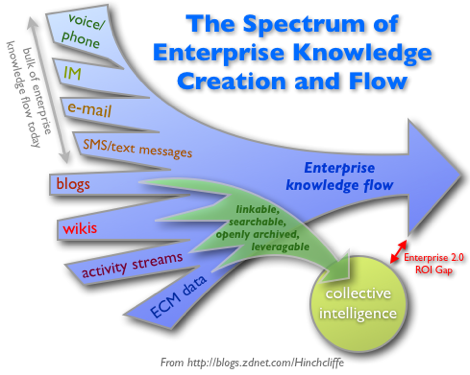
As depicted in the figure above, which lays out the spectrum of most enterprise knowledge creation and flow today, important new channels have been added to the corporate mix in recent years. Channels that are just starting to be used. Blogs, wikis, and activity streams (those event lists in apps like Facebook and Twitter that tell you what's happening in near real-time) in particular are changing how knowledge workers express themselves and work with each other. The intrinsic design of these tools creates much more of a usable, accessible information ecosystem than traditional tools. These traditional tools can create powerful, local information flows but little build-up of value over time or collective intelligence. In other words, the new social tools change enterprise knowledge flow by making it more social, more open and public, discoverable, and ultimately, the most leverageable.
Note: I somewhat reluctantly included ECM in this list since the latest crop of ECM tools are adding much of the emergent, freeform, and social aspect that makes Enterprise 2.0 apps so distinct, powerful, and engaging. Just be warned that most off-the-shelf ECM today is not going to enable Enterprise 2.0 outcomes.
So the latest data above shows that it's clear that Enterprise 2.0 has arrived for most of us. Now the question is what are going to do with it? We need some policies, we need some help for workers with literacy, and most of all, businesses need to offer clear guidance: When should social tools be used for getting work done and when should the older, traditional tools be used that keep information submerged and unusable by the rest of the organization. Hint: The create the most value for the organization (and themselves), workers should generally default to social tools unless the information is highly sensitive.
But the extremely rapid rise of the tools in private life gives us an indication of what's to come: Despite the powerful network effect of traditional communication tools, social tools have become highly disruptive to the status quo on the consumer world. This same type of disruption, while dampened by company policy and governance, is only starting to be felt in businesses today now that the tools are in place in most companies.
Wise organizations will manage to this, get out ahead of the curve, and direct it for their benefit.
How are you using social tools in your business? Or not using them? Why or why not? Put your comments in Talkback below.