Web 2.0 definition updated and Enterprise 2.0 emerges

The annual Web 2.0 Conference starts this Tuesday and with it comes an important update of the vision of the next generation of networked applications. Thus, the major event during the leadup to the conference is not the pending renaming of the conference to the Web 2.0 Summit, but the issuing of the most complete articulation yet of what exactly Web 2.0 is, something which the industry has frequently struggled with.
Written primarily by John Musser (of the terrific Programmable Web site) along with support from Tim O'Reilly and the O'Reilly Radar Team, the new 100 page report -- titled Web 2.0 Principles and Best Practices -- was published late last week and is available immediately. As most readers here know, O'Reilly Media originally introduced the term in 2004 and followed it up in 2005 with a widely read seminal five page essay that attempted to describe the successful design patterns and business models emerging on the Web today. This new report, probably not given as much fanfare as the original essay due to it being a commercial report, is a significant improvement on the original articulation of Web 2.0 in a number of ways.
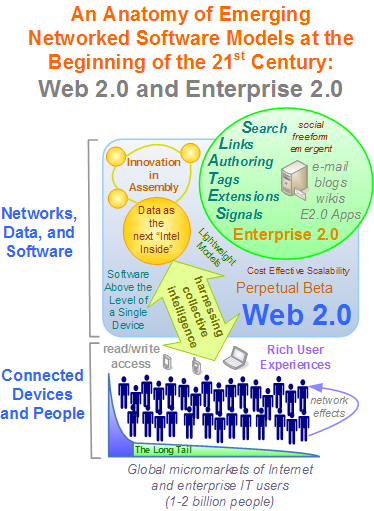
First, the report dives deep into the specific market drivers that are reshaping the Web by what the techniques that are seen to be working on the most successful Web sites today. These drivers include the 1+ billion connected Internet users, the mass proliferation of online devices, users that are fundamentally more engaged, the mashup ecosystem, and much more. And the report specifically quantifies all of these trends by introducing plenty of specific background documentation, something which earlier descriptions of Web 2.0 clearly lacked.
Second, the report explores and deconstructs five common myths about Web 2.0, something that often plagues people that are trying to earnestly apply Web 2.0 techniques to their own products and services. My favorite was the myth #3, "It's only about user participation" that goes into why user participation must drive actual downstream reuse or it fails to derive any real value or actually trigger network effects. The upshot is that misconceptions about Web 2.0 techniques abound (such as it's all about Ajax or that you must have a community) and these really helps address many of them.
Third, the report is notable in that it marks the continued ascendancy of Enterprise 2.0, which is the application of Web 2.0 technologies to workers using network software within an organization or business. Andrew McAfee has been instrumental in providing clear, clean explanation of Enterprise 2.0, and has introduced his "SLATES" mnemonic to help guide those creating or acquiring Enterprise 2.0 software.
SLATES describes the combined use of effective enterprise search and discovery, using links to connect information together into a meaningful information ecosystem using the model of the Web, providing low-barrier social tools for public authorship of enterprise content, tags to let users create emergent organizational structure, extensions to spontaneously provide intelligent content suggestions similar to Amazon's recommendation system, and signals to let users know when enterprise information they care about has been published or updated, such as when a corporate RSS feed of interest changes.
While SLATES forms the basic framework of Enterprise 2.0, it does not negate all of the higher level Web 2.0 design patterns and business models. And in this way, the new Web 2.0 report from O'Reilly is quite effective and diligent in interweaving the story of Web 2.0 with the specific aspects of Enterprise 2.0. It includes discussions of self-service IT, the long tail of enterprise IT demand, and many other consequences of the Web 2.0 era in the enterprise. The report also makes many sensible recommendations around starting small with pilot projects and measuring results, among a fairly long list.
And while much of the report is indeed only available for purchase (though a good excerpt is available here), the good news is that the ideas in the original 5 page essay have not changed significantly. In fact, it primarily delves into detailed exploration and specific recommendations on how to apply Web 2.0 to your products and services, which is something the industry is genuinely needs.
Finally, in the interests of public education, it's worth noting the eight core patterns of Web 2.0 listed in the report, and which I've tried to put meaningfully in the visualization above:
- Harnessing Collective Intelligence: Sometimes described as the core pattern of Web 2.0, this describes architectures of participation that embraces the effective use of network effects and feedback loops to create systems that get better the more that people use them.
- Data is the Next "Intel Inside": A phrase that captures the fact that information that information has become as important, or more important, than software, which has become relentlessly commoditized.
- Innovation in Assembly: The Web has become a massive source of small pieces of data and services, loosely joined, increasing the recombinant possibilities and unintended uses of systems and information.
- Rich User Experiences: The Web page has evolved to become far more than HTML markup and now embodies full software experiences that enable interaction and immersion in innovative new ways.
- Software Above the Level of a Single Device: Software like the horizontally federated blogosphere (hundreds of blog platforms and aggregators) or the vertically integrated iTunes (server farm + online store + iTunes client + iPods) are changing our software landscape.
- Perpetual Beta: Software releases are disappearing and continuous change is becoming the norm.
- Leveraging the Long Tail: The mass servicing of micromarkets cost effectively via the Web is one of the primary "killer business models" made possible by the Internet in its present form.
- Lightweight Software/Business Models and Cost Effective Scalability: Everything from Amazon's S3, to RSS, to Ruby on Rails are changing the economics of online software development fundamentally, providing new players powerful new weapons against established players and even entire industries.
And I'll be at the Web 2.0 Conference/Summit myself next week and will try diligently to have as much coverage as possible here. And while it's clear that Web 2.0 is very much in its early stages, I expect there's be plenty of interesting things to report. More here soon.
Most people will agree the Web has continued to evolve. What do you think the most important changes are?