BlackBerry Messenger 'used to perpetuate riots' in London

By | August 8, 2011, 11:11am PDT

Summary: London is besieged with rioters; a city under attack by its own people. Is the BlackBerry perpetuating violence?

LONDON — Riots and violence are spreading throughout the British capital: initiated by the killing of a man by armed police in Tottenham, north London, and perpetuated throughout the city by seeming discontent at the current government.

Having said that; frankly, nothing is quite clear.

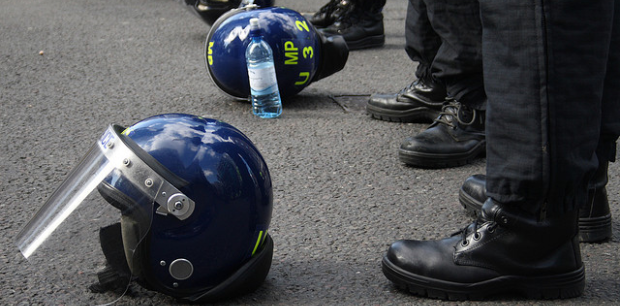
Burnt out police cars, London buses and buildings, the throwing of stones at police and widespread looting. London is under siege — by its own people.

Many have turned to social networking sites, like Twitter and Facebook, to vent raw emotion and to report the events currently ongoing. But the BlackBerry seems to be the weapon of choice for many — using in particular the BlackBerry Messenger service – predominantly used by younger people.


(Image via Flickr)

Just before the weekend, I suggested the younger generation should leave the BlackBerry behind; either forget it for the back to school season, or simply to ride out their contracts and find something new.

However, the encrypted and private nature of BlackBerry Messenger is being reported in the press today as one of the sole methods of sending secret messages to other BlackBerry users, in a bid to continue the violence on the streets of London.

One member of the public reported a short while ago on the BBC News channel: “There was a BlackBerry message going around, saying: ‘4 o’clock we’ll be meeting outside Lewisham train station’.”

According to Ofcom’s recent study, BlackBerry handsets are the most common for British teens — with 37% of teenagers aged 13-18 owning one.

PINs — the Personal Identification Number — isn’t just for your chip-and-pin credit or debit card. Used as a unique identifier for each BlackBerry device, PINs can be spread on other social media sites to connect with one another. It is like a phone number, except limited for the BlackBerry range.

Sending PIN messages is a secure and encrypted way of transporting text from one device to another — regardless of whether you are using the corporate BlackBerry Enterprise Server, often limited to enterprises and corporations.

Court-issued warrants could be used to access PIN and BlackBerry Messenger text if necessary, but as the riots progressed from Friday night onwards and continue today, law enforcement cannot keep up.

Having said that, the UK arm of Research in Motion is “stepping in” to help law enforcement wherever possible, the company said on its Twitter account.

Further to this statement, Patrick Spence, managing director of global sales and regional marketing at the BlackBerry maker, said:

“We feel for those impacted by this weekend’s riots in London. We have engaged with the authorities to assist in any way we can. As in all markets around the world where BlackBerry is available, we cooperate with local telecommunications operators, law enforcement and regulatory officials.

Similar to other technology providers in the UK we comply with The Regulation of Investigatory Powers Act and co-operate fully with the Home Office and UK police forces.”

BlackBerry Messenger has, for quite some time, been a replacement for text messaging. Acting in an all but exact way, users are able to send mass messages to their contacts through “broadcasting” — allowing influential users to organise events, send out party invitations — or in this case, a meeting place to commit acts of violence.

Because of the complexity of current events and the long history that precedes events running up to Friday, it is impossible to know whether BlackBerry Messenger really is being used as a conduit for lawlessness and disorder.

Research in Motion UK’s indication, however, does seem to point in that direction.

Related content:

Kick off your day with ZDNet's daily e-mail newsletter. It's the freshest tech news and opinion, served hot. Get it.

Topics

Zack Whittaker, a criminologist who studied at the University of Kent, Canterbury, is a journalist, writer and broadcaster.

Disclosure

Zack Whittaker

I worked briefly with Microsoft UK in 2006 but no longer have any connection with the company. Regardless, I remain impartial and unbiased in my views.

I don't hold any stock or shares, investments or industrial secrets in any company, but have signed confidentiality agreements with a number of UK and U.S. organisations, whose names I am not at liberty to disclose.

I was involved with Kent Union, the University of Kent's student union, undertaking voluntary, non-salaried, elected positions between early 2009 and mid-2010.

No other company, body, government department, non-governmental organisation or third sector organisation employs me or pays me a salary in any capacity whatsoever.

As a freelance journalist, whenever expenses are given and taken by a company that is not CBS Interactive, these will be disclosed in each relevant post to ensure transparency.

I currently work with a UK law enforcement unit, but this is an entirely separate position which bears no connection to other work.

(Updated: 23rd October 2011)

Biography

Zack Whittaker

Zack Whittaker, criminologist who studied at the University of Kent, UK, is a journalist, writer and broadcaster.

After studying criminology at university, though still in his early-20's, he has already had a series unconventional work and voluntary positions. He has worked with researchers studying neurological illnesses like Tourette's syndrome (which he suffers from), has given lectures on the nature of disabilities in the public community, and occasionally ends up speaking on television and radio discussing the events of the day.

He first had academic work published at the age of 22, then still an undergraduate, and has been cited by a wide range of publications: from the Huffington Post, Business Insider, AllThingsDigital, The Atlantic Wire and CBS News.

Talkback Most Recent of 13 Talkback(s)

  • ZDNet Gravatar
    Pandorum
    8th Aug
  • RE: BlackBerry Messenger 'used to perpetuate riots' in London
    @Pandorum
    I assume he's being paid by a pr firm. This article is pointless
    ZDNet Gravatar
    KenoshaSysAdmin
    8th Aug
  • ZDNet Blogger

    RE: BlackBerry Messenger 'used to perpetuate riots' in London
    @KenoshaSysAdmin I appreciate the comments -- if you take a look at Techmeme, you can see how others have reported this, too.

    w w w.techmeme.com/110808/p11#a110808p11
    ZDNet Gravatar
    zwhittaker
    8th Aug
  • RE: BlackBerry Messenger 'used to perpetuate riots' in London
    Funny how the "authorities" made hero's of the "Arab spring" social network users, but make villains out of domestic users, all the while ignoring the root cause of the problems! Looks like a double standard to me!
    ZDNet Gravatar
    kd5auq
    9th Aug
  • ZDNet Gravatar
    sagec
    8th Aug
  • ZDNet Gravatar
    deaf_e_kate
    10th Aug
  • ZDNet Gravatar
    otaddy
    8th Aug
  • Communication used to perpetuate riots in London.
    If 37% have blackberries, the other 63% have a different phone or no phone.

    If the iPhone were more popular, would you be blaming facetime and iChat? If Android was the market leader, which IM would be at fault?

    Free hint for all the "Journalists" (bloggers, influential tweeters, etc included):

    Communication is how we came out of the trees and formed societies. Communication was necessary for us to organize into towns and cites. The individuals that require communication will use the available methods.

    The decision to try and slant this as a fault against the blackberry is horrendously misplaced and smacks of widespread bias in the media.
    ZDNet Gravatar
    rtk
    8th Aug
  • ZDNet Gravatar
    tonymcs@...
    9th Aug
  • No, I don't believe so...
    Remember the LA riots after the Rodney King hearing in mid 90's?

    No-one had instant, handheld communication then. It was a matter of enough people pissed off to get out and the street do damage.

    I would say it's a non-factor; not just BBM, but Facebook, Twitter, iChat and the like.

    If people are going to get out and be destructive (losing a hockey game for God's sake!), they're going to do regardless of how they communicate.

    People that aren't prone to idiotic acts of violence or aggression won't take part, whether they get a message on FB or BBM.

    Either way, Godspeed and Mind how you go
    ZDNet Gravatar
    UrNotPayingAttention
    8th Aug
  • ZDNet Gravatar
    dwb124
    9th Aug
  • awsome
    Zack, you have not taken your article where you could have... Let's not forget the millions of Blackberry users around the world, businesses and governments - they are as evil as those teenagers from London. We should do something about this, don't you think???
    ZDNet Gravatar
    hcosma@...
    8th Aug
  • RE: BlackBerry Messenger 'used to perpetuate riots' in London
    So it's ok for Twitter to continue open despite Iran rioters / protesters using it to coordinate, but not ok for Blackberry to let UK rioters to coordinate?

    Isn't this all about why people are pissed off so much both in Iran and UK and not about what social media services they are using?

    Telephones, personal messengers, mails can also be used for such purposes. Do we need to stop them too?

    Cannot believe UK and Iran have this kind of similarities when dealing with rioters
    ZDNet Gravatar
    prastagus
    11th Aug

Talkback - Tell Us What You Think

Formatting +
BB Codes - Note: HTML is not supported in forums
  • [b] Bold [/b]
  • [i] Italic [/i]
  • [u] Underline [/u]
  • [s] Strikethrough [/s]
  • [q] "Quote" [/q]
  • [ol][*] 1. Ordered List [/ol]
  • [ul][*] · Unordered List [/ul]
  • [pre] Preformat [/pre]
  • [quote] "Blockquote" [/quote]

The best of ZDNet, delivered

ZDNet Newsletters

Get the best of ZDNet delivered straight to your inbox

Facebook Activity

White Papers, Webcasts, & Resources