It appears that all lost data are recoverable, so the damage to the affected accounts will remain limited.
All in all, Gmail remains my e-mail service of choice. Switched a couple of years ago, and never looked back. No need to.
Summary: Gmail has bellyflopped again, only weeks after Hotmail suffered an outage which affected thousands of people. Is the cloud the safest place for an email service?
Google has followed seemingly similar steps to Microsoft in a recent outage, which now affects around 150,000 Gmail users, deleting not only their emails but folders, personalised settings, labels and themes too.
Engineers have been working on this since the early hours, according to the company, while they state that less than 0.1% of all users are affected.
Google Apps users, including Google Apps for Education users, are also under the affected umbrella, but thankfully most students should have slept through the outage, as students sleep on average 109% of the time (gratuitous joke).
Many students, though using Microsoft’s Live@edu service and other college and university in-house services to manage their email, link in to Gmail for additional storage.
Nevertheless, this will be a significant blow to the public relations of the company, with Gmail as one of the worlds most used free web based email services.
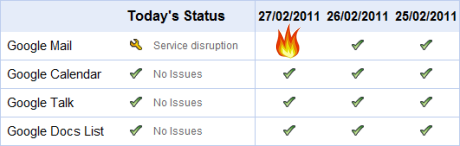
In credit to Google, however, it updated its Dashboard pages over the weekend to acknowledge the problem, whereas Microsoft resorted to taking to the convoluted forums it hosts on their own problem pages, when it suffered an outage over the New Year break.
Is the cloud the best place to store email? Or would you prefer to manage your own in a private cloud set-up? Have your say.
Related content:
Kick off your day with ZDNet's daily e-mail newsletter. It's the freshest tech news and opinion, served hot. Get it.
Zack Whittaker, a criminologist who studied at the University of Kent, Canterbury, is a journalist, writer and broadcaster.
I worked briefly with Microsoft UK in 2006 but no longer have any connection with the company. Regardless, I remain impartial and unbiased in my views.
I don't hold any stock or shares, investments or industrial secrets in any company, but have signed confidentiality agreements with a number of UK and U.S. organisations, whose names I am not at liberty to disclose.
I was involved with Kent Union, the University of Kent's student union, undertaking voluntary, non-salaried, elected positions between early 2009 and mid-2010.
No other company, body, government department, non-governmental organisation or third sector organisation employs me or pays me a salary in any capacity whatsoever.
As a freelance journalist, whenever expenses are given and taken by a company that is not CBS Interactive, these will be disclosed in each relevant post to ensure transparency.
I currently work with a UK law enforcement unit, but this is an entirely separate position which bears no connection to other work.
(Updated: 23rd October 2011)
Zack Whittaker, criminologist who studied at the University of Kent, UK, is a journalist, writer and broadcaster.
After studying criminology at university, though still in his early-20's, he has already had a series unconventional work and voluntary positions. He has worked with researchers studying neurological illnesses like Tourette's syndrome (which he suffers from), has given lectures on the nature of disabilities in the public community, and occasionally ends up speaking on television and radio discussing the events of the day.
He first had academic work published at the age of 22, then still an undergraduate, and has been cited by a wide range of publications: from the Huffington Post, Business Insider, AllThingsDigital, The Atlantic Wire and CBS News.
Get the best of ZDNet delivered straight to your inbox