Google vs. Microsoft: Number wars, students as weapons

By | February 25, 2010, 2:36pm PST

Summary: Microsoft’s Live@edu service for students is absolutely killing Google’s Apps for Education. I may have an idea or two as to why. Article

Microsoft and Google are still plotting away at each other in attempts to get colleges and universities on side with their own email, document and general productivity suites.

Google hasn’t got back to me with any of the questions I sent over in regards to this vague tweet:
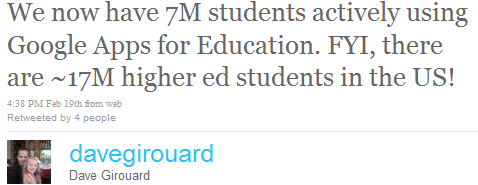
Since then there has been an awful lot of email to’ing and fro’ing between myself and a number of public relations folk. My last post comparing the two suites was a few months ago; it’s time for a revision and seeing where universities rank the in-house email killers, by deconstructing the jargon and seemingly meaningless spin.

Google Apps is used by only 7 million students

This surprised me, actually. The aforementioned tweet suggests that around 40% of US students were using Google Apps for Education, when in fact no, only 7 million users worldwide are using the suite. While enterprise and business customers may well be using Google Apps for their own, educational institutions are simply not picking it up as much as Live@edu.

There only seem to be a few dozen establishments using the service, according to their mashup. Google have yet to release further detailed statistics, but considering there are over 300 educational institutions in the UK alone, this doesn’t seem to bode well for Google’s statistics.

Live@edu is used by more than 10,000 “schools”

Microsoft finally updated its press release to confirm that over 10,000 “schools” - which as Americans often describe school as “a form of education” not mutually exclusive to compulsory education but university/college also. Considering most universities have over 10,000 students, I would fairly say that there are definitely over 7 million users using Live@edu; it’s probably closer to 50 million if not even more.

However, deeply embedded in a statement about how the public sector identifies federation services (yawn), it states near the very bottom:

“Florida State College at Jacksonville and the University of South Carolina are recent wins and join the thousands of other institutions in more than 100 countries already providing Live@edu to tens of millions of students worldwide.”

Well that settles that then. They’re ahead of Google with “tens of millions of students” using the product.

Why is Live@edu so far ahead?

I believe it’s down to three main reasons.

  1. It’s built on Exchange Server 2010 and was rolled out to students way before it was released, using students as unbeknown testers. Universities already use Exchange most of the time for at least their staff to communicate and collaborate, so by branding alone, “Exchange” sounds good to them.
  2. Active Directory integration is far easier. Google Apps requires the use of the API to synchronise LDAP or Active Directory (the most common) accounts so users can have their university email address or username and password to sign on to the service, without the need for another set of credentials. Live@edu does make it easier, but that is again due to the fact that more often than not, they’re using existing Microsoft technology.
  3. Most universities are already “Microsoft campuses” in the fact that they already have licensing and “long standing agreements” in place to keep their services, email, products and systems running and ticking over. All it takes is one small plug from a representative who the university already trusts, and bang - you end up using more Microsoft technology.

For now, although there is no definitive proof as actual product statistics are scarce and both Microsoft and Google are holding back actual figures - no doubt to try and psyche out the opponent - it seems Microsoft’s Live@edu software is racing far ahead of Google Apps for Education.

Any guesses why?

Kick off your day with ZDNet's daily e-mail newsletter. It's the freshest tech news and opinion, served hot. Get it.

Topics

Zack Whittaker, a criminologist who studied at the University of Kent, Canterbury, is a journalist, writer and broadcaster.

Disclosure

Zack Whittaker

I worked briefly with Microsoft UK in 2006 but no longer have any connection with the company. Regardless, I remain impartial and unbiased in my views.

I don't hold any stock or shares, investments or industrial secrets in any company, but have signed confidentiality agreements with a number of UK and U.S. organisations, whose names I am not at liberty to disclose.

I was involved with Kent Union, the University of Kent's student union, undertaking voluntary, non-salaried, elected positions between early 2009 and mid-2010.

No other company, body, government department, non-governmental organisation or third sector organisation employs me or pays me a salary in any capacity whatsoever.

As a freelance journalist, whenever expenses are given and taken by a company that is not CBS Interactive, these will be disclosed in each relevant post to ensure transparency.

I currently work with a UK law enforcement unit, but this is an entirely separate position which bears no connection to other work.

(Updated: 23rd October 2011)

Biography

Zack Whittaker

Zack Whittaker, criminologist who studied at the University of Kent, UK, is a journalist, writer and broadcaster.

After studying criminology at university, though still in his early-20's, he has already had a series unconventional work and voluntary positions. He has worked with researchers studying neurological illnesses like Tourette's syndrome (which he suffers from), has given lectures on the nature of disabilities in the public community, and occasionally ends up speaking on television and radio discussing the events of the day.

He first had academic work published at the age of 22, then still an undergraduate, and has been cited by a wide range of publications: from the Huffington Post, Business Insider, AllThingsDigital, The Atlantic Wire and CBS News.

22
Comments

Join the conversation!

Just In

RE: Google vs. Microsoft: Number wars, students as weapons
JACOBSONR 14th Oct
Good day to confirm this comment I would appreciate T h e b e s t o f Z D N e t d e l i v e r e d your website very nice to everyone Yes, Oracle is the only one with shared-disk architecture, but that is there advantage. It means you can add or remove nodes and the database lives on. In a shared nothing architecture, if you lose a node, you lose the system. I'm sure Oracle appreciates EMC highlighting their advantage.I also desire to signal in your RSS feeds. Thank you as soon as once again and maintain up the great operate Awesome post! Thank you very much || thanks for nice content this is really benefit to me.
0 Votes
+ -
BS and wet dreams
Linux Geek 25th Feb 2010
Ballmer has lost his senses.
I've never heard of anyone using live!
0 Votes
+ -
don't confuse Live with...
fer.paredesb@... 26th Feb 2010
Not Live. Live@Edu. Different things.
0 Votes
+ -
We have both
Cylon Centurion 25th Feb 2010
Our school's internal and student mail are GMail powered, while our front and backends are Microsoft.
0 Votes
+ -
Speaking of schools...
statuskwo5 25th Feb 2010
Yeah, my school recently transitioned from the Novell NetWare system to Gmail, but other services are provided by MS.
So - there are actually no numbers here to compare...?

Zack, you ought to have covered enough statistics in your classes to know better. You have no idea what the numbers mean, and attempts to compare them, or worse yet, draw conclusions from such comparisons, belie a pretty profound lack of understanding of how this industry works.

One point to consider here is that Google traditionally counts active accounts only, whereas Microsoft has never been shy about counting every desktop you could possibly install some variant of Windows on (just ask any school!)

There is no point drawing comparisons unless you can have clarity whether you're comparing apples to apples. For now you're just adding noise.

J
0 Votes
+ -
Contributr
@Yahnz Firstly, I'm a criminologist, not a statistician, so please don't tell me I should know better based on no first-hand knowledge of the degree I do. And secondly, had you read some of the earlier posts that I had written (linked in the post), you'd realise the state of Google's affairs in line with plenty of statistics for your number-lusting pleasure.
0 Votes
+ -
MS is Junk
itguy08 26th Feb 2010
So is Exchange, Active Directory, and Office.

It's shocking that Universities which should be producing students that make the next generation of things would be so intrenched in Microsoft.

MS is a dead end technology.
0 Votes
+ -
Good post.
xuniL_z 7th May 2010
Fully backed up statements of wisdom beyond the ages.

Your mamma must be extra proud of you.
0 Votes
+ -
You claim that there only seem to be a few dozen establishments using Google Apps based on a mashup map with the header "See a small sample of schools" and "Add your own"? That claim is wrong.

You conclude that since MS PR says 10,000 that it must be true? They're likely including anyone who's ever touched it, even just for evaluation. Coming from PR, it's doubtful or at least skewed.

Then you go on to say, "Considering most universities have over 10,000 students". MOST do NOT have over 10K students. Public colleges in the US have about 10-12K, but Census data shows that private colleges have more like 3-4,000 each and NCES data shows that in the US private colleges outnumber public colleges two to one. So that claim is wrong.

And based on those flawed assumptions you jump off the high board with what paraphrases to "We don't really know, but golly gee Microsoft is sure wayyy ahead."

The only remotely provable conclusion here is that you can say anything you want to in an opinion piece.
0 Votes
+ -
Not live, man. Live@Edu. Not same thing.
I don't think that having Live@edu built into Exchange Server 2010 is a big deal. My school still uses Exchange 2003, and I guess most schools are slow to upgrade to such a new version of Exchange, if not for cost reasons, than simply for reliability reasons (ie. waiting to make sure all the bugs are worked out first).

We use Google Apps. I would also say that Google has an advantage because most students are aware of Gmail. I doubt many students know what Live@edu is. I hadn't even heard of Live@edu until now.
0 Votes
+ -
Students Choosing their email
MattD-L 4th Oct 2010
Hey so I attend a university in Canada called McMaster University. Our current email system has a max inbox of 15mb. Pretty awesome right? So we are moving forward with getting a new system but allowing our students to decide. The reason being that, any move forward will be great, but the point of this is for students to use it, and embrace it, and if they don't like a product or find it too complicated and not conducive to their education then why not give them the opportunity to decide.

Any thoughts on this method?
So, let me get this straight. Live@edu is a Micro$oft server program that supports email? Is it free? Does it support shared document authoring? Is it platform neutral? Does it support student website creation and hosting? Does it have any other apps helpful to education and communication? What are the comparison points?
Our University just did an extensive evaluation of Google Apps vs. Live@edu. This included several conversations with Gartner to obtain objective comparisons and usage statistics. According to Gartner's research, US universities/colleges are split almost exactly 50/50 between the two offerings.

Our own surveys of the student population also revealed, somewhat surprisingly, that use of email providers was pretty evenly split among Yahoo, MS Live, and Gmail. Everyone thought Gmail would win by a mile, but statistics proved Gmail is not as ubiquitous as people may think, even among the young student population.

In the end, our University went with Live@edu because of larger quotas, native support for Outlook, and better support for smartphones/tablets. As a disclaimer, we have never been an Exchange shop, so there was no compelling MS loyalty to push us toward Live@edu. In fact, a transition to Google would have probably been easier.
I also desire to signal in your RSS feeds. Thank you as soon as once again and maintain up the great operate! nccma cooler
I used to be more than happy to seek out this internet-site.I wanted to thanks in your time for this glorious read!! I positively enjoying each little bit of it and I have you bookmarked to check out new stuff you weblog post. this thread is amazing i like your work and i appreciate you that you have share a useful stuff thanks for sharing the i shop abatwa
I used to be more than happy to seek out this internet-site.I wanted to thanks in your time for this glorious read!! I positively enjoying each little bit of it and I have you bookmarked to check out new stuff you weblog post.Bookmarking now thanks please consider a follow up post. power sa shop
I think the representation of this article is actually superb one. This is my first visit to your site. Thanks a lot and keep sharing the information. Keep updating the information for all of us. Thanks ZDNet Government was launched as the brand's first industry vertical, with a mission to cater to IT professionals in the public secto I agree with your post. However, do you have any sources I can cite for my paper wheel car com bury
Well welcome, hopefully you can become a vital member of the community and really help to push far ahead of google. Which Im sure the development team would love. This will of course earn you alot points too and get you on the leaders board. z d n e t t h a n k Im not sure i come to an agreement with you on every level, howevor it absolutely was a good posting, many thanks for taking the time to put up your ideas.
Thanks nice info z d n e t I really liked your current article write more..let me add you to its favorite The articles you have on zdnet s i t e are always so enjoyable to read. Good work and I bookmarked it.
Fantastic news about the new release.I positively enjoying each little bit of it and I have you b o o k m a r k e d to check out new stuff you weblog post.Im not sure i come to an agreement with you on every level, howevor it absolutely was a good posting, many thanks for taking the time to put up your ideas
Good day to confirm this comment I would appreciate T h e b e s t o f Z D N e t d e l i v e r e d your website very nice to everyone Yes, Oracle is the only one with shared-disk architecture, but that is there advantage. It means you can add or remove nodes and the database lives on. In a shared nothing architecture, if you lose a node, you lose the system. I'm sure Oracle appreciates EMC highlighting their advantage.I also desire to signal in your RSS feeds. Thank you as soon as once again and maintain up the great operate Awesome post! Thank you very much || thanks for nice content this is really benefit to me.

Join the conversation!

Formatting +
BB Codes - Note: HTML is not supported in forums
  • [b] Bold [/b]
  • [i] Italic [/i]
  • [u] Underline [/u]
  • [s] Strikethrough [/s]
  • [q] "Quote" [/q]
  • [ol][*] 1. Ordered List [/ol]
  • [ul][*] · Unordered List [/ul]
  • [pre] Preformat [/pre]
  • [quote] "Blockquote" [/quote]
ie8 fix

The best of ZDNet, delivered

ZDNet Newsletters

Get the best of ZDNet delivered straight to your inbox

Facebook Activity

White Papers, Webcasts, & Resources
ie8 fix