Has technology evolved our language beyond recognition?

By | December 1, 2008, 4:34pm PST

Summary: You pick up your Blackberry in the morning because your notebook has a virus. You connect to your cloud storage and retrieve a few documents to store on your drive, and grab yourself a cup of Java. I get emails every day, mostly ordinary commentary from like-minded people, but from time to time, you’ll get an [...]

You pick up your Blackberry in the morning because your notebook has a virus. You connect to your cloud storage and retrieve a few documents to store on your drive, and grab yourself a cup of Java.

I get emails every day, mostly ordinary commentary from like-minded people, but from time to time, you’ll get an email from a “grammar Nazi”; someone who takes pleasure in ripping to pieces what you’ve written because you wrote “their” instead of “there“. Well this one is for you, you sad little low-life’s.

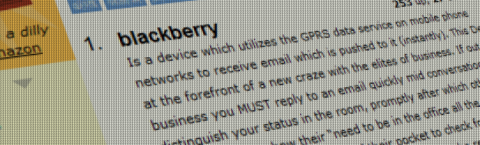
blackberry-language.png

Because of ever changing technologies, new gadgets coming out, new devices being made and more marketing pushing these things out than you could throw a stick at, certain words are almost becoming defunct, only to be replaced by a totally different meaning.

Stephen Fry, a comedic legend, an incredibly intelligent, gay man, who spends his life in thought. A legend to anyone British, but I thought his comments were appropriate. He speaks about language being no more than a mere fingerprint, and his slight satirical view of technology as he explains the Internet.

Let’s take a few:

  • Blackberry: no longer a small fruit you’ll get on a bramble bush, it’s now an essential cellphone type device which pushes email to you wherever you are.
  • Notebook: it’s preposterous to consider handwriting on a paper notebook, because it’s a slimmed down laptop computer.
  • Virus: something you normally went to your doctor about because you’d slept with too many people. Now it’s a bad piece of software which causes havoc on a computer.
  • Cloud: when was the last time you referred to the cloud as a white, fluffy thing in the sky? It’s the Internet, wherever you are, whenever you need it.
  • Java: to me it’ll always be strong, powerful and beautifully smelling coffee, but for many it’s a computer language which is in everything from Blu-ray devices to the occasional space shuttle.

The old meanings haven’t gone away. A cloud can be Internet storage as well as a fluffy sheep-like cloud, and a virus will need a jab in the arm to fix. What worries me is this impressionable generation in front of us, and I’m in there too. Will we forget the original meanings? Will be no longer have need for blackberries because we have our Blackberry’s? Will we become more focused on our computers’ security than our own health?

Serious questions, but the only way I can have answers if you provide them. Is this generation “too stupid or too not-open-minded” to think back to basic education? Will these just be fads? Is our language slowly deteriorating into “txt spk” and words evolving into things they have only been around for, for the last decade?

This could be an interesting one. TalkBack, ShoutBack, BitchBack, anything you want, I’d be glad to hear it.

Kick off your day with ZDNet's daily e-mail newsletter. It's the freshest tech news and opinion, served hot. Get it.

Topics

Zack Whittaker, a criminologist who studied at the University of Kent, Canterbury, is a journalist, writer and broadcaster.

Disclosure

Zack Whittaker

I worked briefly with Microsoft UK in 2006 but no longer have any connection with the company. Regardless, I remain impartial and unbiased in my views.

I don't hold any stock or shares, investments or industrial secrets in any company, but have signed confidentiality agreements with a number of UK and U.S. organisations, whose names I am not at liberty to disclose.

I was involved with Kent Union, the University of Kent's student union, undertaking voluntary, non-salaried, elected positions between early 2009 and mid-2010.

No other company, body, government department, non-governmental organisation or third sector organisation employs me or pays me a salary in any capacity whatsoever.

As a freelance journalist, whenever expenses are given and taken by a company that is not CBS Interactive, these will be disclosed in each relevant post to ensure transparency.

I currently work with a UK law enforcement unit, but this is an entirely separate position which bears no connection to other work.

(Updated: 23rd October 2011)

Biography

Zack Whittaker

Zack Whittaker, criminologist who studied at the University of Kent, UK, is a journalist, writer and broadcaster.

After studying criminology at university, though still in his early-20's, he has already had a series unconventional work and voluntary positions. He has worked with researchers studying neurological illnesses like Tourette's syndrome (which he suffers from), has given lectures on the nature of disabilities in the public community, and occasionally ends up speaking on television and radio discussing the events of the day.

He first had academic work published at the age of 22, then still an undergraduate, and has been cited by a wide range of publications: from the Huffington Post, Business Insider, AllThingsDigital, The Atlantic Wire and CBS News.

Related Discussions on TechRepublic

Did you know you can take part in these discussions with your ZDNet membership?
4
Comments

Join the conversation!

Just In

Language is not a tool, it's a tool box.
Dr_Zinj 3rd Dec 2008
The purpose of language is to transfer meaning from one person to another.

Languages require mutually agreed upon symbols and grammar in order to transfer meaning. Grammer is the set of rules on how to manipulate the symbols. The symbols can be sounds, gestures, writing, colors, smells, tastes, or other perceivable phenomena.

While I don't know of anyone who has constructed a language using the symbols of salty, sour, sweet, bitter, and umami; there's no reason why they couldn't. Certainly 5 different tastes provide a greater density than mere binary notation.

The key to language is getting the mutual agreement between two or more people. (Yes, you could construct an language unique to yourself to store information for your sole use, but that's a lot of work with little return, unless you're into classified communications.) And because people change their agreements all the time, language changes based on the changing agreements.
0 Votes
+ -
Huh?
ParrotHeadFL 2nd Dec 2008
What does Fry's sexual orientation have to do with anything?
0 Votes
+ -
Sorry, this is nothing new. Every new thing, and every new idea is built on things and ideas that came before.

If you doubt this consider how many terms in English have come from ancient roman world, and completely warped their original meaning.

Consider our use of the word 'million' - the root is mil which means 1000. How did it come to mean 1,000,000 in English? Because we are always repurposing words. It happens perpetually, every day. Look at the complete English dictionary - there are over 500,000 words in there - but most people never use more than 20,000 in their life. And a great many of those words in current use are recent inventions. This is how languages evolve and morph over time.
0 Votes
+ -
Evolution of a language
lefty.crupps 2nd Dec 2008
This is to be expected, that any language will evolve with new meanings and words. Pick up some Shakespeare and witness what has happened in the last few hundred years.

Spanish (Castilian), and possibly other languages, have an actual authority* on their language to determine if a word has a changing meaning or spelling, in an attempt to keep it united and meaningful. I like that idea, but I am frustrated by those who speak English natively and yet do it wrong all the time.

That our language is evolving doesn't excuse the should-be-literate who misuse common words, such as "their/they're/there" -- it's not a spelling mistake but a grammar mistake, and if someone cannot use correctly the most common daily tool of human existence (language), how does that reflect on the rest of their tool-using abilities?

On a different point: I agree, why would Fry's sexuality have any relevance to these 'funny' quotes?

* http://en.wikipedia.org/wiki/Spanish_language#Real_Academia
0 Votes
+ -
The purpose of language is to transfer meaning from one person to another.

Languages require mutually agreed upon symbols and grammar in order to transfer meaning. Grammer is the set of rules on how to manipulate the symbols. The symbols can be sounds, gestures, writing, colors, smells, tastes, or other perceivable phenomena.

While I don't know of anyone who has constructed a language using the symbols of salty, sour, sweet, bitter, and umami; there's no reason why they couldn't. Certainly 5 different tastes provide a greater density than mere binary notation.

The key to language is getting the mutual agreement between two or more people. (Yes, you could construct an language unique to yourself to store information for your sole use, but that's a lot of work with little return, unless you're into classified communications.) And because people change their agreements all the time, language changes based on the changing agreements.

Join the conversation!

Formatting +
BB Codes - Note: HTML is not supported in forums
  • [b] Bold [/b]
  • [i] Italic [/i]
  • [u] Underline [/u]
  • [s] Strikethrough [/s]
  • [q] "Quote" [/q]
  • [ol][*] 1. Ordered List [/ol]
  • [ul][*] · Unordered List [/ul]
  • [pre] Preformat [/pre]
  • [quote] "Blockquote" [/quote]
ie8 fix

The best of ZDNet, delivered

ZDNet Newsletters

Get the best of ZDNet delivered straight to your inbox

Facebook Activity

White Papers, Webcasts, & Resources
ie8 fix