IT support: Cut the jargon or find another job

Summary: With IT technicians using language which for the most part is non-understandable to the lay person, isn't it about time that the IT support change their methods before the Generation Y move in and rip them to shreds?
I had a phone call from an extended colleague working for a charity here in the UK. The website they have is throwing up SSL error messages due to the extended security in modern day browsers - Internet Explorer 8 and Firefox 3 are the best examples.
The domain name for the site stands, but the website is hosted by another company which has an SSL certificate for their own subdomain, which covers this charity's website and every other website they host. When accessing the members-only part of the site, they are faced with an SSL certificate error, which is causing havoc with non-technical users and deterring them from using the site.
So from the charity's domain name, hit the Login button and it throws an SSL error because the SSL certificate is issued to the hosting company's subdomain, and not the charity's domain name. It's a domain name mismatch issue and quite common nowadays. Keeping up?
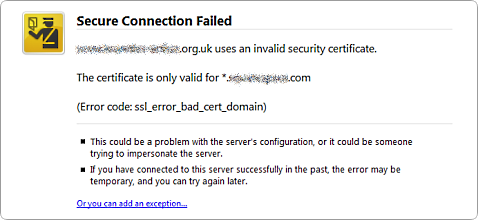
Their support response was to "advise your visitors to ignore this warning". That threw me back quite some way. Is that really the best solution? Or perhaps installing another SSL certificate to accommodate the additional domain name would have been a better idea?
This colleague got in touch with me to ask for my advice after emailing back and forth for weeks, ladies and gentlemen. Weeks.
The first question she had asked was in fact spot on, "Can just purchase a certificate to cover our domain name?" Instead of giving her a valid response, they quite simply bounced around jargon and technical bull which would have made very little sense to someone outside of the IT community.
This happens every day, in every organisation, and this is what I truly hate - hate - about the computing industry. It's the self-important, arrogant nonsense which IT professionals bounce around. They use language which confuses the lay person and causes them to feel inferior, when in fact they are the paying customer.
The reason people ask me for advice is because I don't bounce around technical language, or when I absolutely must, I explain it in almost gratuitous detail so they actually learn from what I say. More often than not, they don't just want an answer or a solution to the problem; they want to know what the problem was and learn from it.
One of my friends working for the Home Office didn't go in for two days claiming she was ill, because she was too terrified to speak to the IT technician on call, because of the flurry of patronising and condescending comments she would have to endure as a result of not knowing something.
Another example was last year. I went to the IT support desk at the university with a friend whose laptop was playing up. I was hungover and tired, and didn't have the energy. But I went for morale support because English wasn't her first language. From memory, this is how it went:
IT support: "So what's the problem?" Friend: "The Internet won't work. I plug it in and network doesn't connect. I need to submit my work otherwise my marks will be zero." [Bad English, I told you] IT support: [sighed and rolled eyes] "Fine, open it up." [The laptop loaded and she put in her password] IT support: "Well it's clear to me that the DNS cache is clogged and needs to be refreshed, so I'll open up a command prompt and flush out the DNS. I'll resolve it and the IP configuration will automatically reset. If you [something, something] the DNS resolver will fail and the connectivity will cease."
All good and well to me, as I understood roughly what was happening. For some reason, the DNS cache needed flushing out and the slate needed to be wiped clean. He did this in a matter of seconds and it was all good and well.
But the attitude he gave my friend - perhaps because of her lack of technical skill or the fact that she was did not speak in eloquent English tongue - he was clearly "attitudey" and made her feel like it was her who was in the wrong. Sometimes computers just screw up, and this was one of those occasions.
She left that office with a negative experience. But it was his fault, the spotty, rude and arrogant idiot who clearly shouldn't be in a public facing job if he cannot grasp the concept of basic social skills.
So this is a plea to the IT community. For crying out loud, get a grip. Sure, you may hate your job and hate people asking you for advice when their computers or devices screw up. But you are a specialist in your field and are respected for knowing that knowledge.
So pull your finger out and learn some social skills, because I can tell you now, ladies and gentlemen, that the Generation Y will not put up with your attitudes. The Generation Y do not appreciate being patronised because we're younger. The Generation Y will rip you to shreds.
Kick off your day with ZDNet's daily email newsletter. It's the freshest tech news and opinion, served hot. Get it.
Talkback
Zack i agree with you to a point
Head on the nail...
[i]"We as IT can fix broken but we can't fix stupid."[/i]
I can't follow your grammar. nt
Seems my point is made
No...
Try a few more capital letters next time you post something.
Here's a little help:
http://www.usingenglish.com/glossary/capital-letter.html
IT_Guy Is an English Teacher and Not IT
Some Jargon but...
Some of us support a lot of people plus having to plan and implement projects so spending a little time, every time to explain everything adds up and can have serious repercussions.
Like I said, attitude is a HUGE factor in support. And yes, we need to do some explaining and not overly "jargonize" our responses but we can't explain everything. We would never get anything done and calls, emails, and work orders would pile up and users would be frusterated.
The problem with attitudes is that it goes both ways
Yeap, i get this all the time.
For the jargon part.. i do admit to speaking to much techno occasionally, but if i see someone is starting to glaze over, i will hit them with an analogy that represents the issue, without the jargon. This issue is hard to gauge because everyones level is different, its up to the IT person to make the extra effort when something is clearly amiss.
Personally, if you broke it, you know the details around when it went kaput and what you were doing. Most people are afraid the IT guy will yell at them for doing something stupid. Well this may be the case sometimes, its more important that the problem gets fixed. The IT person should be more tactful in their brow beating. The end user should take more responsibility for their actions.
i think that statement is a good compromise.
That is what i thought....
Spot On!
HappyHarry
RE: IT support: Cut the jargon or find another job
The user is responsible for their actions. Plain and simple. If I take my car to the repair shop and the windshield wipers don't work, but tell the mechanics that "it's driving funny and for them to check it out", do you think they will see the wipers not working? Maybe after many more questions from them and several more hours at their shop. In my 17 years of IT, irregardless of the size of the company I've been at (small mom and pop, mid sized, multi national) the user's have always, always, taken the approach that IT is their own personal repair squad, that they can do whatever they will to, that they can bring their home computers in for repair, that they can just give some stupid answer to a simple question, and that they are not responsible for anything they do wrong to the computer. Then when we try to explain to them in a manner that does not insult their intelligence, we are greated with either "talk english to me, I don't understand that IT garbage of yours", "I have an advanced degree and don't appreciate being talked down to", or the ever famous "deer in head light look". Either way, it's always IT's fault for their screw up's because their managers don't have the guts to say "This is company property. You break it, it may not get fixed and you will be written up for it". Why? Because that approach isn't PC (politically correct). And let's not forget the user replying "Well I have a friend/child/relative (etc) who does what you do and they can fix it next time". Fine, let 10 year old Johnny fix it - maybe he can get the garbage out of the keyboard too. And maybe I'll call him for help over a nice 4 day weekend when I'm reconfiguring the entire network and he's at home watching Sponge Bob. Also having the ever present thought of being outsourced at a moment's notices doesn't help an IT person's psyche one bit, nor does a user's perception that all IT does it play internet games. If this field is so friggin easy then let's seen them do it.
Do they act this way when explaining their ailments to a doctor, or dentist, or their tax situation to an accountant or lawyer? No. Why - they hold those people to a higher status than us in IT. Until user's start treating IT with the respect and decency that they, the user, demand from us, it will never change. So they will just have to live with it.
anlashok1967 you got it 200% right..
RE: IT support: Cut the jargon or find another job
I am not seeing your point here..
RE: IT support: Cut the jargon or find another job
??, ??? ??? ????? ??????? ???? ????? ?????? ?? ????
????????!