ie8 fix

Ten years since Windows XP hit manufacturing

By | August 24, 2011, 5:04am PDT

Summary: It is ten years today since Microsoft rolled out Windows XP to manufacturers. Are you still using the ageing operating system?

It is ten years since Microsoft released what turned out to be the world’s most popular operating system into the wild — into the hands of manufacturers like Dell and HP to install on new PCs.

Bill Gates and Jim Allchin signed off the gold disk in view of journalists, shortly before it flew off in a helicopter to bring the brand new operating system to OEM builders.

As the ageing operating system is still used by tens of millions worldwide, holding around 45 percent share according to StatCounter, it finally dipped below the 50 percent mark last month.
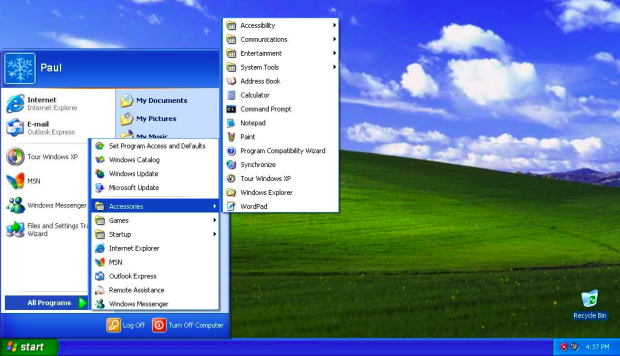
Within two months of its release to manufacturing, it became available to the general public — and copies flew off the shelves.

But one tragic event and another major blow to Microsoft hit the Windows XP launch.

With just over a month before the October 25th general availability for the public to pick up their copy of the next-generation operating system, two planes slammed into the World Trade Center on September 11th. Microsoft took the wise decision to scale down the worldwide launch party.

A group known as devils0wn, with just over a month before general release, was cracked and released into the wild. Though the key has long-been obsolete, it enabled millions to illegally pirate the disk without buying a copy.

But Windows ploughed on and continued to sell across most of the world — and within a few years, it had become the world’s most popular operating system — peaking at 76.1 percent in January 2007.

As Windows 7, released in October 2009, still has a way to catch up as Microsoft continues to engage in disaster recovery mode after the ‘Vista fiasco’.

Microsoft has sold in the region of 350-400 million copies, based on figures from earlier this year.

Related content:

Kick off your day with ZDNet's daily e-mail newsletter. It's the freshest tech news and opinion, served hot. Get it.

Topics

Zack Whittaker, a criminologist who studied at the University of Kent, Canterbury, is a journalist, writer and broadcaster.

Disclosure

Zack Whittaker

I worked briefly with Microsoft UK in 2006 but no longer have any connection with the company. Regardless, I remain impartial and unbiased in my views.

I don't hold any stock or shares, investments or industrial secrets in any company, but have signed confidentiality agreements with a number of UK and U.S. organisations, whose names I am not at liberty to disclose.

I was involved with Kent Union, the University of Kent's student union, undertaking voluntary, non-salaried, elected positions between early 2009 and mid-2010.

No other company, body, government department, non-governmental organisation or third sector organisation employs me or pays me a salary in any capacity whatsoever.

As a freelance journalist, whenever expenses are given and taken by a company that is not CBS Interactive, these will be disclosed in each relevant post to ensure transparency.

I currently work with a UK law enforcement unit, but this is an entirely separate position which bears no connection to other work.

(Updated: 23rd October 2011)

Biography

Zack Whittaker

Zack Whittaker, criminologist who studied at the University of Kent, UK, is a journalist, writer and broadcaster.

After studying criminology at university, though still in his early-20's, he has already had a series unconventional work and voluntary positions. He has worked with researchers studying neurological illnesses like Tourette's syndrome (which he suffers from), has given lectures on the nature of disabilities in the public community, and occasionally ends up speaking on television and radio discussing the events of the day.

He first had academic work published at the age of 22, then still an undergraduate, and has been cited by a wide range of publications: from the Huffington Post, Business Insider, AllThingsDigital, The Atlantic Wire and CBS News.

73
Comments

Join the conversation!

Just In

RE: Ten years since Windows XP hit manufacturing
michaellashinsky@... 2nd Sep
@anonymuos

I do not agree with you. I support 200 pcs and WinXP, prior to SP2, was a buggy nuisance! After SP2, it was finally how it should have been in the first place. Why do we put up with paying for the privilege of being M$ beta testers? It really pi$$es me off!

Most of our systems are still running XP, and doing just fine. I rolled out about 2 dozen Win'7 systems this year as replacements, and for the most part they run well, but I still get goofy errors that defy explanation, and since there were so many hits on Google, I am not the only one experiencing them.
0 Votes
+ -
Contributr
What were you doing? Did you celebrate the day? Do you still even have a copy of Windows XP running, or has it been relegated to a virtual machine? Was Windows XP the best operating system to date, or simply lasted longer because of Vista's failings? Have your say.
0 Votes
+ -
@zwhittaker - We're still running XP on a Sony VAIO RB-Series machine and a Fujitsu Lifebook P7120. Both of those machines run everything from Media Center to iTunes to Microsoft Office without a problem, but with the Sony's memory maxed out at 2 GB, and the P7120 maxed at 1 GB, so neither of them will run Windows 7. But they really don't need to. MS needs to make systems that aren't such memory hogs. We tried Vista on both, but found it to no improvement to XP, so we stuck with XP and everything is fine. Needless to say, the newer computers in our house run Windows 7, but these two old ones are just fine.
@sue swift "so neither of them will run Windows 7"

Sure about that, Sue? You might be surprised at what Win7 can run on. I have a Z60T ThinkPad (circa 2005 - bought in 2008) with 2gb and a Pentium M processor at 1.7ghz that I have Win7 on.
First, I signed up to MS Technet and downloaded the 90 day eval copy of 7 to test it out.
Startup and shutdown are way faster than a clean XP install. Everything seems snappier - even after loading firewall and malware utilities and such. Had to scrounge a little to get a working sound driver, and Aero does not work, due to the outdated, unsupported video subsystem, but it still looks great. I liked it so much that I bought a family 3 pack of Win7 Home. (note: you can legally 'upgrade' an XP system, but you must do a clean install, and getting the license activated takes a phone call or a tweak that is easily found online.)
Last I checked, about two months ago, the 90 day eval was still available. Just have to sign up to get access to it. If you have a spare empty drive to swap out and install to, it is a great way to test drive Win7. (you could probably install to an in-use drive, but a blank drive is safer).
@zwhittaker Still running WinXP SP3 on my desktop machine at my office (not by my choice).
Upgraded to a laptop with Vista in October 2007, and while it was undeniably a rough transition to adapt to the different file structure and a couple early flaws, the OS really hasn't been that bad since they put out the first service pack.
I personally feel that Vista's bad rep is unjustified today, but unfortunately it will forever be a grease stain on MS's polo shirt.
0 Votes
+ -
Until the hardware or software craps out
cwallen19803@... Updated - 24th Aug
@zwhittaker

I'll run XP until either the hardware or software ceases to function. I have XP on two P4 machines from 2005 that just won't support Windows 7, and one dual core machine from 2007 that will but my wife was worried about compatibility issues. She keeps her household apps on that box, so she gets to decide.

My personal laptop runs Windows 7, but all our machines at work, except for very recent replacements, all run XP and I don't see anyone in the company running around like headless chickens to upgrade the OS as long as the machine is functioning.

I like Windows 7. I also liked my '94 Mazda MX-6 untiil it became unfunctionable after 15 years.
0 Votes
+ -
@zwhittaker
As Windows 7, released in October 2009, still has a way to catch up as Microsoft continues to engage in disaster recovery mode after the ?Vista fiasco?.

What about the Windows NT and ME fisacos?
0 Votes
+ -
@zwhittaker

I still run XP on my main machine and so does my daughter. Earlier this year I wanted to upgrade my hardware but leave my software alone. So I built up a new machine, popped my old drive into my new machine, re-registered it with MS, installed the new drivers that came with the motherboard and off I went. I'm sure I'll still be happy a couple of years from now.

I only run a newer OS when I buy a newer machine and it comes along for free. I'm still running a Win98se laptop with Quicken '98 as my financial box. Never connnected to the internet.
0 Votes
+ -
RE: Ten years since Windows XP hit manufacturing
Return_of_the_jedi Updated - 24th Aug
Delete Me.
0 Votes
+ -
@zac
Your post PC era will never be upon you because of your nostalgia for Windows.
0 Votes
+ -
Contributr
@Return_of_the_jedi I personally want the PC to reign on. Long live the PC!
0 Votes
+ -
XP is the zenith of Microsoft
xp-client 24th Aug
That XP became reliable only after SP2 is a total myth. XP was gold right from RTM. It became much more secure after SP2. Another myth: XP was a minor update. XP brought a plethora of new features: http://en.wikipedia.org/wiki/Features_new_to_Windows_XP. And another myth: XP doesn't run on modern hardware. Wrong. XP runs and scales extremely well on modern hardware, even multi-core processors. XP after SP2 is also secure enough.
0 Votes
+ -
@anonymuos - I'm still running Windows XP, and it runs fine on modern hardware. I built a new AMD box this spring, with USB 3.0, SATA 3, etc. There's still readily available drivers for XP for each hardware component on the motherboard. The only thing you may need to do is install an update (KB953028) to prevent crashes on machines with more than four processor cores. I have not yet run across a new hardware device made by a major manufacturer that doesn't have an XP driver available.
0 Votes
+ -
@anonymuos

Windows XP isn't built to take advantage of multi-core processors like Vista and 7 are.
0 Votes
+ -
@Cylon Centurion, that's a myth. Windows NT has always supported symmetric multiprocessing and programs need to be specifically programmed for parallelism to take advantage of multiple cores. The operating system's kernel scheduler will try to balance the workloads but unless the program is multi-core optimized (using a parallelism optimized compiler like the ones in Visual Studio 2010 or Intel's Parallel Studio), it won't make much of a difference. And btw Visual Studio 2010 also runs on XP. The Vista/7 scheduler does have minor changes for more fair scheduling but that's about it. Programs won't automagically run faster on Vista/7 because you have a quad core CPU any more than on XP. Multi-core aware programs can be written on XP as well as long as the compiler supports it.
In order to utilize multiple cores, the application has to be written to do that. Installing a single threaded game on a multi core computer will result in only 1 core being used by the game. There is an advantage in that the OS can assign other tasks to the idle core(s). So the game can have 1 core's undivided attention. This is not a bad thing, and does result in real performance improvements. But because the game itself only "understands" 1, then it will only use 1. This is the same whether you use XP or 7. Nearly all past and current applications for PC including the ones built into Windows are only single processor/core aware. This will change over time, for sure. But in many/most cases will require developers to write completely new apps. For example, robocopy in Windows 7 is multi-threaded. Some video encoding and editing apps are multi threaded. They will perform slightly faster on W7, but that doesn't mean Windows XP (or Windows 2000) cannot take advantage of multiple cores at all. XP and later also support simultaneous multithreading (something Windows 2000 does not).
0 Votes
+ -
@anonymuos

I do not agree with you. I support 200 pcs and WinXP, prior to SP2, was a buggy nuisance! After SP2, it was finally how it should have been in the first place. Why do we put up with paying for the privilege of being M$ beta testers? It really pi$$es me off!

Most of our systems are still running XP, and doing just fine. I rolled out about 2 dozen Win'7 systems this year as replacements, and for the most part they run well, but I still get goofy errors that defy explanation, and since there were so many hits on Google, I am not the only one experiencing them.
0 Votes
+ -
When XP first came out, average PC hardware was too slow for it, and it was generally much less usable than Win2K and especially Win98. Hardware that could run XP with any sort of snap didn't become common until about when Vista came out. Vista's problems along with the first Linux-loaded netbooks (which freaked Microsoft out enough to keep XP available first for just netbooks, which couldn't run bloated Vista, but then to all PC's as Vista's "Wow" quickly faded to mostly "Ugh!") kept XP around until Win7 was rushed out the door a couple of years later, and giving consumers the rare luxury of running Windows with speed on cheap hardware.

Win7 was basically recooked Vista, but was fixed up enough, and when combined with the faster mainstream hardware available two years later was a bit more acceptable to the general public (especially after it became impossible for the average consumer to by a new XP PC, however desired or even needed it may be.)

But Win7 really is a barely discernible improvement over Vista: bloated, sluggish and aggravating in its design and usability. Indeed, over this past weekend I had to spend some phone time talking someone with a new notebook running 64-bit Win7 through how to access shared printers at this XP-dominated office he works part time at. The official solution is inexcusably nonintuitive for a non-techie, and reflects very poorly on Microsoft's coders in how they couldn't make things easier in dealing with what would be a very common scenario.

Personally, I've been toying with Linux distros off and on for a while but kept Win2k, XP and even 98 around on different PC's mostly out of laziness. But I've been finally moving away from the toying stage and have settled in with making that my primary OS and running different Windows flavors as needed in virtual machines. The hardest decision has been which Linux distro to use (I've been liking lightweight Peppermint a lot since putting it on a netbook.)

For more mainstream users, when they are ready to replace their old WinXP PC's, and they see/hear about continuing hassles with Win7, as with that shared printer scenario, getting an Mac seems more and more attractive: if you are going to get something so different from what you are use to, and as long as it runs MS Office in some form, why not a Mac? This is even more the case if they have kids in college and high school where Macs have really begun to take over, if for no other reason than the drastic reductions in infections and general hassles from moving from a Windows notebook to a MacBook.

I would say, overall, Vista/Win7 will be seen down the road as Microsoft's swan song.
0 Votes
+ -
@JustCallMeBC Windows XP ran great as long as you ignored Microsoft's minimum system requirements. It worked best with 256 MBs of RAM. Looking at the back of PC Magazine and PC World Magazines, most PC vendors such as DELL and HP were preloading systems with 256 MBs of RAM in 2002, this was 4 years before the release of Vista.
0 Votes
+ -
I'll second this.
ye 24th Aug
@adacosta38: Though I didn't read it all. Stopped reading at this point:

"Hardware that could run XP with any sort of snap didn't become common until about when Vista came out."

Seriously?
0 Votes
+ -
I'll 3rd it!
SElizDav 24th Aug
@adacosta38 Seriously dude, what rock have you been stuck under? When I worked at a small college in SC we made the transition from ME to XP (all we needed was memory upgrades) and had absolutely no problems with performance. I no longer work there, so I don't know if they are still running XP or if they switched to 7, but for the almost 10 years I was there it was great.
0 Votes
+ -
RE: Ten years since Windows XP hit manufacturing
a foot in both camps 24th Aug
@JustCallMeBC
I beg to disagree about the XP system requirements. 512MB RAM and a processor running at about 1GHz and a clean XP, be it with or without SP1 or SP2, ran quickly on my desktop vintage 1998. Of course several manufacturers supplied their own bloatware with an installed XP and after firewalls and anti-virus guards are installed, especially recent ones, plus all the Windows security and other updates a PC does really really slow down significantly.
As a result of working to speed up the sluggish Windows XP systems of many friends, neighbours and associates it was clear to me that the inconvenience of fresh installs to restore XP performance was needed about once a year.
It seems like the use of the Registry and DLLs may have been the slow motion culprits.
So I spent quite some time looking for a PC operating system for my now 6 years old laptop, a Toshiba Equium M40X 1.5GB RAM 1.6GHz processor, that did not slow down with time.
OS/2? no not mainstream and not kept up to date.
I experimented with several Linux distros including Fedora, openSUSE, Debian and Ubuntu and have now run the latter from 7.10 up to 10.04 for the last four years as my working opsys.
No slowdowns but I must admit that there was a small amount of effort to get wi-fi and a Canon printer working.
I do have XP as a guest of Ubuntu running with VirtualBox for those IE dependent websites.
I tried Windows 7 on the above laptop and it ran slowly so I expect that most people with unmodified PCs supplied by manufacturers more than 3 years ago will have stuck with XP. However I replaced a friends ailing Vista with Windows 7 on his 1 year old laptop, 2GHz processor, 4GB RAM and Windows 7 runs well.
At last it seems that most manufacturers who now supply PCs with Windows 7 pre-installed have provided at least 3GB RAM and a 2GHz processor.
So much for Microsoft's documented minimum requirements for Windows 7 of 1GHz processor and 1GB RAM.
@a foot in both camps: If you take a fresh Windows XP install and avoid installing any new stuff to it, it will continue to run just as fast five years later as it did when freshly installed.
If you take a fresh Windows XP install and avoid installing any new stuff to it, it will continue to run just as fast five years later as it did when freshly installed.

And how many people do that, ye?

Get real.
@JustCallMeBC
Wow. Not my experience at all.
As I posted a few posts above, I installed a Win7 eval on some old hardware (my daily driver), just to see what it would do. Overall, it is good. Better than XP clean on the same system. So much so, I bought Win7 to install on it full time.
Sure, Vista had problems, but MS came through with 7. Swan song? Get real.
0 Votes
+ -
@JustCallMeBC Wow! You actually had the time and silliness to post that. You must be on some great medication.
0 Votes
+ -
RE: Ten years since Windows XP hit manufacturing
JustCallMeBC Updated - 24th Aug
Hmmm...lots of odd, random replies to my post. If you were running XP Office 2k and little else, and weren't doing updates, the first gen XP PC's were still too slow, especially compared to how zippy Win98 ran on similar enough hardware. This is not arguable. But with each service pack, Office update/upgrade, and such, both the memory and CPU requirements for a responsive enough XP steadily went up. On top of that, the average retail consumer ended getting PC's and notebooks with more and more resource-draining crapware preinstalled, so to compensate for that, you needed still more memory and power.

One client, until recently, had a bunch of 2.8-3Ghz P4 workstations, and every year or 2 they needed the memory to be doubled to keep the machines working smoothly, and on top of periodic cleanups (like with CCleaner) and defragging. When these workstations were finally replaced a couple of months ago with much faster PC's downgraded to XP, most of those older workstations averaged about 1.5 Gb in memory, and had still slowed down to an aggravating degree.

A more telling comparison came later when I had to fix up two identical Dell notebooks, about maybe 3 years old, and preloaded with Vista: one I was told to wipe and put on XP, the other I was just to remove a rootkit that got on it. The first I put on an nLited version of XP and it flew even with a base install of apps and an AV. The second one was slow to the point of uselessness -- which has been my experience with older PC's running Vista -- even after removing the rootkit, completely wiping out unneeded, obsolete programs, and replacing the useless AV with a much lighter, more effective one, and then running general clean-up and defrag.

So the first gen Vista machines were ideal for XP, but not so much with Vista. And if you get XP put on a current generation machine meant for Win7, you have probably the fastest, most responsive Windows machine since Win95 (if installed at the time on a PC meant for 98se or 2K.) And it will likely be the last fast Windows machine ever.
0 Votes
+ -
More crap.
ye 24th Aug
@JustCallMeBC: Do you really expect anyone believes you?
  • Flagged
0 Votes
+ -
@ye Only the computer literate.
0 Votes
+ -
Then you're naive.
ye 24th Aug
@JustCallMeBC: Only the computer literate.

It would make sense if you said illiterate but the literate aren't as easy to fool as you seem to believe they are.

Who says you're 'literate'.
0 Votes
+ -
Grow up.
ye 24th Aug
@ScorpioBlue: Who says you're 'literate'.

These juvenile, second grade responses have no purpose in these forums. Take them to the playground.
0 Votes
+ -
Just calling the kettle black, ye
ScorpioBlue 24th Aug
But I didn't need to tell you that, did I? wink
  • Flagged
0 Votes
+ -
try it
bezoeker 25th Aug
@JustCallMeBC
Everybody can now test and use a recent OS with only a few clicks and without deleting any data.
Also for old hardware it should be possible to find a recent working Linux distribution.
0 Votes
+ -
RE: Ten years since Windows XP hit manufacturing
LoverockDavidson_-24231404894599612871915491754222 24th Aug
10 years and still going strong. I use Microsoft Windows 7 at home but at the office its a Windows XP network for now. Plans are in place to upgrade to Windows 7. Also have a few Windows XP boxes in a spare room but the hardware on those is old so the boxes are off most of the time.
I continued to use Windows 2000 for years and retired Windows 2000 when Vista was released. Never had any problems with Vista and would be using it today if I hadn't needed a 64 bit version of Windows for the 8GB of memory.

Windows XP was a great OS for its time. Fast, stable, secure. It's no surprise people continue to use it today.
0 Votes
+ -
@ye

XP is hardly "secure".
0 Votes
+ -
I don't want to leave XP
alfred@... 24th Aug
XP now behaves extremely well. I bought a new PC last year but I got it without an operating system so that I could keep on using XP. I still use some programs that do not behave properly in Win7. They do however perform exactly what I want. I have a Win 7 PC but it is only used occasionally as a test bed to see how web sites behave on it.
0 Votes
+ -
Stayed with 2k until 2006
mike21b@... 24th Aug
Then finally got XP. At home, I adopt the newer versions sooner - currently on 7 there, but 9 out of 10 computers are still XP here at work. We didn't even allow 7 until a few months ago.
0 Votes
+ -
I've had Win XP Pro for 8 years. It works as well now as the first day I bought it. Why should I change?
Still use it at office. Just works
0 Votes
+ -
It Works...
escapepod 24th Aug
While my main PC has Vista, and my HTPC has Win 7 (and an assortment of bench PCs are running various flavors of Linux), I use XP on most of my other PCs just because it works, and is perfect for testing out some of the apps I come across.
...XP still works like a charm for me. I am waiting to see what Windows 8 is really about next year and then might change together with new hardware.....
I still use it on a refurbished Compaq 4400 pc. It does everything I need it to. I still think it's the best OS. I also use it at work (a major insurance company). I have a 13" Macbook Pro (aluminum body) and run OSX and Windows 7 on it. Still like XP over those two. Not much of a fan of Win7 or Office 2007. Long live the PC!
0 Votes
+ -
I remember I could not wait!
jscott418 24th Aug
As I was yet to dwell into the Apple world of Mac's yet. I was waiting for XP to arrive. Its interesting today how such a operating system still runs well in todays computing world. Apple gives such grief to Microsoft for XP. Yet its still going like the battery Bunny. I am really not saying it should still be around. But for those that still use it. I think its ammazing they seem to prefer it over anything else?
10 years and STILL going strong. Why change IF the new OS's are NOT supporting my PC's hardware and the 3rd party software I want to run???
ANSWER:
IF MS wants me to by Win-7 then MicroSoft must buy me a PC that works with MY software that I (not MS) want to run, I'll be glad to move on from XP.
Until then, I'm staying with XP.
@fm-usa: IF MS wants me to by Win-7 then MicroSoft must buy me a PC that works with MY software that I (not MS) want to run, I'll be glad to move on from XP.

Yes they want you to buy their latest and greatest. Just like every business that releases a new product. They don't make money if you continue using their previous stuff.
0 Votes
+ -
...when they already monopolize everything else.

I'm sure Ballmer won't suffer if he doesn't get a new Rolls for this year.
  • Flagged
15 windows XP sp3 boxes used for content creation for 6 years give or take. Never had an issue. Except for odd driver or hardware issue. Best OS ever. Stable, speedy and relatively cheap. Endless software choices. Scales effortlessly. Can see it last for another 2-3 years at the least.

Just give it 4 gb ram and watch it perform. Love it.

What's new in Windows 7 except the fancy interface which changes the game?
I don't know why these tech writers think people will go out and replace their operating system.

I, like many, consider the OS to be an integral part of the computer it came on. When you buy a new computer you get the latest operating system. That OS is "sized" for that computer. If you upgrade your OS you almost certainly must upgrade your computer.

I use a computer until there is a good reason to replace it, my new computer will likely have a different OS.

I really feel sorry for businesses that need the same OS on all their computers. I don't understand why they make that commitment, but if they really need that kind of system, I guess they have to bite the bullet. I don't understand the necessity. I print from both Windows 7 and XP computers through my router without problem. How others have problems with different OSes is beyond my comprehension.
Regular and Power Users are very comfortable with the XP UI. They can do anything they want to do. Businesses spent millions training users on XP. Microsoft is clueless, they radically changed the UI for no good reason. Remember the old saying, don't fix it if it is not broken. They should have had an XP mode option on Vista and Win7. If you have to learn a new UI you might as well switch to Apple or Linux or better just stay with XP.

Join the conversation!

Formatting +
BB Codes - Note: HTML is not supported in forums
  • [b] Bold [/b]
  • [i] Italic [/i]
  • [u] Underline [/u]
  • [s] Strikethrough [/s]
  • [q] "Quote" [/q]
  • [ol][*] 1. Ordered List [/ol]
  • [ul][*] · Unordered List [/ul]
  • [pre] Preformat [/pre]
  • [quote] "Blockquote" [/quote]
ie8 fix

The best of ZDNet, delivered

ZDNet Newsletters

Get the best of ZDNet delivered straight to your inbox

Facebook Activity

White Papers, Webcasts, & Resources
ie8 fix