ie8 fix

US still the supercomputing superpower; Academia has major stake

By | June 1, 2010, 2:14am PDT

Summary: With the bi-annual report of the top 500 supercomputers, the US still remains the fastest but academia shows a huge portion of the number-crunching pie.

As per the BBC News report yesterday, the bi-annual top 500 supercomputer list has been released and shows some interesting statistics. As a criminologist and a dyscalculiac, I need numbers but can barely read them at the same time. Nevertheless, these statistics show some interesting facts.
Information today is the new worldwide currency. This has been seen all over, with intelligence agencies fighting wars over intelligence, lives being lost for the sake of a prototype, and a worldwide network of intelligence gatherers working against their own governments. Information is priceless, and the ability to number crunch at the end of the day will be the nation’s way of ‘comparing sizes’ at the global urinal.

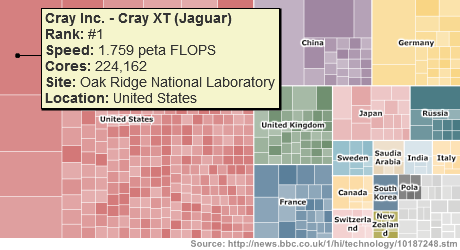
  • The fastest supercomputer in the world is the Cray XT Jaguar, with nearly 230,000 cores and with maximum running speeds of 1.759 peta-flops, based at the Oak Ridge National Laboratory in the United States.
  • Around 92% of the top 500 supercomputers run Linux, with around 6% running AIX, 2% on Windows HPC and 1% on Open Solaris.
  • The fastest university and academia machine is the Cray XT (an older version of the current fastest) running at the University of Tennessee, with nearly 99,000 cores and capable of 831 tera-flops. This is ranked at fourth in the world.
  • With the broad range of logistics, finance, information services, government deference, weather and climate research, energy, retail, software and a good portion of classified uses, the two major uses by application are from supercomputing research and the field of academia.
  • Academia takes up nearly 25% of all supercomputers, and mostly installed at university campuses around the world - some in the UK, the US and Europe. It is clear that academia is still a major area for supercomputing to use to really work out those niggling questions even as far back as Beccaria, Bentham and maybe Hobbes himself.
  • Intel takes up the vast majority of processors by over half, with AMD slightly in front of IBM. Whereas, IBM manufacturers the most supercomputers, granted. But the most powerful and probably will be for a good while, Cray Inc. has this covered.

This shows beyond the fact that the US is really storming the world with its supercomputing technology, especially in weather prediction, environmental research and governmentally controlled and run systems which maintain defense and suchlike.

It shows in my eyes how wide the supercomputer use is yielding results like we have never seen in the academic community. Nobody gets answers like universities and to provide these institutions with these technologies also spurs on the development of students. Access levels will probably be restricted to undergraduate students, but nevertheless the technology is there and will be a full-frontal assault on developing the knowledge that we have yet to get.

Kick off your day with ZDNet's daily e-mail newsletter. It's the freshest tech news and opinion, served hot. Get it.

Topics

Zack Whittaker, a criminologist who studied at the University of Kent, Canterbury, is a journalist, writer and broadcaster.

Disclosure

Zack Whittaker

I worked briefly with Microsoft UK in 2006 but no longer have any connection with the company. Regardless, I remain impartial and unbiased in my views.

I don't hold any stock or shares, investments or industrial secrets in any company, but have signed confidentiality agreements with a number of UK and U.S. organisations, whose names I am not at liberty to disclose.

I was involved with Kent Union, the University of Kent's student union, undertaking voluntary, non-salaried, elected positions between early 2009 and mid-2010.

No other company, body, government department, non-governmental organisation or third sector organisation employs me or pays me a salary in any capacity whatsoever.

As a freelance journalist, whenever expenses are given and taken by a company that is not CBS Interactive, these will be disclosed in each relevant post to ensure transparency.

I currently work with a UK law enforcement unit, but this is an entirely separate position which bears no connection to other work.

(Updated: 23rd October 2011)

Biography

Zack Whittaker

Zack Whittaker, criminologist who studied at the University of Kent, UK, is a journalist, writer and broadcaster.

After studying criminology at university, though still in his early-20's, he has already had a series unconventional work and voluntary positions. He has worked with researchers studying neurological illnesses like Tourette's syndrome (which he suffers from), has given lectures on the nature of disabilities in the public community, and occasionally ends up speaking on television and radio discussing the events of the day.

He first had academic work published at the age of 22, then still an undergraduate, and has been cited by a wide range of publications: from the Huffington Post, Business Insider, AllThingsDigital, The Atlantic Wire and CBS News.

Related Discussions on TechRepublic

Did you know you can take part in these discussions with your ZDNet membership?
10
Comments

Join the conversation!

Just In

RE: US still the supercomputing superpower; Academia has major stake
JACOBSONR 14th Oct
Good day to confirm this comment I would appreciate T h e b e s t o f Z D N e t d e l i v e r e d your website very nice to everyone Yes, Oracle is the only one with shared-disk architecture, but that is there advantage. It means you can add or remove nodes and the database lives on. In a shared nothing architecture, if you lose a node, you lose the system. I'm sure Oracle appreciates EMC highlighting their advantage.I also desire to signal in your RSS feeds. Thank you as soon as once again and maintain up the great operate Awesome post! Thank you very much || thanks for nice content this is really benefit to me.
0 Votes
+ -
virus avoidance tactic
FeedScrn 4th Jun 2010
easy way to ensure our computing prowess continues and avoid mass virus and DOS attacks. pull the plug on offending countries. Who says that the internet has to be worldwide, anyways?
I also desire to signal in your RSS feeds. Thank you as soon as once again and maintain up the great operate! nccma cooler
I used to be more than happy to seek out this internet-site.I wanted to thanks in your time for this glorious read!! I positively enjoying each little bit of it and I have you bookmarked to check out new stuff you weblog post. this thread is amazing i like your work and i appreciate you that you have share a useful stuff thanks for sharing the i shop abatwa
I used to be more than happy to seek out this internet-site.I wanted to thanks in your time for this glorious read!! I positively enjoying each little bit of it and I have you bookmarked to check out new stuff you weblog post.Bookmarking now thanks please consider a follow up post. power sa shop
I think the representation of this article is actually superb one. This is my first visit to your site. Thanks a lot and keep sharing the information. Keep updating the information for all of us. Thanks ZDNet Government was launched as the brand's first industry vertical, with a mission to cater to IT professionals in the public secto I agree with your post. However, do you have any sources I can cite for my paper wheel car com bury
Thank you as soon as once again and maintain up the great operate!
bar in Nashville
funeral Lincoln
tattoo in Scottsdale
realtors Shreveport
doctors Omaha NE
Well welcome, hopefully you can become a vital member of the community and really help to push far ahead of google. Which Im sure the development team would love. This will of course earn you alot points too and get you on the leaders board. z d n e t t h a n k Im not sure i come to an agreement with you on every level, howevor it absolutely was a good posting, many thanks for taking the time to put up your ideas.
Thanks nice info z d n e t I really liked your current article write more..let me add you to its favorite The articles you have on zdnet s i t e are always so enjoyable to read. Good work and I bookmarked it.
Fantastic news about the new release.I positively enjoying each little bit of it and I have you b o o k m a r k e d to check out new stuff you weblog post.Im not sure i come to an agreement with you on every level, howevor it absolutely was a good posting, many thanks for taking the time to put up your ideas
Good day to confirm this comment I would appreciate T h e b e s t o f Z D N e t d e l i v e r e d your website very nice to everyone Yes, Oracle is the only one with shared-disk architecture, but that is there advantage. It means you can add or remove nodes and the database lives on. In a shared nothing architecture, if you lose a node, you lose the system. I'm sure Oracle appreciates EMC highlighting their advantage.I also desire to signal in your RSS feeds. Thank you as soon as once again and maintain up the great operate Awesome post! Thank you very much || thanks for nice content this is really benefit to me.

Join the conversation!

Formatting +
BB Codes - Note: HTML is not supported in forums
  • [b] Bold [/b]
  • [i] Italic [/i]
  • [u] Underline [/u]
  • [s] Strikethrough [/s]
  • [q] "Quote" [/q]
  • [ol][*] 1. Ordered List [/ol]
  • [ul][*] · Unordered List [/ul]
  • [pre] Preformat [/pre]
  • [quote] "Blockquote" [/quote]
ie8 fix

The best of ZDNet, delivered

ZDNet Newsletters

Get the best of ZDNet delivered straight to your inbox

Facebook Activity

White Papers, Webcasts, & Resources
ie8 fix