What does Google's piracy 'nonsense' and an extradited student have in common?

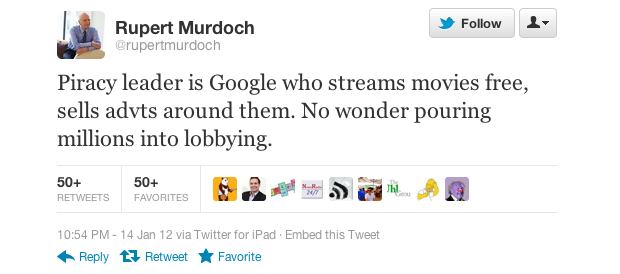
Rupert Murdoch, a recent addition to the Twitterverse with over 140,000 followers, has recently used the social networking site to fire allegations haphazardly against the search engine giant Google.
According to sister site CNET, Google has responded with disdain at Murdoch's tirade:
"This is just nonsense, last year we took down 5 million infringing Web pages from our search results and invested more than $60 million in the fight against bad ads...We fight pirates and counterfeiters every day."
Murdoch's decision to place the president and the Internet giant in the firing line is due to the SOPA battle still being fought in Congress, with its anticipated repercussions still fresh in the minds of the tech community.
The online war against SOPA continues, with the majority of the tech community and online corporations viewing the bill as a means to limit free speech, due process, innovation, and cause investment to dwindle.
The Stop Online Piracy Act (SOPA) is backed by numerous industries, including media corporations, music labels, and household names within the film industry. Supporters suggest the legislation is a means in which to protect copyright materials overseas -- therefore, perhaps, U.S. based law has the right to be enforced on a global basis.
Considering the scapegoat case of TV-Shack's creator, the UK justice system appears inclined to agree.
Murdoch stated across Twitter that Google was profiting from advertisements through pirate links, and furthermore, the Internet giant is a "piracy leader".
A report filed by the International Federation of the Phonographic Industry (IFPI), who represents music labels globally, chastised Google for not being tough enough in tackling illegal file-sharing and copyright infringement. 'Modest steps' have been made according to the report, but this is not enough to placate the entertainment industry.
As both the IFPI report and Murdoch insinuated, by directing results, search engines are earning revenue from sponsored advertising. However, I cannot see the link between generated revenue and pirate links being a central part of a search engine's function, nor does it seem to be an avenue that keeps profit margins high enough for CEO's to dine on champagne and oysters, cackling over their Rolls Royce being courtesy of The Pirate Bay.
Perhaps the future for search engines, especially if SOPA forces its way through, will be immediate liability no matter where the users are in the world. The barriers between international laws are already beginning to blur. The case of TV-Shack creator Richard O'Dwyer has demonstrated this more than ever.
The British student's website is thought to be hosted on a server in Sweden, and the .cc domain name belongs to the Keeling Islands. Without any solid and obvious connection to the United States, minus the fact that users of the service may happen to live there, it seems incredulous that the student lost his appeal and is soon to be shipped over as a politician's sacrificial goat.
TV-Shack apparently made more than $230,000 in advertising revenue, according to U.S. prosecutors. Even though the British student's website isn't illegal in the UK, and is little more than a search engine as it does not host pirated material, he is still facing charges of breaking U.S. law. O'Dwyer now faces the prospect of serving years in a U.S. prison.
This landmark case sets a precedent that law in one country expects itself to be imposed anywhere else in the world -- so we can all be culpable for crimes across the pond. Murder, perhaps, but acting as a search engine?
Should I be extradited for tweeting a link to The Pirate Bay, even though in my current country of residence I am not breaking the law?
So, where is the link between these two cases?
What SOPA does, since governmental and industry figures seem to have given up on targeting the perpetrators of piracy online, is focus on the connections between websites and services. So, in both these cases, the primary function of both services is to connect material and user, without hosting any of the suspected files themselves.Google falls within the scope of a service that offers links to pirated material, as does TV-Shack.
Murdoch's ranting personifies what many industries would like to press as opinion in the minds of those who have the power to instigate or rebel against the SOPA legislation -- that whether or not you host pirate material, if you have any connection whatsoever to it, you are culpable. So, forget going after the ones 'seeding' torrents, or allowing films to be downloaded off their servers, go for the ties that bind information and users together instead.
Perhaps one of the only reasons the British student is being trussed up for the sacrificial feast is to placate American authorities -- British law appearing to decide it falls under the hand of the U.S. justice system for the sake of foreign policy.
Large corporations are too heavy a target to hunt currently, so go for the individuals instead.
Wait until SOPA is in place, then target the major connective services -- perhaps Google or Bing's CEO will be next to find themselves in front of a U.S. judge.
Image source: Twitter.
Related:
- Google's SOPA press stunt: Can we truly hold them liable?
- ‘Guinea pig’ extradition case sets dangerous precedent for pirating Britons
- Google, Amazon, Twitter and Facebook consider 'nuclear' blackout
- Have we raised a generation of pirates?
- SOPA: Could the bill harm entrepreneurship?
- Would a Wikipedia blackout be such a bad thing?