Why enterprise networks run Windows, not the Mac

Summary: Have you ever considered why the Mac is so well suited to the home environment? Has it ever occurred to you why the Mac is great with multimedia, with fun stuff like graphics and movie editing, but not so great at the serious stuff?
Have you ever considered why the Mac is so well suited to the home environment? Has it ever occurred to you why the Mac is great with multimedia, with fun stuff like graphics and movie editing, but not so great at the serious stuff? With these, have you ever pondered as to why you very rarely see a bunch of Macs in an enterprise, corporate setting?
My esteemed colleague and friend, Chris Dawson, asks whether universities should be gently weaned off Microsoft products; Office and Windows included. Open source should be included in universities, and indeed they are. They are free, they are malleable and edited according to each institution's needs provided they have the time and money, and they promote entrepreneurship.
Apple have won awards for their "interesting" approach at advertising, winning the 2007 Grand Effie Award, with over 70 adverts to their name. They work in non-sequential continuity by comparing a Mac to a PC - or rather, Mac computers running Mac OS X vs. any other device running any other operating system, but always taking a petty jab at Windows. But what they have inadvertently done by pointing out that, even though Macs are more fun, "easier to use", more exciting to use and are great for the aforementioned multimedia items, it's not serious operating systems.
That to me, makes it sound rather unsuitable for an office, corporate, enterprise or university environment. They haven't just shot themselves in the foot, they've executed the Mozambique drill on themselves.
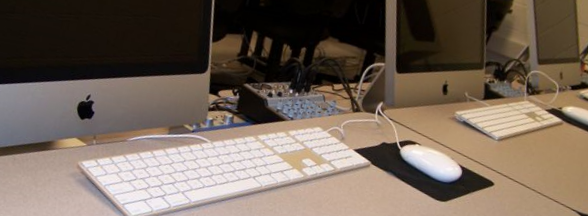
It's not to say that they haven't made some headway in the last few years. My university has a dedicated Mac lab on the Medway Campus, aimed primarily at the music and multimedia technology students. However there's only one reason why I can possibly comprehend why they have done this - equality. It's almost like segregation of a "race" of students not having a single Mac on campus. A fair number, no where near a majority though, of students use Macs and the majority of those have some design inclination.
The other, clearly obvious issue, is compatibility. No matter which way you look at it, even though Microsoft (on occasion) release software which is Mac compatible, the two companies just epically fail at making anything competitor-compatible. Steve Jobs once said:
"iTunes on Windows is like giving someone a glass of ice water in Hell."
Maybe so, Steve, but when the user interface is almost unreadable and when a sporadic blue screen of death comes out of nowhere, I would call that a gross screw-up on your part. Microsoft aren't exactly brilliant at designing/converting software for Mac but at least they get it half right.
But even still, most of the university-applicable applications do not run on a Mac machine. Boot Camp would allow you to use Windows on a Mac machine but then that would defeat the entire point; licensing issues are confusing and the hefty costs of the Mac hardware would render the entire project unfeasible, especially in this economic climate.
Windows has been around for decades, and took the early lead with ordinary lay consumers early in the computing market to ensure people started using it in the first place. Ever since Windows 98 came out, the marketing push had geeks nursing a semi and almost wetting themselves with excitement. With the cheap costs of Windows and the even cheaper and more economical cost of the PC in the late 90's meant schools were snapping them up faster than a fatty buying cakes in a bakery.
As a result, we have been forced to use Windows. Those who have gone their separate ways, parted with Microsoft and converted to the Church of Apple have done so with anxiety but eventually found their true calling. We all know how to use Windows and have been taught to do so since we were little nippers, so we automatically use what we are more comfortable with. This hasn't changed at all, even at university level.
One last thing, Mac has the fashion vote. Nobody outside the personal four walls of their home office or even their house cares about fashion, especially in the workplace. You want something that works, something that can be upgraded without lengthy deals or excessive costs. The fact of the matter is Apple put more money than sense into their Mac devices to make them look nice, rather than suitable in terms of costs for working or studying environments.
So, without going into the technical details of hardware specifications or in depth into licensing and building costs, it's clear to me why the Mac won't work in the enterprise. The iPhone does, and will continue to, but Windows and the two-decade old PC has firmly taken the seat at the top and won't be shifting until Microsoft cuts support for the last ever Windows operating system.
Don't hold back, you know you want to say something...
Kick off your day with ZDNet's daily email newsletter. It's the freshest tech news and opinion, served hot. Get it.
Talkback
Here's an asbestos suit.
Anyway...
The reason they don't succeed is down to three things:
1) TCO - ripping out your infrastructure to replace it with someone else's gear doesn't make sense unless you have to. Since good PCs and Macs have the same lifespan on average (no surprise since they use the same components) and most corporate arrangements tend to favour three to five year leases MS would really have to balls up to open the door to other providers.
2) You have a choice of precisely one hardware vendor. Bang goes any competitive leverage there then!
3) All the good business applications - well, all the ones that are actually used anyway - are geared to Windows,
This kind of sucks but it's really Apple's own fault - they had their chance and blew it.
Here's why
Strike 1.
Corporate customers want document automation system. M$ has one (Office + Sharepoint). Apple has none.
Strike 2.
Corporate customers don't wanna overpay IT charges under this economy. Windows machines are easily 300 or 400 less expensive.
Strike 3, Apple is out.
Very logical reasoning
it seemed like everything was oracle db a few years ago.. but
im a contractor, so i move around alot.
Considering most IT...
At one place I worked at we actually considered Oracle, but after comparing prices and learning curve, we ended up just going with SQL.
Very silly reasoning
quality SQL servers. It's silly to contend that the MS SQL server is the
only one on the market, therefore Macs aren't ready for the enterprise.
Are you guys listening to yourselves? :)
You mean $teve Job$
I think you nailed it with #2
And that's the scary part. What if after you converted your entire company (or stated up your company) with Apple products, they could turn around and double the price of their hardware next year.
It's not like you could tell them to take a hike, you'll now run your OSX and business apps on a Dell, or HP, or Acer, or Compaq, ect.
you mean like Microsoft has done
Worse, Microsoft "delegates" responsibility onto the individual OEMs
Such "delegation" (let's try "shifting responsibility because we're all rich and fat greedy wankers") is the attitude of an indolent toddler.
You've never called an OEM.
"delegation", "shifting responsibility", or the more commonly quoted "vendor fingerpointing" occurs in help desk support regardless of vendor. Call up Canonical and demand a fix for having to run windows only programs from Adobe in wine, watch them point you to Adobe for your request.
Far more often than not, the indolent toddler in the equation is the customer, not the vendor.
Google funny help desk calls for countless examples across the industry.
Oh dear...
Remember we're talking about commercial arrangements, not individual users. We have defined contracts with BOTH HP (our current hardware supplier) and MS with defined SLAs and penatly clauses for failure to adhere to those SLAs. This is an industry wide practice.
People like Hypnotoad obviously do not and have never worked in IT, particularly a desktop support environment, or they wouldn't be making such stupid and unfounded statements.
whatever ~
or allow outside devs to tackle it, without the threat of lawsuits.
Steve Jobs.
BTW, if Jobs was smart, he would have thrown his pride out the
window when OS X Tiger came out and sold it for anyone with a
Pentium 4 or better, or AMD64-based PC. Then two things might hold
true - Intel would have VR enabled on all the Core 2 based processors,
and the OS X netbook would have already happened. I'll agree that OS
X wouldn't have the kind of marketshare that Windows has, but had it
been legal to install on Dells, HPs, Lenovos, and other computers, the
OS X marketshare would probably be somewhere around 20% today,
instead of just under 10%.
As brilliant as the man is in marketing and getting his people to
combine 3 or 4 technologies to make what he calls a breakthrough
device, he just doesn't have the best business sense. Bill Gates was
right in saying Apple should have licensed Mac OS to other
manufacturers back in the 80's. Hindsight is 20/20 however.
If..
You miss Apple's main selling point
People who want the ease of computing without the BSDs associated with DLL failures will choose Apple and gladly pay extra for it.
Besides---corporate America was never a part of Apple's marketing strategy.
Err...
Not the same.
You can...
Which is the point...
Virtualization of OS X
Apple hardware and only with OS X Server.
As for the whole hackintosh thing, the lawsuit and EULA haven't stopped
our good friends at Psystar from making machines running OS X targeted
specifically at business, such as a rack-mounted unit running desktop OS
X. I hope the people that buy those machines for production use enjoy
having to deal with updating a hackintosh, however - it's possibly one of
the most nerve-racking things you can do.