Your grammar is terrible. Get off Facebook

Mobile phone use and the popularity of social networks are often blamed for students who don't possess a good understanding of grammar. However, can we truly blame technology for poor writing skills, or are there other dominant factors?
How many things are wrong with the sentence below?
"I can'r stand people that dont know the difference between your and you're. There so stupid."
My Facebook feed is a continual stream of grammar train wrecks. This is simply one example of what many Internet users view with occasional cringing or a perhaps a pregnant pause to decipher a particularly perplexing status update.
There are a number of campaigns against bad grammar online. Dedicated in seriousness or as simple parodies, the complaint against poor grammar and spelling is a persistent one.
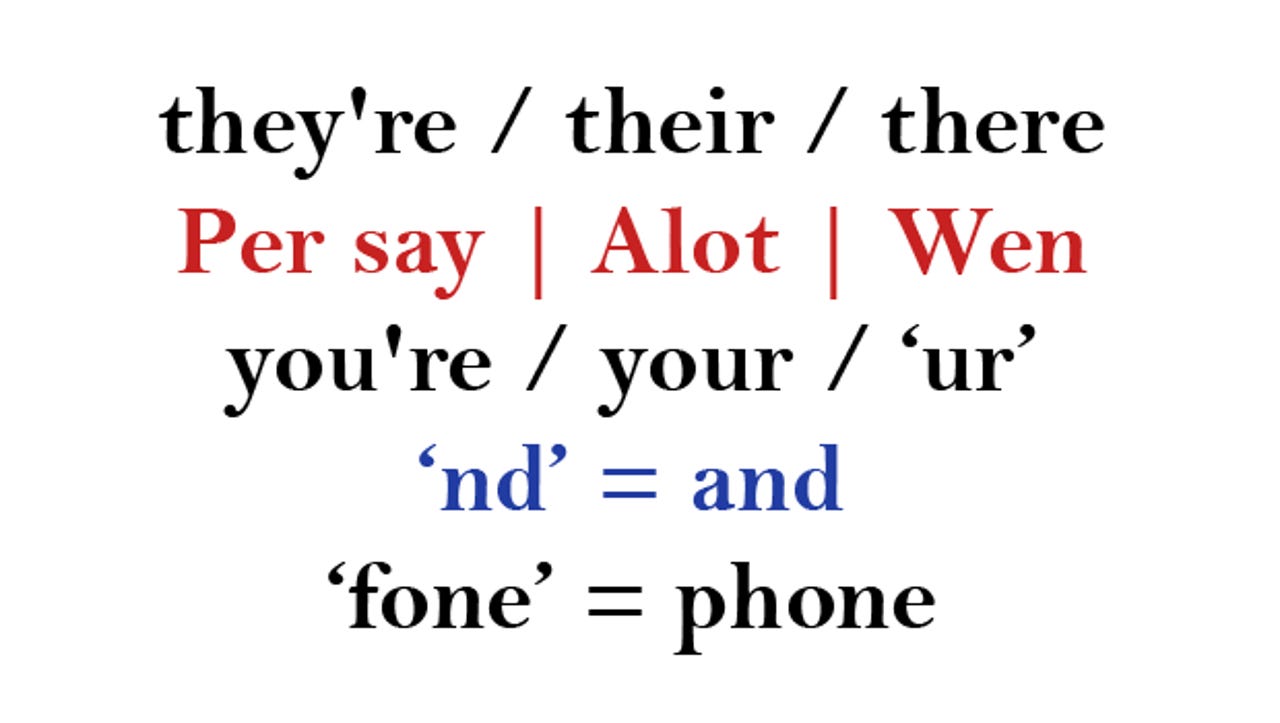
Academics are among those who complain about the low level of basic grammar knowledge in entry-level students.
Paul Budra, an English professor at Simon Fraser University, said: "Punctuation errors are huge, and apostrophe errors. Students seem to have absolutely no idea what an apostrophe is for. None."
Professors find emoticons, butchered words and poor grammar knowledge in coursework and exam papers. Employers find spelling mistakes in resumes, and perhaps if they're particularly unlucky, the occasional smiley-face.
But can we blame technology for this? Facebook and Twitter, naturally it's your fault.
It's a stretch to sensationalise and blame illiteracy on mobile devices or online networks. As I recall, my first encounter with a 'smiley' was in primary school, used as a replacement for 'well done' -- and not through a Twitter feed.
The use of imagery as word replacement and shorthand is ingrained in the way we are taught in school. Smiley faces are used in primary, acronyms like 'RW' for 'reword', and 'imp' for 'important' litter marked essays in high school.
Extensive peer grading is used to save time, and although this has benefits, it is unlikely grammar mistakes and other classmates will pick up spelling consistently.
For my English A-level exams, I scored 95--100 percent across the board. However, I spelled 'February' wrong until I was in my twenties. This wasn't picked up in the ten years or so at school I had to write the full date in the right-hand corner of my workbook.
In the same way that you learn a second language, peer correction is a necessary component in improving grammar skills. (I still have nightmares over some incredibly cringe-worthy mistakes I made whilst learning Spanish). But this method is generally used in schools for marking answers to questions, and not to check writing quality in itself.
If social media platforms are now used as a main method of communication among younger generations, can it also be an unconscious way of enforcing poor grammar skills? I am yet to see anyone correcting grammar across Facebook -- unless it's imbued with sarcasm.
It is becoming a normal mode of behaviour online and through mobile devices to ignore punctuation, capitalization and grammar rules. This may be simply because it's possible to use 'lazy English' without censure, or when texting it saves space and money. Or, pure laziness in itself.
I use text speak. I branch out with the odd 'LOL' or 'OMG' -- and yet I am still able to string together a sentence, and keep my resume free of spelling mistakes.
Lady Greenfield, professor of synaptic pharmacology at the University of Oxford, believes that social networks promote 'infantalising' young users' communication skills.
The professor's case suggested that 'less sophisticated' children find it hard to separate communication online and in real-life situations, and that teachers complain of social networking influencing schoolwork.
Perhaps it does to an extent. But in a school system where dictation is rare and time is spent spoon-feeding concentrated doses of 'how to pass an exam' instead of basic skills, what can you expect?
In the UK, it is only from next summer that students will be penalized for sloppy grammar in English literature GCSE exams -- and even then, only up to 12 percent of their final mark. If we're taught proper spelling and punctuation isn't that important, how can we rage when students use it poorly online?
Grammar isn't given a high priority in Western school curriculums. It wasn't until I trained as a teacher that I was given any basic training in grammar, or had even heard of a preposition. Latin classes no longer existed in public school. When I began, I had no idea what the tenses 'present perfect' or 'past simple' were, let alone an understanding of irregular verbs beyond what I knew due to being a native speaker.
I wasn't the only one. Everyone in the course met up to complete our language assignment -- struggling through grammar explanations that we were then expected to teach the next day.
When I asked my tutor why grammar wasn't extensively taught in British schools, he replied: "You know how to walk, don't you? Why would I bother teaching you how it is you walk when we have exams coming up?"
If younger generations aren't taught basic grammar skills in schools, then we cannot expect standards to improve.
For future job prospects, this kind of attitude can have serious detrimental consequences.
Don't get me wrong. As a teacher, nothing annoyed me more than poor spelling and grammar. But I didn't point the finger at Twitter or Facebook. Nor did I point it at my colleagues. I pointed it at school systems that don't incorporate enough grammar, and a saturated exam syllabus that allows little time for teachers to actually teach basic skills.
If continual links are going to be placed between social networking and grammar standards, perhaps sound empirical research should be performed on what is actually a complex issue -- rather than taking the easy approach and blaming technology that happens to be popular with young generations.