ie8 fix
madison

How LCD makers lie to you about viewing angles

By | December 17, 2007, 7:44am PST

I was in a large computer store looking at computer LCD monitors and a lady was asking about which one was the better one to buy.  A man (presumably her family) told her that the ones which indicated TFT (Thin Film Transistor) were the ones to buy.  I then interjected that everything was TFT and it’s been that way since the extinction of those ugly STN passive matrix LCDs 8 years ago they use to sell with the cheaper laptops.  Of course this invariably invited more questions as to which LCD was the better buy and better quality so I spent a few minutes showing them some of the shortcomings to many of these displays.

The first thing I noted was the poor viewing angle of every LCD on the display with the exception of a single model.  To see this in effect, simply lower your head a few inches in front of the monitor and you will see the brightness of the entire display dim dramatically.  Looking at the display from the bottom makes the image almost darken to the point of being black with some weird hues showing.  Many of these displays don’t even look right when viewed at a slightly down angle since the color will change drastically.  Case in point, look at the photos below of a typical LCD monitor which uses the most common TN (twisted nematic) technology.
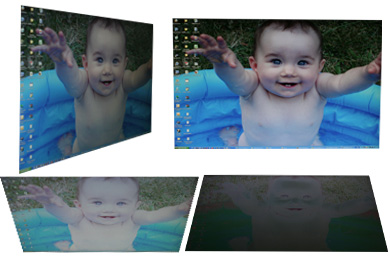

Photo credit: Vincent Alzieu of BeHardware.com (quality review)

What’s extremely frustrating is that the manufacturer claims that this display has a vertical viewing angle of 160 degrees.  Yet the image above came from a photograph shot at 50 degrees above and below which indicates a 100 degrees spread.  If we wanted to be extremely generous, we could say that the top-down view pictured bottom left is barely acceptable (it isn’t as far as I’m concerned), but the bottom-up view is flat out atrocious and there is no way in hell you can tell me that’s an acceptable image at this viewing angle.

In reality, the usable viewing angle of this display vertically is about positive 35 degrees to negative 10 degrees at best and that’s being generous.  But looking at the vendor specifications, there is no way that you as the consumer would know this when you’re making the purchase.  Now I don’t have a problem with the actual specs at the price they’re selling it at, but I do have a big problem with the deceptive advertising.

Only one of the LCD monitors out of about 30 models being shown on the show floor was viewable from all angles and it was most likely using PVA (Patterned Vertical Alignment) technology but it was about 30% more expensive than other displays of comparable size.  It looked like something like the image below which is actually quite viewable at any angle.  Furthermore, these displays typically offer true 8 bit per color or even 10 bits per color whereas the TN type displays are limited to 6 bits per color.


Photo credit: Vincent Alzieu of BeHardware.com (quality review)

So the old adage that you get what you pay for holds true when it comes to LCD monitors, but manufacturers need to be honest with their customers.  I purposely avoided singling out any single manufacturer because they all do the same thing, but this kind of deceptive advertising needs to stop.

Poll

Do you feel deceived about LCD viewing angles?

Kick off your day with ZDNet's daily e-mail newsletter. It's the freshest tech news and opinion, served hot. Get it.

Topics

Disclosure

George Ou

http://blogs.zdnet.com/Ou/?page_id=557

Biography

George Ou

George Ou, a former ZDNet blogger, is an IT consultant specializing in Servers, Microsoft, Cisco, Switches, Routers, Firewalls, IDS, VPN, Wireless LAN, Security, and IT infrastructure and architecture.

Related Discussions on TechRepublic

Did you know you can take part in these discussions with your ZDNet membership?
125
Comments

Join the conversation!

Just In

laptops included
justincase@... 22nd Jan 2008
This is esp. evident in "media center" laptops.
My Hp has a stiff hinge, so it is maddening to try to get it tilted at "just the right" angle to have a proper view for a movie. And if 2 people are trying to watch the movie at once with different eye heights, don't even try to find a happy medium for the two of you. Someone just gets stuck with it way too dark/light
0 Votes
+ -
That's why...
CowLauncher 17th Dec 2007
you really need to go to the store a look at them in action.
0 Votes
+ -
What if you don't live by a store?
georgeou 17th Dec 2007
What if you don't live by a store? Do you think the manufacturer should list "160 degrees" as the vertical viewing angle?
0 Votes
+ -
Then you don't have that advantage
nucrash 17th Dec 2007
This comes with the territory. The next best thing would be to google the terms. If you don't know how to do that or are incapable of figuring that out, ask some one besides a salesman.

A salesman's job is ultimately to get rid of merchandise. Whether he sells you junk or not does not always bother him.

http://www.google.com/search?hl=en&q=LCD+Monitor+reviews+&btnG=Search

Granted, the audience may not always consider this information. When dealing with consumers that want to know what computer to buy, I have started to steer them into searching on their own. I love knowing all the information, but I am finding that looking everything up for people is becoming too time consuming. So to teach them to look things up for themselves is usually a better suggestion.
Buy you know darn well that 99% of the public can't or won't. They just buy based on what the marketing material says. So what I'm saying is that vendors have to be honest and we need a standardized benchmark to give out these metrics.
0 Votes
+ -
I do agree on standards
nucrash 17th Dec 2007
I won't argue about being held to a standard and having truth in advertising, however, people still need to take some responsibility for their purchases.

I do want a world where I can go to a store, look at a monitor's specifications and know whether or not the monitor is better than another monitor.

For that matter, I want to be able to go to the store and look at an HP Turion system and see how it compares to the HP Celeron system. For that matter, I think there needs to be a standardized benchmark applied to computers where I can tell a manager, "This computer is faster than That Computer."

Benchmarks are great, but they are only good for the "Top of the line systems" and rarely seem to be used for a run of the mill laptop. I could have a Core 2 Duo 2.8 GHz system with 4 GB of RAM and a 40 GB 4000 RPM disk. If I look up the performance specs on the processor, I will think that laptop is the end all be all. But I would be cursed at the second I get the system for how slow it is.

Why stop at LCDs? Let's get an entire set of standards for all things computer related. If you sell a System, place a SPEC benchmark on it. No more of this, "Is HP better than Dell, IBM, or Apple?"
0 Votes
+ -
What WAS the brand/model of the monitor that looked so good? C'mon... clue us in.... please.
0 Votes
+ -
The link is an excellent review
georgeou 17th Dec 2007
The link I posted below the photo is an excellent review, I would highly recommend reading it for all the details.
0 Votes
+ -
Marketing materials are irrelevent...
sframberger@... 20th Dec 2007
Consumers fall asleep the moment they set eyes on any marketing brochures and stated specifications, since it's all gibberish to them.

The only thing they look at is price and size. The bigger and cheaper, the better.

Viewing angles? If you just plan to look straight at it on a desk, those are irrelevent.

Us geeks care. Everybody else does not.
0 Votes
+ -
Viewing angles are most definitely not irrelevant. Your eye to the top of the display and to the bottom of the display forms a line of sight of about 20-30 degrees. There is a noticeable change in color and brightness from top to bottom. In fact on some webpages where there are subtle color differences, I actually have to drop my head a few inches or raise a few inches to see some of the details.

The color isn't the same and the crappy monitors have fake artificial color and not natural/vibrant color. Maybe you don't care about that but please don't say it is irrelevant.
0 Votes
+ -
Lots of People Care
pj_mouse 21st Dec 2007
As an artist I care if the values and hues are off. I've had a bad monitor before and was quite shocked to finally see some of my work on a better one. I don't do that for a living but if I did I would likely have some upset customers if they'd received the work I did on the bad monitor.

As a desktop publisher, I care if the colors are off. I want something onscreen that's comparable to what the customer is going to get on paper. Often specific company colors are needed and they'd best be right. You don't always get the RGB values along with the job.

Anyone editing videos for home or business would want to know that what they see on the computer is going to look like what they put on a DVD and view on a display elsewhere.

People do a lot more with their computers than just email and casual surfing. Lots of us work with visuals.
0 Votes
+ -
I agree with Pj mouse, this is important to many people. I just have to add the rest of us pot heads, gamers, anime freaks, online social networks, virtual lives etc, etc.

People watch movies on their laptops and many times they watch movies with a significant other and sometimes a whole cypher of burnouts. Angle is very important if more than one person is trying to enjoy a movie.

Gamers bring their laptops to gaming networks or hook it up to a friend's network, etc. And to them the angle is very important, also for the other friends and family who just want to watch and not play. They invest top dollar for a video card and processors - of course they care about manufacturers lying about the capabilities of the monitor.

Then you got the digital comic book community. A comic book on wide screen trubrite laptop monitor is one of the most beautiful things to witness in this ever expanding cosmic Universe.

And what of the kids making social network personal pages. They go nuts adding all of these corny graphics. There already are free services that give you flash templates for those social network sites. They work with visuals too ... perhaps even more so. Parents should put them in a martial art school or something.

I have also noticed a new trend in socializing between friends and family. How often have you heard this?:

... "Did you see this video on 'whatevertube'?"

And then you answer ...

"No, I also have to show a few online videos myself, but after you show me this". The quality and specs of the monitor is important to everyone.

So yes this was a great article and even though my monitor is really nice, I still feel the outrage for every one getting cold hustled this way. I think the author and this community should call out some companies even if we don't get them all. Writing an article like this is leaning towards consumer advocacy, and I think the author should take a harder stance. You won't be alone. There will always be hundreds of people posting their support.
0 Votes
+ -
Color-accurate and calibratable LCDs do exist, but are considerably more expensive. Also, CRTs have the advantage of not having a native resolution to lock you into. You can switch screen resolutions without having text get all blurry and/or jaggy (the scaling algorithms have improved recently, but text and line art is still not as clean at non-native resolutions than at native resolutions, and while ClearType™ [Microsoft®] and CoolType™ [Adobe® Acrobat™] algorithms do increase clarity at the native resolution, they make things worse when the resolution is scaled at all).

In all other respects, LCDs are better. They’re always geometrically perfect, without having to resort to pincushion, trapezoid, etc. controls (and even with those I have yet to see a CRT capable of displaying a straight-edged, linear-sized rectangle all around the borders of the screen). They are capable of using ClearType/CoolType. They use less power (critical in these days of impending Hubbert’s Peak [look it up but only if you can tolerate learning something that is extremely depressing]). They generate less heat, which means that (except in winter) your office air conditioning also uses less power.
0 Votes
+ -
Read the return policy
sykandtyed 18th Dec 2007
0 Votes
+ -
Give me break.
frgough 19th Dec 2007
What if you don't live by a store? This isn't Uganda.
0 Votes
+ -
I live 50 minutes from the nearest tech store. And I'm close by. Many people in my area live hours away from one. I can go to Walmart, but everyone knows that if you are serious about getting decent equipment, you have to go to the right store. What if you use Apple products? I live 4 hours from the nearest Apple store.

Just because we live in a country that has stores doesn't mean that 90% of the population living rural areas has access to all different kinds of them. Your inability to recognize that not everyone is like you doesn't change facts.

Since you never have anything good to say, why do you even bother to read this blog? You are so close-minded and ego-centric that I am starting to understand that you honestly believe that if it's okay for you then it must be okay for everyone else, and if you don't like it, neither should anyone else.

They have cults for people like you, you know.
0 Votes
+ -
I'll bet you don't live 50 minutes
frgough 21st Dec 2007
from a wal-mart.

LCD panels are in more places than just tech stores.
0 Votes
+ -
Seeing sets in the store may not help
frabjous 22nd Dec 2007
I read in another forum that stores sometimes (?) tweak the higher-priced
sets for the best display, while leaving cheaper sets at the default settings. It
would be a pain to figure out how to change each set to default, and make
the change, so as to compare sets equally--but it could avoid
disappointment. Another problem seems to be that at least some
manufacturers optimize displays for the fluorescent lighting in stores--and it
might look too red, etc., in your home with incandescent lighting. Buyer
beware!
I remember reading in one of these TalkBack threads about a customer who went to a major national chain store specializing in technology, who read the specs on a computer for sale. It said that the graphics card was a DirectX9-capable NVidia GeForce or ATI Radeon X or some such. He ran ?DXdiag? on it, which reports the actual DirectX hardware. It was a low-end Intel motherboard integrated graphics chip, incapable of decent frame rates on even low-end 3D games these days.

He was ejected from the store and forbidden to return for doing that. That sort of thing is actual criminal fraud on the part of the store. I hope he sued their @$$e$.
0 Votes
+ -
It's a minor thing
dave.leigh@... 17th Dec 2007
George, the deception here amounts to a non-issue in that the screen is the one thing you really see right there in the showroom. You've got a row of laptops, and the single most visible aspect is the screen. Other than to see what the hard resolution is I don't much look at that spec.

I suppose it could be an issue for those that buy on-line, but I wouldn't do that without going to a brick-and-mortar to check it out in person first. This is because I want to feel the keyboard, try out the pointing device, and feel the heft of it.

Given that 3M are selling privacy screens to CUT DOWN the viewing angle, isn't this a bit of a tempest in a teapot? (At least where laptops are concerned. Large screens intended for audiences are another matter.)
0 Votes
+ -
While I agree that viewing angle is ...
ShadeTree 17th Dec 2007
... a major issue for LCD TVs I don't believe it is as much an issue for comuter monitors. The reason being computer monitors tend to be directly in front of the user at a distance of between 18" and 24". They are normally at eye level or can be tilted for direct viewing. TVs on the otherhand tend to be viewed from much farther away and at more extreme angles. Just my 2 cents!
It is a big issue just by adjusting the screen a two degrees. On most of these laptops, I can't see the highlight details or I can't see the shadow details. If I want to see highlights, I have to pull the LCD towards me 2 degrees. If I want to see shadow details, I have to push the LCD away 2 degrees. Just dropping your head a few images causes the entire screen to dim. Furthermore, only one part of the screen can be perpendicular to your line of sight unless you're at infinite distance from the screen.
0 Votes
+ -
I don't know where you saw laptops ...
ShadeTree 17th Dec 2007
... that varied that wildly over 4 degrees. I think you might be exagerating to make a point.
0 Votes
+ -
I never said "wildly", you did
georgeou 17th Dec 2007
I said in order to see subtle shadow detail or highlight detail, I had to adjust the viewing angle slightly.
... swing qualifies as wildly! Let's not mince words, okay?
0 Votes
+ -
But it does lose detail and that's a quantifiable and noticeable fact, but I never said wildly.
0 Votes
+ -
words, standards
dhays 18th Dec 2007
The word is losing, not loosing. Totally different meanings.

Standard descriptions, and specifications would be nice.
Just like in the sixties on amplifier power RMS or peak? Or FM sensitivity to determine reception capability. I think it was microvolts, the less the better, if I remember correctly.
0 Votes
+ -
losan
ýlysdexia 1st Jan 2008
?
0 Votes
+ -
Hey George if Dynamic range is that critical then why did you switch to LCD..
You do know that there isn't an LCD display made that comes close to matching the dynamic range or resolution of a CRT. In fact last time I checked the best LCD TV's available only managed about 50% of the dynamic range of a decent CRT. Of course us professional photographers have know this for quite sometime. If you are looking at seeing the maximum detail all the way from the deepest shadows to the brightest highlights then you better just forget LCD it can't do it. Picture quality is not an LCD strong point in fact the only benefit to an LCD display is size and power consumption.
Geometric precision. The locked-in native resolution to a fixed pixel grid, while it has disadvantage (any non-native resolution looks blurry and/or jaggy from scaling), it is nice to know that what looks like a rectangle on your screen really is a rectangle. LCDs do not have, nor do they need, linearity, pincushioning, trapezoidal distortion, parallelogram distortion, corner pinning, etc. controls. CRTs do, and even with those, I have yet to see one display a truly straight-edged and right-angle-cornered rectangle that nearly fills the screen.
0 Votes
+ -
It can be.......
linux for me 18th Dec 2007
If you where bifocals, and have to tilt your head up and down to see through them, then there can be a problem with these screens. I know, because I wear bifocals. And does get to be a pain to readjust the screen every time you shift positions.
0 Votes
+ -
words
dhays 18th Dec 2007
wear?
0 Votes
+ -
Seems I proved my own point! (NT)
linux for me 18th Dec 2007
NT
0 Votes
+ -
How many people buy those 3M filters?
georgeou 17th Dec 2007
I only knew one person that bought one for $100 and he stopped using it in a week. Besides, this is vertical viewing.
0 Votes
+ -
How many laptop screens don't tilt?
dave.leigh@... 17th Dec 2007
You're right in that it's vertical viewing; however, all laptop screens tilt, and your hands are scant inches from the screen.

In principle I agree with you; everyone should tell the truth, the whole truth, and nuthin' but the truth. However, 1. I know they don't; 2. I can see it myself; 3. the screen tilts . 1+2+3=this is a minor thing.
0 Votes
+ -
Used to use one
Azathoth 18th Dec 2007
I used one of those filters with a 19 inch CRT monitor at my old job, but it really dimmed down the display, even when viewed straight on. Now that I'm in a Healthcare related position I've seen several places where such filters would be good from a HIPAA standpoint. However, most of the people I've seen use them have them to hide their internet surfing from their boss.
0 Votes
+ -
Mout Point
cybr2th 20th Dec 2007
So, we should all hover over the monitor to simulate real world conditions?
Who cares if you can't hover over it and see it?

I bet if its laying flat, screen down on a desk, your viewing angle will suck too, but c'mon..these screens are made to be seen head on. I dont know a soul that when I tell them to watch my youtube video, they get on the floor under my desk to watch it.

If you want viewing angle, get a 36"+ flat screen TV, mount it to a wall and your done.
0 Votes
+ -
Almost a daily request...
devlin_X 23rd Dec 2007
I am asked almost daily for privacy screens. Many places that handle sensitive or personal information in public/semi-public areas use them a lot.

I was surprised when I first saw how much those things were, and to think the old LCD did it for free.....
0 Votes
+ -
great reporting George
Linux Geek 17th Dec 2007
I was not paying too much attention to the viewing angle so far.
It is indeed deceptive since today most TVs claim 170 viewing angle.
Another fake manufactured number is the contrast ratio that has no standard way to measure in the industry.
There is a standardized way to measure, but they don't follow it. You see these outrageous claims with outrageous contrast ratios and it's all nonsense. You pretty much have to rely on review sites like the one I linked to for any kind of detailed information.
0 Votes
+ -
The complete specs are lies.
slopoke 17th Dec 2007
As you point out the viewing angle is misleading. The number of colors is lied about by claiming the number of color after pixel dithering (6 bit - 16 million) instead of the true number of colors (8 bit 16.7 million):
http://compreviews.about.com/od/multimedia/a/LCDColor.htm

The contrast ratio spec is a lie:
http://www.pcworld.com/article/id,110483-page,1/article.html

So is the refresh rate:
http://www.pcworld.com/article/id,121906-page,1/article.html

In reality there are three majot types of LCD panel; S-IPS, VA and TN with the TN ones being by far the most common (and cheapest). Within each type all the specs are pretty much locked in although over time they all improve.
http://www.pchardwarehelp.com/guides/lcd-panel-types.php

Oh, and the vendors dont' tell you which type of panel they are using even the high end ones.

So there's no truth in advertising with any LCD display spec.
0 Votes
+ -
The entire industry is a lie
dave.leigh@... 17th Dec 2007
Look, computer manufacturers routinely confuse decimal and binary capacities for storage, memory, etc. Damned near every PC component you buy is marketed with "lying" specs. The lawyers have noticed:
http://www.betanews.com/article/Western_Digital_Settles_Capacity_Suit/1151510648

But it's not just high-tech. Food packagers routinely confuse calories and kilocalories. When I buy a suit, am I getting the whole nine yards? Probably not, I'm kind of short. Airspeed rarely coincides with your actual speed. Metric tons aren't tons. And the world hasn't stopped spinning yet.

George does a great job of education here. But I'll let everybody else go nuts over it while I file the information away in the interests of becoming an informed consumer.

But think of this: your best defense against deceptive manufacturers' claims is to go and look at the products you want to buy. If everybody's lying, then making them tell the truth won't magically improve the viewing angle, refresh rate, contrast value, or color, (or gas mileage, for that matter). They'll be the same tomorrow. So buy on the basis of what you see, even if you buy online. If you can't go and see for yourself, buy on the basis of third-party reviews (like consumer reports, or George here). But don't buy based on what the marketing department included in the brochure.
0 Votes
+ -
metric
dhays 18th Dec 2007
good point.
I have a beef with the metric system in the common use of grams and kilograms for weight measure, when they are not. A gram is a gram no matter where you are--Jupiter, Mars, Earth, the moon, etc. but it will weigh more or less where ever you are. It is a measure of mass, not weight, weight is a measure of mass being acted upon by a force, in this case gravity. It should be in Newtons or dynes, depending on whether you are using the Kilogram-meter system or the gram-centimeter system.
http://en.wikipedia.org/wiki/Mass_versus_weight or any good Physics text.
0 Votes
+ -
In a sense
alaniane@... 18th Dec 2007
yes; however, most gram measurements used for weight are implied to be the weight of 1 gram of mass taken at sealevel at the equator (to be more precise). The fact is measurement systems are relative to begin with. Even the numeric system used is relative. A billion in the US is 10 raised to nineth power whereas it is 10 raised to the twelfth power in Britain. That's why we speak of the earth having around 6 billion people and the English say that it has around 6000 million.
0 Votes
+ -
Good Observations
EBathory 18th Dec 2007
What counts is the "Big Sell". My husband kept saying that a 50" TV was too big until I explained to him that with HDTVs especially you can't think of the size alone as manufacturers have creative ways of measurement. If I were to put an HDTV 32" side by side with my 32" CRT TV, the latter would look way bigger.

Read as many 3rd party reviews as possible. Then go see and judge for yourself. Everything is not always as it is put forth to be.
0 Votes
+ -
I doubt that they don't follow the standard, I think that this is really more of a question of having a clue with ?viewing angle? really means.

The actual industry definition is the included angle when viewed from the side where contrast ratio drops to 5:1. It has nothing to do with color, or up/down viewing (I did a little measuring at my desk here and to view my displays at a 35* angle from below I?d have to be sitting on the floor under my desk with a transparent desk, not sure how useful that is or if my boss would tolerate it) or for that matter, most of what was mentioned in your review.

In essence contrast ratio is just a measurement of the difference between white and black and strictly a measurement of brightness. 5:1 means that when the screen is totally white it?s 5x brighter than when it?s totally black.

Now for those of you real world people that think like ?he?s thrown out numbers, but what does that mean to me?? Well, most good LCD?s have contrast ratios of 800:1 or better head on (and that?s somewhere around where most people will really start having problems distinguishing the difference between really dark, dark grey and black, no light coming from the display and vice versa at the white end). Really good displays (you might have one of these if you do desktop publishing or video editing for a living) will be at 1000:1 or more, and if it _really_ matters to you you?ll have a CRT monitor which have much higher contrast ratios.

Anyway, if you compare the typical 500:1-1000:1 contrast ratio to the 5:1 where viewing angle is measured, the point is that viewing angle ends up being the included angle where the difference between the brightness of white and black is somewhere between 1/100th and 1/200th of what it is head on.

Back to being an informed consumer, this ends up being a big ?who cares.? It?s just a big number they can put on the box to impress those that don?t know what it means. So what is a useful number? I?d start with the contrast ratio, I would recommend that most people look for something over 600:1, and Samsung and a few others make cheap displays that look great that are mostly over 800:1 (surprisingly, dell branded displays can be quite nice, their big ones are reasonably priced and some get into the 1000:1 range). From there look for the interfaces you need, a reasonable layout and controls that are reasonable. If color is really an issue for you, you?ll find that between most modern displays that have already met the standards that have met these simple standards + a decent, modern video card, you?ll have more than enough adjustment to get the colors where you like them.

As far as professionals that spec these things out for commercial use... well you shouldn?t be asking the question, you should know a lot more detail than this.

-Mark
0 Votes
+ -
The Facts Help
apoor 19th Dec 2007
Mark, thanks for posting the details that were omitted from the original story. Yes, the industry is consistent in how it measures viewing angle. No, this measure does not correlate at all with end user experience. This is the same as is the case with contrast ratio. But this is nothing new; cutthroat competition destroyed other specs over the years, too, such as laser printer resolution and CPU chip "speeds".

Just remember that manufacturer specifications are there to make you want to buy that product, not educate you. (The exceptions are the closely regulated specs like car MPG and energy consumption of appliances, which themselves are still open to criticism.)

Alfred Poor
hdtvprofessor.com
0 Votes
+ -
Ambivalent?
techboy_z 17th Dec 2007
I have never felt deceived, but I guess I've never made viewing angle a top criteria for my purchase. For one thing, I'm usually sitting right in front of my display, rarely working with others near it, unless I'm docked and have another dual display connected. My primary criteria these days tend to be CPU, memory, battery life, weight, fully keyboard layout, wireless spec, etc. The displays are all pretty good these days, IMO, and viewing angle could be considered a "spoil me" criteria, almost. In fact, with privacy concerns, I'm almost wondering if a wider viewing angle is even desirable?

Nonetheless, kudos for some good reporting...I'm honestly not always a fan, but you did a decent job of explaining a few things on this that I was not aware of.
But you can't see highlights or shadow without adjustments. The problem with these TN displays is that just by dropping your eyes a few inches makes the entire screen dim. This lets you see the highlights better since it's dimmer. If you want to see the shadow detail, you have to be looking slightly down at the display. So we're not just talking about 50 degrees viewing angles with drastic color changes, we're talking about minor 5 degrees adjustments that result in less dramatic changes in the image.

You also have to remember that these TN displays are 6 bits per color so the color quality sucks.
0 Votes
+ -
"In fact, with privacy concerns, I'm almost wondering if a wider viewing angle is even desirable?"

All these displays can be viewed from the sides. It's the top/bottom that's the problem.
0 Votes
+ -
laptops included
justincase@... 22nd Jan 2008
This is esp. evident in "media center" laptops.
My Hp has a stiff hinge, so it is maddening to try to get it tilted at "just the right" angle to have a proper view for a movie. And if 2 people are trying to watch the movie at once with different eye heights, don't even try to find a happy medium for the two of you. Someone just gets stuck with it way too dark/light

Join the conversation!

Formatting +
BB Codes - Note: HTML is not supported in forums
  • [b] Bold [/b]
  • [i] Italic [/i]
  • [u] Underline [/u]
  • [s] Strikethrough [/s]
  • [q] "Quote" [/q]
  • [ol][*] 1. Ordered List [/ol]
  • [ul][*] · Unordered List [/ul]
  • [pre] Preformat [/pre]
  • [quote] "Blockquote" [/quote]
ie8 fix
Click Here
ie8 fix

The best of ZDNet, delivered

ZDNet Newsletters

Get the best of ZDNet delivered straight to your inbox

Facebook Activity

White Papers, Webcasts, & Resources
ie8 fix
ie8 fix