madison

Is ESPN committing reverse Net neutrality?

By | June 21, 2006, 3:08am PDT

Summary: Are ISPs blocking ESPN or is it the other way around? Is it possible that ESPN is making certain demands of the ISPs to be able to “carry” ESPN360 as if they were cable companies? Does this mean that ESPN is demanding preferential treatment and free connectivity to the ISPs that aren’t ESPN360 carriers? Does this mean ESPN360 is demanding free caching services from the ISPs since the only scalable way to effectively deliver high-quality video on demand? And most importantly, is ESPN demanding a fee per subscriber from the ISP? If any of this is true, those of us who don’t watch ESPN will be forced in to subsidizing this sort of activity.

A little more than a week ago I had a Net neutrality debate with Russell Shaw.  Russell Shaw speculated that there had to be some sort of Net neutrality violation going on and that the ISPs were locking ESPN out without some sort of special contract.  In Russell's blog, he speculates:

"My guess is that ESPN360 and Comcast did not come to a licensing agreement. It was ESPN360 that refused to pony up."

But as I dug a little deeper and discussed the issue with some fellow bloggers Matt S and Richard Bennett and looked around on ESPN360, I came to a startling thought:  Could this be a case of reverse Net neutrality service blocking?  If this is the case then Russell might be right about a neutrality violation, but he may have gotten the role of the perpetrator and victim backwards.

The more questions I asked, the more it seemed like this was a case of ESPN doing business as usual with Cable TV operators, only this time it seems they may have extended the concept to the Internet Service Providers (some of which are also Cable TV operators).  ESPN being an extremely popular channel is in a position to be a tough negotiator in extracting revenue from Cable TV operators which get passed on to all cable subscribers regardless of whether they watch ESPN or not.  Is it possible that ESPN is extending this exact same negotiation tactic to the Internet?

I went surfing on ESPN360.com and I was directed to a popup window titled "SORRY, YOUR INTERNET SERVICE PROVIDER DOES NOT CARRY ESPN360 VIDEOS" which then informed me:

"Good news for Sports Video Deficiency sufferers!

Although your current Internet provider doesn't carry ESPN360, from June 26 - July 19, everyone will have access to all of the sports video clips, games, live events and original ESPN shows exclusive to ESPN360 users. For now, click on the button, 'I Want ESPN360' and fill out the form to send a note to your Internet provider asking for permanent free use of ESPN360 and take a stand against sports video deficiency!

All-access period June 26th - July 19."
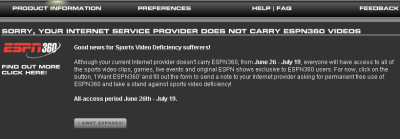
Exhibit A: You are a video deficient sufferer

Now wait just a minute; I am a video deficient sufferer on every day of the year except for June 26th - July 19th?  Who gave me a reprieve from my wretched video deficiency in those three weeks?  Why does this seem so familiar?  Come to think of it, I've had these kinds of free premium TV channel trials on my Cable TV service.  After I click on the "I want ESPN360" button, I get this nice convenient form to nag my ISP that I want them to carry ESPN360.

Exhibit B: Here is how you can nag your ISP!

This second form shows you a list of partners that do "carry ESPN360" (sounds a lot like Cable TV terminology).

EPSN360 carriers Video "deficient" ISPs
Adelphia Cablevision
Verizon Cox
Beld Comcast
Charter LA, Stl SBC
Grande Time Warner
Mediacom College (dorm?)
MidHudson Other

So this is very interesting.  In order for this to be a case of Net neutrality abuse where ISPs block or degrade websites, I would have to believe the following:

  • I would have to believe that there was some massive conspiracy between some of the biggest Cable and DSL broadband operators in the Country to block ESPN360 videos.
  • I would have to believe that the ISPs have somehow managed to only block the premium content from ESPN360 but just so happens to allow the free samplers from EPSN360.  This would require that the network understands what's going on at the web application layer to know what's a sampler and what's a premium service to block.
  • Then almost like magic on June 26th, all the ISPs that don't "carry" ESPN360 would all simultaneously unblock ESPN360 for the exact duration of a few weeks.
  • I would also need to believe that the FCC would do nothing to intervene in such a massive conspiracy when the FCC had already slapped down Madison River Communications for blocking Vonage and fined Madison $15,000.

While I couldn't say for sure, I would have to bet that this is most likely NOT a case of a Net neutrality violation, but just the opposite situation where ESPN360 is treating the Internet like Cable TV where we get little choice in channels since they're all pre-packaged.  More than likely, it's a case of ESPN looking at your source IP address.  If ESPN sees you coming from an IP address starting with 24, then it knows you're coming from Comcast and it can tell you that you are "video deficient".

So what does all of this mean?  Is it possible that ESPN is making certain demands of the ISPs to be able to "carry" ESPN360 as if they were cable companies?  Does this mean that ESPN is demanding preferential treatment and free connectivity to the ISPs that aren't ESPN360 carriers?  Does this mean ESPN360 is demanding free caching services from the ISPs since that is the only scalable way to effectively deliver high-quality video on demand?  And most importantly, is ESPN demanding a fee per subscriber from the ISP?  If any of this is true, those of us who don't watch ESPN will be forced in to subsidizing this sort of activity.

Now if ESPN can demand money from ISPs for the privilege of being able to "carry" ESPN360, then why couldn't Google video demand similar privileges and payment from ISPs since it would be suicidal for any ISP to not be able to "carry" Google or Google Video?  Google certainly is in a much better position to bully any ISP than the other way around.  Technically speaking, it would be very easy for a content provider to cut off any IP range they want and effectively block all ISPs that won't share their subscription revenues.

The Net neutrality advocates worry so much about the content transporters that they have never considered the possibility of "evil" content producers.  While I don't know the exact business model behind this ESPN360 deal, it certainly looks like ESPN is blocking entire blocks of IP addresses that correspond to non-paying ISPs.  If this is true, doesn't this turn the entire Net neutrality debate on its head since we may need to reverse our focus towards the abusive content companies?  If the Net neutrality proponents can get so worked up about non-existent and fabricated cases of abuse on the part of the ISP, would they get as passionate about the real possibility of reverse Net neutrality?

[Update: Fellow blogger Justin James followed up on this issue]

Kick off your day with ZDNet's daily e-mail newsletter. It's the freshest tech news and opinion, served hot. Get it.

Topics

Disclosure

George Ou

http://blogs.zdnet.com/Ou/?page_id=557

Biography

George Ou

George Ou, a former ZDNet blogger, is an IT consultant specializing in Servers, Microsoft, Cisco, Switches, Routers, Firewalls, IDS, VPN, Wireless LAN, Security, and IT infrastructure and architecture.

Talkback Most Recent of 37 Talkback(s)

  • Seems to me to be more like telcoms regulating....
    .... the customers' surfing habits, but this one should regulate itself
    because the audience will not be big if just a few can watch and the
    content provider want to make money of course.

    As with telcoms wanting to regulate the Net-traffic, stupid choices
    should solve *this* limitation automatically, sooner or later, and the
    antitrust law should fix the former head-ache.
    ZDNet Gravatar
    Mikael_z
    21st Jun 2006
  • You have got to be joking!
    You have got to be joking! I'd have to believe the moon was green before I'll believe this is an ISP blockage. This is fairly obvious it's an ESPN tactic.
    ZDNet Gravatar
    georgeou
    21st Jun 2006
  • Yes, but I can't see how ESPN can gain anything....
    .... from this. I can understand surf-regulation more (greed).
    ZDNet Gravatar
    Mikael_z
    21st Jun 2006
  • Not surprising
    Since you're wearing the telcos are evil blinders.

    Let me spell it out for you. ESPN gets money from the ISP from this.
    ZDNet Gravatar
    baggins_z
    21st Jun 2006
  • And only ESPN would sink to such tactics..
    C'mon George, if there's a buck to be made then the company that can extract it will try to.

    This is the point of the whole "Net Neutrality" debate. Remove the economic incentive now for providing preferred access for additional fees. This DOESN'T however mean that an ISP cannot provide QoS services to their individual customers it just means that they won't be able to charge premiums for incoming traffic.
    ZDNet Gravatar
    Robert Crocker
    21st Jun 2006
  • Economic incentive?
    Remove economic incentive and you have the wonderful economic utopia of the former Soviet Union. Note that they are "former" because their economy collapsed under their "profit is evil" thinking.

    Profit is good. Deprogram yourself from your Marxist college professors. Even China has begun to realize that eliminating profit puts a vice on the neck of an economy.
    ZDNet Gravatar
    baggins_z
    21st Jun 2006
  • That's not why USSR fell
    They fell trying to out spend the US on military spending. It was a matter of who ran out of money first.

    It could be argued that it was the communist regimes economic policies that caused the USSR to run out of money first but if you've ever talked to someone who lived in that regime you'd know that wasn't true. The reality is that the USSR really wasn't communist. They were more of a dictatorship. Stalin being the dictator. Dictatorships are very profitiable for the dictator and thier friends. For the people it really depends on the dictator.
    ZDNet Gravatar
    voska
    21st Jun 2006
  • Are you nuts? This is ISP blocking?
    ESPN is blocking entire segments of users until they can extract money from an ISP. This ain't QoS on the content providers part. This is turning the Internet in to the cable TV model.
    ZDNet Gravatar
    georgeou
    21st Jun 2006
  • RE: Are you nuts...
    Is this suprising seeing as ESPN is a cable content provider?

    On the otherhand, I don't see the problem with this(legally speaking). It's not censorship (which is at the heart of the matter...whether it is censorship of content to prevent ideas from being transmitted or blocking content to force companies to pay for services) when a content provider says that "I am not going to provide service to Comcast customers because Comcast won;t pay me $x for my contest..." Service providers have a right to refuse service. If you walk into the local grocery store and they don't like you...it is perfectly within thier right to deny you service. Now it would be censorship if Comcast turned around and said that I am not going to let you...the Comcast customer...view the ESPN360 videos.

    Now with that said, it may not be censorship, but I don't think that it is right (though ESPN does deserve an income), as many people don't have much of a choice but to use Comcast cable access (I have been in that situation), so it is not fair to them as they don't have the ability to jump to another service that does offer what they want...kinda like in the cable business. I think this is areally boneheaded move on ESPN's part.

    I think the root of the problem here is the virtual monopolies that the cable companies have when it comes to internet access (same problem existed in the DSL world, but that has changed and there is competition for service there). Getting DSL is not always an option...even in areas one would think this would not be an issue. I used to live in Lisle, IL, which is in the heart of the Illinois Research and Development Technological Corridor along Interstate 88 in Chicago's western suburbs. I lived in an apartment complex, where about 3 blocks down the road was Lucent technologies. Across the interstate was Tell Labs. Not far away you find Unisys, Microsoft, BP Amaco, etc...just to name a few. Most of the people that live in Lisle are techies....folks who would be very likely to use broadband services. Yet I the best I could do was an isdn line. At the time I couldn't get cable either...but that changed shortly after I moved...but they still can't get DSL there.

    The root of the problem here is the infrastructure. If we were able to force the infrastructure changes that allowed for comeptition, then companies liek COmcast nad AT&T would be forced to not only lower prices, but also offer what the customers want instead of what they want to provide.
    ZDNet Gravatar
    woad@...
    21st Jun 2006
  • Can you read?
    My point was that while ESPN is the current "infringer" the real point is what companies will do to make a buck. Any web site has the rights to restrict access to their content. ZDNet requires a registration for TalkBack, the NY Times has locked a portion of its content behind a pay-only wall. Maybe ESPN's approach will work for them or maybe they'll lose too many potential customers and have to rethink it.

    Net Neutrality doesn't address the supplier. Net Neutrality addesses the owner of the pipe. If they can start extracting premiums from companies in order to get their content into that pipe then we see the whole model turned upside down.

    (I brought up QoS again just to point out that it's a red herring in the whole net neutrality debate.)
    ZDNet Gravatar
    Robert Crocker
    22nd Jun 2006
  • Then why not take those provisions out of Markey and Snowe?
    "I brought up QoS again just to point out that it's a red herring in the whole net neutrality debate."

    Then take those provisions of banning charges on enhanced QoS out. As for the anti-block and anti-degrade provisions, that's already covered outside of Markey and Snowe.
    ZDNet Gravatar
    georgeou
    22nd Jun 2006
  • This is perfectly legitimate.
    ESPN makes the decision as to who can see their premium content. What's wrong with that? If they lose revenue based on their own decisions, that's their problem.

    It is quite different than if it were Verizon that said "You can access content at ESPN," while Comcast said "No ESPN.com for you."


    "The Net neutrality advocates worry so much about the content transporters while the content the "evil" broadband duopoly of the Telephone companies and the Cable companies that they have never considered the possibility of "evil" content producers. While I don't know the exact business behind this ESPN360 deal, it certainly looks like the blockage of entire source IP blocks is being done from ESPN's side of the pipe. If this is true, doesn't this turn the entire Net neutrality debate on its head since we may need to reverse our focus towards the abusive content companies?"

    This is the content providers making decisions as to who can access their content, and not the access providers. Think of it like an amusement park. The park owners get to decide who may enter, and who may not within certain legal boundaries. What may not happen is for the city that owns the main access road to decide that only those driving American-made cars may get to the park in the first place.

    Does that mean that I like it? No, but since the content providers own the content it's perfecly legitimate for them to restrict access to their content.
    ZDNet Gravatar
    Letophoro
    21st Jun 2006
  • Non-sequitir
    Your comment is completely ridiculous. The ISP are also content providers.

    Here's how it will work in the real world without Marxists messing it up.

    ISP providers will advertise packages of content they have available at different pricing structures, just exactly like cable and satellite companies do today. People will buy what they want, and won't buy what they don't think is worth it.

    Here's where the whining comes in. Moveon.org may realize that just about nobody cares about the bilge they spill and no ISP will bother to carry them because there isn't a market for them.

    However, like good Marxists who can't compete in the marketplace, they'll demand the state come in and exercise a little tyranny in their behalf.
    ZDNet Gravatar
    baggins_z
    21st Jun 2006
  • Re: Non-sequitir (sic)
    The ISP are also content providers.

    Why, because they have a website? I don't know what ISP you use but while mine (Time Warner) does attempt to provide some sort of portal "experience" I have no idea what it is. I look at my ISP like I do my phone company. I want dial tone, and I want it uninterrupted, and I don't want anything else.


    ISP providers will advertise packages of content they have available at different pricing structures, just exactly like cable and satellite companies do today. People will buy what they want, and won't buy what they don't think is worth it.

    Then they will be offering television programming. Good for them. I don't care. Just because they do it over IP doesn't mean it need have anything to do with the Internet access part of their business. Or are you saying they want to reduce the Internet to a mere 500-channel "package?" I can't see that happening.


    Here's where the whining comes in. Moveon.org may realize that just about nobody cares about the bilge they spill and no ISP will bother to carry them because there isn't a market for them.


    Of course there's a market for them. There's a market for everyone. But of course you must mean mass market. You're right. There's not much content on the Internet that has the mass market appeal as, say, whatever that show where people get thrown off an island.

    Yes, I think we'd all be better off if the only content that was available is content like that.

    Does that make me Capitalist enough for you?


    However, like good Marxists who can't compete in the marketplace, they'll demand the state come in and exercise a little tyranny in their behalf.

    Name me an industry that doesn't do that. Just one. Porn. Oops. Name another.

    People who stand on the sidelines calling rational actors Marxist are useless and ignorant.


    happy
    ZDNet Gravatar
    none none
    21st Jun 2006
  • re:Non-sequitir
    I would have to say the reverse is true...about comments being rediculous.

    ISP are not content providers...they are service providers. Some service providers also do provide some content, but that is only to thier subscribers. A Content Provider does not provide service.

    If a Service provider decided not to carry MoveOn.orgs content, they would be guilty of censorship and the government would be right to step in and enforvce the first amendment. If MoveOn.org decided that provider x was just another Red State ***** and didn't want to provide them thier content, that would be thier right.

    Eric
    ZDNet Gravatar
    woad@...
    21st Jun 2006

Talkback - Tell Us What You Think

Formatting +
BB Codes - Note: HTML is not supported in forums
  • [b] Bold [/b]
  • [i] Italic [/i]
  • [u] Underline [/u]
  • [s] Strikethrough [/s]
  • [q] "Quote" [/q]
  • [ol][*] 1. Ordered List [/ol]
  • [ul][*] · Unordered List [/ul]
  • [pre] Preformat [/pre]
  • [quote] "Blockquote" [/quote]
Click Here

The best of ZDNet, delivered

ZDNet Newsletters

Get the best of ZDNet delivered straight to your inbox

Facebook Activity

White Papers, Webcasts, & Resources