Japan's ISPs agree to ban P2P pirates

Summary: Four of Japan's largest Internet provider organizations have come to an agreement with copyright holders on how to tackle the illegal file trading on P2P (Peer to Peer) networks. Comprised of about 1000 major and smaller Japanese Internet providers, the four organizations agreed to target flagrant copyright violators by first warning them and then banning them if their behavior doesn't change.
Four of Japan's largest Internet provider organizations have come to an agreement with copyright holders on how to tackle the illegal file trading on P2P (Peer to Peer) networks. Comprised of about 1000 major and smaller Japanese Internet providers, the four organizations agreed to target flagrant copyright violators by first warning them and then banning them if their behavior doesn't change.
According to the Daily Yomiuri Online, the Internet providers two years ago attempted to disconnect users anytime they detected the use of Winny (a popular Japanese P2P application) or any other file-sharing software. But that ran afoul of the Japanese Ministry of Internal Affairs and Communications because of concerns of privacy and the providers abandoned that practice. This time the Internet providers seem to have learned from the past and they're going to be much more targeted by going after the most obvious transgressors of illegal file trading.
When the copyright owners see a list of IP (Internet Protocol) addresses downloading their copyrighted content, they'll send that list of violators to the ISP (Internet Service Provider) and the ISP will warn and then ban the copyright infringers if necessary. This method doesn't involve any of that politically dreaded DPI (Deep Packet Inspection) since the copyright owner merely needs to look for their own content on the popular file trading sites and ask for a list of peers by merely participating in the file trade. Not only does this method avoid privacy concerns, it also happens to be the most practical if not the only way of attacking the problem since many file trading applications are already completely encrypted against packet snooping.
Update 5:40AM - Just to make myself extra clear since many people refuse to believe that we are not talking about deep packet inspection here. P2P in Japan like the latest "Perfect Dark" application (successor to Winny and Share) is already fully encrypted at both the protocol and data level. That's encryption is completely bypassed since the content owners merely need to download the Winny, Share, and Perfect Dark and look for their own content that's being pirated. Then all they need to do is connect to it as if they were a user and then download the content to see if it is indeed their content. Then they already have a list of IP addresses that participated in that file exchange. There's no decryption, key cracking, or deep packet inspection going on here.
Japan is considered one of the most connected broadband nations on the planet with widespread 100 Mbps broadband service. Many people in this country believe that by simply offering more capacity, there would be no need to manage the network since congestion problems would be gone. But Japan teaches us that no matter how much capacity you throw at the problem, congestion will always be a problem and the vast majority of it will be caused by P2P traffic.
At the iGrowthGlobal Panel on Network Management on Capitol Hill (my recap here), I met Haruka Saito who is Counselor for Telecom Policy from the Embassy of Japan. Mr. Saito was my fellow panelist and he shared the following data with the congressional and FCC staffers in the audience. He presented the following data from the Japanese Ministry of Internal Affairs and Communications which had been studying the issue of Net Neutrality in Japan for more than a year.
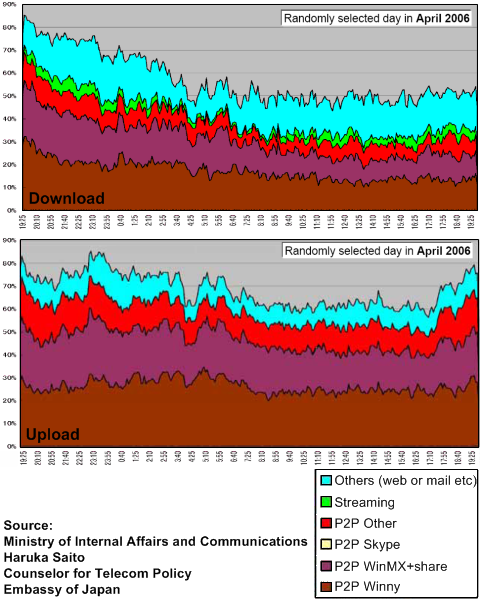
[Updated 3:15PM - I had incorrectly stated that 1% consumes 63% of all traffic because I read the charts wrong. The corrected text is in bold below.] As you can see, the utilization levels especially for uploads are dangerously high and that P2P traffic absolutely dominates both upload and downloads by a very large margin. Winny, WinMX, and Share (a successor of Winny) dominates the P2P usage. From this data, the P2P users that make up 10% of all Internet users in Japan hog ~75% of bandwidth resources and 1% of all Internet users in Japan consume 63% of that 75% share. That means just 1% of users consume 47% of all the Internet traffic in Japan. It's no wonder the ISPs in Japan want a solution that cuts off the most egregious illegal file traders who also happen to be the biggest bandwidth hogs.
Kick off your day with ZDNet's daily email newsletter. It's the freshest tech news and opinion, served hot. Get it.
Talkback
Anonymous P2P and ressource usage
Not only won't they be able to block the sharing, but they will end up with a congestion of their making.
P2P in Japan is already fully encrypted at both protocol and data
P2P in Japan is already fully encrypted at both protocol and data. As I pointed out in the blog, that does NOT matter. The content owners merely need to download the Winny, Share, and now Perfect Dark and look for their own content that's being pirated. Then all they need to do is connect to it as if they were a user and then download the content to see if it is indeed their content. Then they already have a list of IP addresses that participated in that file exchange. There's no decryption, key cracking, or deep packet inspection going on here.
For the programs you are talking about
What I dont understand from the link you provide, is how they are planning to do that. they want too retrieve IP adresses from pragram specifically designed to ubfuscate IP address. the article does not explain how they plan to do. do you have any specifics aside from this article ?
Explain to me how is it difficult to infiltrate
You can have at least two approaches that block identification
- the peer do not know the content of the cache
- the cache is encrypted
as a result of that first technic ( which cannot be considered high tech I agree with you ) some, probably most file downloader will not know they are downloading any specific content, and won't be the destination of the downloads, which mean that even if their IP can be identified they are not infringers, and no action can be taken against them.
the second technic related to IP obfuscation, where the sender does not send packet to the destination, but to an identifier that is decoded to the destination IP by the P2P cloud. as a result, a peer connecting to the network wont know to whom he is sending packets.
I'm pretty sure there are plenty other technics that can be used next to these two to ensure that peers cannot either resolve nor deduce other peers identity; as the route legislators are taking worlwide is toward peers IP identification and settlement, most likely anonymous p2p will develop adding new technics to the one I mentionned above, in order to block IP identification.
At some point in time, you need to know who the source of the file is
The plausible deniability here is also dubious because the proxy in the middle is also willingly and deliberately participating in piracy. It's not the same as an ISP where the ISP MUST route the data. The Proxy is routing data via extra hops deliberately generating more traffic on the network to deliberately hide the fact that someone is downloading illegal content.
Also, the ISP can ban proxy activity explicitly in their terms of service
there are different problems at hand
* protocol encryption/tunnelling: encrypting one protocol paquet within another general protocol prevents protocol identification and also ensure content encryption
* basic anonymization : hide sender or receiver behind an address translation mechanism
* advance anonymization : address translation is done [i]in the cloud[/i], paquets are expurged of any data permitting sender identification. destination of paquets does not contain permanent identification of destination, but a transient ID that is decoded/translated during routing. Sender cannot identify destination.
Still more variety can be added, regarding routing, message split with different routing... etc
of course as you stated, some of these techniques can be prohibited either by law or contract; however, as the whole online economy is based on secure crytography, as the use of crytography in essense make it hard/impossible/prohibited to identify underlying usage of cryptography, it will be hard/impossible/prohibited to enforce such limitations.
Moreover, perfectly legitimate use are possible for all these technics ( online payment, VPN, DRM, free speach ... etc ) limited the probability of complete ban of them.
An ISP can choose what to sell you. Free speech has nothing to do with it.
As I said
In the good old days, they could simply ban any server application, but things have eveolved in such a way that this is to my knowledge not possible anymore. to many things depends on you accepting connections now.
Assuming you can accept incomming connections, and subsequently use encrypted protocols there is no way they can know if you are serving as a proxy or not, except making assumption based on your network activity profile. These however are not certain identification, but only clues.
As for free speech, i was only mentionning, among many other legitimate uses, that encryption and anonymization is a way of circunvemnting censorship. As these techniques have many legitimate usages some of which are essential for the economy, other beingpokitically/philosophically appealing, i doubt they will be banned altogether by the legislators ( ISP have nothing to do with that )
cleartext?
This is the part I can't understand. Winny claims to be an anon P2P based on freenet, that it anonymizes users in the filesharing portion. The arrests that occurred appear to have been based on tracking down users from the non-anonymized bulleting board.
So, are user IP addresses shown in cleartext or are they blocked and what do you have to do see them? If it's police-level investigation, I have a problem with saying there's no privacy implications.
See: http://government.zdnet.com/?p=3716
Yes, it's clear text after you decrypt it by participating as the client
However, there's nothing to prevent the content owner from setting up a bunch of proxy nodes and clients and gathering data. If the content owner finds and downloads content that belongs to them that is being illegally shared and if that content flowed through a proxy server under the control of the content owner, then you can figure out who the source of that file is. It's a lot harder than normal P2P to track down because of the extra man in the middle but it's still sufficient to make a few examples out of.
Re: Yes, it's clear text after you decrypt it by participating as the clien
Which is why so many Tor nodes are run by various governments.
:)
Yup, you got it
Yup, you got it. You have enough of those anonymiser nodes collecting data samples and there is no anonymity.
RE: Japan's ISPs agree to ban P2P pirates
<a href="http://www.rxshop.md/products/antinarcoleptic/buy-provigil">Provigil</a> / <a href="http://www.rxshop.md/products/antiviral/valtrex">valtrex online</a> / <a href="http://www.rxshop.md/products/haircare/propecia">generic Propecia</a> / <a href="http://www.rxshop.md/products/haircare/finpecia">Finpecia online</a> / <a href="http://www.rxshop.md/products/antibiotics/zithromax/">generic Zithromax</a> / <a href="http://www.rxshop.md/products/allergy/periactin">buy Periactin</a> / <a href="http://http://www.antinarcoleptic.com/buy_nuvigil_online_order_cheap_generic_nuvigil.htm">nuvigil</a>
You read the article wrong then. I never said they're blocking all P2P
Not what I meant...
It is not an opinion that P2P hogs bandwidth like crazy, it is fact
It is not an opinion that P2P hogs bandwidth like crazy, it is fact. Those charts I posted weren't just pulled out of thin air; they're from the Government of Japan who has been studying the issue for nearly 2 years.
Just 10% of all Japanese Internet users are using P2P to consume 75 to 90 percent of all traffic in Japan and it's about the same everywhere else in the world. I am calling it as I or any reasonable person would see it.
P2P is not inherently bad
"Just 10% of all Japanese Internet users are using P2P to consume 75 to 90 percent of all traffic in Japan and it's about the same everywhere else in the world."
It's inconsistent to criticize the P2P protocols and and then go after just the copyright-infringing users. P2P in general is not inherently bad, so I'm not sure why you're deciding to criticize P2P on the basis of "bandwidth hogging" just because P2P protocols happen to be the method of choice for a lot of high-bandwidth uses.
The P2P usage pattern is a fixture now, and there are already innovations being built to leverage it (ex. Verizon and P4P, and Vuze and the current vision of the Semantic Web in general). It would be heinous to block P2P usage as a whole - P2P is not inherently bad, and can have lots of good applications. So, saying that certain P2P protocols are using lots of bandwidth is true but doesn't mean anything - it would be as if you pointed out that IPv4 was "hogging" all the bandwidth. Why shouldn't P2P be an acceptable use of the network? The answer, as the Japanese apparently found, is to avoid focusing on P2P protocols and find out how why it's being used [i]so much[/i].
So Japan goes after the illegal part of all that P2P traffic. I think you should be analyzing how much of that P2P bandwidth is illegal content, since that's really the only angle from which reducing P2P usage for the sake of reducing network congestion might be acceptable and legit to the majority of people. Trying to reduce P2P usage just for the sake of reducing usage probably won't fly.
I never said block the P2P users as a whole or anything like it
Right now the user with 10x more active sessions automatically get 10x more bandwidth when resources are under contention because TCP congestion control is fundamentally broken. There are very smart people working with the IETF to address this issue but it may take another decade before that gets implemented. Until such time, we need cruder methods handle the bandwidth hogs who HAPPEN to all be P2P file traders.
I never said P2P was fundamentally bad, but it does use way more bandwidth than it needs to which is why they're trying to make it more intelligent and efficient with the P4P working group. P2P and P4P also fundamentally bypasses the TCP congestion control because of its multistream advantage.