Tech Broiler

Jason Perlow and Scott Raymond

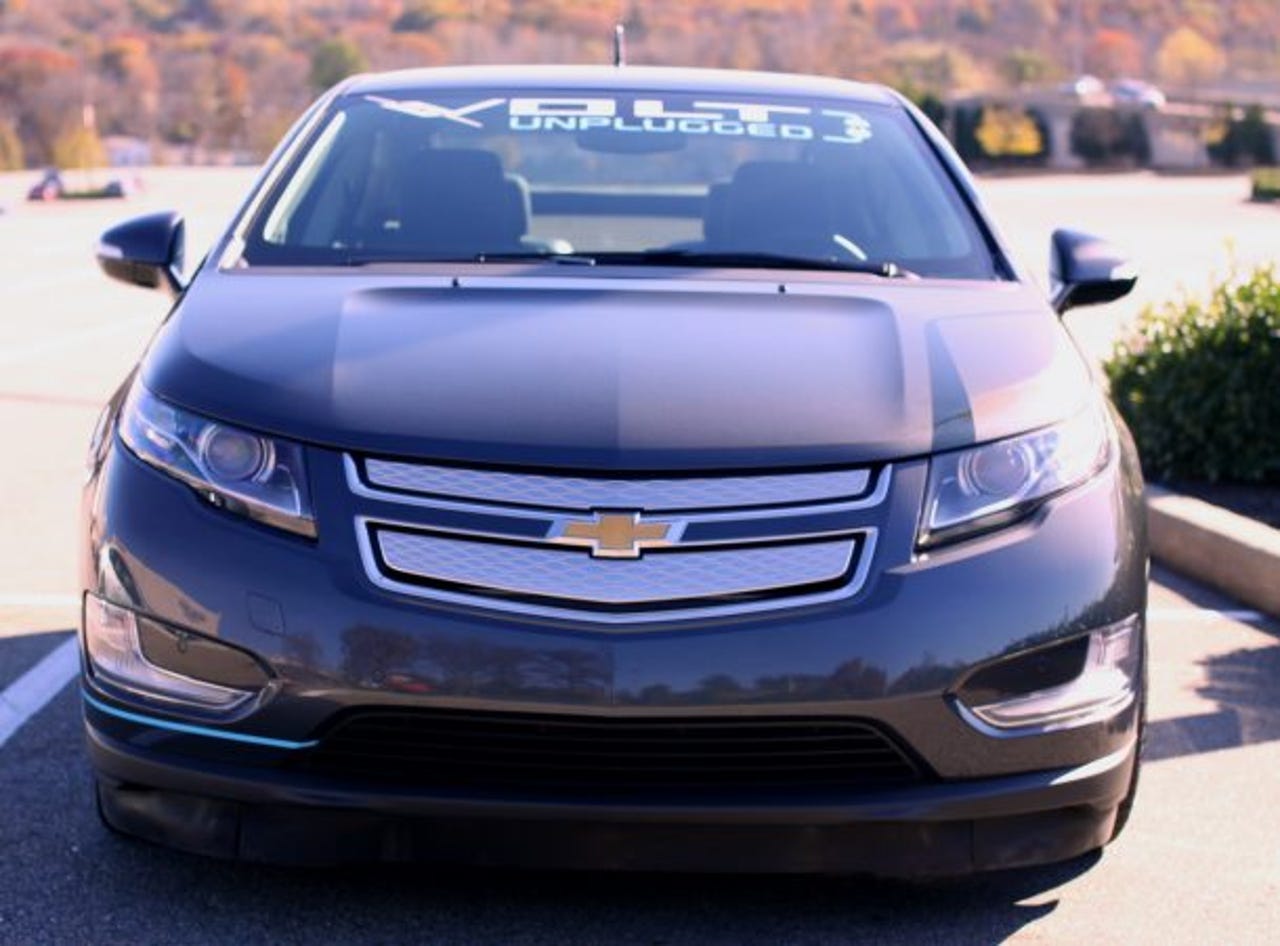
An electrifying weekend with the Chevy Volt

By | August 19, 2011, 9:57pm PDT

Summary: GM’s Chevy Volt has some amazing technology under the hood, but its electronics are almost too over the top.

Late last year, I had a brief opportunity to test drive the Chevrolet Volt during its “Unplugged” tour.

My test drive, however, amounted to a couple of 30MPH laps around a makeshift driving course inside a parking lot in a large suburban shopping mall. While I did get to observe the technology up close, it was only for about an hour or so and I really didn’t get the comprehensive hands-on experience with GM’s flagship hybrid-electric vehicle that I wanted to.

I had asked GM if it would be possible for me to do a longer-duration test of the Volt, but apparently they were really short on vehicles and the review cars were in heavy demand by other media organizations that were doing long-term evaluations of the vehicle. So I would have to wait.

Also Read:

Last Friday, I finally got my chance. At 9:30 in the morning, a representative from GM handed over the keys to a Chevy Volt, and parked it in my driveway. Unfortunately, a mix up with another journalist who forgot to put the charging cord back in the trunk meant that I only had 14 miles of EV (pure battery power) mode left on the vehicle, and GM’s delivery guy had to go run out get me one so I could charge the car later.

So Friday afternoon I drove it sparingly, because I didn’t want to go to gasoline-assisted “ER” (Extended Range) mode too quickly. I wanted to see how far the car could go on a full charge before hitting the 1.4L gasoline generator which powers the electrical drive system for longer distance driving.

I knew the Volt was a very high-tech car from my short preview back in November. But I really had no idea how sophisticated the electronics on this thing would actually be, in practice.

The first time I took it out for a solo spin was to drive down to my local pizza parlor during my lunch break. Okay, so I took the key-fob (which isn’t actually car keys, it’s just a remote with the security proximity sensor on it) hit the door unlock button, and got into the vehicle.

Let me tell you that from the perspective of someone who drives a 20-year old, nearly analog-everything car — a classic 1990 560 SEL 5.6L Mercedes-Benz, stepping into the Volt was like something out of the Jetsons. Or Star Trek.

I glanced at what was a dizzying array of buttons on the main “center stack” (which has a large multifunction touch screen display at the very top) and the completely digital dash (or “Driver Information Center” as it is officially called) which told me that in order to start the vehicle, I had to hit the brake and then push the lighted blue “Energize” button.

As soon as I did that, the entire car came to life, complete with boot-up sound, which sounded like I had just engaged the warp engines on the Enterprise.

It was… Knight Rider-like. Frankly, I’m surprised with all of the electronic accouterments the car has and for $41,000 MSRP, that they don’t sell one in black with a red Cylon eye scanner in the front. You know, the David Hasselhoff Edition Volt.

So now it’s 90+ degrees out in the middle of August and humid as all heck. Give me air conditioning!

The problem was, my ADD-riddled and low blood sugar brain was utterly stymied by how to turn the damn A/C on. Heck, on my old Mercedes and on virtually every single rental car I get when I travel on business, it’s usually pretty intuitive.

This thing you need a freaking aerospace engineering degree to figure out.

Now, granted, my understanding is that people who purchase a Volt get a comprehensive training session from the dealer, where they explain how to use the ultra-sophisticated multi-function main stack that controls climate, navigation, entertainment, energy efficiency and electrical power plant monitoring, the rear-view camera, the front-mounted .50 calibre machine guns, pop-out bullet-proof shield, oil slick dispenser, smoke grenade launchers and all that cool stuff.

I was also supposed to get one of those, but the screw-up with the missing charger cord and a busy conference call hell-day pretty much deep-sixed any chance I had to get a full run down on the … avionics systems.

By the end of the weekend, I sort of got the thing figured out, but the user interface on the Volt seems ridiculously complicated for what is essentially a family car or a commuter vehicle.

This is not a Gulfstream g650 or even a Bugatti Veyron, for crying out loud.

It’s almost as if GM was thinking “Well, the car is going to end up costing the early adopters over 40 grand before tax incentives, and it’s supposed to be this futuristic hybrid electric vehicle, so let’s fill it with all sorts of really cool looking electronic crap that shows just how sophisticated it really is, even though all the important stuff is under the hood.”

I really do want to emphasize that the user interface on the Center Stack is… well, awful. The buttons themselves on the stack are also of the touch-sensitive variety rather than electro-mechanical, and are the same color as the stack, so it gets confusing.

At night, I found both the main dash and the center stack illumination to be a bit to dim, and it was hard to see the button controls, even with the display lighting sent to max in the vehicle configuration menus.

This may have been due to an ambient light sensor issue, and unfortunately I didn’t drive the vehicle Sunday evening due to heavy rainstorms, so I have no idea if the main stack illumination behaves differently under various lighting conditions or not.

Not to say that the electronic doodads and graphics aren’t cool, because they are, but in my opinion, if it takes more than one or two finger touches to adjust climate control or get into the navigation options, configure Bluetooth or tune your XM Radio, or if the UI flat out stymies the user even if it’s supposed to be one or two touches away because it doesn’t behave as expected, then you pretty much borked the user interface design.

I also want to add that from a purely ergonomic perspective, that the center/main stack itself is not driver optimized for pure touch and quick glance alone. It requires far to much concentration to use, to the point where altering something as simple as a climate control setting could get you in an accident.

I had to appoint my wife as co-pilot in the passenger seat, and even she couldn’t figure most of the stuff out.

This is something that GM really needs to fix on the next version of the car. Hey, why not hire Apple to do the stack UI? That’s an idea.

So, on to the more important things. The main Driver Information Center itself is thankfully easy to understand, even though it is completely digital and equally Star-Trekky as everything else on the car.

The left-hand side of the dash display shows your estimated remaining mileage in both EV mode (electric drive) and ER (extended range) as well as current battery power and gasoline fuel levels. Drive gear modes is the same as on a gasoline vehicle, with the typical “PRNDL” indicator.

Miles per hour is shown in a digital speedometer, and the right hand side shows acceleration or “thrust” power, with a spiffy green orb that floats up or down depending on how efficiently you are driving the car. Ideally, you want the green orb to stay dead-center when you are driving, so it’s kind of like a built-in video game.

The dash is configurable with a number of selectable modes, as shown in the video below.

Unlike other hybrid vehicles like the Toyota Prius, the Volt uses a purely electrical drive-train virtually all of the time, so there’s no “Tachometer” per se in any of the selected dash modes.

When the 1.4L engine engages in ER mode after the battery runs down, it’s strictly used as a generator for the electrical power system, and it adjusts its cycles depending on whether the electrical drive system needs increased voltage or not, and in an optimized fashion so that fuel isn’t consumed inefficiently.

There are apparently times where the generator can directly assist the drive-train to power the wheels under higher speed conditions, but I’m not sure I ever experienced that when I was evaluating the car.

So only the car’s computer system actually needs to worry about RPMs. Which means you’re essentially driving a computer. It sounds weird, but at the same time, it’s kind of cool.

While GM advertises that the Volt can get up to 50 miles on a full charge, what you really end up getting is actually based upon driver habits and environmental conditions. After a full night’s charge, we noticed that the EV mode range indicator showed us 34 miles, which is really just an estimate.

Charging the car is easy — you simply pop the charging receptacle with either the key-fob or the button on the driver side door, and plug in the over-sized six-pronged cord which is attached to an alignment handle with a lever lock trigger that has a built in LED flashlight so that you can align the connector in low light conditions.

The car beeps to confirm that it is charging, and you get a green light on top of the dash behind the windshield that blinks to confirm charging status.

If you desire, you can set the car to delay charging until such time during the late evening or early morning when your electrical billing rates are optimal. The default charger that comes with the car will do a full charge in about 10 hours. GM also sells an optional 240V fast-charger that will completely charge the batteries in 4 hours, which costs about $1500 to install in a typical home garage.

With a full day’s driving on Saturday, and with the air conditioning on variable modes including econ, auto and comfort, we actually did about 42 miles before ER kicked in and the gasoline generator started. And when it happened, we were doing over 65 miles an hour on the highway, and it was instantaneous and seamless.

As far as audible cues to the driver, the car is pretty much silent in EV mode until ER kicks in, and then the generator revvs as necessary in order to supply electrical power to the drive-train. You do get a slight electric whine from the drive-train, especially when braking or when coasting (which is used to automatically re-charge the batteries via regenerative braking) but it’s a cool science-fictiony car sound.

Other than the overly-complicated user interface and controls for the non-critical entertainment, climate and navigation subsystems, I thought it was a really fun car to drive. By far, however, what impressed me is the underlying Voltec hybrid propulsion system.

How does the car itself drive? All in all I have to say that the 149HP, 273 pound-feet of torque Voltec power-train is extremely smooth and responsive. This is not a sluggish vehicle by any stretch of the imagination.

Handling on the car was excellent. No problems maneuvering around tight turns. When you put your foot to the floor, the car really takes off. That’s because with an electrical motor, you get 100 percent torque pretty much instantly. This came in handy on certain highway ramps where there were very short merges and we needed to accelerate quickly to get into the flow of traffic.

As far as comfort — the Volt doesn’t have electrically powered seats, so that’s a bit annoying for $41,000 car. I’m a big guy, and while I had no problem fitting in the car, it was a bit tight on my shoulders and I didn’t like the fact there weren’t any handles on the roof ceiling to help me pull myself out of the car, which has a very sloping roof.

If you’ve got any kind of back problems whatsoever and you’re six feet tall or more, you’re gonna hate getting in and out of this car. I found myself doing something of a contortionist bit and a neck twist to pull myself in and out.

Additionally, I thought that the visibility in the front and rear windows (the Volt is a hatchback) was less than optimal.

Keep in mind that unlike the major automotive publications which have done very comprehensive reviews of the vehicle which should give you a better idea of whether or not this car is for you and how efficient it really is, my fling with the Volt was short, so I am only going on my limited exposure to the car.

My overall impression is that the Volt is an extremely important milestone in the future of automotive engineering and I think it will change the industry. Would I drive a Volt again? Abso-freakin-lutely. Would I want to pay for and own one? At this point… no.

However, this is not to say that a Voltec-based car isn’t on my close watch list for a future vehicle purchase. It is. But I want to see new cars from GM, including SUVs, luxury vehicles and sports cars, full sized sedans, minivans, and even trucks that use evolved versions of this system.

I also think that GM needs to focus on what’s under the covers in the next car that uses this propulsion system rather than the electronic doodads, and the user interface shouldn’t require an electrical engineering degree or a pilot’s license to understand.

Okay, we get it GM, it’s an advanced hybrid EV. Now If the company keeps their priorities on fuel economy issues, battery technology, and power-train performance, and they can get the manufacturing costs of the core components for this propulsion system reduced by increased efficiency in manufacturing scale, I think Voltec has a formula for success.

Have you purchased or are considering a purchase of a Chevy Volt? Do you think you will own a Voltec-based vehicle in the future? Talk Back and Let Me Know.

Kick off your day with ZDNet's daily e-mail newsletter. It's the freshest tech news and opinion, served hot. Get it.

Topics

Jason Perlow, Sr. Technology Editor at ZDNet, is a technologist with over two decades of experience integrating large heterogeneous multi-vendor computing environments in Fortune 500 companies.

Disclosure

Jason Perlow

My Full-Time Employer is IBM. I write as a freelancer for ZDNet.

Disclaimer: The postings and opinions on this blog are my own and don't necessarily represent IBM's positions, strategies or opinions.

I own no investments or direct financial instruments in the companies I write about.

Biography

Jason Perlow

Jason Perlow, Sr. Technology Editor at ZDNet is a technologist with over two decades of experience with integrating large heterogeneous multi-vendor computing environments in Fortune 500 companies. A long-time computer enthusiast starting the age of 13 with his first Apple ][ personal computer, he began his freelance writing career starting at ZD Sm@rt Reseller in 1996 and has since authored numerous guest columns for ZDNet Enterprise and Ziff-Davis Internet. Jason was previously Senior Technology Editor for Linux Magazine, where he wrote about Open Source issues from 1999 to 2008.

In his spare time, Jason is an avid amateur chef and food writer, where his work reviewing New Jersey restaurants has appeared in The New York Times. He is also the founder of the popular food web site eGullet and blogs about restaurants and cooking at OffTheBroiler.com.

Related Discussions on TechRepublic

Did you know you can take part in these discussions with your ZDNet membership?
105
Comments

Join the conversation!

Just In

kjcepdu 21 cal
cdfwekrdfe63-24379036429235870947346447271823 23rd Nov
boapza,xidaedyt34, mftkk.
0 Votes
+ -
10 hrs for a full charge
wackoae 19th Aug
And that is why this vehicle will be a FAILURE.
0 Votes
+ -
Contributr
@wackoae It's 4 with the 240V fast-charger, which I suspect most people who would buy this car would install in their garages.
0 Votes
+ -
@jperlow Sure, it is less than 10 hrs, but the negative factor is still the same. It is 4 hrs of wasted time to recharge very inefficient batteries that will barely take you on a round trip to the next town.

The best you can get out of this vehicle is 100 miles per charge (that means you are limited to 50 mile radius). That will drop quickly as the batteries are used. By the end of the 2nd year, you would be lucky to drive 25 miles on a full charge.
0 Votes
+ -
Charge time is not a big impediment
HollywoodDog 20th Aug
@jperlow 95% of the commuting public drives less than 50 miles a day, which means under normal conditions you'll very seldom use the gas. If I had this car, I'd have to worry about the gas going bad from never using it.

I drive a Subaru WRX, and for the last three years I've never driven more than 25 miles at a stretch, except for the vacation trip which I'm now on.
0 Votes
+ -
Shorter is better
rhonin 20th Aug
@jperlow

Just when you really really need it, you find yourself an hour into a looong recharge cycle.
Better if it has a two stage charge:
0-60% fast, 61-100% slow - or some variation of....

But yes I agree, 100 miles is a bit narrow....
@wackoae, @rhonin "100 miles"? I think you have confused this car with the all-electric Nissan Leaf. The Volt has a ~40 mile range (+/- depending on temp, speed, terrain) on battery, but has a gas engine backup plan, so you never will be stuck waiting for a charge, just use gas if your battery runs out & you don't have time to charge or access to a charger.

Most people commute 40 miles to work, and they have 10 hours to charge the car between the time they get home & before they leave the next day. On longer trips they can just use it as a normal hybrid and fill up w/ gas every 350 miles or so, plenty to get way farther than "the next town".

As for battery longevity, it uses temperature management & only uses about the middle 2/3 of its capacity to prolong life. It's warranted for 8 years, and should still get 70+% capacity after that, not drop to 25% capacity after 1 year!
0 Votes
+ -
I agree with jperlow
vulpine@... 22nd Aug
@jperlow: ... to a point.
Fast charge: A 4-hour charge is notably better than a 10-hour charge if you're reasonably active. On the other hand, not everybody drives 100 miles each way to work--or even 40--so the fast charge at each end should get you to work and home without burning a drop of gas. Even if there's not a charger in your parking garage, you've already cut your gas mileage in half by running all battery one way.
Frequency of use: Again, not everybody takes off down the road every 20 minutes. Your car tends to sit in one place for hours on end. Whether you only charge at home or find a charging station in route, your car sits still usually for at least a couple hours during the day and if that's at your home or parking garage, you should be able to plug in.

Of course, that does offer a serious problem. Lithium batteries have a bad habit of developing a 'memory.' You charge too frequently and the car will get into the habit of losing charge too soon. You don't charge soon enough and you might kill the batteries entirely. Granted, the gas engine is designed to prevent this (and I'm sure the electronics will go out of their way to prevent taking them all the way to zero) but it could develop a problem similar to a 1968 Oldsmobile my dad bought that refused to go over 60 mph when he bought it, despite having a big-block 350 under the hood. It took him almost a month of hard driving before the engine finally broke that self-imposed speed limit. What would happen with a Volt that developed a memory?
@wackoae Do keep in mind it switches to a generator when the battery runs out, and that can be filled with plain old gasoline.
@wackoae Some people love visiting gas stations for some reason. I couldn't care less how long it takes to charge, it happens overnight.

And then the next day, I don't have to plan my route around a gas station, and pay close to $4/gallon for gasoline. Why anyone would thing the gas station experience is a great thing is a mystery to me.
@apeweek

My last two vehicles:
- Honda Civic Hybrid (2nd owner in the state of FL ... only because they gave my car to someone else), drove for 5 years, 130+ miles everyday.
- Toyota Prius, had it for 4 years.

In 9+ years of hybrids, I haven't paid a single dime for repairs (only basic maintenance) .....
@wackoae
In 9+ years of hybrids, I haven't paid a single dime for repairs (only basic maintenance)
So, how much did you pay to dispose of the batteries ecologically when you were done with the car? Thought so.

I drive a TDI "clean diesel" (2009 green car of the year) and get around 1000 to 1100km per 48litre tank (about 4.8l per 100km). Most of my driving is highway, and I realize that a hybrid would do better than I would in town. On the other hand, the Jetta could be driven for 16,000km before it was carbon neutral with a new Prius. If you drove your Prius mostly on the highway as I do, it's arguable how different the carbon emissions would be, although let's assume that the Prius still has an edge. When it comes time to replace the vehicle, you still have to dispose of the batteries, and the way we do that today, assuming they are disposed of responsibly, is we put them on a tramp steamer that takes them to China. I could drive my Jetta a million km and not produce a tiny fraction of the pollution that ship would on it's trip across the ocean.
Battery technology will have to get a lot better before I buy a hybrid. Either that or I move downtown, but then I'd probably take public transportation.

Of course that's just my opinion, I could be wrong.
0 Votes
+ -
@wackoae
..... and for everyday commuting you have a winner!
If you simplify the controls and keep the price below $20K.
@kd5auq
Lol at $41000 for a small round town commutor you better love the car as its your car for next 15 years to break even on the cost and if you live in a large city forget it as you have to be able to charge it and if you live on the 2nd to 120th floor extention cords are not an option and charging posts are far and few between.
@kd5auq The "toy" is overpriced, underpowered and you get better mileage with a Honda Civic (which cost less).
0 Votes
+ -
@stephen
baggins_z 22nd Aug
Right. Because the only time I will ever drive the car in a day is to and from work. And If I'm always running the gasoline generator, I should just save myself $20,000 and buy a gasoline powered car right from the start. After all, at $4.00 a gallon, that's 5,000 gallons. At 25 mpg, that's 125,000 miles. At an average driving distance of 12,000 miles per year, that's ten years. Explain to me again why I want to buy a Volt? Oh, yeah. That's right. I've forgotten my 3rd grade education and actually believe CO2 is a deadly poison threatening all life on the planet instead of a vital plant nutrient REQUIRED for all life on earth.
@baggins_z
Lol someone who understasnds basic math and fiscal responsibility lol Love it such a rarity now adays. Great post for the simple minds.
0 Votes
+ -
You DID forget your 3rd grade education
use_what_works_4_U 22nd Aug
@baggins_z
All things *in moderation* can be good. Lest you forget, the supply of CO2 is essentially limitless unless every animal on the planet figures out how to live without breathing. The supply of oil is NOT.

Furthermore, you can die of a hear attack if you drink too much water and it isn't properly processed due to the electrolyte balance that would induce. Water is one of the most essential substances for life on the planet, but it certainly can kill both in too great as well as too limited a quantity.

With the deforestation of the planet and the steady increase in CO2 there is a measurable imbalance being created. Too much of anything is toxic. I don't know where that magic line is for CO2 but it is definitely out there.

Over the last 30 years I've seen the tide lines at my uncle's house on the water rise consistently to where they are now 4 feet above where they used to be. Is CO2 warming the planet and altering the water cycle? I don't claim to know but I know that a lawn blukheaded 4 feet back from the high tide line should not be underwater twice a day every day in less than one lifetime, so something is changing, and it certainly isn't a scarcity of CO2.
@baggins_z

Isn't CO (or carbon monoxide) a more dangerous product of a vehicle exhaust??
0 Votes
+ -
@macadam
baggins_z 23rd Aug
Absolutely oil is limitless. First, we haven't even begun to tap current reserves. Two, there is evidence oil forms more quickly than previously thought. Three, we can bioengineer bacteria to happily produce oil.

Next, CO2 is a trace gas in the atmosphere, comprising approximately 0.04%. Carbon dioxide becomes toxic to humans at about 5% concentration. In other words, atmospheric CO2 would have to increase by 128 times to become a threat to human health. However, CO2 is also fertilizer. Greenhouse growers today routinely double or triple CO2 levels in their greenhouses to boost production. If anything, there is too little CO2 in the atmosphere currently.

Next, tide levels have nothing to do with CO2 levels. They are the result of gravitational pull from the moon and the sun.

Finally, CO2, being a trace gas in the atmosphere has almost no impact on global temperatures for a very simple reason: Water vapor is about 100 times more common in the atmosphere and is about 25 times a more powerful green house gas.

So, here's the truth: The world is not ending because of you. In fact, the world isn't ending at all. So smile, and when an environmentalist next tries to tell you how to live your life by throwing a guilt trip at you, tell him to shut the hell up.
0 Votes
+ -
@beejay
baggins_z Updated - 23rd Aug
Internal combustion engines only produce carbon monoxide in significant quantities when run in an enclosed space where insufficient oxygen is present for complete combustion. It's not really a problem in the outdoors.

Let me amend that. A bad fuel injection system or carburetor can also produce high CO emissions. So, keep your car tuned up.
0 Votes
+ -
You REALLY don't know what you're talking about
vulpine@... Updated - 23rd Aug
@baggins_z :
* First off, let's consider that the average economy car today gets between 30 and 40 mpg on the highway. Yes, I know; commuters don't spend that much time at highway speed, they've clogged up the highways with their traffic jams. Still, at a simple 30 mpg times 5,000 gallons is 150,000 miles--about the average lifespan of a modern car. That's roughly 10 years for the average driver (who does more than 12,000 miles a year.)
* Second, while CO2 may be a plant nutrient, the problem is we're producing far more CO2 than we have plants to absorb it and that CO2 is going into the upper atmosphere where our plants can't access it.
* Thirdly, oil is not limitless. World reserves suggest maybe about 30-50 years remaining if our current usage rates don't change. Considering China has recently become a huge oil user--the heaviest user in the world--our usage rates are going up not down, meaning that 30-year cushion is dropping fast.
True, we're learning how to create oil from plants, but our plant life itself is not limitless. We absolutely need to come up with a viable alternative within our lifetime--and I don't have that much life left to me.
* Fourth, CO, otherwise known as carbon monoxide, is poisonous to air-breathing creatures. It's colorless, odorless and extremely dangerous even when driving on the open highway if your exhaust system is damaged or you don't ventilate the vehicle properly. It's not just garages where it can kill you, it can poison you while you're driving along even at 70mph.

In truth, humans have affected our environment far more than you want to believe. Maybe you don't remember the brown clouds that used to smother our cities--brown clouds that would still be there were it not for the EPA. Maybe you don't remember the cooler summers the world used to enjoy before the Industrial Revolution. Maybe you don't remember the clear, blue skies that inspired "America the Beautiful".
Read a little history. Go out into the middle of Kansas, hundreds of miles away from any major city. Look at what humans have done to our world. Maybe we didn't cause the warming itself--after all, it's apparently a part of a global cycle; one of many--but we have accelerated it. Were it not for our tens of thousands of commercial jets flying daily across the country, our skies would be bluer; our air would be as much as five degrees cooler. The week after 9/11/01 proved that here in the northeast. I live only 150 miles from NYC. I live maybe 100 miles from where that hijacked flight went down in Pennsylvania. I live less than 100 miles from Washington DC. I experienced what grounding all those civilian flights did to our climate for one week. Apparently unlike you, I paid attention to what I saw.
0 Votes
+ -
@wackoae

I disagree. I work from home and commute about 20 miles for errands in a given day. This car is PERFECT for me or anyone else that lives close to their place of work. Besides the ergonomics and dash i'm sure Chevy will get this fixed. Like it or not this cars technology is the future. While your working at the oil refinery today start thinking about your next job.
@wackoae
The vehicle is already a failure as it sold under 8000 units with the now expired $7000 federal rebate program. the car at $41000 is about $20000 to high to be a realistic option. To get your money back out of the car you have to drive it a minimal 15 years to break even.
0 Votes
+ -
@Fletchguy You realize the car is not even in full production yet, right? It had very limited test runs in a few states. Now if they only sell 8000 at the end of 2012, you'll have something to talk about.
discontinue it without too much bad publicity to itself and the government which "sponsored" it.

It's the HP TouchPad in the form of a car. It's dead for all practical purposes. A loser should not be allowed to continue draining resources and money from a company which is still trying to get its act together and still losing money.

Perhaps it would've stood a better change at around 20,000 dollars, because, 35 miles to the charge was a loser from the beginning, and the price tag was a killer to boot. Then, it had to be "subsidized" by tax payers, and that made it an even bigger loser.

Say goodbye to the Volt.
0 Votes
+ -
@adornoe@... perhaps the fed govt should force a mandate that all federal agencies purchase this car. That way Chevy and the fed govt can look good and say"hey, look what we did for the environment." Mr Al Gore would be so proud of us...i feel a tear coming on
I wish I could wager against all the people who are sure the Volt will fail.

Most people cite the high pricetag, but it's the total cost of ownership that matters. Just look at the lease price - it's just $350/month. And a typical driver (15k miles/year) will save easily $150+ per month in fueling costs (electricity is far cheaper than gas.)

Here's a cost-of-ownership calculator that includes the Volt, see for yourself:

http://www.squidoo.com/a-free-calculator-for-economy-hybrid-and-electric-cars
**pats her hybrid**
Well, that is so different from what I learned before.
Moncler Shop
0 Votes
+ -
RE: An electrifying weekend with the Chevy Volt
Hallowed are the Ori 20th Aug
@zuggboot

^^ Spammer ^^
So far, I've read only - fair sky and warm weather - reviews for this vehicle. Although I am an enthusiastic supporter of this new technology, I really am curious about how it will perform during extended cold periods.

PS GM used a fleet of 100 Volts to parade down Woodward Ave this week during our - Dream Cruise - weekend. It was a nice sight to behold while strolling thru this Northern Detroit Suburb.
@kenosha7777 I was in that parade, in my Volt. It was wonderful.

Michigan is a cold climate, so of course the Volt was tested in cold weather. The Volt features battery temperature conditioning to get consistent battery performance in temperature extremes.

What saps range in hot/cold weather really has more to do with how much heater/AC the driver uses. The trick is to use the preconditioning feature of the volt. While still plugged in, pre-start the car. This brings the cabin temperature to a comfortable value without using the battery. Simply maintaining this temperature then will use much less of the battery, and affect driving range relatively little.
to do with less, common man.
0 Votes
+ -
Absolutely
use_what_works_4_U 22nd Aug
@baggins_z
For once we agree! More is NOT better and although I wouldn't be willing to give up too much, I sure do think we can all stand to reduce our consumption.

When I park at work I leave the cabin of my car empty, the windows open several inches, and I cover it with a lightweight car cover. The anti-theft chip in my key keeps it from being hotwired easily, the airflow keeps it cooler, and the cover keeps it shaded. In anything less than 90+ degree weather my car is comfortable when I get in it and I do not use the A/C until I reach highway speed. The only reason for turning it on then is to roll up the windows so I can save gas.
0 Votes
+ -
@macadam
baggins_z 23rd Aug
You misunderstand me. I think it is morally evil for a self-appointed elite to take upon themselves the divine right to tell me or you or anyone else how to live. Environmentalism has NEVER been about the environment. That's just the tool used to guilt you into surrendering your freedom. Like all tyrannies, environmentalism is about a self-appointed few deciding they are smarter and more moral than you and therefore have the right to tell you what you can and cannot do.
0 Votes
+ -
@apeweek "preconditioning" the cabin temperature to a comfortable level? ya gotta be kidding me..suck it up and freeze your cheeks for a few flipping minutes
@kenosha7777
Thats an issue as the batteries cost around $5800 to replace and they have yet to really discuss the effects cold has on them. In Chicago we have weather thats negative 80 below with wind chills regular and extended sub zero months which eat all batteries even brand new ones quickly so if every 2 years you add almost $6000 for batteries that will not cut it.
@Fletchguy

Wind chill means nothing to a battery; it is about the effect of wind on the skin.

The batteries have an 8 year warranty, so your point is moot.
0 Votes
+ -
@Fletchguy thank you. i asked that in a post earlier with some other questions..my post got zapped. Now i know. so a car that costs about $40g for a loan that probably last 6 years means that during those 6 years you need to buy 3 sets of replacement batteries at, call it $6g-the math is easier. After paying $40g in loans, not including interest, we will say about, being conservative here, $55g PLUS the $6g(3)=$18G + the $55G= $73G. This of course doesn't include maintenance, gas, electric bill increase, brake pads, rotors, tune up, oil changes, tire replacement, wheel alignments, starters/alternators, etc etc.. Talking about close to $100g by my guestimate for a car that might last 10years. Who has that kind of "disposable income" oh wait..fed funded... maybe obama care will cover electric car maintenance which will be shoved down all our throats
0 Votes
+ -
The world is not ready for Chevy Volts
Dietrich T. Schmitz * Your Linux Advocate 20th Aug
Not knocking GM for their leadership, but, it's a hard sell.

The price has to get down to $20K at least to really incent purchase.

As for myself, living in Upstate New York, I've driven a 2001 Subaru Forester for 10 years--it died on the Interstate a couple of weeks ago, so I was faced with making a quick decision.

I went with a 2011 Subaru WRX. This car is sick.
But at $25K, AWD for the snowbelt, and 25-30MPG highway mileage, it was a no-brainer.

Point?: A technology shift such as the Volt is going to take a major convincing like gas going to $8/gallon to reach a tipping point or the sales price has to come down--way down to make them utilitarian, instead of currently elite.
0 Votes
+ -
@Dietrich T. Schmitz * Your Linux Advocate

There are more negative factors here:
- A very long re-charge time. Anything more than 15 mins is a deal killer.
- Power grid is NOT READY for the increase in demand.
- Talking about the increase in power demand, guess what the side effect will be? INCREASE in energy cost for EVERYBODY. Even little old grandma, who doesn't own a car, will have to pay extra so that others can charge their vehicles for 4+ hrs.
@wackoae

15 minutes? Are you high? You cannot even fully charge a cell phone that fast. 4 hours with the fast charger is pretty decent. Also you can plug in for a few hours to get a charge then use the car to run to the store and plug it in when you get home again. 10 hours with the normal charger is not unreasonable. I mean if you charge it at night and get 6 - 8 hours of sleep that means you just need to be home 2 - 4 hours more a day.

The power grid needs to expand yes but these vehicles are consume less electricity to charge than many appliances

You act like the world is rushing out to buy these things. This is slow process and plans need to be made for the future yes but the Mall by my work has added power charge stations already and I thought I read about Walgreens doing the same in the near future.
@bobiroc - 15 minutes is actually a decent comparison. The Volt is not competing with cell phones, it's competing with gas powered automobiles and it takes considerably less than 15 minutes for me to fill a tank on a comparably sized car.

Furthermore, the electric range is crap. Unless you take very short daily trips, you will be hitting the gas tank a lot. I have a fairly long commute. Given the EPA ratings for the Volt for mileage, I would need to drive the Volt for over 300K miles before the cost of ownership with my present car would be approximately equivalent. Even if I drove the short trips and used electric exclusively, I'd still need to drive over 200K to match cost of ownership. The most miles I ever kept a car for was 183K.

The price point for the Volt is way too high with the limitations it has. Today's fuel efficient gas cars are way more cost efficient and have fewer limitations.
@sullivanjc

I used the cell phone as a comparison to the battery size. I don't think you can even fully charge a conventional car battery in 15 minutes. You can only push so much power through.
0 Votes
+ -
@wackoae
power grid, especially true..what type power plants are going to be opened that " green" so that the greenies can be happy. Cant be coal.. to much smoke....cant be hydro- no river rafting- too bad cause that might be their lone sore of bathing, no nukes...cause nukes is bad......old slogan from the '70's "eat more beans! America needs gas!!!
0 Votes
+ -
@Dietrich T. Schmitz * Your Linux Advocate

Subaru is a great choice and likely made in the USA as opposed to your average domestic car which may well be made in Mexico or Canada.

All of this silly. The ECO-nutjobs love it and will line up to show everyone how "environmentally conscious" they are. When all they are really doing is shifting the burning of fossil fuel (nothing wrong with that btw) from the vehicle to the power plant.
After driving my new volt for a week I love it even more. No gas ($58), no smog, a blast to drive and with my solar panels no contributions to the middle east. Lease payments of $440-249 gas no used = $191 per month. You're right about the handle to pull your self out of the seat though.
@E D Wolf
Hey, to each his own, but I think you are not figuring in the total costs. If you didn't have solar panels then you basically have a coal-powered car, since that's where your electricity comes from. If you have enough solar capacity to completely cover your needs (doubtful, but whatever), then you need to figure the opportunity costs of those panels into the total picture.

I would wager that your expenses are far higher than what they appear to be at first glance.
@Dorkyman
Gasoline takes about 6 kilowatt-hours of energy per gallon to refine, so your car is both coal-powered AND gasoline powered.

Incidentally, the power grid is just half coal-powered, so it's just half the amount of pollution you're imagining. Actually, far less than half because electric power is much more efficient than gasoline.
smog around you? It's a miracle! Hate to break it to you, but those solar panels require oil to manufacture. Or do you think mining, manufacturing, and transportation energy is provided by pixie dust?
0 Votes
+ -
kjcepdu 21 cal
cdfwekrdfe63-24379036429235870947346447271823 23rd Nov
boapza,xidaedyt34, mftkk.

Join the conversation!

Formatting +
BB Codes - Note: HTML is not supported in forums
  • [b] Bold [/b]
  • [i] Italic [/i]
  • [u] Underline [/u]
  • [s] Strikethrough [/s]
  • [q] "Quote" [/q]
  • [ol][*] 1. Ordered List [/ol]
  • [ul][*] · Unordered List [/ul]
  • [pre] Preformat [/pre]
  • [quote] "Blockquote" [/quote]
ie8 fix

The best of ZDNet, delivered

ZDNet Newsletters

Get the best of ZDNet delivered straight to your inbox

Facebook Activity

White Papers, Webcasts, & Resources
ie8 fix