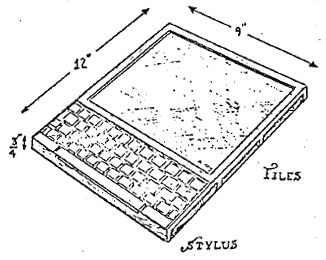
Can we finally realize Alan Kay's Dynabook for $100?

Summary: The Dynabook. Source: A Personal Computer for Children of All Ages, Alan Kay, XEROX PARC 1968.
The Dynabook. Source: A Personal Computer for Children of All Ages, Alan Kay, XEROX PARC 1968.
November 5th, 2008 was the 40th anniversary since computer scientist Alan Kay devised the "Dynabook", a theoretical computing device which was aimed toward higher education and "children of all ages".
Since the device's theoretical conception in 1968 and a publication of a paper proposing its use in 1972 when Kay was at Xerox's PARC, many of the technologies that were in Kay's conceptual device finally did come to fruition such as portable and mobile computing, GUIs and object-oriented programming languages. But has the Dynabook truly been realized?
Click on the "Read the rest of this entry" link below for more.
In a nutshell, no. While we have made tremendous strides in computing and information technology in the last 40 years, it's hard to say that we've been able to go completely paperless and create the computing equivalent to the 1930's Volkswagen or the "People's PC".
And certainly, from the perspective of the Dynabook's true purpose as an educational tool, even the OLPC organization of which Kay is an active consulting member has fallen way short of its original lofty goals to getting a computer into the hands of every single student in the world at a cost of $100 per unit, not the $294.00 that Kay originally proposed in 1972.
Alan Kay's proposed cost of the Dynabook was $294.00 in 1972 money, which adjusted for inflation is roughly $1538.00 today.
I believe we have all the technologies necessary to create the Dynabook, but to get a tablet-type ebook/computing device into the hands of every single student in the entire world -- be it in developing countries or in our own educational institutions, we're going to have to try a lot harder in terms of cooperation between competing companies with their own technological agendas.
We're going to need to put a lot of petty differences aside and provide government incentives to these companies to bring the cost of manufacturing and development down in order to finally realize Kay's dream.
Also Read: A Kindroid in Every Pot? (ZDNet Education)
Certainly, Dynabook-like devices which meet or exceed Kay's original design specifications exist today, such as Amazon's Kindle. The Kindle, however, sells for $359.00, which although far below the $1538.00 in parts cost that Kay originally estimated is out of the question in terms of being able to provide every single student in higher education with, let alone every single student in elementary or high school.
There are certainly similar devices that are slightly cheaper, such as Sony's, but $260-$300 is still too much money.
I've already suggested in another piece that Amazon focus on its e-book store, drop its own proprietary device, partner with Google and go with an Open Source Kindle device -- an "OpenKindle" or a "Kindroid" that any manufacturer could produce.
Such an Android-based e-book reader that had an open development platform would go a long way towards realizing Kay's Dynabook, provided economies of scale could be reached to bring the cost down where e-book readers are accessible to literally everyone.
As if the cost of the devices aren't enough of a barrier to getting ubiquitous computing and electronic texts to the educational masses, there's also the cost of textbooks themselves.
When I was in college, I remember even used texts costing me around $500-$700 per semester, and that was back in the late 80's. I was a liberal arts student, majoring in International Relations and Economics -- I can only imagine what they cost today, never mind the pre-law and pre-med books which have to be even more expensive.
While some college textbooks are available in electronic form, and certainly most high school and common literature used at the university level can be obtained from Amazon's Kindle store, there hasn't been much incentive to move entire college and high-school curricula to go fully paperless or 100 percent e-book.
$5 per e-copy of the Complete Works of Shakespeare, which can't be transferred from Freshman English class student A in 2009 to Freshman English class student B in 2010 due to DRM restrictions is still too much especially when we are talking about stuff that is no longer a subject of copyright.
Inner-city High School students aren't going to buy $5 copies of Mark Twain anthologies when their parents can barely afford to give them lunch money and their school can supply them with a 5-year old beat-up paperback version for free, that is assuming that their school district budgets can even get them copies in the first place.
There's no reason why classic electronic media shouldn't be cheaper than dirt, if the objective is to improve education and literacy. This and lowering the cost of the hardware itself is an area where our new president and administration should clearly get involved.
My colleague Christopher Dawson, who writes ZDNet's Education blog, talks at length about what the benefits of doing this are, so I'm not going to repeat his column -- as an educator, he knows much more about the subject than I do.
However, I will say that going paperless and getting a cheap electronic tablet into everyone's hands --- not just students, is a very good idea for a ton of reasons. It's ultimately green, vastly reducing the shipment of paper books to university stores which eats up natural resources and adds to our carbon footprint.
Mass production and adoption of such a device would enable the use of social networking technologies -- so that education can be extended outside the classroom, such as for distance learning and part-time students.
For example, imagine electronic textbooks and works of literature that can be highlighted (remember the yellow highlighters we all used to carry in school?) and annotated by 100,000 students, all which can have forums/discussion boards and publicly viewable notes and tags with embedded hyperlinks that can be turned on and off by the reader.
Can the Dynabook for Children of All Ages be realized in the current economy? Or can popularizing electronic media and e-books get us out of our educational rut? Talk Back and Let me know.
Kick off your day with ZDNet's daily email newsletter. It's the freshest tech news and opinion, served hot. Get it.
Talkback
Dynabook for $100?
Well, if we can cooperate on something as huge as the Linux kernel, I see
Faulty assumptions
Capitalism has its own mechanisms for keeping prices low, so the idea that socialism will lead to lower prices than capitalism is a questionable assumption at best, and a complete fallacy at worst.
Competition and cooperation are not mutually exclusive, and I question whether a "pure cooperative" situation will really lead to lower prices. If there is no competition, what kind of checks and balances are there against abuse of the system?
Therein lies an incredibly faulty assumption: The assumption that we can somehow get rid of abuses by wishing them away and pretending they don't exist. There [b]must[/b] be checks and balances of some sort. Wishing away our troubles won't make them go away.
Stupid, Stupid, Stupid, Stupid, All of It!
<br><br>
This is all stupid because it is all founded on the current wisdom of the Haves, who in their arrogance, feel they know what the Have Nots need and want. A prime example of the Road to Hell being paved with Good Intentions.
<br><br>
How about we first see to it that all the fathers have jobs, health care and pension so all the families have fathers who then can, in concert with the family, decide who needs what for what course of study.
<br><br>
* Aside from the elitist crap, all a $100 notebook does is further entrench the Have Nots by limiting their choices. As a young person, would YOU want to design your future on one of those pieces of Toast with a Keyboard?
<br><br>
If I had nothing, I'd rather have my own fast, 100Gig USB flash drive and a library down the block with totally full blown computers with unlimited, 24/7 access.
<br><br>
Oh, sorry. We might have to pay as much as $500 per year in taxes for that. One working man's car payment. For a library and excellent, maintained, on line access. Oh, sorry again. That would create another actual job or two.<br><br>
<a href="http://www.westernnewsco.com/wine/winearb.html">Wine Arbitrage here</a>
Stupid?
A meaningless and artificial distinction. I know plenty of "haves" who will never be satisfied, and plenty of "have nots" that are happy to have very little, and couldn't care less that they don't own the latest gizmos and gadgets.
Yes, it is good to have programs that help people who find themselves in exceptional situations. But just because a program benefits a number of people in extreme situations does not imply that the program will work for the entire economy.
"How about we first see to it that all the fathers have jobs, health care and pension so all the families have fathers who then can, in concert with the family, decide who needs what for what course of study."
Problem is, you're asking something that ignores situational distinctions. I'm living off of my savings right now, and I've planned it carefully to last until I graduate from college. Technically, I'm unemployed, but that doesn't mean I'm in any danger of dying of starvation. Even under ideal conditions, there will be some level of unemployment.
Yes, it is good to have programs to service those in extreme situations - but to base our entire economy on such programs is stupid. They do not scale well, they do not encourage hard work, and they handle corruption poorly. They are not suited for large scale economies.
Quite often, the answer is not in one extreme or another, but rather somewhere in the middle.
Huzzah
You're missing the point
reader (and btw if OLPC had sold 50 million instead of 500
thousand machines then the unit price would indeed
already be below $100).
The Dynabook is not (primarily) about reading, it is about
using a personal computing device to amplify thinking.
And for that, the hardware is quite secondary, it can and
has been engineered already. What is missing is the
software, there simply is no good learning software that
would teach a child important ideas.
Putting books in every child's hands is a first step of
course, and if the book could actually teach the child to
read itself that would already be a huge step forward, but
it would still fall way short of Alan Kay's original Dynabook
vision.
Perhaps you should read the Dynabook paper instead of
relying on secondary sources:
http://www.mprove.de/diplom/gui/Kay72a.pdf
An Android-based Dynabook...
The learning software, while indeed important, would come as a result of a movement to get these devices in the hands of children in the first place.
Extremely good point. We need to get these into the hands of children, THEN
But, you do have to get started. The OLPC was a huge inspiration, and got everybody thinking.
No, Bad Point.
<br><br>
It's called (Insert Brand here, Lenovo, Acer, whoever) and (Insert Sales org here, Best Buy, whatever).
<br><br>
Anyone who can pay can get the lightest, smallest, anything they want right NOW.
<br><br>
Which brings me back to fathers and good jobs and children who can choose what kind of PC they want rather than a blog deciding for them.
<br><br>
<a href="http://www.westernnewsco.com/wine/winearb.html">Wine Arbitrage here</a>
You could have said the same thing about operating systems too, but, Linux
Call us...
What number do you want to be called at?
you forget one thing
Battery life shhouldn't be an issue
I would love to see something like this become reallity as my 14 year old son currently carries 40 to 60 lbs. of books home every day in his back pack, and that can't be good for his back. Wouldn't it be nice if his load could be reduced to only a few pounds?
Re: you forget one thing
Your Economics are Backwards
1. Increasing taxes to subsidize this global program is not appropriate -- the experience curve effect will drive down costs plus people value what they pay for. The government and people of Chad, just to pick an example, need to decide this is a priority, not a bunch of well-intentioned Americans and Europeans.
2. Rather than critizing vendors for charging for rights protection, for example, we instead want the profit motive to fund innovation and distribution. Unlike blog writers, few work for free. Here in the US, there is plenty of money in just about every single school system to pay these fees -- it's just a matter of resorting priorities.
3. Alan November (novemberlearning.com) as you probably know has written a lot on how to use tools like the Dynabook (and ipods and blackberies etc) in refashioning education.
The governments of the world have a history of supporting education. Why
Another point: back problems
She is well now, but I hear from Pediatricians that this remains a problem.
e-books of texts are a great benefit. A $100 reader would make this easier to implement.
RE: Get the government involved?
Why?? Because they do such wonderful things now?
Oh I get it, now that we have the wonderful King Obama we'll acomplish great things never seen before.
The US government should have one directive, defense of our country.
Social programs should be left to the states and counties or even better the towns and organizations closest to the people LIKE YOU!
If you think something should be done why don't you do something like advertise your old PC for free to someone in need?
Everyone should be charitable!
When the government is, that's called Socialism.