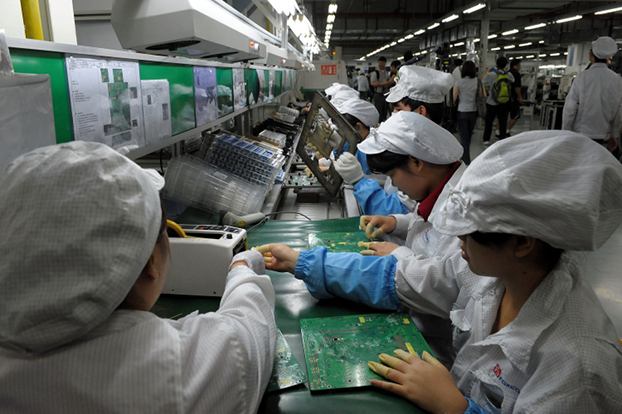
Factory workers in China: A Pyrrhic victory for a world that lost its conscience
I lost the Great Debate to what can be summed up as harsh statistical reality. But what does our unyielding appetite for Chinese durable goods mean for the first world conscience?
Sometimes, you have to go into a battle with the full knowledge that you are going to lose.
According to ZDNet Editor-In-Chief Larry Dignan, our Government blogger and my long-time friend David Gewirtz won our face-off in the Great Debate solely on the statistics of pure unflinching numbers. I lost, but I took the moral high ground.
As much as I would like to believe that costs are going to increase due to the possibility of human rights conditions improving in China, the reality is that from a systemic perspective, that nation is such a long way off from improving the lives of its people to the level of a Westernized nation that it will likely take decades before we will ever see an economic impact on the supply chain.
That's great for companies like Apple, but it sucks for the human beings that feed our thirst for electronic gadgets.
Better work conditions are only part of the variables linked to overall costs of the goods being produced. Wages, benefits and and working hours factor into do factor into the overall picture but these are more than offset by tax advantages and reduced regulatory costs imposed by the Chinese government as well as the price of energy and other raw materials that are needed to produce durable goods in that country.
One only has to look at the overall picture in China to fully understand the magnitude of the human rights problem and why it is unlikely to abate anytime soon.
The vast majority of Chinese -- hundreds of millions of them -- not only work in conditions that most of us would consider barbaric but their living conditions make many of the people in our own country living in near poverty look like they are living in comparative luxury.
While the big modern cities like Shenzen and Chengdu where Apple's products are being made are growing and new cities are popping up all the time, there are still many places in China still do not have electricity and clean running water. So everything is relative.
In this debate, even though I knew there was no way I was going to win against Gewirtz's hard numbers, I thought it was important to take the moral high ground. Ultimately if you believe that all human beings should have the opportunity to live and eat well, and work under clean and healthy conditions and work reasonable hours, then the first world lens is the only frame of reference you can possibly have. This is the standard that you set, and you keep that standard in mind, but you also don't assume you can change things overnight.
The ripple effect of increased prosperity positively affects the entire community. The rising tide lifts all boats, so to speak.
So how do you improve the situation? It would require a fundamental shift in the way products are manufactured. At the end of the day, as CBS News demonstrated in its investigative report "The Dark Side of Shiny Apple Products"these consumer electronics products are being manufactured by hand using human beings.
Could you mechanize and introduce more automated manufacturing methods instead of using what basically amounts to slave labor or indentured servitude? It requires motivation.
In Japan, the country has experimented heavily with robotic assembly lines in the last 30 years (particularly in their automotive industry) because they wanted to find their way out of an energy crisis that began in the 1970s, in addition to eliminating monotonous jobs that nobody wanted to perform and improving overall output efficiency.
But Japan's and China's culture and socioeconomics are very different. It's actually cheaper for final assembly in China to be done by human beings instead of robots because have such a huge supply of labor that is willing to work under such harsh conditions and for such low pay.
Regardless of working conditions, working in electronics manufacturing is so much better than doing hard manual labor in China's infrastructure improvement projects or agricultural work, especially for the uneducated.
And as good as today's industrial robots are, they still can't do the type of precision manufacturing work required to do final assembly for something like an iPhone or an iPad. Even in Japan or in Korea, which are far more modernized than China in their manufacturing practices, human beings still do some of the finer work.
But even if robots are capable of doing all of the work, China's vast and cheap labor pool isn't going to disappear anytime soon, so there's little incentive to replace human beings with robots. Not unless the manufacturers themselves had compelling reasons to do it, which they don't.
So if you can't replace human beings, what about inspections, like the type that Apple is now proposing to be done by 3rd-parties?
It's certainly a good start but it only matters if Apple is vigilant with continuous follow-ups by the third-party auditors, and if there are actual negative consequences for the non-compliant manufacturing subcontractors. But it remains to be seen if other major consumer electronics manufacturers who do business in China are going to be vigilant about auditing their subcontractors as well, now that the human element of Apple's manufacturing has been placed under the microscope. And as well-intentioned Apple may be with allowing 3rd-parties to examine their assembly lines at their subcontractors, we all know that any pre-arranged inspections are going to give Foxconn and other companies doing outsourced work considerable notice in order for the third party inspectors to see what they want to see, with no violations. There has to be unfettered access to the facilities for repeat inspections, without any notice in order for this process to be effective at all.Apple's decision to allow 3rd-party inspections of its production lines in China was primarily a public relations move although it is clear, at least from internal communications that have been since made public, that executive management was incensed that the company could be perceived as uncaring. However it remains to be seen if Apple is more concerned about the perception itself or if it wants to demonstrate legitimate compassion for the people who manufacture its wares.
There may be an interesting twist. ZDNet's own Tom Foremski noted this week that Apple cultivating a "Think Fair" image may also be good for business and give them a competitive advantage, given the fact that their streamlined supply chain and significantly higher margins may give them some leeway for creating Fair Trade electronics whereas their competitors may face significant challenges in doing the same.
So what can be done to affect change against a seemingly unsurmountable systemic human rights problem in China?
Voting with one's dollars sends the ultimate message. However, social networking has been very effective in affecting change in governments, such as we have seen in recent power struggles in the Middle East, so it is not unreasonable assume that similar tactics used against large companies might be similarly effective.
If there was a large concerted effort by citizens of Westernized nations to campaign quite vocally using social networks against large companies which do not represent the conscience of its customers, it is possible that technology companies may have to respond to pressure by the sheer force of hundreds of thousands or millions of consumers voicing their displeasure. Whether or not these types of efforts can get started in the first place and generate enough inertia to even make a dent in the problem is difficult to determine. As noted in Tom Foremski's piece this week, there will always be a portion of the consumer base that cares deeply about where their goods come from and how they were manufactured, as we have seen with Fair Trade efforts with Coffee, Chocolate and Clothing, and the organic/sustainable/local foods movement(s) which label their products as such, and there has been a considerable amount of success with that, although it only represents a small portion of those industries as a whole.
Still, it must be acknowledged that while some people are definitely willing to pay a premium for these sorts of products and spend their money exclusively on them (a la Whole Foods) not everyone is.
I would really like to believe that American consumers have compassion and a conscience. If more and more concrete reports of workers being mistreated coming out of China actually result in people boycotting products from manufacturers that condone such practices, then I think it would be a huge step for our culture and renew a lot of faith in the moral compass of our society. I think we would all be better off for it.
But I really can't say that if, before buying a tablet or smartphone that was made in China, a prospective consumer was forced to watch a video of exactly what conditions those workers that made that product had to endure or live under, that the consumer wouldn't still buy the product in question.
After all, people still buy produce from Mexico and other parts of Latin America but few people really stop to think about the living and working conditions of the workers that harvested their lettuce or their strawberries. So why expect that from people buying iPads or iPhones?
Boycotts only work if the consuming public itself can be organized and send very strong messages to companies that their labor practices in China are not acceptable. We've seen this work in prior decades with the petroleum industry such as with Exxon for their environmental transgressions with the Valdez disaster in Alaska and also most recently with BP during their Deepwater Horizon spill in the Gulf of Mexico. Large organizations would need to get involved in order to coordinate group efforts to make effective boycotts.
Barring the effectiveness boycotts, what are electronics manufacturers going to do in order to stay ahead of human rights concerns?
It's possible that as a result of this public outcry over mistreated Chinese workers, the foreign technology companies investing in China themselves may start having to build their own factories in that country and control their own means of production to ensure their own labor compliance directives.
This is already happening. For example Motorola Mobility (soon to be fully-owned subsidiary of Google), which has a firm commitment to corporate responsibility, has invested a tremendous amount of money building its own factories in China and conducts and discloses regular audits of working conditions.
And Motorola's workers in China are in fact Motorola employees.
Obviously, the cost to Motorola Mobility in order to have a corporate conscience is a high one. It is reflected in lower profit margins for their products which obviously hampers its ability to compete relative to companies like Apple. And if having a corporate conscience becomes the norm, these companies will either have to pass these costs to the consumer, or eat it as a cost of doing business.
If Gewirtz's numbers have any validity, and if Foremski is correct that Apple could start an entire trend of "Think Fair" electronics in order to gain a competitive advantage, than I suspect it will be the latter.
So what about manufacturing products in the United States instead?
Look, I'm not running for office, but it would not be a ridiculous overstatement to say that over the last 30 years, oppressive taxes, unionized labor and ever encroaching government regulatory controls over our manufacturing base have contributed to the United States becoming an inhospitable environment for most companies to do manufacturing business.
It would be nearly impossible for these companies to stay competitive if they produced electronics in the United States because you would have to pay these workers decent salaries and decent benefits. You would have to conform to American labor laws which significantly reduce the number of hours these people could work, and you could never legally employ child workers -- which many factories in China do, legal or not.Don't get me wrong -- I think there is a definite market for genuine American-made products. That much is evident from the agricultural and food industry, as well as other specialized luxury goods such as spirits and other consumables.
However, the idea that you can make a sophisticated piece of electronics like a smartphone in the United States competitive with similar products from China or Korea is ludicrous because you could never source all the components domestically. Virtually all of that stuff, from the semiconductors to the display unit, to the battery are all made in Asia.
So at best you're doing final assembly at an American plant. If it costs $100.00 more to do that, and you labelled it "Made in the USA" I'm not sure you'd get sufficient demand for the product to justify doing it in the first place. But if you could somehow keep costs down and make it competitive with products being produced in China, I could see people buying it.
After all, various Japanese and German car companies have had some success doing final assembly in the United States, but they haven't been passed off as American products. It was simply more cost effective to do it here rather than ship entire completed cars overseas, in order to avoid US tariffs.
I can't claim to have the answers to solving all of the problems of the world. Neither can Gewirtz. But I hope that as a result of this debate and Apple's recent PR imbroglio that the next time one of you purchases a piece of consumer electronics made in China from Best Buy or your favorite online retailer, that you understand the human cost that went into it.
Has the Westernized world lost its conscience when it comes to feeding their appetite for durable goods? If it has, can it ever get it back? Talk Back and Let Me Know.