Tech Broiler

Jason Perlow and Scott Raymond

Google's two-factor authentication: nice idea, but unwieldy

By | February 11, 2011, 10:44am PST

Summary: Google’s new two-factor authentication scheme is a huge improvement in terms of account security in the public Cloud. But I can’t use it for regular day to day use.

Google’s new two-factor authentication scheme is a huge improvement in terms of account security in the public Cloud. But I can’t use it for regular day to day use.

Sometimes, with technology, you need to be careful what you wish for.

A couple of days ago I kvetched about needing something better than straight password authentication for sites like Google and FaceBook. I suggested that perhaps we might need to look at biometrics, but I realize that getting that type of thing standardized and deployed into actual products might take several years.

There is another type of authentication mechanism, which is extremely effective at keeping out the bad guys from your applications and accounts and that has been around for quite some time — it’s called two-factor token-based authentication using one-time passwords.

Unlike various kinds of biometrics, this type of system doesn’t require new hardware on your PC or smartphone to employ, and has been in use for well over a decade, particularly in the financial industry.

RSA Data Security for example has made a nice business out of this with their SecurID product line, which is deployed as a credit-card sized device or a special keychain “token” issued to each user that displays a new verification code every sixty seconds.

That verification code, when used in combination with the account password, uniquely identifies the user. If you l don’t have that authenticator token, you don’t get in.

Verisign, now a division of Symantec, has a cloud-based service that allows you to use your existing smartphone instead of a separate hardware gadget as the “token”.

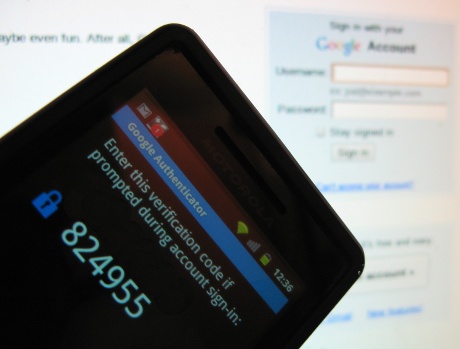
What Google has done is pretty similar. Instead of a keychain or a credit-card, it allows you to store an authentication token on your cell phone, be it an Android or iOS device, and have it display the passcode to you in a mobile application. Alternatively, if you don’t have a smartphone, Google can SMS your cellphone an authentication code each time you need to sign in.

Also Read: Your online deadbolt: Google opens 2-step verification to all users

You can have this set to re-authenticate you each time you log in via the web, or every 30 days.

Now, all of this works pretty well, provided you are just using GMail and Google Apps over the web. It will lock your Google account down like Fort Knox. The phishers and the bad guys won’t have a rat’s ass chance in hell of breaking into your account.

The problem is, if you use your Google account for anything other than GMail and Google Apps on a browser, it gets a bit more complicated.

In my case, the minute I turned on the two-factor authentication, I broke every single app that I use that authenticates with Google: GMail and all Google services running on my Android phone(s), Mail on my iPad, and my Instant Messenger clients running on my various PCs/VMs and iPad.

It also broke all the web sites which I use that have to cross-site authenticate using my Google account, of which there were about a dozen, including FaceBook and Quora.

This can be fixed, but it’s tricky. You have to log into your Google Account settings and issue special passwords for each service and application that talks to Google. I got it working for my Android phone, and for the IM client running on my PC. However, as soon as I realized how many of these I would have to issue to every service and web site that I use that signs in with my Google ID, I said NO MAS!

Now, I’m not saying that there aren’t a whole bunch of people that would find Google’s 2-factor authentication useful. Not everyone is as gadget and connectivity-crazy as I am. But just about everyone I know has access to at least 1 PC and 1 mobile phone, and uses at least 1 or 2 social networking services, so this could be daunting for most people to deal with.

Where I see Google 2-factor authentication coming into play at least for now is secondary Google accounts that could be used to store critical information, such as financial data, confidential information, et cetera. With these, you’d log in strictly via the web or one or two selected devices running mobile apps, and you wouldn’t cross-site authenticate with it.

For that sort of use, I think Google’s 2-factor option is great. But for my own day to day use — at least until they figure out how to make this work better in the complex app/site mix that I swim in, I’m going to pass.

Are you planning to use Google’s 2-factor authentication? Talk Back and Let Me Know.

Kick off your day with ZDNet's daily e-mail newsletter. It's the freshest tech news and opinion, served hot. Get it.

Topics

Jason Perlow, Sr. Technology Editor at ZDNet, is a technologist with over two decades of experience integrating large heterogeneous multi-vendor computing environments in Fortune 500 companies.

Disclosure

Jason Perlow

My Full-Time Employer is IBM. I write as a freelancer for ZDNet.

Disclaimer: The postings and opinions on this blog are my own and don't necessarily represent IBM's positions, strategies or opinions.

I own no investments or direct financial instruments in the companies I write about.

Biography

Jason Perlow

Jason Perlow, Sr. Technology Editor at ZDNet is a technologist with over two decades of experience with integrating large heterogeneous multi-vendor computing environments in Fortune 500 companies. A long-time computer enthusiast starting the age of 13 with his first Apple ][ personal computer, he began his freelance writing career starting at ZD Sm@rt Reseller in 1996 and has since authored numerous guest columns for ZDNet Enterprise and Ziff-Davis Internet. Jason was previously Senior Technology Editor for Linux Magazine, where he wrote about Open Source issues from 1999 to 2008.

In his spare time, Jason is an avid amateur chef and food writer, where his work reviewing New Jersey restaurants has appeared in The New York Times. He is also the founder of the popular food web site eGullet and blogs about restaurants and cooking at OffTheBroiler.com.

40
Comments

Join the conversation!

Just In

RE: Google's two-factor authentication: nice idea, but unwieldy
shravan9 27th Dec
i have used this, bt suddenly i formatted my phone now login in in my andriod is accepted, don't know why? also i can't logged in in gmail via pc because its need
code.. don't know what to do..
0 Votes
+ -
So what you really want...
jasonp@... 11th Feb 2011
is more security, but you don't want to be bothered with having to do anything extra to gain that security. The magical security fairies should fly by and sprinkle security pixie dust over the internet. Either that or every phone, computer and device that can connect to the internet should be equipped with biometrics scanners...maybe we could get the government to make it illegal to surf the net on a device without biometric authentication. If you find yourself in that whining mode, step back and say "Hey, I'm sorry. I was full of crap. I don't really want better security options, I just wanted something to complain about." Or you could just say "Hey, I'm a ZDNet blogger." Same thing...

Seriously, if you want better security (you seem to be claiming that you do), then don't cry like a six year old girl with a skinned knee for having to actually DO something to get it.
0 Votes
+ -
Curiouser and curiouser....
jasonp@... 11th Feb 2011
@jasonp@...
My last two sentences somehow got bumped up to the last two sentences in the first paragraph.
@jasonp@... No need to be rude eh!
0 Votes
+ -
Contributr
@jasonp there are other forms of 2-factor security. And I didn't say this solution would never work, but it needs to be made easier to use for the average person.
0 Votes
+ -
The other forms...
jasonp@... 11th Feb 2011
@jperlow
for the most part require an up-front cost. So the alternative right now seems to be force everyone into spending money or force them into spending a little of their time setting things up. If there's a third alternative, by all means share.
0 Votes
+ -
I do wish...
wolf_z 11th Feb 2011
@jperlow

...you'd get away from the love of biometrics. It's a dangerously stupid idea. A lot of people have listed the reasons why, but you persist.
0 Votes
+ -
Contributr
@wolf_z "A lot of people have listed the reasons why, but you persist."

It's called having an opinion. This is an opinion blog. I'm entitled to mine and so are our readers who participate on here, including yourself.

There are as many advocates for the technology then there are against. And I have a huge a amount of research and testimonials from government and financial industry clients that I can point to which prove that biometrics is effective when employed correctly.
The point is that security is a pain. If it was easy for the user then it's easy for hackers and all. I think in this case you can't have your cake and eat it too. How 'bout creating 2 gmail accounts. One for your social sites to openid or oauth and the other for your "important" things. The "important" one uses two-factor authentication. Oops. That's two much work for the lazy user.
0 Votes
+ -
Hysterical?
PreachJohn 11th Feb 2011
@jasonp@... reading your post twists the original issue so badly over the top that it borders on stupidity.
Take care.
0 Votes
+ -
@jasonp@... ...for those of us who are techno geeks this might be great. But for the vast majority of people, if you make security too hard, they will not use it. I have seen this over and over and over again. When the level of effort reaches a certain point you can't get them to use it.

Its one thing at the office where I can mandate policies. But for home users this just isn't going to work.
0 Votes
+ -
I think 2-factor is a great option and yes, I'll be using it.
Dietrich T. Schmitz, ~ Your Linux Advocate 11th Feb 2011
No reason not to.
A minor inconvenience goes a LONG way toward eliminating man-in-the-middle attacks and scripting hacks.

No more! We have alot to learn and Europe is way ahead on this count. Been doing it for years.

So, Jason let's get PhoneFactor on ZDNET and you'll have not only eliminated the 'rif raf' but immediately see a net improvement in the general behavior in the TalkBacks.

h-t-t-p://www.phonefactor.com/

It's easy to implement Jason. OK, get going.
0 Votes
+ -
Contributr
@Dietrich T. Schmitz, Your Linux Advocate The day of reckoning on Talkbacks is coming, Dietrich. Soon. happy
0 Votes
+ -
I hope so . . .
JLHenry 13th Feb 2011
@jperlow

I stopped commenting for the most part because of the nonsense . . .
0 Votes
+ -
Why would you use this?
LiquidLearner 11th Feb 2011
@Dietrich T. Schmitz, Your Linux Advocate

Linux is invincible. Since you don't use Windows there isn't reason for you to use anything more than a 4 digit numeric password right?
@Dietrich T. Schmitz, Your Linux Advocate

So you're going to be paying for all the minutes this uses on my phone, right? No? Then zip it.

LastPass has MFA which works *and* is functionally free: printable grids.
0 Votes
+ -
Reading your whole article, I've come to the conclusion that the "Hollywood" option might be best left to "Hollywood".

Than again, it does protect G-Mail accounts and that's a very big plus.
0 Votes
+ -
Contributr
@kenosha7777 There are other mechanisms for doing 2-way besides Biometrics or by using one-time numerics. I was told about this one today, which looks pretty interesting:

http://www.youtube.com/watch?v=P7hKMnPicKc

No other devices to use except your own brain.
@jperlow That is so clever, simple and straight forward from a user stand point. There must be a huge flaw in their reasoning!
@jperlow
That "image-based authentication" security password protocol outlined via your link was pretty impressive. I wonder how many attempts it would allow before the system locked out that user?

I think a hacker could just "take a guess" and try to get lucky if he knew something about the system and how many image associations might be required to gain access. If that hacker had a list of system ID names, he might be able to use "brute force" techniques to gain access to a few of those accounts.

I don't know .. I like the image based security idea but it still could be hacked.
@jperlow That image-based system solves the problem of making the password more secure, but it isn't quite the same level as the two-factor authentication method. In theory, even if I GAVE someone my password, they couldn't login without also having physical access to my cell phone.

With the image based authentication, as soon as I gave someone my three categories, they'd be able to get in every time.

I'm not saying the idea is to tell people what your password is or to give people your categories, but the point is... one is simply more secure, as it requires physical access to my cell phone.
The other concern is... with a password... assuming it's case-sensitive (most are)... and assuming it requires at least 6 characters (most do)... there are over 50 billion possible combinations. So, a system would not be able to use a brute force attack too easily.

With the image based system, let's assume the user just picks 3 categories. That's only 504 possible combinations that would need to be tried (with a 3x3 grid of images). Now, sure, a system could lock the account after 3 invalid attempts. However, when if the hacker tries hacking into 500 different user accounts, trying 1 random combination with each. Statistically, they'd be able to get in pretty easily. So, rather than being able to just lock down individual accounts, the source of the hacker would need to be locked out. Given the use of proxies by hackers, this would be a lot harder to manage.
If you force users to pick at least 6 categories, I would imagine the task of picking the right images might be made more difficult. Remembering 3 categories in a demo is one thing, remembering 6 or more categories for months is another thing.

Don't get me wrong... I do think this is a novel idea... and it may be better than standard textual passwords for many people, especially the ones who pick easy passwords... but it isn't quite the same level of two-factor authentication.
@jperlow I loathe the way the commenting system only lets you nest comments like two deep, when you're not actually replying to that comment.

@BIGELLOW
Three ways to avoid someone having your password:
A) Don't give out your password.
B) DON'T give out your password.
C) Do NOT give out your password.

WRT probability, this is hardly the appropriate place for a high-school maths lesson, but those are 500 unique events. The probability only increases if you're guessing a single individual's code, or if the grid isn't sufficiently random (and even then, only marginally).

I'm not even sure what the probability of guessing a random non-repeating 3-digit number would be in 500 attempts. .004? .005?
@jperlow The "two-way" portion of that scheme seems really weak. If the attacker knows the categories (which can be done by monitoring a single log-in session or looking under the users keyboard) they have enough information to log in whenever they want. This does not seem ANY more secure than a simple password scheme to me. The only benefit I see is that it might enable you to force the user to initially pick a longer password because of the "memory trick" involved.
0 Votes
+ -
No Form of Authentication Stops Bots
RandSec 11th Feb 2011
@jperlow: But pictures will not stop a bot, nor will any type of 1-time 2-factor, biometric, or crypto password. Authentication is not the problem. The problem is the bot. The only known solution is to not have a bot.
@jperlow The problem is that the images don't necessarily immediately trigger which categories you chose. It's not a good solution at all, in fact it's worse.
0 Votes
+ -
I'll take unwieldly
HypnoToad72 11th Feb 2011
Everybody wants things simple; whether they're marketed the idea or are naturally indolent. Then they wonder where ID theft comes from...
0 Votes
+ -
Need 2 accounts?
GreyTech Updated - 12th Feb 2011
I think it will result in users needing two accounts. One with single password for applications that need to be accessed by multiple devices/applications automatically. Perhaps you calendar is synchronised with your home and work PCs and your iPad. A second where you want secure access to your email, word processing and spreadsheets.
0 Votes
+ -
Been Using This For 6 Months & Love it!
EntrepreNerd Updated - 12th Feb 2011
IMPORTANT!
------------------------------------------------------
DO NOT BE LAZY! You only have to setup application-specific passwords ONCE. So take a few minutes & do it.
------------------------------------------------------

I have 15 Services, Apps and/or devices that I had to generate codes for and it took all of 15 minutes. you only have to generate an Authentication Code for 3rd party Apps ONCE. Once it is setup you are done and do not have to worry about it again. Best of all, if you decide to stop using an App or Service you do not have to take the time, and frustration, to cancel your account. You can simple "revoke" access to your Google Account and be done with it.

TIPS:
You will be given the option to create a title of your 3rd party apps. You would do well to be detailed here. I use a simple formula to keep it clean and simple and it goes like this. Platform Name | Service Name

Some Examples:
iPhone | Google Voice
Chrome | Browser Sync
Desktop | Google Talk
iPhone | Meebo
Google | Cloud Print

Please, please, please DO NOT listen to the author of this article. Do not be lazy with security, not when it would take you less time to truly and fully secure your Google life than it would to stand in line for a mocha.
0 Votes
+ -
How about permanent tattoos with strong passwords?

Seriously, my first experience with a token was a $5 unit that Paypal offered. It's bulletproof, but eventually is forgotten when you need it, so an alternate page is provided for hints to allow access.

I saw the image video, but it seems someone could start guessing your categories since only 3 were used and they are displayed on every login attempt. From a cyber-external-hack view, It looks like it would be adequate.
0 Votes
+ -
Contributr
@Joe.Smetona They only used 3 in that video. If you start using 4 or 5, the level of complexity is much higher for the attacker and not much harder for the user to deal with.
0 Votes
+ -
Thanks Jason.
Joe.Smetona Updated - 13th Feb 2011
@jperlow A previous poster mentioned limiting the number of attempts before locking the account or temporarily disabling it. That would go a long way at preventing repetitive automated hacking attempts.

I've noticed some web password screens allow say 14 characters to be properly accepted, but the input screen on the website only accepts say 12, so the truncated password is considered incorrect. It does not seem to happen as often now and initiating a new password is made more difficult by the omission of the initial password specifications.
Take it from an expert with over 15 years of experience in online security... This is the wrong direction. Google chose the worst form of two-factor authentication available ("out-of-band").

Google is perpetuating the misconception that a hacker cannot compromise the process since the hacker is not in possession of the user's phone. However, the hacker does not need to be in possession of the user's phone to compromise an "out-of-band" process. The hacker simply needs to trick the user into divulging the received phone code. This is the method typically used by hackers to compromise out-of-band authentication. The hacker constructs a counterfeit webpage to solicit the user's credentials (a relatively easy task for a hacker). Then, using scripting on the counterfeit webpage, they transmit the solicited credentials to the legitimate google website. Google sends the user's phone a code, and the user, believing they are communicating with the legitimate google website, enters the received code on to the counterfeit webpage. The counterfeit webpage then sends this additional information to the genuine google website and...presto... they are logged into the victim's account.

All google has done is add more complexity to their login process but they have not added any real additional security. Companies who have toyed with this method in the past (google is by no means the first) typically abandon it after several months due to high user complaints, great losses of users, and little security benefits realized.
0 Votes
+ -
False web sites.
Joe.Smetona 13th Feb 2011
@anony567 ...I've come across counterfeit web pages and they are scary. A single misspelled character next to the proper character is all it takes. The graphics are copies of the graphics you expect to see and all the input links are there, ready for the unsuspecting user to input all of their credentials. It's easy for almost anyone to be fooled and checking the address bar is really the only way to tell.
@anony567 Your MIM attack is at best challenging to successfully deploy. I would like a POC page to demonstrate that you can make it happen. First of all, each code is only good for a few seconds, so the attacking webpage has to survive the challenge back to you, then get the code that you just had pop up (clock's ticking while you type it in), then before the time runs out still transmit that to google, then fool you into thinking that you're still in the google app you've logged into. As I said, I'd love to see the POC.
@anony567 Wait a sec. Does this stop at "Presto!" because you cannot use the same code at two places at the same time? If you pass the captured code through to google and the user on to his gmail experience, then a millisecond later, that code is not going to work from your hacker's website, I don't think. I think it will be like musical chairs. Whoever sits first gets the seat. I may be wrong, but I think either the user is going to get a request for another token or the hacker will.
0 Votes
+ -
You're Worried Too Much
m0o0o0o0o 14th Feb 2011
I've been using Google's 2-factor for months, and I don't find it inconvenient. The application-specific passwords are for client-side apps like your mail and calendaring programs, and you only have to set them up once. If anything that bothers me because it's like factor-and-a-half authentication - two-factor only occurs on the web then, not through other programs. For as infrequently as I'm bugged to use Authenticator, and as fast as the process is, I don't find this even the least bit challenging, difficult, etc. I suggest you give it a try and tell us what you think in a month.
0 Votes
+ -
Yeah, too much trouble...
james347 14th Feb 2011
...just dump the whole two factor thing. They will never get it right so why bother trying.
Can I force this as a mandatory option for end users? or do users have options to bypass this? Thx.
i have used this, bt suddenly i formatted my phone now login in in my andriod is accepted, don't know why? also i can't logged in in gmail via pc because its need
code.. don't know what to do..

Join the conversation!

Formatting +
BB Codes - Note: HTML is not supported in forums
  • [b] Bold [/b]
  • [i] Italic [/i]
  • [u] Underline [/u]
  • [s] Strikethrough [/s]
  • [q] "Quote" [/q]
  • [ol][*] 1. Ordered List [/ol]
  • [ul][*] · Unordered List [/ul]
  • [pre] Preformat [/pre]
  • [quote] "Blockquote" [/quote]
ie8 fix

The best of ZDNet, delivered

ZDNet Newsletters

Get the best of ZDNet delivered straight to your inbox

Facebook Activity

White Papers, Webcasts, & Resources
ie8 fix