How Microsoft's Windows Phone 7 can win mobile with virtualization

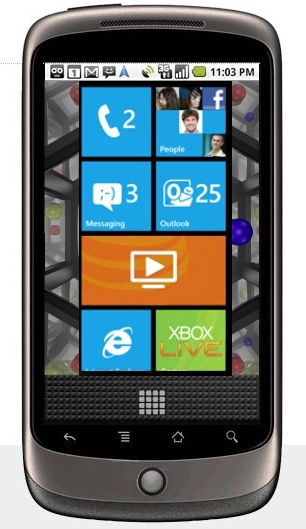
Microsoft's mobile market share is currently looking pretty insignificant in the consumer space. But in the enterprise, all of that could change with virtualization technology.
Yeah, Perlow is on another tear with virtualization again. But bear with me for a minute.
In previous articles, I've talked about how Google and handset hardware manufacturers could take advantage of mobile virtualization technology in order to simplify the distribution and the development of the Android operating system.
Mobile virtualization could be used to solve a number of problems, the main issue being the long waits between OS updates on existing handsets and also to reduce the complexity of having to roll out customized or templated Android OS images to varied hardware designs simultaneously.
Also Read: Android Virtualization, It's Time
While this is certainly a goal and an important value add to provide this capability to Android phones in the near future, this is not the main reason why these mobile virtualization products are currently under development.
In actuality, the initial "Go to Market" plan for products such as Open Kernel Labs' OKL4, VMWare's Mobile Virtualization Platform and Wind River's Hypervisor is to provide enterprises a means to abstract and wall off the consumer Android OS from a separate Android-based "Virtual Phone" that can be pre-loaded with enterprise applications and connectivity.
This Virtual Phone, which contains all the applications, settings and configuration data needed to communicate with the enterprise messaging and back-end application infrastructure exists as a Virtual Machine, running on an embedded hypervisor, which is deployed "Over the air" through a managed software distribution infrastructure.
The Virtual Phone VM runs as a totally isolated system process, and cannot communicate or share data with the original consumer smartphone OS that came with the device.
The reason why this Virtual Phone concept is beginning to gain traction in large enterprises and at the carriers is because companies are increasingly moving to a "Bring Your Own Device" model in which employees purchase their own personal smartphones, such as Android devices, iPhones and BlackBerrys, but require access to corporate resources such as enterprise secure email, calendaring and other applications.
There are a number of solutions other than virtualization that are being proposed that would allow end-users to flip between personal and corporate data. One of these is BlackBerry Balance, but it is specific to RIM's handsets and its upcoming PlayBook tablet. For the iPhone, AT&T has developed a solution called Workbench. As of yet, Verizon does not yet have an equivalent solution for their own iOS devices.
Still, the market leader in consumer smartphones is Android, and all indications are that Google's mobile OS is on an upward trendin overall market share, particularly in the US. While RIM and Apple are jockeying for a strong second place, Microsoft isn't anywhere near striking distance with Windows Phone.
It's not even a contender, and it isn't resonating with consumers despite its innovative UI and Microsoft's efforts to push it through multiple carriers.
However, all of this could change, provided that we take the turn lemons into lemonades approach, and focus on where Microsoft is strong and Android is weak.
[The Enterprise: Turning the Windows Phone frown Upside Down]»
One of the biggest problems Android faces is to how consumer handsets can be integrated into the enterprise. Some handset manufacturers such as HTC have licensed Microsoft's Activesync technology in order to communicate with back-end Exchange messaging and calendaring systems.
Additionally, enterprises themselves can also license solutions such as the Good Technology server in order to provide that same functionality.
However, the Activesync licensing issues with Microsoft as it relates to the various handset manufacturers to integrate that functionality into Android is an ongoing problem because a number of them (such as Motorola) are currently in litigation with Redmond regarding their possible infringing on Microsoft's intellectual property.
There is also the possibility that future changes in the Exchange/MAPI/ActiveSync stack could present compatibility challenges for Android handsets with Microsoft messaging and enterprise application infrastructure going forward.
The solution to me seems pretty obvious. Instead of using Android-based "Virtual Phones" on handsets, Microsoft should position an Enterprise-optimized version of Windows Phone 7 as a virtual machine that can be deployed on any smartphone running any of the vendor hypervisor stacks.
This is the same exact way Microsoft deploys its Windows desktop and server OSes on VMWare, XenServer, Red Hat Enterprise Virtualization, Oracle VM or on their own Hyper-V in the datacenter.
This dual-environment smartphone approach would simplify the situation for the enterprise greatly. Enterprises will no longer need to worry about which handset has the proper licensing agreements, or invest in back-end mobile management and connectivity infrastructure such as RIM's BES or Good Technology.
All enterprise customers would have to do is utilize some sort of standardized SAAS product provided by the carriers to deploy a templated, virtualized, secure enterprise Windows Phone 7 over-the-air to Android devices, with all of the configuration required to connect to the back-end corporate data running on Microsoft infrastructure in a secure fashion.
From a licensing perspective, the enterprise simply buys the correct number of CALs for Virtual Windows Phone from Microsoft. Simple. Elegant. Windows Phone 7 from the perspective of the end-user running an Android device simply becomes an App.
When the employee needs to access his corporate data on his Android phone, he touches a button or an icon that switches him over to his Outlook running on his virtual Windows Phone. To flip back to their personal data, he or she does the exact same thing. This would be just like in the VMWare video above, but instead of with an Android virtual instance, it would be Windows Phone.
There's also no technical reason why Apple couldn't partner with Microsoft to provide this same capability on an iPhone as well.
Additionally, the hypervisor would also be able to determine whether or not an incoming call is personal or private, and the billing infrastructure at the carrier would be able to provide the appropriate reports to the enterprise for accounting purposes.
All of this sounds like science fiction. But this exact type of SAAS product is now under development, by a company called Red Bend.And towards the end of 2011 or in early 2012, this type of thing could very well become a reality.
Red Bend may not be a recognizeable name to enterprises or consumers. But they are the market leader in over-the-air software updates for mobile devices. Carriers use their infrastructure and software to deploy firmware updates to over one billion handsets today.
In September of 2010, Red Bend quietly purchased VirtualLogix, a developer of -- you guessed it -- Type 1 Hypervisors for smartphones. And they also have a yet-to-be-named SAAS product in development that carriers can use in conjunction with their existing over-the-air infrastructure to deploy VMs on smartphones which have this hypervisor pre-installed.
Are you pondering what I'm pondering Pinky?
I think so Brain, but where is Microsoft going to get a Type 1 real-time embedded hypervisor at this time of night?
As it stands right now, Red Bend's hypervisor has been engineered to run virtualized instances of Android. But there is no technical reason to prohibit Windows Phone 7 from becoming virtualized, should Microsoft decide to have the necessary dialog and partner with them and/or VMWare, Open Kernel Labs or Wind River to optimize Windows Phone 7 with the necessary paravirtualization support needed in order to run as a VM on all of the mobile hypervisors.
And there's certainly nothing to stop them from say, buying Red Bend software or one of the other embedded hypervisor vendors for the purposes of accomplishing this goal and becoming the world leader in enterprise virtual machines for next-generation smartphones, no matter what Android (or Windows Phone) device the consumer wants to purchase at their choice of carrier.
Should Microsoft partner and or purchase Red Bend to pursue a Virtual Windows Phone strategy? Talk Back and Let Me Know.