Tech Broiler

Jason Perlow and Scott Raymond

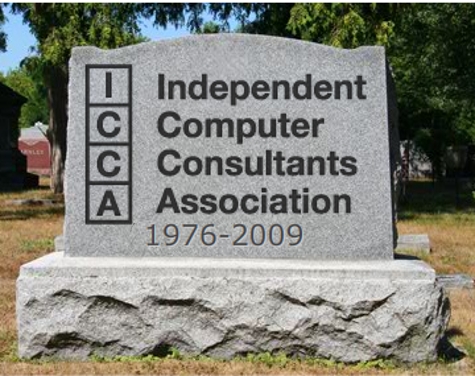
Independent Consultants: Rest in Peace?

By | January 20, 2010, 2:30pm PST

Summary: The Independent Computer Consultants Association (ICCA) a professional organization that assisted small computer consulting businesses in the United States for over 30 years shut its doors at the end of 2009. Under the current economic climate, Is the independent consultant itself also living on borrowed time? Do you ever get that email or phone call when [...]

The Independent Computer Consultants Association (ICCA) a professional organization that assisted small computer consulting businesses in the United States for over 30 years shut its doors at the end of 2009. Under the current economic climate, Is the independent consultant itself also living on borrowed time?

Do you ever get that email or phone call when someone tells you that a mutual friend or a colleague had passed away some time ago? And then you get that sad feeling in your chest about being out of the loop and utter disbelief about what happened? That’s what happened to me today.

Click on the “Read the rest of this entry” link below for more.

Today, via a mutual friend in the industry, I discovered that the Independent Computer Consultants Association, the ICCA, had closed its doors at the end of 2009. I was utterly gobsmacked on hearing this, because I had just interviewed the founder of the organization, Steve Epner, about their upcoming 2009 conference back in November in my Frugal Tech Show podcast that I do with Linux Magazine’s and DaniWeb’s Ken Hess. I was also extremely surprised to have not heard about this in the various mainstream technology web sites I read, so I suspect many of you probably didn’t know about it either.

The ICCA was a not-for-profit, 501(c)6 corporation and professional organization in the US whose mission for over 30 years was to help guide independent computer consultants in good business practices, professional development opportunities and to provide assistance, benefits and a mutual forum for independent consultants to communicate with each other.

Also See: Frugal Tech Show, Interview with Steve Epner, ICCA Founder

Although I myself had not used the services of the ICCA since 2005, after shutting down my own business, which I maintained for about 10 years as a personal corporation and a subcontractor until I joined Unisys and then IBM, I felt this loss with a particularly heavy heart, because I knew that if such an established organization in our industry for helping small consulting businesses could fold, what of all the small consulting businesses themselves?

On its homepage, the ICCA cites economic challenges as the reason for its demise — specifically, that many independents have had a severe decline in their revenue and/or the loss of their businesses completely, with many of their long-time members retiring or changing careers altogether. Some of them, like myself, went back into “Mainstream” employment. Today I came to the very sad and hard realization that I was a contributing statistic that led to this wonderful organization’s downfall.

If a long-standing professional organization such as the ICCA can fail in today’s economy, what about independents themselves? Do they still have a place in our industry, or will the big players make them an anachronism?

While I think it’s very important and critical to our industry for the big players to remain healthy — a biased view that I naturally have, being an employee of a large service delivery organization — I also think that it’s important that the independent shops, no matter how small stay healthy as well.

After all, we use a lot of these guys as subcontractors for highly specialized skill sets that we don’t necessarily have in-house, or that are in short supply. And I’d like to think that someday, when I finish my professional career being a part of a large service delivery organization, that I’ll have the option of returning to private consulting.

Hearing of the ICCA’s demise hit me with a bit of an uncomfortable reality check — returning to the industry as a private consultant may prove much more difficult than I originally thought. I remember what it was like to chase various head-hunting agencies that represented the big companies and to have to constantly sell myself in an unpredictable feast or famine type of environment. And that’s when I was charging rates twice that of what a comparable independent usually gets now, in a booming economy.

These days, I still get the occasional e-mail from a recruiter who has my name in their database, and virtually everything I am sent is expected to be performed for insanely low hourly or per diem rates.

Customers going through these headhunters are almost always seeking form W-2 contractors (1099s, i.e. corp-to-corps need not apply unless you have a million dollars or more of professional liability insurance) or want to offer permanent positions with salaries that would be more appropriate for someone that is a first year out of college kid.

Of course, what these headhunters/placement agencies/body shops are frequently asking for on behalf of their clients is actually pretty complex and skilled work that only an experienced professional can perform. And those are the GOOD jobs. Sites like DICE.COM used to be full of independent work and long term contracts, but now what remains is almost entirely in-house for hire perm IT work, if it even exists.

I pinged a few of my freelancer friends and asked them if they thought independent consulting was dead or if they agreed with the ICCA’s moribund description of the industry. While none of them thought it was “dead”, we all seem to agree that the situation isn’t very healthy either. Independents will need more and better ways to distinguish themselves and with unique services if they are to survive. And even if the economy does “come back”, we all agree that the good ‘ol days are long gone for the independent consultant, as a species.

Are you/were you an independent computer consultant and are re-evaluating your career options? Are you considering going back into the corporate IT workforce? What are you doing to keep yourself in demand and your business healthy? Talk Back and Let Me Know.

Disclaimer: The postings and opinions on this blog are my own and don’t necessarily represent IBM’s positions, strategies or opinions.

Kick off your day with ZDNet's daily e-mail newsletter. It's the freshest tech news and opinion, served hot. Get it.

Topics

Jason Perlow, Sr. Technology Editor at ZDNet, is a technologist with over two decades of experience integrating large heterogeneous multi-vendor computing environments in Fortune 500 companies.

Disclosure

Jason Perlow

My Full-Time Employer is IBM. I write as a freelancer for ZDNet.

Disclaimer: The postings and opinions on this blog are my own and don't necessarily represent IBM's positions, strategies or opinions.

I own no investments or direct financial instruments in the companies I write about.

Biography

Jason Perlow

Jason Perlow, Sr. Technology Editor at ZDNet is a technologist with over two decades of experience with integrating large heterogeneous multi-vendor computing environments in Fortune 500 companies. A long-time computer enthusiast starting the age of 13 with his first Apple ][ personal computer, he began his freelance writing career starting at ZD Sm@rt Reseller in 1996 and has since authored numerous guest columns for ZDNet Enterprise and Ziff-Davis Internet. Jason was previously Senior Technology Editor for Linux Magazine, where he wrote about Open Source issues from 1999 to 2008.

In his spare time, Jason is an avid amateur chef and food writer, where his work reviewing New Jersey restaurants has appeared in The New York Times. He is also the founder of the popular food web site eGullet and blogs about restaurants and cooking at OffTheBroiler.com.

Related Discussions on TechRepublic

Did you know you can take part in these discussions with your ZDNet membership?
39
Comments

Join the conversation!

Just In

RE: Independent Consultants: Rest in Peace?
JACOBSONR 14th Oct
Good day to confirm this comment I would appreciate T h e b e s t o f Z D N e t d e l i v e r e d your website very nice to everyone Yes, Oracle is the only one with shared-disk architecture, but that is there advantage. It means you can add or remove nodes and the database lives on. In a shared nothing architecture, if you lose a node, you lose the system. I'm sure Oracle appreciates EMC highlighting their advantage.I also desire to signal in your RSS feeds. Thank you as soon as once again and maintain up the great operate Awesome post! Thank you very much || thanks for nice content this is really benefit to me.
0 Votes
+ -
Sad but not surprising
pkatz 20th Jan 2010
This reminds me of when my beloved PC Magazine lost its print version. I grew up with that magazine in the 90s, but times have changed.

Likewise, contractors have all sorts of free information available on the Internet for figuring out how to run their consultancies. The Microsoft Partner Programs (free or paid) provides consultants with all sorts of useful info, as do many other sites (and perhaps YouTube videos).

So here's a question? What would an organization like ICCA need to provide as a member benefit to maintain healthy membership numbers?
0 Votes
+ -
Don't discount the ability to get 'legit' health insurance (i.e., not riddled with so many exclusions and holes that it's worthless) as a factor in the decline of the independents.
If I could double, maybe even triple, my income but I was responsible for my health insurance, I probably would stay with a traditional employer with a group plan. The laws don't protect independents.

I worked as an independent in the early 90s, but I had to quit because I made the grave mistake of filing one too many insurance claims. I'm in great shape in terms of weight, blood pressure, etc., but it only takes one health issue. I ended up effectively blacklisted from health insurance and ended up on a plan run by my state for the 'uninsurable.' It's the reason I have worked for companies with group plans since and probably will for the rest of my life.

Until the laws change, you're absolutely on your own adrift if you're not under a group plan. Been there, done that. Not worth it.
0 Votes
+ -
Health insurance
pdth 20th Jan 2010
The ability to get and afford health insurance is probably the biggest issue facing independent consultants (and any self-employed people) today. Especially experienced consultants with families. When you pay over $30k per year for standard mainstream health care and it keeps rising at the rate it has, doubling in just the past 3 years, many consultants might as well connect a money pipe from their clients to their insurance company. If insurance reform doesn't pass, and now, you might as well stick a fork in us.
0 Votes
+ -
Precisely why health insurance linked to a "job" is ludicrous!
Of course, it?s part of our (the USA?s) system of ?Corpocratic? rule!
Those in power do not want to see protection for the independent. One has to be a "wage slave" and fit into the system. Granted employment by a corporation need not be a bad thing, it?s just they want to have that control. There?s fitting into the corporate culture, the politics, etc. That is/was the great thing about consulting, an extremely high ratio of technology to BS!
Never really thought much about consulting business. IMO,
it's just a bunch of IT people who are so lazy they'd
rather just tell people how to fix their problems than to
get off their lazy bums and actually do some work and fix
the problems.
0 Votes
+ -
Spoken like a true Corp IT Guy
bubbatex 21st Jan 2010
This is your world: http://www.mwls.co.uk/anecdotes/5monkeys.htm Enjoy it.
0 Votes
+ -
Negative Attitude
neil@... Updated - 21st Jan 2010
I'm an independent consultant and business has never been better. When I worked in the corporate world I was as negative as CobraA1 and probably as equally unproductive. Now I have a very positive attitude focusing on non-profits and helping them with IT support and web site management. CobraA1 is probably concerned about making a huge profit.

It's sad that there are still opinionated people like you out in this world and that has made life as hectic, confusing and expensive as it is.

Get a life, Cobra.
0 Votes
+ -
wow...
g-ssg-22738810691057158710505623722271 21st Jan 2010
I love being lazy. I love to drive all over town and make 2 to 6 visits with my clients 3 to 5 times a week. Yep gonna loaf big time tomorrow and go down to the hardware distributor and pick up some equipment. Drive clear across town and visit two clients. After which, I head north and move a small call center's contents out of the way so the construction can proceed. Come back to the shop and configure some of the equipment purchased, test backups and take care of my own hardware. Then Monday morning I'll head back to the last client and put the call center back together.

I love being lazy, just like one big nap.

cheers (except to Cobra1a a pthheppptttttt!)
0 Votes
+ -
Consultants, Lazy?
Thrash88 11th Feb 2010
I imagine there are consulting assignments where the "output" is some kind of paper study and the "consultant" never gets in the trenches. I'm not that type nor know of someone doing that!

On the contrary, doing onsite contracting (some may not consider that consulting) I?ve found it's the staffers that spend their time surfing the net, reading emails, etc.

NB: It's the contractor or consultant that ISN'T on SALARY, paid only hours worked (if it's a contract gig) has no real benefits (the shops MAY offer minimal benefits you may never use).
0 Votes
+ -
RE: Independent Consultants: Rest in Peace?
dazimmer@... 20th Jan 2010
It was a sad day we had to decide to close ICCA. It
was like pulling the plug on a loved one.

Is the independent consultant becoming extinct? I
certainly hope not, but there sure isn't anyone out
there pulling for us. Companies bow to the regulations
and suggestions of the larger consulting firms that
its risky to hire the independent - ya know, tax laws,
20 question, new regulations that could be enacted any
day to change the rules,preferred vendor lists, etc.

Being a buyer's market, prices are drastically
depressed. Then, you have the glut of the unemployed
"transitioning" between jobs who take consulting jobs
to fill the gap in money since their last paycheck.

Healthcare and everything else costs more, higher
taxes, etc. So, between the price pressure, the
competition increase from the unemployed, the down
economy, and rampant rumors, the independent life
style is very difficult.

The rhetoric of "just re-invent" yourself is so old
and to what should I reinvent myself to be? It does
become maddening.

I firmly believe there is a need for the independent
in our industry. But swimming uphill becomes tiring
for many, so we re-invent ourselves into employees of
someone else, retire, or simply just quit.

All of this to say, "Long Live the Independent." For
many of us, it is the only way to live and we will
determine someway to survive.

PS. ICCA was a 501(c6) not (c3). It derived its money
from membership, not general public donations.
0 Votes
+ -
Contributr
Thank You
jperlow Updated - 21st Jan 2010
Thank you David. Your organization helped a lot of businesses such as mine thru the years and for that we should be truly thankful and appreciative. Also thanks for the clarification on tax status, I didn't even know there was a 501(c)6 until I looked it up. I started a 501(c)3 and just joined the board of another one, so I am familiar with those.
0 Votes
+ -
"All of this to say, "Long Live the Independent." For many of us, it is the only way to live and we will determine someway to survive."

HERE, HERE!!! BRAVO!!

The swim may be uphill, but for many seeking to remain above the mediocre, it's the only way!
0 Votes
+ -
Lack of contractor jobs? You must be kidding right? DICE is full of contractor jobs, it just depends on the skill set. The only point I agree with is that rates are lower than they were. Other than that, most of these points qualify as disinformation.

- In Demand Contractor
0 Votes
+ -
Yes, the future is very questionable.
No_Ax_to_Grind 21st Jan 2010
My organization of people have top skills in our area of expertice (factory automation) and are very well thought of and respected by our clients. However, that simply isn't enough to substain our companies future. In truth, we are doing "ok" but we have not grown in people or gross sales for about three years and that is very troubling.

I see us going through much of the same thing manufactures have gone through in the US. To put it simply, we can not compete on a cost basis with off shore workers. Most clients look at it and say, "we are already outsourcing the work, why not out source it to the lowest cost vendor?" Business is business so I can not fault the logic behind that type of decision.

The road ahead does not look good at all.
0 Votes
+ -
I'm an independent consultant (actually a small firm now). We've stayed in business or 18 years, and are still going. Yes, the business has changed. Most of the contractor level work is going very cheap. The big guys are not just big firms that do consulting themselves, but there are mega-bodyshops that don't provide any expertise, just staff augmentation (bodies). And a lot of the contractors are on visas and work very cheap.

The key for us has been to be Consultants, not Contractors. In my world, a Consultant is someone you hire because of what they know. A Contractor is someone you hire because they have skills you probably already have, but need more of.
0 Votes
+ -
Good thing outsoursing didn't contribute
Keeping Current 21st Jan 2010
Grrr
As an Independent Consultant you can have a very
specific skill-set or knowledge that can be critical
in maintaining the way a client utilizes IT in their
unique environment. Until off the shelf or SaaS
software can fill every need out of the box, this will
remain true.

A personal relationship with decision makers is
crucial in keeping work coming your way. Someone has
to do the work and as long as you can consistently do
it well with the client's best interest in mind, you
are in good shape. Most people resist change and like
a comfort level. Good independents can provide this,
where larger companies tend to have much more
turnover.
Ultimately, people like to work with people they like.

What is gone is the arrogance of a decade ago where
skills were in such high demand independents thought
they could run the show and clients simply had to deal
with it.

Treat your clients well and don't give them a reason
to be disloyal and you will still thrive.
0 Votes
+ -
and where's that damn tooth fairy!
UnCommonCents 21st Jan 2010
Reasonable advice, but not reality. Being likable and treating clients
well -- accommodating 'need it yesterday' requests, cutting rates to
competitive levels --does NO good when clients are closing doors and
struggling to maintain even a shell of their former self.

For reality check, see...
http://freelancersunion.org/advocacy/index.html (I'm not advocating
for them, but interesting points).
0 Votes
+ -
The same issues employees would face
MaranathaP 21st Jan 2010
If a company is failing and struggling to stay
afloat, who his in a better position? Which
is more costly; a contractor who only gets paid
for work done, with no additional overhead such
as benefits; or an employee who must be paid
regardless, plus gets vacation, sick time,
healthcare, 401k, etc.?

Logistically the contractor is in a better
position and hopefully would not be as
decimated should the company need to sever
ties.

Your point applies to everyone and is in no way
unique to consultants.

A unified voice would do the industry well; a
"union" will only cause more damage and send
more work overseas.
0 Votes
+ -
Friendship vs. $$$$
No_Ax_to_Grind 21st Jan 2010
In the corporate world, $$$ wins hands down. When you can get the same work done in say India for 1/3 the cost no one is going to not take advantage of it. Or if they do ignore the difference they better be ready for a stockholder suit.
0 Votes
+ -
I have been in Data processing for 45 years and I have been a consultant for 34 (mostly independant with perhaps 6 of those years as an employee of a consulting firm). Is it dead? Well, if not, it is on very poor live suppoert. I used to have three contracts (on average) waiting for me to finish any engagement and the only gaps I encountered were thos I planned for vacations and family. In 2001, I was on what was supposed to be a 5 year contract with United airlines. I taught there technical peopl how to properly run a 'sales development' system which took it from being hated by the user to being loved by the user. More was planned. Then the manager who brought me in was assigned to a high profile takeover which never happened and the replaced her with a junior person who had been part time and wanted to replace me with a friend of hers. I did have 4 more years to go on the contract, but after thinking about it, decided that I did not really want to 'go to war' over it and that I would probably by inundated ith offers anyway. I wasn't. I had a single one-week contract that summer and then nothing till 2006 - a project which lasted 3 months at more than my standard rate ($120) in Honolulu. since the summer of 2001 when the United Airlines project ended, I have sent out well over 100,000 resumes, and had many calls, but all were for an impossibly low rate. I consider myself 'semi retired' in that I do still send out resumes when asked and still get at least one offer ber per week (at an impossibly low rate). Yeah, I am beginning to think that independant consulting IS dead. As far as the ICCA is concerned, I only went to one meetingin Cicago and pretty much convinced that at least that branch was essentially worthless to me. All of the people I met at that meeting were not ocnultants, they were contract programmers and whikl there is definitely a place for contract programmers, they are not consultants and those I questioned did not even know the difference. Essentially a contraact programmer writes programs designed by someone (usually an employee). A consultant handles a task or tasks which may or may not include programming and does what needs to be done. Yes, on a few contract, I did write code, but mostly I managed projects - sometimes helping the staff who wrote the code. The simple statement a consultant can do contract programming, but a contract programmer cannot be a consultant kind of says it all.
0 Votes
+ -
the situation is dire for independents
Linux Geek 21st Jan 2010
were I work the contractors are admitted only if they come from the 'preferred vendor', a well known big Indian body shop that sends people on L1 visa working on $25/hour...sad.
0 Votes
+ -
Red Letter Day! We agree.
No_Ax_to_Grind 21st Jan 2010
And yes, it is sad.
0 Votes
+ -
There is a big shift in the industry and there is a big reason for this change. I am an independent consultant and software developer in the Healthcare industry (among other industries).

What happened is in the 80's and 90' and even into the early 2000's you had a tremendous amount of companies that had built in house software systems. These systems were built during the computer boom days when little software was available. This is kind of like in the early automobile days when Detroit had hundreds of little car makers and hundreds of little fabrication shops all over town.

Eventually the industry matures. The paradox result is that the cost of the product becomes lower for businesses, but the cost of developing software or product in question becomes more expensive, in fact too expensive for one business to take on all by themselves.

My current experiences that most of the smaller medical centers or even smaller businesses that at one time hired developers and consultants to maintain, create and add new features to their custom software systems. Now this sector of the software business is in a big tailspin, and the reason is quite simple:

It is because the vast majority of these businesses are switching over to off the shelf systems. What this means is that as a software developer you won't be freelancing for 4-5 different businesses. What is occurring is that those businesses will have NOW purchased a more robust and more mature software product that represents a HIGHER dollar value investment. In fact larger then what one company could affored to build and maintain.

In other words a sizable chunk of these businesses now don't do anymore in-house software development because they are now purchasing off the shelf systems. As an result they don't need in house consultants and developers very much anymore.

So, 15-20 years ago it was COMMON to see even some fairly small businesses or small manufacturers who had built their own custom payroll system from the ground up. However having to hire and keep some consultants and developers on staff to maintain and run a payroll system which now can be purchased in the commercial market for far less cost means they don't need or hire many consultants and developers anymore.

This also means that as an developer building payroll systems, you'll not be Consulting or freelancing to all those small businesses anymore. You ONLY will find work at an local software house that is selling and maintaining an payroll system for the 30-50 customers (businesses) in town.

So, this means the business in question can concentrate on their core competencies, and they and substantially lower their cost of not having to have fulltime developers or freelance consultants at their beck and call. It also means that the business becomes far less beholden to one developer or consultant if he gets run over by a truck or gets sick.

In other words that payroll software development house has many customers, and has many developers on staff, and therefore one person becoming sick or getting run over truck does not jeopardize your business in any way.

So much of this trend is really a result of the software industry maturing. I've seen a significant numbers businesses move from custom built systems that they had for the last 15 to 20 years to now that of more mature off the shelves systems that they purchase.

The end result of this process is there is the need for a LOT LESS developers and consultants in our industry. As we move towards cloud computing these ratios of software users to developers will substantially increase again. The end result is that we really have way WAY TOO many millions of developers and people in our industry. A few People can now maintain and run a whole warehouse full of cloud computers with great ease. In fact, most of the system maintenance is automated.

So, as we adopt cloud computing we should see much larger (massive) layoffs as it is simple math that cloud computing will DRAMATIC effect the ratio of developers needed to supply consumers their software.

With cloud computing, reasonable estimates show that we only need about 1/5th the numbers of people we have in our industry now.
0 Votes
+ -
Waiting for the next cycle...
vineel@... 21st Jan 2010
I've been independent most of the last 15 years. The good
times are when a new tech wave hits a peak, and
everybody's businesses expand, and companies hire
consultants to fill in gaps in knowledge and manpower.
When a new cutting edge technology starts to gain traction,
and the only people that know how to use it are
consultants.

We're in the trough of the wave now -- web apps have been
around so long that they are commoditized -- the tools are
mature and most of the skills have become mainstream.
The mobile market is still young -- it supports cottage
software industry, but not actual software industry.
Businesses themselves aren't expanding because of the
overall economy, so there aren't growing pains that
consultants can ease.

These are certainly not the "good times".

There's still work out there, but the rates are lower and you
can't be as picky. But that's true for non-consultants too.

The financial side is certainly tough -- in NYC, you pay
federal, state, city, and self-employed tax -- which come to
45%+ of income. Plus $1k/mo for family health insurance,
minumum.

I'm still sticking it out, though. The benefits of being your
own boss, getting to spend more time with your family, and
the constant learning that you can do on your own are still
worth the pain for me.
0 Votes
+ -
There was no community. I joined back in 2006, and found that their message boards were very sparse and disjointed.

I'd see posts spattered with talk that read like this:

"Well I'm not you're every day run of the mill virus quasher." (Lots of hot air included)

It seems that if they were truly an organization bent on increasing the brotherhood of the consultant community, they'd be more open minded. Take the dues, and be inclusive.

I've got a stack of newsletters that preach the virtues of business development, yet it seems that they didn't actually follow any of it.

It should have been a signpost when all the local chapters started drying up.

They got blindsided, they talked too much about "Paradigm Shifting Business strategies", and didn't cater to the tiny independent guy who was starting from ground zero.

Their forums were clunky and listless. This coming from a community of computer specialists! What gives here?! We've got teenagers generating more buzz than a consultants association! Hello! Web 2.0 people!

Not everyone can be a SunOS IngresDB specialist, or have the keys to the castle as it were to dying technologies.

Next time, try not to be so stuffy with you're profession. By the way, I'm still removing viruses, and I'm not doing too shabby. Wish I could say the same for those who were well versed in 20 year old technologies.

I just wish I could have that extra year of dues back.
0 Votes
+ -
I'm extremely busy, in demant and busy every day
John Hanks Updated - 21st Jan 2010
I'm not sure what skill sets others have that are different, but I am in demand 7 days a week in the area where I live. (NW Washington State)

It seems that some folks can afford new systems and others need them repaired and upgraded to last a bit longer.

I've been doing this for 25 years and full time self-employed with very little down time since 1995.
Mostly I sell, repair, upgrade PC's and setup & manage small business networks.

I have to go camping some place where there is no cell phone service just to get some rest and relaxation.

I worked at a major corp for a few years, but they always wanted me to be on time to work and I'm a night-owl, not a good situation.

Of course, all is not perfect, there are issues like health care costs and building up a steady client base that takes time and causes a lot of stress.

John
0 Votes
+ -
IT consulting has become a commodity
bblackmoor@... Updated - 25th Jan 2010
Even as little as five years ago, an IT consultant was an outside expert called in to solve problems, or to create value for a business who wanted to find an edge over the competition. As the holder of knowledge and skills few others possessed, we were respected, and clients listened.

This is no longer true. IT has become a commodity: widely available, aggressively priced, and valued as much as a business values its janitorial staff or the company that handles its payroll. IT is simply another necessary cost which provides no significant business benefit other than to keep the status quo in place.

A good friend of mine, who provides technology policy advice to the state of Virginia, put it this way: when there is a job that your business needs done in a way that no one else is doing, you want to hire the best you can find and make sure you keep them. When that job is something every business needs to have done, in pretty much the same way, it makes sense to outsource it at the lowest cost possible. IT is just overhead, like janitorial service, or building maintenance, and it is put in the same category in the business' ledger.

There is nothing here to "ride out". IT has become a commodity, as valuable and respected and as easily replaced as light bulbs and batteries. We had a good run while it lasted, but technology and society have moved on. You might as well try to open a boutique that sells paper towels.
0 Votes
+ -
RE: Independent Consultants: Rest in Peace?
mwilson48386@... 26th Jan 2010
Of course being an independent computer consultant is no longer a viable option.

Most, if not all, of the large corporate entities that used to hire such consultants will no longer even consider doing so. They now insist on only obtaining people from consulting companies such as Compuware, IBM, HP or Accenture.

I work for one such company. At various times, they have needed certain people with circumstances that would of required 1099 contracting. However, management refused to allow that and said people were forced to find some body shop to "hire" them so they could work for either my consulting company or their customer.

This really started to become a trend when Ford and some other corporations lost lawsuits by contractors, or contractor's heirs, demanding employee benefits. Apparently, those contractors and heirs argued successfully in court that the contractors were treated the same as employees and therefore should also have the same benefits.

Then there is the Liability Insurance thing...
0 Votes
+ -
Yes, Lawyers, litigation! 5 ML ( MegaLawyers) at the bottom of the ocean - a small start! That part about benefits, again where is Health Care reform? I can see a contractor's (or the heir's view).
0 Votes
+ -
I used do be
jeanprupp 27th Jan 2010
I used to be an independent consultant in Venezuela a couple of years ago. After the economic crisis I moved to Switzerland. I find that the IT industry here is heavily commoditized. I'm working for a local medium sized consultancy firm now.

There's always room for good skillsets in the industry whatsoever, and I'm still quite proud of my work. There's not so much of the wow factor from outsiders of the field though. I think it has become way too technical and obscure for others to understand the work and challenges of the field. But I enjoy as much as ever, even when it has become way less glorious.

Try to keep yourself somewhere where you're considered important and essential. Take joy in what you do and keep your standards high, no matter if others realize, you're always going to know that you did a great job.

Computers are funny in a very special way. Keep challenging yourself and having a great time, even if the money doesn't flow as it used to. Working in what you love is priceless.
0 Votes
+ -
I also desire to signal in your RSS feeds. Thank you as soon as once again and maintain up the great operate! nccma cooler
0 Votes
+ -
I used to be more than happy to seek out this internet-site.I wanted to thanks in your time for this glorious read!! I positively enjoying each little bit of it and I have you bookmarked to check out new stuff you weblog post. this thread is amazing i like your work and i appreciate you that you have share a useful stuff thanks for sharing the i shop abatwa
0 Votes
+ -
I used to be more than happy to seek out this internet-site.I wanted to thanks in your time for this glorious read!! I positively enjoying each little bit of it and I have you bookmarked to check out new stuff you weblog post.Bookmarking now thanks please consider a follow up post. power sa shop
0 Votes
+ -
I think the representation of this article is actually superb one. This is my first visit to your site. Thanks a lot and keep sharing the information. Keep updating the information for all of us. Thanks ZDNet Government was launched as the brand's first industry vertical, with a mission to cater to IT professionals in the public secto I agree with your post. However, do you have any sources I can cite for my paper wheel car com bury
Well welcome, hopefully you can become a vital member of the community and really help to push far ahead of google. Which Im sure the development team would love. This will of course earn you alot points too and get you on the leaders board. z d n e t t h a n k Im not sure i come to an agreement with you on every level, howevor it absolutely was a good posting, many thanks for taking the time to put up your ideas.
Thanks nice info z d n e t I really liked your current article write more..let me add you to its favorite The articles you have on zdnet s i t e are always so enjoyable to read. Good work and I bookmarked it.
Fantastic news about the new release.I positively enjoying each little bit of it and I have you b o o k m a r k e d to check out new stuff you weblog post.Im not sure i come to an agreement with you on every level, howevor it absolutely was a good posting, many thanks for taking the time to put up your ideas
0 Votes
+ -
Good day to confirm this comment I would appreciate T h e b e s t o f Z D N e t d e l i v e r e d your website very nice to everyone Yes, Oracle is the only one with shared-disk architecture, but that is there advantage. It means you can add or remove nodes and the database lives on. In a shared nothing architecture, if you lose a node, you lose the system. I'm sure Oracle appreciates EMC highlighting their advantage.I also desire to signal in your RSS feeds. Thank you as soon as once again and maintain up the great operate Awesome post! Thank you very much || thanks for nice content this is really benefit to me.

Join the conversation!

Formatting +
BB Codes - Note: HTML is not supported in forums
  • [b] Bold [/b]
  • [i] Italic [/i]
  • [u] Underline [/u]
  • [s] Strikethrough [/s]
  • [q] "Quote" [/q]
  • [ol][*] 1. Ordered List [/ol]
  • [ul][*] · Unordered List [/ul]
  • [pre] Preformat [/pre]
  • [quote] "Blockquote" [/quote]
ie8 fix

The best of ZDNet, delivered

ZDNet Newsletters

Get the best of ZDNet delivered straight to your inbox

Facebook Activity

White Papers, Webcasts, & Resources
ie8 fix