Japan quake and tsunami puts Apple iPad in perspective

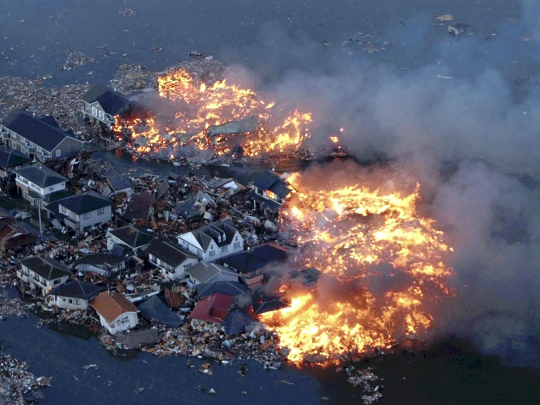
The ensuing destruction wreaked by the tsunami that hit coastal areas of Japan on Friday caused by a 9.0 maginitude earthquake puts life in perspective, particularly for those of us obsessed with expensive tech toys. (Photo: CBS News)
Sometimes it takes a disaster for reality orientation and life's priorities to set in.
This week, at least for those of us reporting in the New Media and other technical publications that cover computers and the consumer electronics industry, all eyes were on Friday, the 11th of March, 2011. The day that the iPad 2 went on sale.
Some of us became completely obsessed with the notion of buying an iPad 2and wrote about the anticipation and lengths one would go through in order to obtain it.
I include myself in this shameless group -- I woke up that Friday morning to find out there was now a 2 or 3 week shipping lag instead of a 2 or 3 day estimated time until I'd receive one if I placed an order with Apple's web site that day.
Massive lines at the local Apple stores in Northern New Jersey and New York City were forming as early as 9 or 10am, seven hours before they were supposed to go on sale. My chances of getting one on launch day or even in the next week were pretty much shot.
I was disappointed that I wouldn't be able to test it out and write up my impressions of it for the following week on ZDNet. I recall I may have even cursed and yelled at my computer screen a few times, feeling sorry for myself that I wasn't one of the selected few technology journalists who had earlier access to the device for review.
That disappointment and my own personal selfishness ended a whole five minutes later, when I received a shower of incoming Twitter messages alerting me to current events in Japan.
I turned on the TV to watch the morning news, where my screen was filled with images of destruction the likes of which we haven't seen since Christmas of 2004, when an destructive tsunami originating in the Indian Ocean from a massive earthquake killed hundreds of thousands of people in Indonesia, Sri Lanka, India and in other countries within reach of the wave.
Indeed, Hurricane Katrina which followed in our own country in August of 2005 caused untold billions of dollars of damage and displaced the lives of hundreds of thousands of people in New Orleans and all over the Gulf states, but the loss of life, while tragic, paled in comparison to the Indian Ocean tsunami.
We hoped we'd never see anything like those two disasters ever again.
At 2:46PM local time, Friday March 11, when many of us had just gone to bed on the West Coast of the United States, history repeated itself. A massive earthquake, caused by a tectonic megahthrust confirmed by the USGS to be 9.0 on the the moment magnitude scale, struck 81 miles off the coast of Japan's T?hoku region.
The resulting tsunami wave created by that earthquake has now caused vast and untold amounts of destruction in the Japanese city of Sendai, and has displaced at least 200,000 people now living in temporary shelters, with a death toll that is already estimated to be in the thousands.
The number of dead will likely rise very sharply over the next several weeks once the full extent of the damage from this event has been completely assessed. Many thousands of people are also reported as missing.
On top of this natural tragedy, the specter of a nuclear disaster has also emerged. Three of Japan's reactors, located in the prefecture of Fukushima, have been heavily damaged and are leaking radiation.
Three other reactors in the same prefecture are apparently experiencing problems with failed emergency cooling systems.
Eleven of the country's fifty-five nuclear plants were completely shut down on Friday, leaving many areas without power and working telecommunications infrastructure.
The three severely damaged reactors are located Fukushima #1 (Dai-Ichi) at part of a complex of six reactors, which began construction in 1966 and was opened by Tokyo Electric in 1971.
A second nuclear power plant, Fukushima #2(Dai-Ni) which is in a nearby a complex of four reactors, is also experiencing problems.
[Next: the possible implications of full or partial meltdowns]»
Current reports coming out of the country and the Fukushima area are sketchy and conflicting, but we know that as a result of the earthquake and the tsunami, hydrogen explosions at three of the buildings at the #1 (Dai Ichi) plant have caused extensive damage to the the walls of the buildings housing reactor units 1, 2 and 3 and their emergency cooling pumps.
The containment vessels themselves in reactors 1, 2 and 3 with the reactor fuel rods have not yet been breached.
Additionally, possibly as a result of collateral damage from the explosion at the first reactor, two (2) more of the six reactor cores in the Dai-ichi plant are having emergency cooling system failures.
Also, as of 8PM EST on March 12, it is being reported by multiple agencies that at Fukushima #2(Dai-Ni), three additional reactor coolant system failures have occurred.
Approximately 200,000 people living in the affected area near the two Fukushima nuclear plants have now been evacuated.
Earlier in the day on Saturday, March 12, radiation in the contaminated steam from the damaged cooling turbine pumps in the first reactor at Fukushima #1 had been reported to be leaking due to detection of cesium-137 isotopes taken from samples from the air of the surrounding area and the measurement of the radiation in the immediate vicinity of the reactor facility which is at eight times normal levels.
It was reported by various news agencies on March 12th that the first of the six damaged reactors was leaking approximately the amount of radiation in one hour that a typical human being receives in one year.
Japanese workers are now feverishly pouring in sea water into the three damaged reactors with the failed cooling systems in order to avoid complete meltdowns and core breaches similar to the Chernobyl event in the Ukraine in 1986.
According to various nuclear experts that were initially interviewed on the subject, it was thought that the event would most likely be similar in scope to the Three Mile Island incident in 1979, which was rated a 4 out of 7 in terms of its severity and environmental impact on the International Nuclear Event Scale.
Japan's own nuclear regulatory and safety agency, NISA, has currently rated the Fukushima #1 (Dai-Ichi) event an INE of 4. However, a senior NISA official had been quoted on Saturday saying that they"see the possibility of a meltdown"at Fukushima #1 (Dai-Ichi) reactor 1.
Japanese Chief Cabinet Secretary Yukio Edano has been quoted by multiple news agencies that there may have already been a partial meltdown of the fuel rods in all three of the damaged Fukushima Dai-ichi reactors.
Should any one or more of the affected Fukushima reactors undergo a complete meltdown, with the melted fuel leaving the containment vessel, resulting in one or more INEs of 7 (this being equivalent to a Chernobyl event, the worst nuclear accident in human history) the contamination from airborne radiation would be devastating for Japan, the entire pacific region and for the Western United States.
Such an event would potentially sicken and result in the deaths at a bare minimum of many tens of thousands of people, and causing severe environmental damage, not to mention tremendous negative economic impact to Japan and the entire affected region.
While this worst case-scenario is unlikely since the situation is not a "fast reaction" like Chernobyl (in that case, the entire reactor exploded, blowing the roof off the building and exploding the containment vessel, exposing the raw, melted fuel to the open air and sending a huge cloud of radioactive material into the atmosphere) even partial meltdowns resulting in multiple INEs of 4 or a 5 are still within the realm of possibility.
All of this puts life in perspective and makes you think about what is important. Human lives are important. Being obsessed with high-tech gadgets is not.
While my wife did end up standing on line at Target for me at 5PM yesterday, and I did eventually end up getting my iPad 2, I primarily used it on Friday night to watch the horrible scenes of destruction and live videos that kept rolling in from Japan. The gift was bittersweet.
It becomes very difficult to enjoy technology and a device as fun as the iPad when you know so many people are dying, or will die as a result of this incredible tragedy and horrible disaster.
Whether you got your iPad or not on Friday, I urge you to donate to either the American Red Cross or the Salvation Army which are two of the larger BBB accredited charities assisting in the relief efforts.
Donors can text “Japan” to 80888 from their cell phones to donate $10 to Salvation Army efforts. They can visit mobilecause.com for terms and conditions and should respond “Yes” to a “Thank you” message they receive.
Donors can text “Redcross” from their cell phones to 90999 to donate the same amount to that organization.
Larger donations can always be made online via the Red Cross website or Salvation Army website.
UPDATE (6x) Monday March 14 2011, 8:14PM EST: A total of six reactors in the greater Fukushima area have now suffered emergency cooling system failures as reported by the Los Angeles Times and Japan's Kyodo News Agency.
NISA, Japan's nuclear safety and regulatory agency, is now saying that it is possible that Reactor 1 at Fukushima plant #1 could undergo a meltdown and the Chief Cabinet Secretary of Japan has stated that two of the reactors may have already undergone partial meltdowns.
In addition to Reactor 1, Reactor 3 and Reactor 2 at Fukushima #1 have also experienced similar hydrogen explosions damaging their building structures. Article copy has been updated.
A Japanese soldier carries an elderly man to safety (Photo: CBS News)