Tech Broiler

Jason Perlow and Scott Raymond

Optimum Ultra: So how fast is it?

By | July 7, 2009, 2:37pm PDT

Summary: Optimum Online’s $99 per month Ultra DOCSIS 3.0 service is one of fastest residential broadband offerings available today. But is it really “Up to” 101Mbps as advertised? As I mentioned in a post last week about broadband service outages, Last Friday, I was upgraded to Optimum Online’s Ultra service. Ultra is a new service offering from [...]

Optimum Online’s $99 per month Ultra DOCSIS 3.0 service is one of fastest residential broadband offerings available today. But is it really “Up to” 101Mbps as advertised?

As I mentioned in a post last week about broadband service outages, Last Friday, I was upgraded to Optimum Online’s Ultra service. Ultra is a new service offering from Cablevision which provides DOCSIS 3.0 service, which is rated at 101 Megabits (Mbps) or 12.53 Megabytes (MB) per second for download speeds and 15 Megabits or 1.85 Megabytes per second upload. Both of these speeds are advertised as “Up to”, in other words burst mode speeds in optimal network conditions.

Click on the “Read the rest of this entry” link below for more.

The CISCO DPC3000, the premises equipment used for Optimum Online’s Ultra Service.

Optimum’s Ultra service is deployed no differently than any other cable broadband install, but even if you are an existing cable broadband customer with Cablevision, you will be charged $300 for an on-site visit and the new equipment, which is a CISCO-Scientific Atlanta DPC3000 DOCSIS 3.0 modem. The DPC3000 has a 160Mbps max throughput, but this is only if all four RF data frequencies are being used simultaneously. Currently, Cablevision is only using 3 of the 4 frequency channels on the DPC3000. DOCSIS 3.0 itself has a theoretical burst mode speed limit of over 300Mbps, but this is by using 8-way channel bonding and no product currently exists on the market which does this yet.

DOCSIS 3.0 Systems Architecture (Source: Cablemodem.com) Click on the diagram to enlarge.

The on-site visit is required because in order for the service to function properly, only a minimal amount of RF noise can be on the coaxial cable line, so typically the premises cable and connectors are swapped out and the line run to the local “Node” is tested for signal quality. Each Cablevision distribution node services approximately 500 customers, and connectivity from the node is home run via fiber-optic cables back to the main Optimum collocation centers.

In most circumstances, the visit should be a half hour or less to swap out the modem and check the signal quality. In my case, the supervisor elected to replace my entire cable infrastructure, and do some maintenance on the street-level signal amplifier that was mounted on the telephone pole which was having some moisture-related issues with its physical housing, so it was a 3 hour visit. I appreciated his thoroughness and attention to detail, so I have no qualms with the length of the outage.

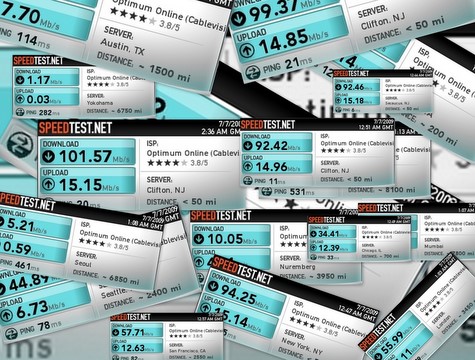
After the modem is installed, the technician runs a series of speed tests using OOKLA’s Speedtest.net site, using a direct CAT-5 connect to the DPC3000 from his laptop, which has a 1000Base-T (1Gig Ethernet) connection. On the first run, he got over 112Mbps using a server connection that had 21ms latency which was less than 50 miles away on Cablevision’s own network. Satisfied, he went on his way, and I connected the modem to my router at the time, a NETGEAR Prosafe SRXN3205, which is an upper-end, branch office 5GHz wireless VPN rules-based firewall router with 8 gigabit Ethernet LAN switch ports, and a gigabit Ethernet WAN port for connecting to DSL, cable modem or other network equipment.

PDF Download: optimum-online-speed-tests-ookla

The architecture of my home network consists of 2 NETGEAR GS608 v2 8-port gigabit Ethernet switches, both of which host several desktops and test servers in my office and are directly attached to the broadband router. In addition to the switches the broadband router is connected to a VOIP appliance and a dedicated NETGEAR 5Ghz 802.11N wireless bridge that is linked to two other 5Ghz 80211.N bridges, one of which resides in my wife’s office and provides her PC and printer with connectivity.

The second bridge provides 270-300Mbps connectivity for my Slingbox and my Roku Netflix streaming device in my living room. Additionally a single 2.4Ghz Linksys Wireless-N game adapter is connected wirelessly to the router for my DirecTV DVR in my upstairs bedroom. All the NETGEAR bridges are forced into 5Ghz Wireless-N mode so that there is no mixed traffic coming in from these devices and are dedicated to high-bandwidth tasks such as downloading movies. Every PC or server which is wired to a switch is forced to 1Gbps Full. Suffice to say this type of high-speed home network is exactly the type of customer that Optimum Ultra is designed to service.

So as soon as the Cable Guy left the house, I jack in the SRXN3205 and start doing some tests, with only my desktop PC switch connected so that my XP laptop and test Windows 7 PC have connectivity. The first thing I noticed was that on every single OOKLA speed test that I did to local NY-based, low latency servers is I maxxed out at about 50Mbps.

I had thought that Cablevision had pulled a fast one on me, but sure enough, when I direct connected the modem to my laptop or the Windows 7 test box, I got much higher transfer rates, around 100 megabits. This led me to suspect that either the SRXN3205 was misconfigured or some type of protocol negotiation issue or packet loss was occurring.  I’m not entirely convinced that the SRXN3205 is a bad solution, but I haven’t had the chance to follow up with NETGEAR yet to see if we can resolve it — I had my installation on July 3rd, and had little time to resolve the problem before everything shut down for the holiday weekend.

EDIT: Here’s what I heard from the NETGEAR product manager, Jason Leung:

This is because the SRXN3205 is only rated 60 Mbps!  A firewall is very different from a router and you can’t compare the throughput between the two.

This is because a Router is not a Firewall.  A Router routes every single packet as fast as it can.  A Firewall has to do real work to determine which packets to route and which to drop —- hence it’s a VPN/FW, not a router.

A lot of consumer grade equipment advertise FW capabilities but in reality all that consumer grade equipment is doing is NAT.

For customers which need a true rules-based VPN firewall for Ultra or FiOS, Jason recommends the FVX538, which has a WAN port that is rated for 100Mbps sustained data transfer, as opposed to the SRXN3205.

To eliminate the possibility of it being the NETGEAR router, I went out to Best Buy and purchased a new Gigabit SOHO router, an Apple Airport Extreme. Sure enough, I got very high throughput with the OOKLA tests with the Airport Extreme, and I probably would have kept the device had it not been for the fact that the Extreme has very limited firewall capabilities and lacks port triggering and a number of other advanced networking features I need for various types of testing.

The Airport Extreme also lacks a web-management interface, and only has 3 switched Gigabit Ethernet ports for LAN attached devices, which I think is a bad design choice for what is probably the most expensive SOHO router on the market. In my opinion it should have a web GUI and more advanced firewall functionality and at least five ports for $179.00. However, if you are a SOHO user that happens to use a bunch of Apple products such as the Apple TV and Macs, you’ll probably love the product, particularly if you are using a service such as Ultra or FiOS. You’ll also notice from the speed test PDF that is enclosed in this post that it scored overall the fastest in the 3 routers I tested with on the OOKLA benchmarks.

In any case I returned the Airport Extreme to Best Buy and decided to go with another product, the CISCO Linksys WRT610, which is a gigabit Ethernet 5Ghz/2.4Ghz dual band SOHO router. My rationale with going with a Linksys instead of another NETGEAR was that I wanted to eliminate any possibility of there being a vendor compatibility issue between the CISCO and NETGEAR equipment. In theory, the WRT610 should be fully optimized and certified to work with CISCO’s own broadband equipment even though Scientfic Atlanta and Linksys are two different subsidiaries.

Over the 4th of July weekend and through early this week, I ran a battery of OOKLA speed tests on Speedtest.net to determine just how fast the quality of service I was actually getting. OOKLA’s methodology for SpeedTest.net is documented on their web site, but suffice to say that the lower the latency you have to the target server, the faster you are going to go. So anything under 20ms ping times you are going to get very fast results.

As you increase packet trip times, your speed decreases dramatically. Trip time is entirely dependent on the speed of the link at every step of the route and how many “hops” you have between your premises equipment, to the backbone of your broadband provider, out to the Internet, and to the target server. You also have to assume that with any network connection that a SOHO router itself is going to add packet overhead, around 10 percent, and you’ll see another 20 percent overhead on the WAN connection itself just added by using TCP/IP itself. So 70 percent utilization is really the best you can hope for, in fully optimal circumstances.

That being said, OOKLA’s SpeedTest.net site is not necessarily a good overall test of whether or not you can saturate the broadband connection, because it only does about a 10-20 second burst of data from one end to the other. If you are connecting to a low latency server, that is barely enough time for the transfer to “Ramp Up”.  Therefore I decided to do more extensive testing and “Loaded the deck” for a best-case scenario to max out the line.

For my first series of speed tests, I contacted Limelight Networks to see if they could provide me with some large files I could download over http protocol using Linux’s wget utility, which is the web protocol equivalent of an FTP client. Limelight, as some of you may recall, is a large content delivery network provider and was the hosting solution that NBC chose for delivering the Olympics video content. They were happy to oblige, providing me with a set of files that were within 9ms ping time from my premises equipment, and less than 3 hops away from Cablevision’s network.

PDF: limelight-pingresults

PDF: limelight-bigfiles-withrouter (100 and 500MB file download using WRT610N)

PDF: limelight-modemonly (same tests as above with CISCO modem direct connected to PC)

Note: All tests above use obfuscated results to mask identity of the servers used to protect content and supplier bandwidth. All metrics are unaltered.

As you can see from the test results, when downloading from Limelight, the transfer speed was maxxed out at around 32Megabits or around 4MB per second, way short of the full 101Mbps that is advertised. I’m still not finished doing tests with Limelight and this slower than expected speed may due to a QoS configuration issue, so continue to watch this space. [EDIT: See "Trafficking in Michael Jackson" for an explanation. We got Jackdotted.]

As a second test, I contacted a friend who owns a large ISP based out of Boston, who has a collocation center with 3Gigabits of aggregate bandwidth. His servers are less than 20ms ping from my premises, so I did some large file download tests using the same methodology as with Limelight. I did a lot better, around 8.5 to 10MB per second. The tests were performed at off hours, at 10-11PM at night, where the least amount of traffic was hitting his servers, so this was a purely best case scenario where latency was as low as I could expect and incoming bandwidth was as big as I could possibly want.

PDF: 3gigpipes (ISO file download using WRT610N)

[EDIT: A re-attempt at the Boston-based 3gig provider on July 9th yielded a burst transfer rate of 11.4MB per second, or 91Mbps on 579MB ISO]

The results match with my expectations of 20 to 30 percent overhead on the bandwidth with an expected net performance of about 70-80Mbps (10MB a second) under very optimal conditions.

In summary, I do think that Ultra and other high-bandwidth services such as FiOS do provide unparalleled speeds to subscriber households, but the caveat is that you cannot expect to get performance like this all the time, and that network overhead, latency and routing is a reality we’re never going to get away from. As more content ends up at CDNs like Limelight and Akamai where bandwidth-intensive files are locally cached near the customer, the benefits of these fast broadband connections will be more evident — but until then, early adopters will have to put up with vastly fluctuating performance.

What have your experiences with Optimum Ultra and Verizon’s FiOS been like? Have you performed similar benchmarks? Talk back and let me know.

Kick off your day with ZDNet's daily e-mail newsletter. It's the freshest tech news and opinion, served hot. Get it.

Jason Perlow, Sr. Technology Editor at ZDNet, is a technologist with over two decades of experience integrating large heterogeneous multi-vendor computing environments in Fortune 500 companies.

Disclosure

Jason Perlow

My Full-Time Employer is IBM. I write as a freelancer for ZDNet.

Disclaimer: The postings and opinions on this blog are my own and don't necessarily represent IBM's positions, strategies or opinions.

I own no investments or direct financial instruments in the companies I write about.

Biography

Jason Perlow

Jason Perlow, Sr. Technology Editor at ZDNet is a technologist with over two decades of experience with integrating large heterogeneous multi-vendor computing environments in Fortune 500 companies. A long-time computer enthusiast starting the age of 13 with his first Apple ][ personal computer, he began his freelance writing career starting at ZD Sm@rt Reseller in 1996 and has since authored numerous guest columns for ZDNet Enterprise and Ziff-Davis Internet. Jason was previously Senior Technology Editor for Linux Magazine, where he wrote about Open Source issues from 1999 to 2008.

In his spare time, Jason is an avid amateur chef and food writer, where his work reviewing New Jersey restaurants has appeared in The New York Times. He is also the founder of the popular food web site eGullet and blogs about restaurants and cooking at OffTheBroiler.com.

Related Discussions on TechRepublic

Did you know you can take part in these discussions with your ZDNet membership?
36
Comments

Join the conversation!

Just In

RE: Optimum Ultra: So how fast is it?
JACOBSONR 14th Oct
Good day to confirm this comment I would appreciate T h e b e s t o f Z D N e t d e l i v e r e d your website very nice to everyone Yes, Oracle is the only one with shared-disk architecture, but that is there advantage. It means you can add or remove nodes and the database lives on. In a shared nothing architecture, if you lose a node, you lose the system. I'm sure Oracle appreciates EMC highlighting their advantage.I also desire to signal in your RSS feeds. Thank you as soon as once again and maintain up the great operate Awesome post! Thank you very much || thanks for nice content this is really benefit to me.
0 Votes
+ -
Up to 101Mbps is not fast
Necrolin 7th Jul 2009
I get a MINIMUM of 100 Mbps plus VoIP (including the phone) for a whopping $20/month. No limits. No caps. I don't live in America, but you guys are getting seriously ripped off. Just my 2 cents.

Fastest service where I live is being advertised at 160Mbps.... sweet.
0 Votes
+ -
Korea?
snafu_77 8th Jul 2009
Where are you located? Although the US is considered a leading nation for many things when it comes to technology we don't have an updated infrastructure. People here get excited to have their cellphone able to take video while people in places like Japan have video calling for years now on their cells.

100mbps is not available to consumers in most US markets. Its not even available to businesses in all markets and where it is available you pay alot for it.
0 Votes
+ -
Leading?
oliver_foster@... Updated - 9th Jul 2009
"the US is considered a leading nation for many things"

like what? being the financial centre of the western world isn't about leading

I've always considered US to be the leading edge on media drama, capitalistic idiots and self hype. But I honestly can't think of any - and I mean ANY - leading anything to come out of "THE(/OUR) STATES" in a while.

Half of Europe has started subscribing to the idea of 'the American dream' as though it is attainable. It actually repulses me to a degree that I feel like setting fire to my American passport and apologising for our exports.

Why can't we actually lead? With some integrity, honesty and direction? Forget the 300Mbps connection, free healthcare anyone?

P.S. had a rather bad morning, apologies
0 Votes
+ -
I understand
snafu_77 9th Jul 2009
I often feel the same way about it.
Hey no one is gonna pass our trade deficit anytime soon! We're number 1!
0 Votes
+ -
Leading no matter where we go?
hiraghm@... 9th Jul 2009
"free healthcare anyone?"

There's no such thing as "free" healthcare. There's simply healthcare paid for by someone else.

I would like America to resume the leadership role where freedom is concerned. Freedom is not letting the government dictate the lightbulbs you use, or provide you with cradle-to-grave healthcare. Freedom is having authority over your own life and responsibility for it. So, if you want healthcare, don't be a feudalistic serf and have your employer provide it. Don't be a socialist drone and have the government provide it. Work for what you want and buy it for yourself. Don't force me to join a government program (or pay a $1,000 fine) just because *you* want to be able to visit the doctor every time you get a hangnail, at no charge to *you*.

America used to be the leading beacon in the concept of individual liberty, where each of us was considered competent to run our own lives. Now we're all potential terrorists and incompetents; we must be coerced to strap ourselves into our vehicles whether we want to or not and instead of happily sitting on mommy's lap, today's baby is likewise strapped into a torture chair in the back seat; the decision made by the government and not the parents (but when the baby gets old enough for an abortion... suddenly only then is it her body).
The only thing we are considered competent to handle is the voting booth... provided we vote for the left candidate.

Let's lead the world in entrepreneurship. Let's lead the world in allowing the individual to do whatever he wants with his life, if it's driving an SUV or eating sixteen cheeseburgers at once, creating the next Wal-Mart or Apple Computers, or inventing an internal combustion engine that runs off of polar bear tears.
  • Flagged
0 Votes
+ -
Right On!
john_gillespie@... 9th Jul 2009
We need to preserve the freedom of the health insurance companies to
wring as much money as possible out of the people they insure and to
decide which Americans deserve the privilege to be able to pay them for
coverage.
Did you ever wonder how the insurance companies could afford to build
those huge buildings, pay their executives so much and also provide a
good profit for their stockholders? I thought not. Probably a side effect
from sitting in the back seat of your parents car and occasionally flying
forward and hitting the windshield with you head.
0 Votes
+ -
First of all this is way off topic. Second of all, look at every country around the world who offers "free" healthcare, it is just passing the costs along to those who actually work (or want to work). Insurance companies are not the ones causing costs to skyrocket, their profits are steady, not skyrocketing. It is the drug companies, medical resources and others making it so easy for someone to go into a doctor's office and explain that they need an MRI or a scan to determine the problem.

Somewhere along the way, our country and now much of the world has decided that it is their "right" to get something for free, i.e., a hand-out.

For your uninformed mind, most health insurance companies run at about 93%-95% payments. They take in money, invest it till they need to pay claims and those investments are where they are able to give bonuses (and lots of the salaries). This is why so many of them have done so poorly over the last couple years.

But, you seem to have it all figured out, government healthcare is the way to go, right? How is medicare working out for your parents/grandparents -- don't forget, you take away the insurance companies and you won't have any supplemental coverage, suddenly Grandma's retirement checks will be cut by 40% and all her retirement savings will be subject to and ADDITIONAL 40% tax to pay for you to get "free" healthcare.
0 Votes
+ -
things like
midenginedrift 9th Jul 2009
being required to be "strapped in" (seat belt law) became required because people were no longer being responsible or taking responsibility for their actions or the consequences. once that happens the gov gets involved. if you don't want the authorities cracking down on something don't let it get out of control...
We'll soon be paying the price for the Kyoto shakedown.
0 Votes
+ -
Have you tested it with various sites?
0 Votes
+ -
Thankfully -
morrigen 10th Jul 2009
Were back on about internet speeds,not a Nanny State discussion.Here in UK paying ?20 for a 10Mb's from Virgin cable,but only getting 5.8Mb's.Feeling a bit miffed,but going back a few years to 56Kb's,I should really be happy.
0 Votes
+ -
RE: Optimum Ultra: So how fast is it?
MargaretS 8th Jul 2009
Ah - just replied to a different column with same
story. Outages in Dix Hills with Cablevision again!
Makes anyone want to scream!

Do you really think it will be fast all the time? With
constant outages in this criminal conglomerate of a
company, I can't imagine service will be reliable with
Ultra. Fast is good, except when fast only works 1/2
of the time.

As you pointed out before, Cablevision will not be
quick to respond to my concerns. (more accurately,
they are not being quick or responsive in the least)
We can't all be columnists for major blogs happy
0 Votes
+ -
RE: Optimum Ultra: So how fast is it?
FiOS-Dave 8th Jul 2009
From what I hear, FiOS can supply up to 300-400MB
without having to change much at all. It will be interesting to see what happens to the DOCSIS speeds when saturation occurs and "bandwidth stealing" occurs.
0 Votes
+ -
Contributr
This is FUD
jperlow Updated - 8th Jul 2009
Optimum is just as fiber-based as FiOS is, it has all the same back end infrastructure. The only difference between the two is with FiOS you have to be your own "Node" and home run the fiber to the central office/back end, whereas with DOCSIS 3 you have a large community node with telecom-class switching infrastructure that services a lot of customers and has huge fiber trunks going back into the DC. The only major advantage FiOS has is that with fiber, you arent as susceptible to the elements as Coax strung over telephone poles and to the premises over a period of several years will degrade and needs replacement, whereas with fiberoptics buried underground its less of a problem. The cost of tearing up the streets and such for many communities and the disruption it will cause makes FiOS a no-go for a lot of people in this country.

FiOS will win out only when everyone gets fiber runs and they can crank the bandwidth over 1Gbps, in which case the limitations of Coax will be apparent, maybe 5 or 10 years from now. Until then DOCSIS/Cable is just as fast. FiOS will have the same limitations on latency and routing that I identified in this article.
0 Votes
+ -
RE: This is FUD
fatman65535 9th Jul 2009
Quote: The only major advantage FiOS has is that with fiber, you arent as susceptible to the elements as Coax strung over telephone poles and to the premises over a period of several years will degrade and needs replacement, whereas with fiberoptics buried underground its less of a problem.

I am sorry to dispute you, but NOT EVERY FiOS service area is completely underground. In my neighborhood, several blocks are supplied by aerial cable to the back yard utility pole. Then, Verizon will run you underground. The funny thing is that a few streets away, everything is underground, right up to the house. Go Figure! Since I live in a hurricane prone state, I am curious as to the reliability of that aerial fiber optic cable during high winds. If it gets whipped around a lot, it would not surprise me if the glass strands break.
0 Votes
+ -
Contributr
Really?
jperlow 10th Jul 2009
I had no idea, I thought they buried everything so they could prevent degradation.
0 Votes
+ -
No, much infrastructure is above-ground...
randysmith@... 10th Jul 2009
Here in Westchester County (NY), it depends where you are. Most suburban areas have overhead wires exclusively, and there are NO plans to change that in the future (which is why we are hard-hit with outages due to weather events). Some more-expensive housing developments have underground utilities, probably mostly for esthetics, but even those typically have above-ground feeds somewhere "down the street".
0 Votes
+ -
Hi Jason -

The current design of the public Internet is such that consistently high speeds are not yet possible - throughout the world.

That's why Internet-2 was invented for the Military and certain Amademic institutions.

All of these Speed Test sites are rather worthless when you cannot reliably stream HD level content to your computer.

What Cablevision is offering is just Market Hype. Watch the speeds fall when the kids get home from school, or the nature of your web intensive application demands more.

:0)
0 Votes
+ -
Speedtest
winddrift03 8th Jul 2009
try using both toast.net's speedtest ( you can select both multiple file type and different host servers ) and testmy.net. I think these 2 speedtest sites are a better match fir the type of testing you want.
0 Votes
+ -
Only for the cosmopolitan
winddrift03 8th Jul 2009
I love these arguments! Hell, I'd be happy if i could get a 10mb cable connection. The best we are offered by Charter is 5mb!
0 Votes
+ -
You're getting screwed then.
CTRLurself 9th Jul 2009
I'm currently paying for 7mbs from Charter, however after numerous reliability
issues, we now recieve all available banwidth at our node (which happens to
be in our backyard). At off peak times, I've tested upwards of 22mbs for hours
at a time (the hours of 10pm-5am).

Charter recently upped their service offerings in a lot of areas. Call them up and
ask about if there are higher speeds available in your area. I promise you they
would be more than happy to take more of you money every month.
0 Votes
+ -
Yeah Cablevision has actually been having outages all across Long Island not just in the centralized areas that have been getting press.
0 Votes
+ -
RE: Optimum Ultra: So how fast is it?
Clint_bond 8th Jul 2009
What is with Cablevision? In addition to what appears to be false advertising (101 mbs), they have trouble providing basic internet service. I'm glad I don't live on Long Island, but then again I guess any Cablevision customer should be concerned. If internet can go out on all of Long Island, I'd say any Cablevision connections are vulnerable.
0 Votes
+ -
In fairness
epaval@... 9th Jul 2009
There are some outages in LI starting from yesterday but not all LI is affected. I am not and in the past 7 years I had just one 4 hours outage. Rebooting the modem happens no more than once every 3-4 months and I am very pleased with the level of service. I have Boost and I speedtest.net constantly reports speeds up to 35 Mbs download and 5 Mbs upload.
0 Votes
+ -
Here is a great benchmarking site to try.
Smart_Neuron 9th Jul 2009
Hi -

Visit - www.numion.com

This is a real-world test, rather than a quick "burst" type site.

Let me know how you like it.

:0)
Here in New Zealand, most of us don't even have broadband - we have ADSL. We get fleeced $30-$40 a month to get 1GB of 3mbps down and 128kb up! Even the listed speeds fluctuate wildly. So for you "poor" Americans thinking how wonderful it is that Necrolin gets such stupendous speeds, you might spare a thought for those of us "down under" living in the digital dark ages... and be "happy" that you've actually got broadband, not ADSL wink
0 Votes
+ -
Are you serious?
Smart_Neuron 9th Jul 2009
Hi -

I have been to New Zealand and I thought that it is a progressive country! Could it be that your ISP just does not have the infrastructure to provide if you live in a remote area?

:0)
0 Votes
+ -
RE: Optimum Ultra: So how fast is it?
xrayangiodoc 9th Jul 2009
Here in the Buffalo area of Western New York the 20,000,000 b/s (2.50 MB/s) FIOS service typically yields torrent downloads of 2.3 MB/s (18.4 mb/s). The 5,000,000 b/s upload bandwidth (625 KB/s) maxs out at 650-700 KB/s. No significant outages since I had it installed a year ago.
0 Votes
+ -
I also desire to signal in your RSS feeds. Thank you as soon as once again and maintain up the great operate! nccma cooler
0 Votes
+ -
I used to be more than happy to seek out this internet-site.I wanted to thanks in your time for this glorious read!! I positively enjoying each little bit of it and I have you bookmarked to check out new stuff you weblog post. this thread is amazing i like your work and i appreciate you that you have share a useful stuff thanks for sharing the i shop abatwa
0 Votes
+ -
I used to be more than happy to seek out this internet-site.I wanted to thanks in your time for this glorious read!! I positively enjoying each little bit of it and I have you bookmarked to check out new stuff you weblog post.Bookmarking now thanks please consider a follow up post. power sa shop
0 Votes
+ -
I think the representation of this article is actually superb one. This is my first visit to your site. Thanks a lot and keep sharing the information. Keep updating the information for all of us. Thanks ZDNet Government was launched as the brand's first industry vertical, with a mission to cater to IT professionals in the public secto I agree with your post. However, do you have any sources I can cite for my paper wheel car com bury
0 Votes
+ -
Well welcome, hopefully you can become a vital member of the community and really help to push far ahead of google. Which Im sure the development team would love. This will of course earn you alot points too and get you on the leaders board. z d n e t t h a n k Im not sure i come to an agreement with you on every level, howevor it absolutely was a good posting, many thanks for taking the time to put up your ideas.
0 Votes
+ -
Thanks nice info z d n e t I really liked your current article write more..let me add you to its favorite The articles you have on zdnet s i t e are always so enjoyable to read. Good work and I bookmarked it.
0 Votes
+ -
Fantastic news about the new release.I positively enjoying each little bit of it and I have you b o o k m a r k e d to check out new stuff you weblog post.Im not sure i come to an agreement with you on every level, howevor it absolutely was a good posting, many thanks for taking the time to put up your ideas
0 Votes
+ -
Good day to confirm this comment I would appreciate T h e b e s t o f Z D N e t d e l i v e r e d your website very nice to everyone Yes, Oracle is the only one with shared-disk architecture, but that is there advantage. It means you can add or remove nodes and the database lives on. In a shared nothing architecture, if you lose a node, you lose the system. I'm sure Oracle appreciates EMC highlighting their advantage.I also desire to signal in your RSS feeds. Thank you as soon as once again and maintain up the great operate Awesome post! Thank you very much || thanks for nice content this is really benefit to me.

Join the conversation!

Formatting +
BB Codes - Note: HTML is not supported in forums
  • [b] Bold [/b]
  • [i] Italic [/i]
  • [u] Underline [/u]
  • [s] Strikethrough [/s]
  • [q] "Quote" [/q]
  • [ol][*] 1. Ordered List [/ol]
  • [ul][*] · Unordered List [/ul]
  • [pre] Preformat [/pre]
  • [quote] "Blockquote" [/quote]
ie8 fix

The best of ZDNet, delivered

ZDNet Newsletters

Get the best of ZDNet delivered straight to your inbox

Facebook Activity

White Papers, Webcasts, & Resources
ie8 fix