Tech Broiler

Jason Perlow and Scott Raymond

Project Blade Runner: The personal computer of 2019

By | May 6, 2011, 10:55am PDT

Summary: How far do you think we are from our 2019 vision of the personal computer?

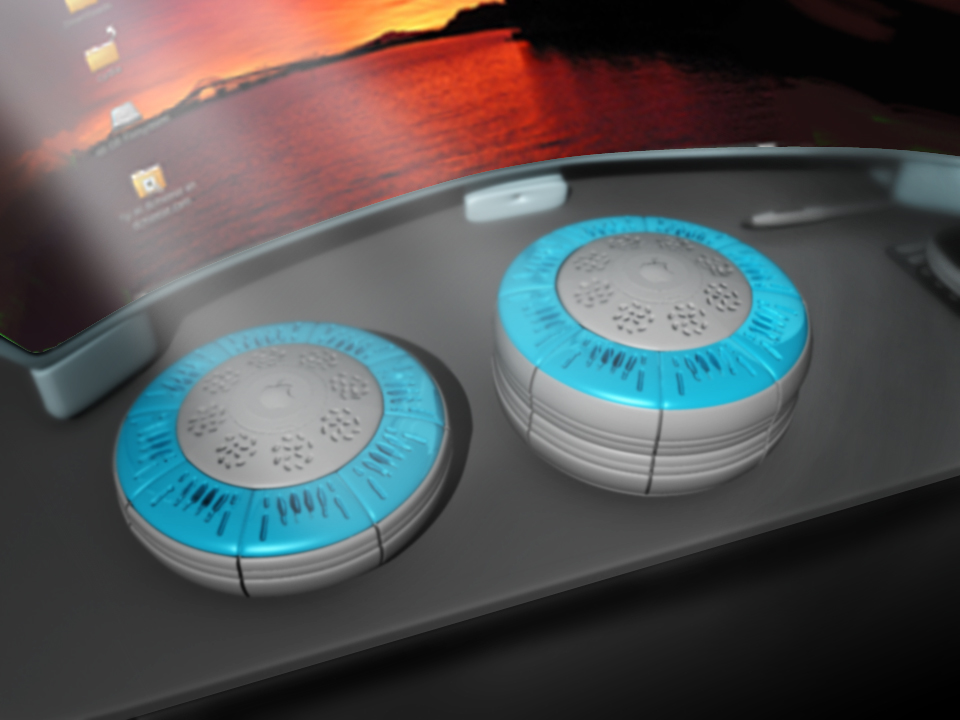
An artist’s rendering of a modular ARM-based Apple “Pi”, circa 2019. (conceptual art courtesy Spidermonkey, Inc.)

With ZDNet having just celebrated its 20th anniversary in April of 2011 and publishing a number of retrospectives on how technology has evolved over the last twenty years, both Scott Raymond and I decided that it might make for an interesting thought experiment to try to project what personal computing might actually evolve into in the next decade.

Also Read: ZDNet 20th Anniversary Special Coverage

The business of trying to crystal ball or read the tea leaves of the computer industry has always been difficult, particularly when trying to project it out for more than two or three years if you aren’t an insider at companies that are directly working on actual technology roadmaps for semiconductors, system components, software and operating systems.

However, even if you are an insider, the gap between researcher and actual productization can often lead to very different outcomes based on market acceptance, real manufacturing costs and any number of other mitigating factors.

Still, there have been a number of recent advances that we have observed in personal computing, the modern datacenter as well as in consumer electronics and embedded systems that allow us to make a number of educated guesses as to how these trends might actually manifest themselves as real products in the future, as much as eight or ten years from now.

Also Read:

Certainly, I expect that we almost definitely have missed the mark on a number of details and will fail miserably to anticipate a number of new technologies or trends, or might even be too optimistic in terms of how quickly some of these ideas may be adopted.

But whether we see this in 2019, 2021 or even 2025, I think that this reference architecture –- which we have adopted the name “Blade Runner” in homage to Ridley Scott’s 1982 vision of 2019 is a good pinhole or an educated napkin drawing for a glimpse at the Personal Computer of the future.

The Blade Runner foundation: “The Hub”

The foundation or basic building block for our Personal Computer of 2019 is what we refer to as “The Hub”. We envision this as a flat, half-inch thick square slab with approximately the same area dimensions of today’s Apple Mac Mini –- about seven and a half (7.5”) inches or 20cm.

The Hub will contain all of the electronic components of what we think of on today’s PC motherboards, but much more integrated and miniaturized. The communications and memory bus, the CPU crossbar, the integrated controller electronics for all the I/O components as well as the networking and interfaces will all be housed in this device.

The desktop PC “case” which we know of today that is filled with wires and expansion boards will no longer exist. Instead, there will be snap-in modules that are more analogous to Lego Bricks that will click into the Hub that will perform the functions of the PC components that we recognize today -– CPU, Memory, Graphics Processing and Storage.

Since virtually all of our components in the PC of 2019 are completely solid-state, relatively low power and generate only a minimal amount of heat, the Hub could sit flat on the desk pancake-style, or in a vertical position.

It could also reside in a living room as an advanced set-top box, connected to a large high-definition display. The actual physical design aesthetics would largely depend on the vendor selling and marketing the system.

The Hub itself is the fundamental building block of the Blade Runner architecture.

While the average PC might consist of a single “Hub”, with a single CPU, memory and storage module, it would be possible based on our driving architectural decisions that multiple Hubs could be connected or stacked together to form much more powerful desktop computer systems, such as for creative content professionals, engineers, or high-end gamers.

We also recognize that many consumers might purchase highly integrated systems where the Hub and modules are in a single, enclosed, non-upgradeable unit attached to some sort of display, or integrated into the display itself, such as with a tablet or laptop computer or even a fully integrated desktop device like “The Screen”.

Also Read: I’ve seen the future of computing, It’s a Screen (2008)

Also Read: 2016, You’re watching the Linux Channel (2008)

For example, some companies such as Apple might decide to adapt this architecture to their own uniquely desired form factors — even exotic saucer-shaped, stackable systems like the “Pi” shown in our title artwork created by our conceptual artist.

But the electronics themselves and basic building blocks in the Hub, regardless of actual end-user product configuration would still be the same.

The important thing to remember about the Hub is that the systems architecture for desktops, laptops, smartphones and tablets would be identical. There would be no important distinction between desktop and embedded systems programming from a developer perspective. We’ll get into this when we discuss the actual operating system that runs on Blade Runner.

[Next: A Modular PC Architecture for the 21st Century]»

Topics

Jason Perlow, Sr. Technology Editor at ZDNet, is a technologist with over two decades of experience integrating large heterogeneous multi-vendor computing environments in Fortune 500 companies.

Disclosure

Jason Perlow

My Full-Time Employer is IBM. I write as a freelancer for ZDNet.

Disclaimer: The postings and opinions on this blog are my own and don't necessarily represent IBM's positions, strategies or opinions.

I own no investments or direct financial instruments in the companies I write about.

Biography

Jason Perlow

Jason Perlow, Sr. Technology Editor at ZDNet is a technologist with over two decades of experience with integrating large heterogeneous multi-vendor computing environments in Fortune 500 companies. A long-time computer enthusiast starting the age of 13 with his first Apple ][ personal computer, he began his freelance writing career starting at ZD Sm@rt Reseller in 1996 and has since authored numerous guest columns for ZDNet Enterprise and Ziff-Davis Internet. Jason was previously Senior Technology Editor for Linux Magazine, where he wrote about Open Source issues from 1999 to 2008.

In his spare time, Jason is an avid amateur chef and food writer, where his work reviewing New Jersey restaurants has appeared in The New York Times. He is also the founder of the popular food web site eGullet and blogs about restaurants and cooking at OffTheBroiler.com.

Related Discussions on TechRepublic

Did you know you can take part in these discussions with your ZDNet membership?
52
Comments

Join the conversation!

Just In

RE: Project Blade Runner: The personal computer of 2019
FAULKNE 13th Oct
Good day to confirm this comment I would appreciate T h e b e s t o f Z D N e t d e l i v e r e d your website very nice to everyone Yes, Oracle is the only one with shared-disk architecture, but that is there advantage. It means you can add or remove nodes and the database lives on. In a shared nothing architecture, if you lose a node, you lose the system. I'm sure Oracle appreciates EMC highlighting their advantage.I also desire to signal in your RSS feeds. Thank you as soon as once again and maintain up the great operate Awesome post! Thank you very much || thanks for nice content this is really benefit to me.
0 Votes
+ -
Interesting that your hub design is very similar to the desktop machine Convergent Technologies put out roughly 25 years ago. There they had a base box with the CPU and memory, and snapped in lego like pieces for disks and other peripherals.

The more things change...
@oldsysprog: ... much slower than it might seem when we think of the future.

2003's PCs are not really that different from 2011 PC conceptually.

And besides tablets becoming main idea what a PC looks like for average person (kids of the future will laugh at thought that computer was a thing to which person should come-to to be used, since they will rarely see standalone machines/boxes), nothing much else will change.
0 Votes
+ -
@denisrs "2003's PCs are not really that different from 2011 PC conceptually."

1992 PC's aren't really that much different from 2011 systems.

92: DOS 5.0, VGA graphics, 40mb to 120mb IDE hdd's. CD-ROM drives were available (remember caddies?). CRT displays up to 17 inches. Dial up modems, BBS systems and AOL met the need for connectivity.

2011: Win7, HD graphics (other than enhanced cooling needs, the cards look the same as a 92 version). IDE is nearly gone, replaced with SATA. HDD size is astronomical in comparison, but the drives externally look the same. DVD and BD burners are externally identical to CD drives in 92 machines, and internally are the same concept. Widescreen LCD displays are the most radical change, along with the ease of setting up multiple monitors on a single box. Oh, and wireless high-speed internet.

With that said, you put a 92 white box next to a 2011 white box and the average person wouldn't be able to tell which one is better. A techie would really have to look at the back of each machine to get the truth.

I'm predicting that 2019 systems aren't going to be radically different than a 2011 system, and that you'll see companies running 2011 boxes in 2019, with users hesitant to change from Win7/8 to Win10. happy
0 Votes
+ -
Oh, and processing speed obviously has changed, but the biggest is that chips in 92 didn't require a cooler (which amazes me when I think about it). I touched a running 486/50 proc with a finger...and burned it pretty good!
@sframberger - you glossed over several major changes, including the demise of the floppy disk (CD drives were wild and exotic in 1992; I worked in a college where we had a total of four PCs with CD drives by 1994) and the rise of USB as a univeral connector. Mice were also somewhat exotic in 1992, as well as audio - few peripherals were present on the motherboard itself as well. The fact that your 2011 "white box" can be tiny and sitting on the desk or even on the back of a monitor is another overlooked fact, as well as the rise of multicore processors and parallelism, on-die cache and GPUs, etc. No, a lot has really changed, and that's not even considering the ecosystem around them - the switch from monochrome dot-matrix printers to the availability of cheap, full-color inkjet printers, the fall in price of scanners (which also cost a fortune in 1992 unless you were using a hand scanner), digital cameras, webcams, wireless peripherals, networked peripherals (printers, scanners, NAS, etc.), home RAID, etc.
0 Votes
+ -
@DeRSSS You have it all wrong. Room temp superconductors and quantum computing will be standard fare. Your personal computer will be a dental implant with more memory capacity than currently available to the NSA, and AI capabilities that an t icipate your needs and desires, evaluate your environment, and help you make decisions in real time. Individual thoughts will become unique, and frowned upon by cutlural icons set up by the Michele Obama ad ministration for your emulation. Happy Meals will still be illegal in San Francisco.
0 Votes
+ -
Wrong Kemo Sabe!
kd5auq 9th May 2011
@oldsysprog
Solid state devices will be too vulnerable to China and India's "EMP" attacks. We will be back to room size vacuum tube 500Khz cpu's! LOL
0 Votes
+ -
I'll disagree with you on tha ARM part
Bill Pharaoh 6th May 2011
as in 8 years too much will change. I can see a hybrid chip on the horizon which is neither x86 nor ARM, instead a hybrid type chip that can be both, or neither, in which the chip will "load" the instruction set and configuration needed to run whatever program you choose.
0 Votes
+ -
Contributr
@Bill Pharaoh What you're referring to is a Field Programmable Gate Array.

http://en.wikipedia.org/wiki/Field-programmable_gate_array

While I see this approach being used for specific ASICs, I don't see this as something general purpose CPUs doing.
0 Votes
+ -
@jperlow: agree.

As to BR project, I would think that it is almost too conceptually good to be ready by 2019.
@jperlow Or perhaps the failed Transmeta Crusoe chip?
0 Votes
+ -
Presumption of ARM is naive
archangel999 9th May 2011
@Bill Pharaoh The writer's presumption that ARM will completely (except in the legacy processor) x86/x64 chips is naive - Intel is hardly going to let that happen - they're already bringing out later this year new x86/x64 compatible chips using new designs that match/beat ARM power profiles
0 Votes
+ -
Contributr
@archangel999 The presumption that x86 is going to be a valid architecture 10 years from now -- 40 years after its introduction -- when compared with architectures that have no limitations imposed by legacy compatibility is also naiive.

What Intel has introduced with Tri-Gate is a semiconductor manufacturing process. It is not an architecture. It could be applied to ARM, IBM's POWER, or any number of other architectures including x86. You're still going to need more transistors to scale x86 relative to everything else, even if the transistors are more dense.
@jperlow "It could be applied to ARM" - it could be applied to AMD's Phenom IIs as well, but Intel has no incentive to let either of those things happen. happy Any change of standard architecture is going to come from pressure from outside Intel. The question is who would apply that pressure? Windows 8 being available on ARM is one of the things that needs to fall into place, but who's going to introduce desktop-level ARM CPUS and who's going to make desktop ARM motherboards? In the past, vendors faced the wrath of Intel for just using AMD CPUs or making AMD motherboards.
"The presumption that x86 is going to be a valid architecture 10 years from now -- 40 years after its introduction"

ARM was invented in 1983 . . . not really that much younger. You act as if it were invented in 2005.

The only reason ARM doesn't have a major legacy problem is because it hasn't changed its instruction set in many years, and it isn't holding onto things like the x86's "real mode" which is virtually unused (but still exists, last I checked).

FYI - do you remember why CISC won the CISC/RISC wars?

There's an advantage to CISC, otherwise it wouldn't be used so much. I don't think we should ignore the reasons why we stuck with CISC in the first place.

"It could be applied to ARM, IBM's POWER, or any number of other architectures including x86."

I'll bet you good money Intel is grabbing as many patents as it can on the process right now.
0 Votes
+ -
Two things I think you need to take into consideration:

Memristor technology will be mainstream within 10 years, which allows a combination of memory and logic functions that uses no power for long-term storage. It should fundamentally change computer design like the shift from structured programming to object-oriented programming, though the change will be only partly underway by 2019.

The other thing is pattern recognition. Intelligent biological entities are good at pattern recognition and digital circuitry isn't. That's basically because psychologists still haven't figured out the mechanism biological entities use. There's an excellent chance they will have that pretty much solved by 2019. Once we know the process, it won't be difficult to replicate it in synthetic diamond (which handles heat a lot better than silicon) chips and software. With software that can do pattern recognition almost as well as biological entities, voice recognition software, image search, and a lot of other applications will make today's bleeding-edge software look like a kid's toy by comparison.
0 Votes
+ -
Contributr
@Rick_R This is a back-of-the-envelope systems architecture, obviously. As to actual software applications, when you have that many cores, there's a lot of things you can do with parallelism, including things like pattern recognition.

As to stuff like memresistors, "racetrack memory", etc., we didn't want to project very experimental stuff into 2019/2021. We wanted to go with existing, proven technologies that would be refined.
0 Votes
+ -
Personally, in 8 years, I see what most of us now think of as our desktop computers becoming personal tablets plus a variety of intelligent, wirelessly-connected peripherals scattered throughout our environment. There will be wireless mass storage modules, wireless keyboards, wireless printers, and wireless displays. It all exists now, it will simply interact more smoothly. The tablet we carry around will contain the processor. When we lay our tablet on our desktop, its touch screen will become an input device while moving display tasks to our larger desktop display automatically. Our tablet will automatically offer the wireless mass storage device sitting in the corner of our office as a place to save or load files. It will automatically add and remove printers as we move through the building so that our documents always print on the closest device. The main difference will be the intelligence added to peripherals to enable transparent interaction between our instant-on tablets and nearby devices. Nobody wants to deal with cumbersome OSes which have insane boot times any longer. Our instant-on tablets will gain power exponentially, doing more and more, until we realize we no longer need desktop PCs, just screens, keyboards, and off-device storage. I don't think even Microsoft realizes how much things are about to change in the next 8 years. Huge, sluggish, operating systems that take forever to start are simply going to vanish. We've tasted "instant productivity" and we want more.
What I'd like for 2019 probably won't be available then.

The personal PC is glasses.

Glasses that offer a virtual hi-res display overlaying the real world, are able to track my gestures, provide a virtual keyboard and offer surround sound. With all the usual accoutrements of a 2011 phone wirelessly linked to the net. A twitch of the finger gives me info on anything or anyone I'm looking at and my work and play can be at a time and location of my choosing.

The future's so bright, I gotta wear shades wink
0 Votes
+ -
Contributr
@tonymcs There is certainly no reason why "wearable" computers could not be made with the same systems architecture and modular components. However what you are describing would likely be best implemented as a wearable display unit (goggles/glasses) with integrated augmented reality electronics and tracking camera. The CPU would most likely be in a small device that you would have to carry with you and would be wirelessly connected to the display.
0 Votes
+ -
RE: Project Blade Runner: The personal computer of 2019
tonymcs@... Updated - 8th May 2011
@jperlow

Yep, that small CPU device is called a phone, Jason Really the only limitation here is the tracking sensor and display. The sensors could be ripped out of a Kinect, but I don't see many transparent hi-res small displays available atm. As for the CPU our current phones (well at least my WP7 phone) are probably fast enough and they should be even more powerful in 2019.
@tonymcs@...

It sounds neat, but realistically, that pretty much isolates you from your environment. Trying to converse with someone or look back and forth between a book or letter and a screen (or two or three screens) would be a major pain. I really wouldn't want a display constantly in front of me wherever I looked. Even now, the first thing I did with Windows 7 was turn off translucency. The fact is that a LOT of what we do really hasn't changed since the EARLY 90's. We still read text on screens and type text into programs. The vast majority of us are not regularly editing videos, manipulating 3D computer-generated graphics, etc.
@tonymcs@...

The tech to do that exists now, if someone took the time to do it. HUDs would be sweet. Ever since Halo I wanted to be able to walk around with an HUD. We have transparent screens and augmented reality, if you connect a goggle monitor to a portable computer we have exactly what you are talking about, and wit can be made right now.
0 Votes
+ -
From a layman's perspective using the ARM architecture for CPU's and mobile devices is rather compelling, with the assumption that an architecture based on energy efficiency can scale up to the necessary levels for performance.

A few things I was wondering about, not mentioned in your article, are developments on a SoC Platform, Software Defined Modems and the effect of the buildout of LTE in telcom.

Any thoughts on these matters would be greatly appreciated.

Regards, Garrett
0 Votes
+ -
I suspect the one killer application will be gesture based keyboarding, like Swype, which will untether the UI from the desk and allow for high speed data input on a tablet like device. Between voice recognition and gesture based tablets we will see the death of the "desktop" PC and each person having some form of personal pad or tablet to do all of their personal and business activities. People keep talking about using the TV an computing together, but that will not happen because the rest of the family will not want to watch mom or dad work on the family screen. Personal and portable is the trend to watch.
I think it's more likely that we'll see an application like OnLive, perhaps from google (maybe they'll buy OnLive for their tech), that you can process and execute in the cloud and have the output at whatever device you want. Sure we could have the modular devices described, but the average user is going to have a wide range of options. With all the divergence in OS's and processing I think something's going to have to bring it all together; a service that is not really dependent on platform, just client software happy
0 Votes
+ -
You have it all wrong. YOUR computer will be a client based on a RFID embedded in your drivers license or implanted in a handy skin flap. The wristwatch will come back, replacing the cell phone, and acting as communication central. Tablets will be obsolete. Ocular implants will provide HUD fed by your wristwatch through a mesh network which also provides connectivity to your standard keyboard if you choose to use it. Your data will be stored in government mandated community data pools. Everything you do and say will be recorded and geo tagged. The FBI will be hiring to keep up with the live monitoring tasks mandated by the new Democratic single house government in D.C.
0 Votes
+ -
You have it all wrong. Room temp superconductors and quantum computing will be standard fare. Your personal computer will be a dental implant with more memory capacity than currently available to the NSA, and AI capabilities that anticipate your needs and desires, evaluate your environment, and help you make decisions in real time. Individual thoughts will become unique, and frowned upon by cutlural icons set up by the Michele Obama administration for your emulation. Happy Meals will still be illegal in San Francisco.
0 Votes
+ -
You have it all wrong. By that time oil production and farming will be the only existing enterprises after the Energy Wars of 2016. The technology will be based on 19th century tried and true methods reinvented as mankind digs itself out of the new stone age.
Since virtually all of our components in the PC of 2019 are completely solid-state, relatively low power and generate only a minimal amount of heat, the Hub could sit flat on the desk pancake-style, or in a vertical position.

I don't know about you, but I'm pretty sure that all personal computers have been 100% solid state since about 1975, minus the CRT and possibly the drives if you want to include them. I'm still using cooling fans and heat sinks in my solid state computer of the present. I think you need to look up the meaning of solid state. Solid state devices still generate heat and that needs to be dissipated in some way, the more devices you have, the more heat you generate.
0 Votes
+ -
Contributr
@BrewmanNH I'm referring to the lack of moving parts and elimination of other components such as large heat-generating capacitors. But yes, I'm also referring to elimination of -nearly- all fans and mechanical components including disk platters. If the appropriate term isn't "Solid State" I am not sure what is.
0 Votes
+ -
@jperlow Caps don't generate appreciable heat, but transistors do. CPUs, GPUs, memory, and drives get hot, so elimination of moving parts is not going to reduce heat. Improving the efficiency of the circuitry will do that, but in the end it is a matter of current flow. As solid state devices are added to increase capabilities power consumption increases. At some point you will be introducing enhanced cooling technology of some sort... Fans work pretty well.
0 Votes
+ -
Each human will have a iBOD ( embedded body computer ) that has adapted to the eccentricities of it's human. It will translate those eccentricities so that humans will communicate more reliably and swiftly.

Voice recognition will be speaker dependent and be converted to a universal digital language ( esperanto ? ) for inter-human communications. A short-hand version of speech/hand gestures/texting will exist for each human.

99guspuppet
I'm puzzled by the focus on a single hub running a single, identical set of components. I'd be interested in why you think that the vast array of choices, devices, configurations and systems we have today will collapse to a single commodity based hardware device.

I certainly haven't seen any evidence of that thus far and it seems to suggest that existing hardware manufacturers will A) agree to a single standard and configuration; B) fail to innovate in order to distinguish their devices from another device; -all in the space of the next 8 years.

I don't see any evidence of a collapsing of the computing paradigm, I see an expansion of it. Whereas a few years ago one chose either desktop or laptop, today you have those choices plus netbooks, tablets and phones.

The forcing function that has enabled this expansion is the improvement in connectivity in wired and wireless speeds and the rollout of high speed mobile data networks. Though you address the issue of running various software platforms virtually, I think you are underestimating the advancement of web based resources that allow one to compute on many devices.

Rather than ask what the PC of the future might look like, a scenario where you are sure to be wrong, it may be more interesting to ask how one might use the capabilities that we know are on the way.

For example:
1. Given that we know that we can expect processor speeds, power consumption and size to continue to decrease and given that memory and storage capacity will continue to increase by 2019 we should expect to be able to embed or carry high speed processing capabilities wherever we need them - displays, cars, phones, display screen etc.
2. Given that network connectivity in wired and wireless will continue to increase even as cost per gigabyte decreases, by 2019 we should be able to access the internet or private networks with greater reliability, lower cost, and with reduced latency effectively removing video, audio, data and storage limitations regardless of whether we are in our homes, cars, aircraft, etc.
3. Web 2.0 will be Web 3.0 or beyond by 2019 as cloud apps and networks become more reliable, robust and accessible. At the same time, advancements in applications and processing algorithms enable the average consumer to know pretty much anything they need to know wherever they may be at a time when they need to know it. Systems and software have enough connectivity, sophistication, and performance to feed a user the right information in the right place at the right time and on the right device.

Adjust the assertions above as you wish, add more of your own, whatever. Then, pose the questions of "What would one do with nearly limitless processing power, information, and communication capability?" "What are we limited by today that might change in that time frame?" "What differences would we see because of these new capabilities?"

THEN, work backwards and decide what kind of hardware one might use to access it, if that is still of interest to you.
We're talking 2019. "Monitors" will be a thing of the past for personal computing. By 2019, we'll be using very lightweight headpieces similar to glasses but that allow you to see through them to the world around you. Think of a 'heads up' type of display. By 2029, those will be gone entirely in lieu of contact lense-based displays.
0 Votes
+ -
Contributr
@dch1969 20-30 years, maybe. Not in 8.
@jperlow Frankly, I don't think any form factor will reach 100% market penetration, ever.

People will just use whatever form factor they like personally (or is best suited to their task).
0 Votes
+ -
2019 probable RAM size 300-400GBs IMHO
GBO Possum 9th May 2011
Try projecting your own personal experience of RAM size in your computers right out to 2019, and I expect you'll end up in this range. This year I will be at 16GBs. If I just go back to 1998, when I had 128MBs, I get to 324GBs. If I go back to 1979 when my Apple ][ had 48KBs, and use that as a base, I get to 398GBs in 2019.

Your mileage may vary
0 Votes
+ -
nothing since the CD
motorcontrol 9th May 2011
To me, there has been no "Show stoppers" well maybe six screen suport from 1 video card....but really whats new.

I see portable computers (laptops,smartphones, tablets etc) as the norm, with every home having a desktop still equipped with a pci x86 but on the micro scale even the processor doesn't need much cooling.(intel still rules)

I just think computers will become our 7th sense
0 Votes
+ -
A silly blog so far from reality
NoAxToGrind 9th May 2011
it's not even worth taking apart.
0 Votes
+ -
I disagree
jdb@... 9th May 2011
@NoAxToGrind: I learned to program 36 years ago and this discussion has been going on at least that long. I still find it entertaining to hear people's imagination of what the future holds.
0 Votes
+ -
The podcast is not working for me. Cannot play, download or subscribe.
0 Votes
+ -
There's your future, right there. Only instead of experiencing a minor inconvenience you will be disoriented and probably paralyzed. Assuming you have enough credit (and that the problem isn't a regional Amazon failure so the para-techs still work), they will fit you with a generic personality module and take you to the central processing unit.
I don't think we will see much about PCs in 2019 (especially after the asteroid hits in 2012. Here are my thoughts. Servers are getting larger! 32 processors and a kazillion GB of RAM. We are going to go back to the days of the mainframe (as someone suggested). Of course, we won't call them mainframes but, rather, Super-Servers. Once you have these, you won't need a PC anymore. Through a combination of Terminal Server and virtualization, we will just need a "dumb" terminal. Think of it as a diskless LAN station with a bit of firmware that will allow you to connect to the Internet and a cloud that hold's your real session. Storage will be in a cloud somewhere. You won't need RAM anymore as you will just use the RAM of the server. Processor? No real need. What you will need are a few chips for the Video controller, and port controls. All wires will be gone! Just some fast WiFi/Bluetooth connections. You won't need anti-virus, as the super-server will run that for you. In fact, your PC may just turn into a tablet.
What about paper computers - the tablets of 2019/2021?
0 Votes
+ -
Thoughts
CobraA1 10th May 2011
"But the electronics themselves and basic building blocks in the Hub, regardless of actual end-user product configuration would still be the same."

Good luck convincing manufacturers to play nicely. Have you not learned?

"Since virtually all of our components in the PC of 2019 are completely solid-state, relatively low power and generate only a minimal amount of heat, the Hub could sit flat on the desk pancake-style, or in a vertical position."

In other words, we will stop playing video games and crunching numbers. Because only then will GPUs and CPUs become cooler and use less power.

We use PCs a bit differently than cell phones - PCs are the real power houses, especially for gamers and other power users. And franky, even my cell phone gets pretty warm after watching a video.

"With the trend in the consumer electronics industry toward completely integrated Systems on a Chip"

Yes and no. SoCs will serve average consumers, but doubtful if they will serve power users.

"The typical central processing unit of 2019 will be an ARM-based architecture, running on a 32-way or 64-way SoC, clocked at approximately 1Ghz."

In other words, we will be going backwards 10 years, not forwards?

Yeah, that's a joke.

ARM we might have, but 1 GHz? More like 10.

"personalized deep analytics"

This needs a translation from random good-sounding words to English.

" it would contain a multi-core x86-compatible low power CPU with onboard RAM"

Which would probably squish a 1 GHz ARM like a bug, and everybody would stop using the ARM module.

"In 2019, we expect that a typical PC will have well over 2 to 8 terabytes (TB) of NAND flash storage (SSD) in a single storage module configuration manufactured using 19nm or 12nm processes."

And it will cost approximately $100,000, which is why people will still be using the disk modules, which will hold 200-800 terabytes of data.

See, I can be a "visionary" too. Just make up a bunch of unrealistic stuff, it's easy!

"We also anticipate that users will have a combination of localized storage on the PC itself and also on the Cloud."

This I would agree with. IMO "the cloud" is not an ultimate destination, and hybrids that work both on and offline are going to be the norm in the future.

"will rent out shoebox-sized rack space to private individuals and small businesses"

Umm, no. I don't see the benefit of a business having to walk out its own employees to a remote location. I doubt that will happen.

It's more likely they will want this on their own premises.

However - I do see simplification of servers coming. Perhaps this "modular PC" idea at the business location. Blades will be pushed into slots that are pre-wired, so you don't have cabling issues. Minimal fuss, very modular.

"While we know that advances in miniaturization with SoCs will produce highly-dense, very fast, low-power, low-heat multicore ARM-based systems"

We don't really know this, honestly. If demand comes for more power again, that will drive heat and power up again. If parallel processing becomes popular (into the realm of dozens of cores instead of just 4 or so), you can bet that will drive power and heat back up again.

"Even now, typical PCs are shipping with 1080p displays "

Which is the same thing as a high-res monitor 10 years ago. Except a wider form factor and flatter.

In terms of pixel count, 1080p was more an advance for TVs than for PCs. CRTs have long been able to use resolutions like 1600x1200 and higher.

"Sometime before the ARM desktop transition, we expect that Windows, Linux, the Macintosh as well as smartphone and tablet-based ARM systems will use onboard firmware-based hypervisors to abstract the resources of the physical hardware from the OS, just as they are deployed in enterprises within datacenter environments today."

So, we'll reinvent the x86 protected mode?

"virtualization" seems to be becoming a fuzzy concept. We may be seeing more direct translation from hardware to software APIs in the future.

And I pray that in the process we don't re-invent the issues we solved with preemptive multitasking. I'm already amazed that cell phones took a huge step backwards in multitasking.

"network/internal fabric"

Please, don't use the words "internal fabric." And kill the word "cloud" while you're at it. There is no reason to invent new ambiguity.

"In other words, the Apps themselves run in completely self-contained OSes on discrete virtual disk images, separate from the Shell and managed by the firmware hypervisor."

No. Most certainly not.

It would be an absolute waste of resources for no benefit. There is zero reason whatsoever to make multiple replicas of an OS. It just wastes resources.

What I imagine is that the OS of the future will actually become more like phone OSes.

"Should an application VM somehow become infected by malware, it will be isolated to the application itself, and the hypervisor will be able to restore a 'virgin' copy of the application from a stored VM template or via the App Store it was originally downloaded from."

Assuming:

-The "hypervisor" itself hasn't been hit
-The malware has successfully been detected
-The malware hasn't hit other modules
-The malware hasn't infected the templates

Sadly, none of these are really safe assumptions.

We're really going to have to turn the screws on our core architectures if we want to fix the malware problem. It's as simple as that. This dives deep into fundamental hardware and OS design. It isn't going to be solved with more reactionary measures.
You missed what I think will be the biggest impact. Color liquid paper with low power needs and proximity charging will help us eliminate most cabling. Multi-touch will be universal. School desks getting monitor power from a central wireless wall unit or solar with color displays any device connects to will be the norm.
0 Votes
+ -
Contributr
@rod You havent read Scott's article yet happy
Well welcome, hopefully you can become a vital member of the community and really help to push far ahead of google. Which Im sure the development team would love. This will of course earn you alot points too and get you on the leaders board. z d n e t t h a n k Im not sure i come to an agreement with you on every level, howevor it absolutely was a good posting, many thanks for taking the time to put up your ideas.
This is my first visit to z d n e t site. Thanks a lot and keep sharing the information. Keep updating the information for all of us.how can i clean up, because i don???t know why it seems my skeen has to fat i get the glasses dirty every day.i search y a h o o Very good quality indeed. I surely recommend it. The template used in their site is also great.
Good day to confirm this comment I would appreciate T h e b e s t o f Z D N e t d e l i v e r e d your website very nice to everyone Yes, Oracle is the only one with shared-disk architecture, but that is there advantage. It means you can add or remove nodes and the database lives on. In a shared nothing architecture, if you lose a node, you lose the system. I'm sure Oracle appreciates EMC highlighting their advantage.I also desire to signal in your RSS feeds. Thank you as soon as once again and maintain up the great operate Awesome post! Thank you very much || thanks for nice content this is really benefit to me.

Join the conversation!

Formatting +
BB Codes - Note: HTML is not supported in forums
  • [b] Bold [/b]
  • [i] Italic [/i]
  • [u] Underline [/u]
  • [s] Strikethrough [/s]
  • [q] "Quote" [/q]
  • [ol][*] 1. Ordered List [/ol]
  • [ul][*] · Unordered List [/ul]
  • [pre] Preformat [/pre]
  • [quote] "Blockquote" [/quote]
ie8 fix

The best of ZDNet, delivered

ZDNet Newsletters

Get the best of ZDNet delivered straight to your inbox

Facebook Activity

White Papers, Webcasts, & Resources
ie8 fix