To Boldly Go Where No Search Engine Has Gone Before

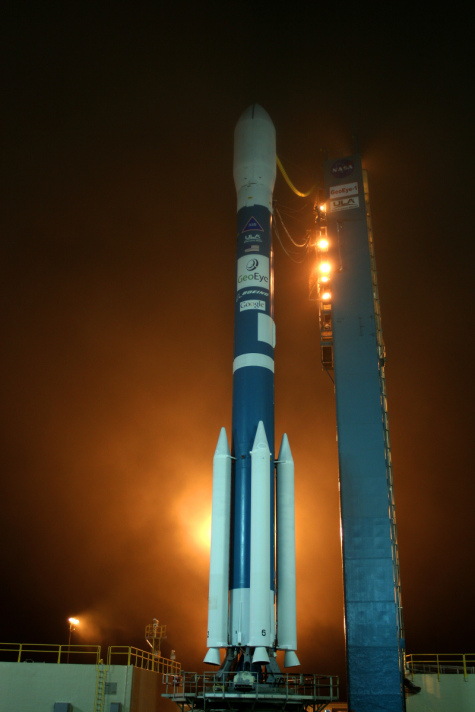
Summary: Google's new Imaging Satellite aboard a Boeing Delta II Rocket. Source: GeoEyeI don't know what it is about rockets, but I don't know a single man, hetero or gay, who isn't extremely turned on or even intimidated by them.
Google's new Imaging Satellite aboard a Boeing Delta II Rocket. Source: GeoEye
I don't know what it is about rockets, but I don't know a single man, hetero or gay, who isn't extremely turned on or even intimidated by them. I've never seen a space launch in person, but Google founders Sergey Brin and Larry Page are now members of a very exclusive club that have seen one up close and personal.
This weekend, Google launched its own imaging satellite, on top of a Boeing Defense Systems Delta II booster rocket, in partnership with GeoEye, the space imagery company which already provides data to Google for Google Earth and Google Maps using its existing IKONOS and ORBVIEW satellites.
Click on the "Read the rest of this entry" link below for more.
Why does Google need its own satellite? Well as my wife Rachel said to me this morning "To turn into that evil computer network thing in the Terminator movies." Okay, maybe not, but still, I thought it was funny.
Google needs its own satellite for a number of reasons. Right now, it gets its mapping imagery from a number of sources, including aerial photos and the IKONOS satellite, which is capable of 1 or 4 meter resolution. The new Google GeoEye-1 satellite will be able to snap continuous images of the earth at 1 or half meter resolution in full color.
While not nearly as sophisticated as what the US government reportedly has on the KH-12 and KH-13 which can read the registration numbers off a license plate from earth orbit -- in the .10 meter range or less, this is still a significant step forward in bringing advanced space imaging technology to the masses.
And because Google is going to be able to have near-exclusive use of this satellite for online mapping data, the photos will not get out of date like many of the current Google Earth images which are years old -- they'll be constantly refreshed, and Google and non-military US Government agencies will also be able to snap images within hours of significant geographical events occurring, such as major floods and damage from hurricanes.
And yes, half meter resolution is definitely good enough to pick out things like troop movements amassing on borders or pick out the kind of tactical details that used to require reconnaissance aircraft 30 or 40 years ago.
Is Google becoming SkyNET with its new GeoEye-1 satellite or a beneficial service to netizens everywhere? Talk Back and let me know.
Kick off your day with ZDNet's daily email newsletter. It's the freshest tech news and opinion, served hot. Get it.
Talkback
skynet
RE: To Boldly Go Where No Search Engine Has Gone Before
become self aware or allow it to tie into the entire
global military defense network there shouldn't be a
problem. Installing the 3 laws of robotics into every
aspect of their rather huge network would probably be
a good thing as well.
I'll bet...
"It is time.."
RE: To Boldly Go Where No Search Engine Has Gone Before
Not quite
Which constitution?
That said, Google *is* a U.S. company, and since I am not American and have a less-than-blind faith in the U.S. government's benign nature (as with *any* other national government, for that matter), I very much doubt that the military, NSA, CIA, DHS or whatever haven't tied the Google satellite launch with lots of restrictions, caveats, threats, etc. Having their own satellite networks, they don't need Google's data (I suppose), but I seriously suspect that there will be regions that they won't allow Google to show in detail - either the resolution will be low or the picture will be "masked."
Call me paranoid, but I think I'm just being realistic.
Give me a break
What legal system, exactly, has jurisdiction over space-based observations? If anything, treaties generally stress some non-military aspect. Given that, it would implicitly give any country the freedom to do whatever they want in space as long as it is non-military in nature.
Taking pictures might make you feel uncomfortable, but it would be interesting to hear a lawyer's opinion.
Yep
While the Constitution does contain some guarantees of privacy, it does not guarantee complete privacy. Also, one has to consider that, the spectrum of privacy may encompass more territory for some than others.
I would encourage the reading of the 4th. Amendment as well as the 14th. Amendment. Keep in mind that, as with all Constitutional interpretations, there is the risk of misinterpretations. Even with those of college backgrounds in the subject. It seems that the King's English as plainly written, isn't so plain for some people. In other words, some people can complicate the simplest thing.
My understanding of the matter is, if the images aren't taken through intrusion, which goes beyond plain view, and it doesn't have content relating to national security, then the privacy clause applies. Again, this is my understanding and may not be that of others.
We didn't disagree
And I don't feel uncomfortable being photographed from space (it's inevitable, anyway). I just meant that any existing U.S. privacy protection law would be irrelevant when Google's satellite takes shots of, say, Burkina Faso or Liechtenstein.
However, a secondary point in my previous post was that since Google is a U.S.-based company and subject to U.S. laws and jurisdiction, I believe it is reasonable to assume that it may have (and probably *has*) suffered pressure from U.S. security agencies to suppress, blur or mask some geographical areas that such agencies deem sensitive. Let's see (or not) once it's in operation...
Is that tin foil cap on too tight?
closing/selling some manufacturing facilities, you are still on
this Google fear thing. If you privacy is really that important,
I would recommend living completely off the grid, lose your
Social Security number (a great tool for building profiles
when going though the 3 domestic credit agencies, Equifax,
etc.) and watch for cameras (don't use an ATM machine, they
have cameras and are connected to FDIC based systems, I
guess using banks is out).
opt out???
Inquiring minds want to know....
Frightening
Now a commercial company is spying on us, in order to make more money from us. I generally like Google, but this is (literally and figuratively) quite over the top.
IBM Roadrunner is more "Turk-like".
candidate... IBM Roadrunner:
http://ocxt.blogspot.com/2008/06/ibm-roadrunner-
petaflops-supercomputer.html
- Roadrunner resides at the Department of Energy's Los
Alamos National Laboratory where its primary task will
be to ensure the safety and reliability of the U.S's
nuclear weapons stockpile.
- While verifying Roadrunner's performance, Los Alamos
and IBM researchers used three different computational
codes to test the machine. Among those codes was one
dubbed "PetaVision"by its developers and the research
team using it.PetaVision models the human visual
system - mimicking more than 1 billion visual neurons
and trillions of synapses. Neurons are nerve cells
that process information in the brain.
The difference between men and boys...
These are just a couple of kids with a LARGE allowance, spending it in ways their parents would never allow. ;-)
The difference between men and boys...
Don't complain when your wish comes true . . .
Tell me AGAIN why I should embrace "cloud computing" as the "inevitable future."
Grow up Google
Supposedly, they are chock a block full of geniuses, yet all they do is copy other technology (gee, who does that sound like?) or else try to lock in all their existing stuff.
that's great for us
RE: Time for better landscaping.