Virtualization: An easy way to kill Apple's HTC lawsuit

Summary: Intel's Wind River Hypervisor and technologies like it could usher in a new age of Device-agnostic Smartphone Operating Systems and unprecedented customer choice.
Intel's Wind River Hypervisor and technologies like it could usher in a new age of Device-agnostic Smartphone Operating Systems and unprecedented customer choice.
My editor-in-chief and colleague Larry Dignan this morning has outlined a number of the strategic problems Apple may have when moving forward with its current litigation with HTC.
Indeed, Apple may have bitten off more than it can chew if Google and Microsoft come into the equation. But I've found something else that may kill this lawsuit and others like it dead -- Embedded Virtualization technology.
Click on the "Read the rest of this entry" link below for more.
Virtualization? Isn't that what big companies use in datacenters? What the heck does this have to do with smartphones and the HTC lawsuit? Indulge me.
In 2008 I wrote an article that didn't get a lot of pageviews -- "I want an iPhoneStormDroid".
It was about Wind River's new virtualization technology that allows embedded operating systems to be abstracted from the hardware that it is running on.
Back then, Wind River was an independent, private software company that sold niche embedded software development suites for vertical market applications. In June of last year, Intel bought them for over $880 million. Recently, Wind River introduced a software development suite for building and optimizing Android phones.
Also Read: Wind River, Tasty Embedded Linux Treat
In my fairy-tale scenario -- or at least in what seems like fantasy today, I described a mobile computing world where a customer walks into a wireless carrier store, picks a "body" or device form factor that they want, activates service, then and runs whatever smartphone OS they want on it -- Android, Windows 7 Phone Series, Palm WebOS, Symbian, MeeGo, BlackBerry, or even iPhone.Today this is a non-starter because device development by the handset manufacturers and the wireless providers is difficult. When a new device is created by a handset manufacturer today, the operating system that runs on it has to be optimized with device drivers specific to the hardware on that handset and software specific to that carrier. The manufacturer may have build processes that help speed development, but it's still no walk in the park.
This process takes a long time because while you may have one model of device that can be targeted to multiple carriers, things like OS software that supports transceiver chip sets may have to change in order to accommodate the network technology being used as well as a myriad of other things that make a new device launch on a carrier a big hassle.
So for example, launching the exact same model of Blackberry Bold on Verizon versus an identical model BlackBerry Bold on AT&T could require a lot of customization work. The same goes with any other smartphone.
But let's just say we brought in virtualization, just like we use in today's datacenters. Virtualization is the de rigeur way we solve large numbers of migration and scalability problems in the modern enterprise, but it's a new concept to embedded systems.
With virtualization, we would be introducing Type 1 hypervisors into smartphones. This means that companies like Microsoft, Google, Palm, Nokia and Research in Motion could develop and sell their OSes to the consumer as software products, instead of having it "Preloaded" or baked into a specific device.
As it stands today, I have to buy a Motorola DROID on Verizon with Android. But hypothetically, let's say I want Windows Phone 7 Series on it instead.
Today, that would be difficult, because Microsoft, Motorola and Texas Instruments (which makes the OMAP chipset and platform that the DROID uses) would have to work very closely to develop a Windows Phone ROM image for DROID. It's doable, but it's not easy, and they'd probably create an entirely new smartphone to do it. It also has political implications because Motorola is currently strategically aligning itself with Google and may not even want to talk to Microsoft.
Also Read: $99 iPhones Will Not Improve the Wireless Customer Experience
But with a hypervisor installed on a smartphone, that could be as easy as buying a "blank" smartphone -- just as if I had bought a PC or a server with no OS installed on it -- and popping in an SD card into my DROID with the Windows 7 Phone OS virtual device image on it that I had bought from say, Amazon or the Microsoft web site, and booting the phone.I could either do this myself, or the customer rep at the Verizon store could do this for me, with SD cards sold with the image pre-loaded with it on the "Software" rack at the store. Or do the entire transaction even over their next-generation LTE wireless network or Wi-Fi.
The hypervisor boot screen would say "Hello, I see you have Windows Phone OS Virtual Image for ARM Processors (version 7.0.1) on your SD card. Would you like me to initialize the system and copy the image into flash memory?"
Then bang, 20 seconds later, I have a Windows Phone 7 DROID. Or a Blackberry DROID. Or a Symbian DROID. Or the latest and greatest Android 2.1 software, without having to wait for Verizon and Motorola to develop one, or for the hacker community to build one for me, like the DroidMod or Cyanogen guys are doing today.
Heck, I would have my choice of Android images, from different companies with different features pre-loaded. Maybe my enterprise has a specific image with apps ready to go, with specific security profiles they want me to use. I could switch to a different smartphone OS just as easily as I could switch my ringtone.
And they would all "Just work", just the same way I can copy a Windows 7 or Red Hat virtual machine on VMWare on a HP system to an IBM system in a datacenter with complete transparency. It also means I could export my Virtual Machine to another device on another carrier if I break my phone or want to upgrade to newer hardware.
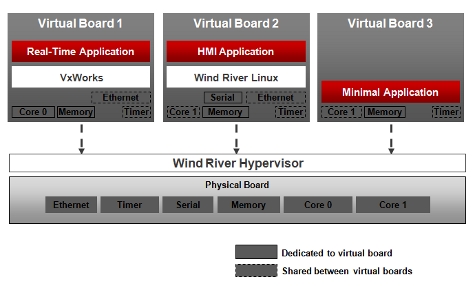
The above video is a rather technical demonstration on how embedded devices can be built with Intel's Wind River hypervisor and run MULTIPLE operating systems simultaneously. It's geeky, but it proves that this technology exists and could be easily applied today or in the near future.
Primarily Wind River is initially selling this technology to customers who need to run their VxWorks and Linux OS in parallel, such as in automobile embedded computers. But I spoke to them in January of 2010 and they told me that a "very large handset manufacturer" was extremely interested in using the technology to run Android and Windows Mobile side-by-side in the 2012/2013 timeframe.
What does this mean for the Apple lawsuit? Well, it means that if HTC were to adopt hypervisors, all they need to do is sell "blank" phones to carriers. They can get out of the business of customizing and building ROM images and specific phones with specific OSes. It means the consumer can buy whatever OS they want to run on whatever model and form factor of HTC phone they want.
It means Apple can't sue HTC or any other company adopting this technology. It would have to go after Microsoft and Google itself. And it means you would finally have some real choice in what smartphone you want to buy and what you want to run on it.
Will embedded hypervisors on smart phones usher in a new age of customer choice and nullify Apple's lawsuits? Talk Back and Let Me Know.
Updated: Mark Hermeling of Wind River responds on his blog with some interesting comments.
Kick off your day with ZDNet's daily email newsletter. It's the freshest tech news and opinion, served hot. Get it.
Talkback
Except...
And this virtualization still doesn't impact the single worst aspect of smartphones--the monthly bill, which is still exorbitant.
Not the way this technology is implemented
You asked ...
I don't think so. Why? Because carriers don't want the customer to be able to move that easily between carriers or platforms.
Today, carriers keep customers coming back by offering a specific device/feature that the customer can only get on that carrier.
I am quite sure that there are lots of iPhone customers who would jump to VerizonWireless in a flash if they could take their iPhone with them. Quite possibly, the opposite is true for Blackberry Storm users.
Carriers keep customers two ways: One is subsidized pricing on devices contingent upon a two-year contract. The other is devices not available elsewhere.
Put a hypervisor on all devices and the customer ends up with a virtually limitless number of choices of features, no matter what the carrier does. The carrier looses all their clout. Good for users?
Maybe but then there is no reason for the carrier to subsidize device pricing. In the end, a la carte pricing could end up costing the consumer a lot more money than they pay now for a phone with a dedicated set of features.
One minor technical issue
A device made for Verizon cannot function on a device made for ATT, regardless of the OS. ATT uses GSM/EDGE/HSDPA technology and verizon 1xrtt/EVDO and moving to LTE. So even if you had OS choice on a carrier with a hypervisor, you couldn't move to another carrier unless the network tech was compatible. You'd still have to get a new "body".
The next logical step would be to make devices with modular transceivers, so you COULD move an iPhone to Verizon.
http://blogs.zdnet.com/perlow/?p=10263
It would appeal to some...
Yes, it's nice to fantasize, no, IMHO it isn't going to solve the legal headaches unless the entire industry were to embrace it.
Oooohhh....Sign me up!!! <nt>
Apple Led
environment. We either respect their property rights, or we
do not. Deferring the lawsuit does not diminish it's merit.
If we are men of principle, we live by them and we don't
try to weasel someone else's stuff. Let's not try to get away
with, or defer a legal transgression by calling it "virtual".
This is simply not the right thing to do. if this gets
bumped to Microsoft or Google, it is no less a theft of IP.
Apple has had a little experience with "look and feel"
lawsuits. Does anyone out there think, that with their
current track record of commercial success, and legal wins
(Psystar) that it hasn't learned some things about
protecting it's property?
Except that Google or even HTC is no Psystar
so there is very little comparison that resembles
the Psystar case.
RE: Virtualization: An easy way to kill Apple's HTC lawsuit
The "App Store" is a simple takeoff on the Repository idea over in the Linux world, just dressed up a bit, and usability improvements. Improvements yes, proper and clear leadership? No.
Apple doesn't really lead, they creatively follow. It is fascinating the watch. And before you flame me, Apple does really really well at being second or third into the consumer markets. Let someone else take the lead and sit back and figure out what they did WRONG. Correct on their mistakes, and release product. It is a risky strategy, but so long as bean counters on Wall Street exist and suck the life out of the other engineering companies who do the initial innovation and then aren't allowed to improve on it, then it is strategy has worked since the first iPods came out. Wall St had given up on the MP3 market, the SmartPhone market and the tablet market when Apple got involved. Other companies couldn't get R&D past the bean counters to do anything else, and Apple's been telling bean counters/stock holders/Wall St to get stuffed for a while. Thank goodness they are doing that, and more power to them for that, but they aren't innovating from the front, more from the rear.
RE: Virtualization: An easy way to kill Apple's HTC lawsuit
seems to develop their own UI to differentiate
themselves from the competition. If every phone
is just hardware and no software, margins are
razor thin. What makes their products better
than the Hi-phone, Sci-Phone, Ty-phone or
whatever no-name manufacturer can come up with,
if they don't differentiate their product
offering?
Motorola has BLUR, Samsung has TouchWiz, LG has
S-Class, HTC has Sense, I'm not sure if any of
these manufacturer wants to give them up so
easily.
Not only that...
Just a thought.
Features specific to the carrier or manufacturer
However, I think all this feature fractionalization is eventually going to become overwhelming and undesireable. End users and developers are more comfortable with standardization.
Whether my "fantasy" will be 100 percent realized and whether device virtualization will become commonplace are two separate things. I could easily see device virtualization being used by a handset manufacturer to speed their development processes and to deploy more than one OS onto a phone body with all their customizations to the OS in place.
However I don't see any reason why with this technology in place that end users won't be able to re-flash with Google's "Stock" Android or Microsoft's "Stock" Windows Phone VM if they don't like what they get from their handset manufacturer or carrier, just as we can re-format our PCs today if we don't like the crapware Windows 7 build. Or run both side by side as the power of these smartphones increase to multi-core with more memory.
RE: Virtualization: An easy way to kill Apple's HTC lawsuit
True, but all of those differentiation schemed UI's are also the biggest annoyances to some end users who want the other one. At the same time, if a HW company can focus on making their hardware better, and have a single SW image deployment across multiple devices? I think everyone wins.
Why do I think that? I've been in embedded development, and dealing with the HW issues (who are in a separate team from you) when all you are wanting to do is release a new software stack is annoying at best, and EXPENSIVE at worst. Abstract that out and you start getting newer/faster hardware on faster schedules AND newer/better software on much faster schedules as well. Win/Win. It is a disruptive tech shift though, and definitely changes the current delivery model.
Amazing
Just how does virtualization kill Apple's HTC lawsuit? If HTC copies
Apple's patented technology, Apple can sue them whether their software
is running natively or virtually.
And HTC can't install iPhone OS onto its hardware. Just ask Psystar.
So just what bizarre reasoning leads you to believe that virtualization
would have ANYTHING to do with Apple's suit?
psystar? what does this have to do with pystar?
Apple believes that the icon setup and feel of some phones out there are too much like the iphone and it has more to do with delaying anything HTC wants to do in the future rather than anything of merit.
You cannot patent "one button below screen" or "touch screen capable" because they are too broad of a technology, but anyone can sue anyone for anything. Doesn't mean they will win, but I am not sure the end result is what Apple is looking for, I think it is the "between" now and then that they see hope and that is to scare HTC and tie their hands, because frankly HTC is just wiping the floor with everyone as far as innovation goes the past year or two.
Apple feels threatened and if HTC spends a few more waking hours and money on the lawsuit rather than R & D, all the better for Apple I guess.
Do not give up HTC. The suit is meaningless. You cannot sue a tie manufacturer because a wheel is round and that is what Apple is doing so don't far for it.
Yes, jragosta, truly amazing, isn't it?
fly at all because I can't imagine any phone
manufacturer would subscribe to his vision
where phone OSes would be hardware platform
agnostic, and phone hardware would be phone OS
platform agnostic.
But... I think your constant attacks on Jason
is clouding your senses in some of your
arguments here.
It's rather obvious what Jason says: as long as
HTC sells hardware without software, and plays
no active role in software distribution, HTC
can wash its hands clean regarding any software
IP infringement lawsuits.
And no one said this virtualization idea means
HTC can sell iPhone OS. One would bet that,
even if this virtualization idea comes to
fruition, Apple won't join. Just look at
Apple's EULAs regarding loading Mac OS on non-
Apple hardware, as installed OS or as guest
OSes on virtual machines.
Speaking of virtualization, the more I read
your stance, the more I feel it resembles the
following:
We all know that Microsoft believes Linux has
components violating its patents. We know Linux
OSes can be set up to run as Virtual machines
on a PCs and Macs via VMWare or Virtualbox.
According to your logic, Microsoft should sue
Apple, HP, Dell, etc. etc. because they sell
hardware that can be used load Linux virtual
machines.
As you said.... truly amazing, isn't it?
Thank You
HTC sells hardware without software, and plays
no active role in software distribution, HTC
can wash its hands clean regarding any software
IP infringement lawsuits."
That is the crux of the argument, Yes.
As to Apple using device virtualization technology I think it may make sense for for them to do it for their own products, so that they can write a single OS image for iPhone, iPod Touch and iPad and deploy it to multiple carriers and multiple devices within their own ecosystem. It would still improve their own internal development model even if it never gets installed on another manufacturer's device.
RE: Virtualization: An easy way to kill Apple's HTC lawsuit
This won't happen.
matter how badly your types so want it to be just so you
can shovel out any old slop you see fit to impose.
The world is a marketplace and it is the consumer that is
king. Do you really think consumers want all the chaos and
uncertainty that an enterprise IT solution would bring to
the real world?
In a marketplace it is the best gear that consumers will
buy. By best I mean at everything...branding, product
quality, service/support, design, value, ecosystem and so
on.
Jason, you are so freaked out by what is happening that
you are losing perspective. Snap out of it man! No one
needs to or should want to beat Apple. They just need to
keep up right now.
You know who is the biggest threat to Apple? It's not
Google or Microsoft. It's Sony. They have so much of the
puzzle in place. If they ever wake up and realize it they
would be unstoppable. Thank about it.
Lawsuits distract.
he just stares at your finger and never what you are
pointing at? Folks are looking at the finger and not what
what is obvious. What is obvious is not sinister and only
involves some hard work and ingenuity. Apple is pointing
right at it.
You would think that the Google guy would have picked up
some clue with his time on the Apple board. What do they
do? Create Android and chuck it out there like a piece of
meat to a pack of hyenas. Sure this satisfies a very very
short term need but has a really uncertain future. Can't
help but think this was planned in some way. I don't
know...was Droid designed not to compete with the Apple
ecosystem in the short term?