Why I'm smarter than an Open Source surrender monkey
Many Open Source advocates have turned into Open Source pragmatists. That doesn't mean we've surrendered. We've evolved.
It came to my surprise last week when a fellow Open Source advocate and DATAMATION contributor, Bruce Byfield, called yours truly and my ZDNet colleague Adrian Kingsley-Hughes out in his piece Tech Pundits Surrender: The Retreat from Free Software and Open Standards.
What set Bruce off? Well, he seems to think that as a group, "Tech Pundits" are collectively giving up on Open Source and Open Standards under the auspices of pragmatism and convenience.
In my case, he was jarred by my piece Why I've been throwing Open Standards Under The Bus.
First, let me begin with my background in Open Source and Open Standards so that we understand where my frame of reference with the entire subject lies.
I began my foray into Open Systems as early as 1987, when I worked on NeXT machines at college. At summer jobs I installed and fixed Altos XENIX and SCO UNIX machines for local systems integrators. I became HP-UX certified and did a lot of Sun workstation work on SPARCs on Wall Street in the early 1990s.
In the mid-1990's I began to familiarize myself with Linux distributions such as Red Hat, Slackware and Caldera, and started to use it more and more on the desktop.
In 1999 I started writing for the fledgling print publication Linux Magazine. Over the course of nine years and ninety articles, I was promoted to that magazine's Sr. Technology Editor.
During that time, I also as a full-time systems integrator deployed numerous Open Source and Linux-based solutions for Fortune 500 companies and for State and Federal Government agencies.
In July of 2001 I also built and launched one of the most popular food discussion websites in the entire world, eGullet, which in two days will celebrate its tenth birthday. I built it entirely on Open Source technologies such as Apache, PHP, Perl and MySQL and it ran entirely on Linux.
To the best of my knowledge, it still does.
Since joining IBM in the summer of 2007, I have also continued to work extensively with Open Source technologies, in addition to other enterprise technologies such as virtualization and Mid-Range and Enterprise systems such as AIX and the zSeries mainframe.
So when I say I've been around the block a few times with Open Source, you can be assured that is true.
Enough with the history lesson and let's get back to Byfield's piece. Firstly, none of this has happened overnight and I take issue with the entire notion of "surrendering" to proprietary systems and closed standards.
To Byfield's credit, in his article he notes that I have been developing the idea of Open Source pragmatism for several years.
In fact, I have. I have also called for new thought leadership in Open Source as well.
I will re-iterate a very important point from that 2009 article, which still holds true today:
Those of us who are Open Source evangelists use Open Source software because it is practical and useful to do so, not due to an inherent ideological need to do so.
So yes, while it pains Bruce to hear it, I've bought a Macintosh. And I'm probably going to buy another one soon. Gasp!
I also like using the Mac as a general-purpose desktop better than my Linux boxes, or for that matter, my Windows VMs. Proprietary.
I like using my Ubuntu Linux box better for sysadmin and desktop virtualization-type stuff than I do on my Mac. Open Source.
I also use Microsoft Office on Windows and the Mac. Proprietary. I use Microsoft Project and Visio on Windows. Proprietary.
I use Apple's iMovie and Aperture on the Mac and their iWork office suite on my iPad. I've also been messing around with Adobe's CS5. Proprietary.
I also prefer to use Chrome as my cross-platform web-browser on all of my platforms that support it, using it exclusively over Safari on the Mac and Internet Explorer on Windows, although I dabble in Firefox because I need it for certain intranet apps at work. Open Source.
I use GIMP and Audacity on the Mac and Linux for simple photo and audio editing. Open Source.
I use Adium and Pidgin for instant messaging on the Mac, Linux and Windows. Open Source.
I use Calibre for managing my eBook collections for my Kindle and my iPad on my Mac, Windows, and Linux boxes. Open Source.
I have an Android phone running CyanogenMOD 7. Open Source.
After returning it in late April, I recently bought a used Motorola XOOM from my Tech Broiler colleague Scott Raymond (who could not resist the urge to buy a shiny-new Samsung Galaxy Tab 10.1) because it finally runs Honeycomb 3.1 and I like how GMail is implemented in it. Open Source.
Um, well sorta. Google hasn't released the source codeto Honeycomb yet.
And so on, and so on. Did I make these choices because I had religious attachments to platforms and ideologies? No, I picked applications and systems that I liked to use and that worked for me.
The reality is that many of us Open Source advocates out of necessity and sheer practicality have become hybrids. We use what is convenient as well as what is useful. We do not distinguish or evaluate the merits of software or technology on a purely religious basis.
We've evolved into new life forms, leaving the purists such as Byfield to wage battles that no longer have any meaning to us.
These battles, such as Free Software and GPL versus the world, or whether or not Apache's OpenOffice.org or the Document Foundation's LibreOffice should be accepted by the community at large as the leading Open Source office suite only have real meaning to folks like Byfield.
I will not belittle the people that want to fight these battles. Perhaps the outcome of these wars will shape the landscape of Open Source and they may even need to be fought, but they have no bearing on how people who actually use this stuff conduct their lives and their businesses.
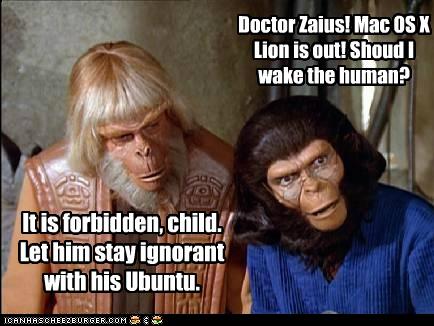
Actor Maurice Evans playing the role ofDr. Zaiussaid it best in 1968's "Planet of the Apes", but to make a point in this article I'll paraphrase it.
"I have always known about the Open Source advocate. From the evidence, I believe his wisdom must walk hand in hand with his idiocy. His emotions must rule his brain. He must be a warlike creature who gives battle to everything around him, even himself..."
As pragmatists we will take what comes out of this social Darwinism and open warfare in the Proprietary, Open Standards, Open Source and Free Software arena and consume what we believe to be good solutions for ourselves and for our customers.
Like "Caesar" in the soon to be released Rise of the Planet of the Apes, we are a new, advanced species which the purists on both sides of the fence are frightened of. We are the hybrid evangelists and Open Source pragmatists.
And I have no doubt whatsoever that we shall rule this industry and become the dominant IT life form on this planet. Scared yet? Talk Back and Let Me Know.