Tech Broiler

Jason Perlow and Scott Raymond

Without Dennis Ritchie, there would be no Jobs

By | October 14, 2011, 10:05pm PDT

Summary: Modern computing as we know it would not have existed without Dennis Ritchie, father of the C programming language and Co-creator of the UNIX operating system.

In the last two weeks, we have lost two people who had immense influence on our industry.

It is undeniable that Steve Jobs brought us innovation and iconic products like the world had never seen, as well as a cult following of consumers and end users that mythicized him.

The likes of which will probably be never seen again.

I too, like many in this industry, despite my documented differences with the man and his company, paid my respects, and have acknowledged his influence.

But the “magical” products that Apple and Steve Jobs — as well as many other companies created owe just about everything we know and write about in modern computing as it exists today to Dennis Ritchie, who passed away this week at the age of 70.

Dennis Ritchie?

The younger generation that reads this column is probably scratching their heads. Who was Dennis Ritchie?

Dennis Ritchie wasn’t some billionaire meticulous wunderkind from Silicon Valley that mystified audiences with standing room only presentations in his minimalist black mock turtleneck with new shiny products and wild rhetoric aimed against his competitors.

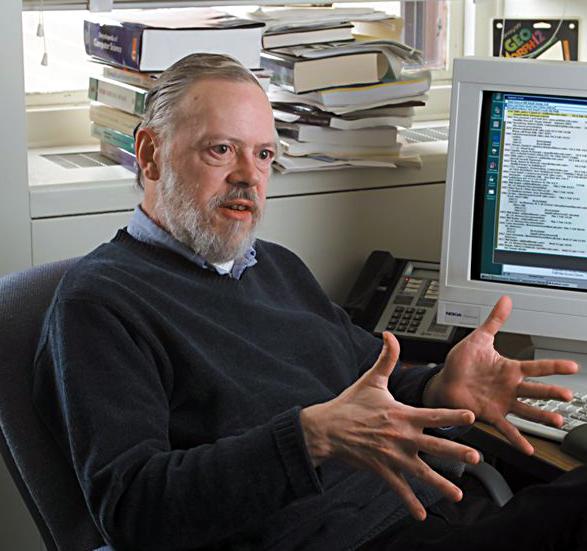
No, Dennis Ritchie was a bearded, somewhat disheveled computer scientist who wore cardigan sweaters and had a messy office.

Unlike Jobs, who was a college dropout, he was Ph.D, a Harvard University grad with degrees in Physics and Applied Mathematics.

And instead of the gleaming Silicon Valley, he worked at AT&T Bell Laboratories in New Jersey.

Yes, Jersey. As in “What exit?”

Steve Jobs has frequently been compared to Thomas Edison for the quirkiness of his personality and inventive nature.

I have my issues with that comparison in that we are actually giving Jobs credit for being an actual technologist and someone who actually invented something.

It is important to realize that while indeed the man was brilliant in his own way and his contributions were extremely important to the technology and computer industries, Steve Jobs was not a technologist.

Indeed, he had a very strong sense of style industrial design, understood what customers wanted, and was a master marketer and salesperson. All of these make him a giant in our industry.

But inventor? No.

Dennis M. Ritchie, on the other hand, invented and co-invented two key software technologies which make up the DNA of effectively every single computer software product we use directly or even indirectly in the modern age.

It sounds like a wild claim, but it really is true.

First, let’s start with the C programming language.

Developed by Ritchie between 1969 and 1973, C is considered to be the first truly modern and portable programming language. In the 40 years or so since its introduction, it has been ported to practically every systems architecture and operating system in existence.

Because it is a imperative, compiled, procedural programming language, allowing for lexical variable scope and recursion, and allowing low-level access to memory as well as complex functionality for I/O and string manipulation, the language became quite versatile.

This allowed Ritchie and Brian Kernighan to refine it to a degree which eventually was further refined by the X3J11 committee of the American National Standards Institute as the ANSI C programming language in 1989.

In 1978, Kernighan and Ritchie published the book “The C Programming Language”. Referred to by many simply as “K&R” It is considered to be a computer science masterpiece and a critical reference for explaining the concepts of modern programming, and is still used as a text when teaching programming to students in computer science curriculums even today.

ANSI C as a programming language is also still used heavily today, and it has since mutated into a number of sister languages, all of which have strong followings.

The most popular, C++ (pronounced “C plus plus”) which was introduced by Bjarne Stroustrup in 1985 and added support for object-oriented programming and classes, is used on a variety of operating systems including every major UNIX derivative including Linux and the Mac, and is the primary programming language that has been used for Microsoft Windows software development for at least 20 years.

Objective-C, created by Brad Cox and Todd Love in the 1980s at a company called Stepstone added Smalltalk messaging capabilities to the language, further extending the language’s object-oriented and code re-usability features.

It was largely considered an obscure derivative of C until it was popularized in the NeXTStep and OpenStep operating systems in the late 1980s and early 1990’s on Steve Jobs’ NeXT computer systems, the company he formed after he was ousted by Apple’s board in 1985.

What happened “next” of course is computing history. NeXT was purchased by Apple in 1996 and Jobs returned to become CEO of the company in 1997.

In 2001, Apple launched Mac OS X, which makes heavy use of Objective-C and object-oriented technologies introduced in NeXTStep/OpenStep.

While C++ is also used heavily on the Mac, Objective-C is what is used to program to the native object-oriented “Cocoa” API in the XCode IDE which is central to the gesture recognition and animation features on iOS that powers the iPhone and the iPad.

Objective-C also provides frameworks for the Foundation Kit and Application Kit that are essential to building native OS X and iOS applications.

Microsoft has its own derivative of C in C# (pronounced “C Sharp”) that was introduced in 2001 and serves as the foundation for programming within the .NET framework.

C# is also is the basis for programming the new Metro applications in the Windows Runtime (WinRT) for the upcoming Windows 8 as well as in Windows Phone 7.x. It is also used within Linux and other Unix derivatives as the programmatic environment for Mono which is a portable version of the .NET framework.

But C’s influence doesn’t end at C language derivatives. Java, which is an important enterprise programming language (and has itself morphed into Dalvik, which is used as the primary programming environment for Android) is heavily based on C syntax.

Other languages such as Ruby, Perl and PHP which form the basis for the modern dynamic Web, all use syntax introduced in C, created by Dennis Ritchie.

So it could be said that without the work of Dennis Ritchie, we would have no modern software… at all.

I could end this article simply with what Ritchie’s development of C means to modern computing and how it impacts everyone. But I would only really be describing half of a life’s work of this man.

Ritchie is also the co-creator of the UNIX operating system. Which, of course, after being prototyped in assembly language, was completely re-written in the early 1970’s in C.

Since the very first implementation of “Unics” booted on a DEC PDP-7 back in 1969, it has mutated into many other similar operating systems running on a huge variety of systems architectures.

Name a major computer vendor, and every single one of them has had at some time an implementation of UNIX. Even Microsoft, which once owned a product called XENIX and since sold it to SCO.

You’ll want to click and zoom into this picture so you can get a better understanding of this “family”.

Essentially, there are three main branches.

One branch is the “System V” UNIXes that we know today primarily as IBM AIX, Oracle Solaris, SCO UnixWare and Hewlett Packard’s HP-UX. All of these are considered to be “Big Iron” OSes that drive critical transactional business applications and databases in the largest enterprises in the world, the Fortune 1000.

Without the System V UNIXes, the Fortune 1000 probably wouldn’t get much of anything done. Business would essentially grind to a halt.

They may only represent about 10 to 20 percent of any particular enterprise’s computing population, but it’s a very important 20 percent.

The second branch, the BSDs (Berkeley Systems Distribution) include FreeBSD/NetBSD/OpenBSD which form the basis for both Mac OS X and the iOS that powers the iPhone. They also are used as the backbone that supports much of the critical infrastructure that actually runs the Internet.

The third branch of UNIX is not even a branch at all — GNU/Linux. The Linux kernel (developed by Linus Torvalds) combined with the GNU user-space programs, tools and utilities provides for a complete re-implementation of a “UNIX-like” or “UNIX-compatible” operating system from the ground up.

Linux of course, has become the most disruptive of all the UNIX operating systems. It scales from the very small, from embedded microcontrollers to smartphones, to tablets and desktops and even the most powerful supercomputers.

One such Linux supercomputer, IBM’s Watson even beat Ken Jennings on Jeopardy! while the world watched in awe.

Still, it is important to recognize that Linux and GNU contains no UNIX code at all — hence the Free Software recursive phrase “GNU’s not UNIX.”

But by design, GNU/Linux behaves much like UNIX, and it could be said that without UNIX being developed by Ritchie and his colleagues Brian Kernighan, Ken Thompson, Douglas Mcllroy and Joe Ossanna at Bell Labs in the first place, there never would have been any Linux or an Open Source Software movement.

Or a Free Software Foundation or a Richard Stallman to be glad Steve Jobs is gone, for that matter.

But enough of religion and ideology. We owe much to Dennis Ritchie, more than we can ever possibly imagine. Without his contributions, it’s likely none of us would be using personal computers today, sophisticated software applications or even a modern Internet.

No Android smartphones, no fancy DVRs and streaming devices, and no Macs and iPads for Steve Jobs and Apple to make Amazingly Great.

No “Apps for That.”

To Dennis Ritchie, I thank you — for giving all of us the technology to be the technologists we are today.

Dennis Ritchie (standing) and Ken Thompson with a PDP-11, circa 1972 (Source: Dennis Ritchie homepage)

Kick off your day with ZDNet's daily e-mail newsletter. It's the freshest tech news and opinion, served hot. Get it.

Topics

Jason Perlow, Sr. Technology Editor at ZDNet, is a technologist with over two decades of experience integrating large heterogeneous multi-vendor computing environments in Fortune 500 companies.

Disclosure

Jason Perlow

My Full-Time Employer is IBM. I write as a freelancer for ZDNet.

Disclaimer: The postings and opinions on this blog are my own and don't necessarily represent IBM's positions, strategies or opinions.

I own no investments or direct financial instruments in the companies I write about.

Biography

Jason Perlow

Jason Perlow, Sr. Technology Editor at ZDNet is a technologist with over two decades of experience with integrating large heterogeneous multi-vendor computing environments in Fortune 500 companies. A long-time computer enthusiast starting the age of 13 with his first Apple ][ personal computer, he began his freelance writing career starting at ZD Sm@rt Reseller in 1996 and has since authored numerous guest columns for ZDNet Enterprise and Ziff-Davis Internet. Jason was previously Senior Technology Editor for Linux Magazine, where he wrote about Open Source issues from 1999 to 2008.

In his spare time, Jason is an avid amateur chef and food writer, where his work reviewing New Jersey restaurants has appeared in The New York Times. He is also the founder of the popular food web site eGullet and blogs about restaurants and cooking at OffTheBroiler.com.

Related Discussions on TechRepublic

Did you know you can take part in these discussions with your ZDNet membership?
171
Comments

Join the conversation!

Just In

rkswycm 12 cqf
bdsfwrryd32-24378968239905618532229711595300 24th Nov
guudmb,rqwsqqts15, gsvvp.
0 Votes
+ -
And jobs he created a lot of.
@Return_of_the_jedi
+1.
0 Votes
+ -
No doubt that Dennis Ritchie is as important as Steve Jobs but everyone has a role to play !
@pore.abhijeet@... Dennis Ritchie is MORE important than Jobs, not "..as.." but Steve Jobs is a force in the technology world too
@pore.abhijeet@... Jobs might have been Walt Disney but Ritchie invented the paint brush and defined much of the color palette.
0 Votes
+ -
very eloquently put
thx-1138_@... Updated - 17th Oct
@cabdriverjim +100
@cabdriverjim Jobs was a genius like PT Barnum, Ritchie was a genius like Edison...
@cabdriverjim ...Well said! A toast to Dennis...
@pore.abhijeet@...

Without Dennis Ritchie and his contributions, Steve Jobs would have remained on a commune after dropping out of Reed College during his freshman year.
0 Votes
+ -
There wasn't a single reason to use the name of the late Steve Jobs in this article except for the "scandal" factor.

Dennis Ritchie is a pioneer in the computer industry on its own and there is no reason to resort to cheap tricks to highlight his accomplishments and invaluable contributions to the world.
@wackoae
Brings things into perspective...
0 Votes
+ -
Contributr
@wackoae I'm bringing Jobs' name into it because his death completely overshadowed Ritchie's and ALL of his products depend on everything that Ritchie created. You won't find Dennis Ritchie memorialized on the cover of TIME or Newsweek.
@jperlow Yes you are right. Steve was an gifted marketer (even Steve Wozniak pointed that out) but Dennis was a real master, a genius. Modern Technological world owe him large than Steve.
0 Votes
+ -
@jperlow
I understand the point, but are the Alan Turings, John McCarthys or Edsger Dijkstras, to name some late folks, or Larry Walls, Guido von Rossums, Dave Cutlers, Bill Jolitzes, or Guy Steeles, to name some living folks who led great advancements in programming and operating systems, likely to receive notice in any widespread way? What about Doug McIlroy, still with us, who got Unix to hit it out of the park with pipes.

Somewhere, there was a project manager for Multics who set the table, with its failure, for the bright kids.

I sort of feel like I'm segueing into an episode of James Burke's Connections.

Any way, good for you to bring Dr. Ritchie's accomplishments to light. I think all those who have an interest in computing as a stepping-stone along the path of human achievement should know what he did and understand how he and his collaborators changed the world. Accomplishments which are just as meritorious regardless of how much adulation Steve Jobs received.

And though I find programming in C akin to juggling dynamite while jogging on a tight rope in clown shoes, everyone who is serious about programming should learn C and learn C from K&R. That book is core truth.
@DannyO_0x98
All of the products produced under Jobs' guidance after he visited Xerox PARC are directly influenced by Alan Kay. I believe Kay has been and continues to be a senior fellow at Apple.
@wackoae I don't see it as incendiary. It is simply a statement of fact. Maybe without Ken Olsen there would be no Dennis Ritchie, too...
0 Votes
+ -
@wackoae

Resort to cheap tricks?

Thats kind of an odd thing to say. What cheap tricks?

You certainly have an odd perspective on this. You seem to be implying that something a little sinister is behind this article due to your conception that there is no reason to mention Steve Jobs in the title. But see, right off the bat you are wrong.

There was very good reason to attach the name of Steve Jobs to the article and its spelled out right in the whole first part of the article.

You see, Steve Jobs just recently passed away, in case you didn't notice, and it got a mountain load of attention. Now another iconic personality from the world of IT has just passed away, Dennis Ritchie, who has an even more pivotal roll in the world of IT then Jobs did. Its an obvious gimme of a comparison and it seems clear the writer would like Richie to get at least the same respect Jobs did. It seems like a very natural reason to bring Jobs into the discussion.

You need to take a pill and relax.
@Cayble

Well said, thats what came to mind when I read this article.
@wackoae The point was to make clear the fact that a man who had far more influence has passed away with far less fanfare.
0 Votes
+ -
RE: Without Dennis Ritchie, there would be no Jobs
partman1969@... Updated - 17th Oct
@wackoae....
Were it a few months from now the comparison wouldn't be there, however many noted "pioneers" have their careers due to the true pioneers such as Mr. Ritchie.
0 Votes
+ -
@wackoae
I think many of us (techies) feel that Richie's death was almost completely missed by the main stream media while Jobs received sometime outlandish accolades.

I agree that Richie's pioneering work for computer science stands on its own. Both men, Richie and Jobs, made important contributions. Each in a very different ways.
0 Votes
+ -
@wackoae Thank you for saying that! It's a blatant putdown to belittle someone's contributions this way. Without John Backus, there would be no Dennis Ritchie. Without Newton there would be no Einstein. Silly statements that belittle both contributors.

No matter what you do, no matter how great your contribution, you will be standing on the shoulders of giants.
0 Votes
+ -
Hardly the point. At all.
Cayble 17th Oct
@nadacloo

Now lets be serious here.

There would be no Einstein without Newton? And that is supposed to be comparable to without Richie we would have no Steve Jobs?

First of all, Newtons discoveries were from way back in the 1600's, you could consider that the "dark days" of physics and while his discoveries were ground breaking for their day they were discoveries that likely wouldnt have taken a whole lot longer for many scientists in the following years to quickly come to the same conclusions. Einstein on the other hand came up with revolutionary concepts that were not only difficult to prove through simple trial and error experiment but were in many respects so complex that for a number of years many physicists were not even sure how much he got right.

In this case Jobs is a lot more like Newton and Ritchie the Einstein. People really have to slow down a little on the "genious" of Steve Jobs. What Steve Jobs did was clever, and very clever because he figured out how to create products that people found intuitive to use and wanted. That was the genious of Steve Jobs, a very great ability but in the long run, he got an awful lot of great press for that.

With Ritchie the thing is, so much of what he did became the underlying foundation of what IT became. I guess sooner or later someone would have recreated what Ritchie created, but it wouldnt have been the same thing, it would have been another persons version of it and who exactly knows what impact that would have made on the IT world.

We already have a whole variety of people who created different cell phones and mp3 players. And you can argue Jobs made them best but there you have it.
0 Votes
+ -
@wackoae .. why? to qualify
thx-1138_@... Updated - 17th Oct
... the importance of C - and to highlight it in the light that both have recently passed on. It is the second major loss to the I.T. industry in a short count of days. Taking account of that, it's completely relevant that Jobs is mentioned. (Learn to read between the lines .. else get reading comprehension lessons.)
0 Votes
+ -
He lived a long life
guihombre 14th Oct
I think that he lived a long life that wasn't cut short.

I think he hadn't contributed for a long time, I notice that people as they reach their time, they sort of wind down in anticipation.

So it's always sad when somebody dies, but I don't think it's the tragedy that's Job's death was.
0 Votes
+ -
Well said.
liversedge@... 15th Oct
.
... them being outer design, UI, and others being software and mechanical engineering (like long detailed patent for a separate step member, which is very specific how to build it, nothing to do what people consider "design").

Also, people who directly know Jobs (see Charlie Rose interview) say than he was no less technologist than a visionary (simply being a visionary would turn him into fantasy writer).

Jobs main concept was always "intersection of technology and liberal arts".

Also, Jobs was directly influenced by the likes of Packard and Hewlett, so I would suggest he would not be lost even there was some other than Unix OS created.

That said, of course, Ritchie is absolutely historic person, among these who defined the base on which everything is running, no doubt. But I would say that Jobs' and Ritchie's legacies are not really that tied together since they were engaged in the different level of technology.

I mean, of course, not the level of "greatness", but level in the structure of technology if you view it from the low to high, from the back-end to the front end. While Jobs pushed certain back-end technologies on his own discretion, thus pushing the progress even in this area, he did not personally developed any of it. His personal inventor and advance input was more in the middle-to-high, front-end levels.
@DeRSSS
he is a presenter and a businessman, patents don't mean anything now that the patent system is so screwed up now.
0 Votes
+ -
Jobs has his name on 300 patents
toddybottom 15th Oct
@qjqqyy
If you do the math, it is impossible that he actually contributed to 300 patents.

No, Jobs simply took his employee's inventions and placed his name on them.

That's the kind of "man" he was.
@toddybottom: ... in the most of patents Jobs was collaborator among many authors (though many key patents list him as primary inventor), so it is perfectly possible for him to be named inventor in these more than three hundred patents.
He did not contribute to any of them.

He simply put his name on them.
0 Votes
+ -
@toddybottom: ... why people all of sudden imagine things like that? Is it certain religion or what? "I deny this reality and substitute it with my own"-like?
0 Votes
+ -
@DeRSSS

...uh, DeRSSS? I hope you're talking about yourself, there when accusing others of 'denying this reality, and substituting with my own'

Ya know, kind of like posting 'data' about mobile OS marketshare, and calling it Neilsen's data

...when it is in fact a slide from the iPhone 4S keynote???
0 Votes
+ -
@toddybottom

It depends on how you define "contribute". It's very possible he came up with some ideas that his employees turned into a working product. The question then becomes how original these ideas were, and if merely coming up with an idea for a product is enough to earn your name on a patent.

But I agree that Jobs most likely never produced a working prototype or even a set of schematics. Personally I am of the opinion that a patent should never be awarded unless a working prototype is produced and is demonstrated to be of some practical use. Though of course we all know the patent system does not work that way.
@toddybottom: ... why people all of sudden imagine things like that? Is it certain religion or what? "I deny this reality and substitute it with my own"-like?

If you believe a lie long enough, certain fanatics will begin to believe it's true. Hence the case with @toddytroll.
@DeRSSS It is easy to ascertain that you see things the Apple way when you measure technological contribution in terms of patents.
0 Votes
+ -
you'll learn him real quick ..
thx-1138_@... Updated - 17th Oct
@nichferber .. he can't start the day without his daily fix of Cupertino
@DeRSSS

Anyone who has read computer history knows that it was Woz that was the tech genius and Jobs that was the marketer/sales guy. Jobs' contribution to the Apple][ ? "Beige plastic... make the case beige plastic".
Its real irony.... just couple of days ago I woke to the news of Steve Jobs death and in the real sense it was a great loss to tech world and there is no doubt Jobs was a real genius and great visionary. All the news channels were covering the news of death of Jobs. Yesterday I was just reading news paper and in one small corner I read the news about of Dennis Ritchie. Only thing which came into my mind t really makes lot of sense to be commercially successful and than being simply genius. Dennis Ritchie was simply a genius a real marvel take any damn system in world mostly its based on C or UNIX or combination of both . Ask Bill Gates, Larry Ellison, Linus Torvalds or head of any other tech company you will need to know importance of C and UNIX. I TRULY AGREE THAT WITHOUT RITCHIE THERE WOULD BE NO JOBS
0 Votes
+ -
If you could allocate 10 more years
guihombre Updated - 15th Oct
@sunilbedi, suppose you were God and could allocate 10 more years to *either* Jobs or Ritchie, but only one or the other.

Which one would make the best use of those 10 years?

If we could run both scenarios, which one would be the better scenario?

I understand Ritchies contribution, I read K&R when I was young, but I know why I mourn Job's passing far more.

Not that I don't tip my hat to Ritchie too.
@guihombre My only point of contention is which I really hate i.e. commercialization of the whole world.

Its time and again proven that you have to be commercially successful no matter how genius you are.

Secondly I don't know whether you ever worked on assembly language...but when we switched from assembly to C it was like a God gift to us.

I agree Steve Jobs or Bill Gates, Larry Elison and Linus Torvalds are great visionary but without Deniss Ritchie things would have been really different
0 Votes
+ -
10 more years?
thx-1138_@... 17th Oct
@guihombre .. Ritchie every time.

.. Next.
0 Votes
+ -
@guihombre
kamit28 15th Oct
Its for the question you asked to Sunil Bedi. If you would have asked me, my answer would have been that it depends on the age, if both Jobs and Ritchie were to die at age of 54, and I were god, I would have definitely choose Dennis Ritchie to live 10 more years. Simply because, Ritchie's creations are core pieces of technology and we need that but what Jobs had created, though was a wonderful and elegant piece of technology but the world does not necessarily requires it. It doesn't solve your problems that way....
0 Votes
+ -
The greatness of Beethoven is that he created never-before heard music based on Bach's musical discoveries. Someone also had to have invented the piano. So what? Who is the greater genius? Paganini needed his luthiers, so what? Edison and Jobs made human life better by giving us things we did not know we needed. Their impact on human welfare was enormous. Their accomplishments were much more far-reaching than those of their contemporaries, though they built upon developments by a host of very capable people. But they were the ones that made the big difference. So let us not deride those that can do so much.
@Brutusbiker about impact on "human welfare". I would posit that a world without Apple is entirely possible (there were alternatives), maybe not as beautiful, and maybe not as soon... but we would have survived. I said in a comment above that I also tip my hat to Jobs, but comparing him to Edison or Einstein is not appropiate, IMHO.
Steve Jobs is used here to light major contribution of Dennis Richie! That's ok and why not... but, would really be not Jobs without Dennis Ritchie? Mr. Rithchie is a spark between others who shine on I.T. as we know it today? So "Without Dennis Ritchie", there would probably not be today's computing science... but there would be maybe something worse, perhaps something better!
0 Votes
+ -
A C family interview, including Dennis Ritchie
Rabid Howler Monkey Updated - 15th Oct
Upon Dennis Ritchie's passing, I poked around on the Internet (another technological marvel that his contributions helped to build) and found this:

"The C Family of Languages: Interview with Dennis Ritchie, Bjarne Stroustrup, and James Gosling
http://www.gotw.ca/publications/c_family_interview.htm

republished from the Java Report in 2000.

Enjoy.
0 Votes
+ -
Worked with all three languages
Richard Flude 15th Oct
@Rabid Howler Monkey thanks for the link, a great read from three amazing contributors to our field.

Love c for embedded, Java for the server, Unix everywhere!
0 Votes
+ -
rkswycm 12 cqf
bdsfwrryd32-24378968239905618532229711595300 24th Nov
guudmb,rqwsqqts15, gsvvp.

Join the conversation!

Formatting +
BB Codes - Note: HTML is not supported in forums
  • [b] Bold [/b]
  • [i] Italic [/i]
  • [u] Underline [/u]
  • [s] Strikethrough [/s]
  • [q] "Quote" [/q]
  • [ol][*] 1. Ordered List [/ol]
  • [ul][*] · Unordered List [/ul]
  • [pre] Preformat [/pre]
  • [quote] "Blockquote" [/quote]
ie8 fix

The best of ZDNet, delivered

ZDNet Newsletters

Get the best of ZDNet delivered straight to your inbox

Facebook Activity

White Papers, Webcasts, & Resources
ie8 fix