NetSuite OpenAir untangles the professional services 'hairball'

NetSuite OpenAir, subsidiary of SaaS-based ERP provider, NetSuite, announced Services Resource Planning (SRP), a new offering intended to help professional services organizations manage internal operations with greater transparency and efficiency.
During a European launch event in London, the company's CEO, Zach Nelson, said that NetSuite OpenAir will "do for services companies what SAP did for manufacturing companies." According to Zach, NetSuite is currently the dominant provider of professional services automation, with a 32% market share.
Following the model of ERP, services resource planning allows NetSuite OpenAir customers to link their core operating functions into a centralized, cloud-based data repository. A central database ensures that information in the system is always up-to-date and synchronized; as a result, users always see a common view of the data.
Since the repository is cloud-based, users to access the system inexpensively across standard Internet connections. Therefore, remote users around the world can connect in real time, without needing to build expensive data links and infrastructure. As is typical with cloud vendors, NetSuite OpenAir, rather than the customer, bears the costs of that infrastructure.
The professional services "hairball." NetSuite OpenAir describes the basic problem of complexity facing professional services organizations as a "hairball," as illustrated in the following diagram:
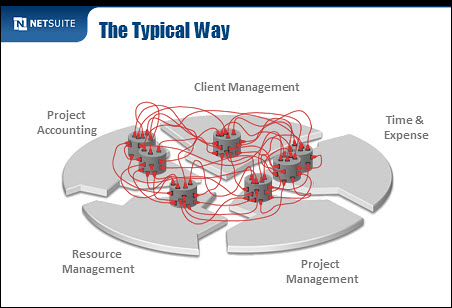
Services organizations typically use a hodgepodge of systems from various software vendors to manage service delivery, accounting, human resources, and other major functions. Each software vendor supplies its own database, creating a complicated and rigid IT environment.
I asked NetSuite OpenAir's SVP of Product Strategy, Ed Marshall, to explain how services resource planning reduces complexity:
Services organizations have evolved over time to try and find point solutions to each aspect of their business. They probably have an accounting system to handle their General Ledger, Accounts Payable and Accounts Receivable. They may opt for a timesheet product, and maybe even an expense management product. Often they are doing time and expense on spreadsheets that need to be reviewed/consolidated/re-keyed by accounting clerks.
Resource management – understanding where your resources are working – is often still done on a white board, or at best a spreadsheet. Project managers have access to Microsoft Project and sometimes there is a spreadsheet to aggregate all the disparate data; more often than not that spreadsheet requires too much effort, and business intelligence is lost.
SRP simplifies the software landscape and provides integrated workflows based on deep understanding of services organizations. For example, time entries instantly show up on a project plan illustrating worked hours vs. planned hours, route to the right project manager for review and approval, automatically flow to an invoice with no re-keying of data, and so on.
The company illustrates this integrated view of data with the following diagram:
STRATEGIC ANALYSIS
As an ERP vendor, NetSuite understands the concept of single, unified system designed to improve data flows and simplify an organization's IT environment. With services resource planning, the company adapts this knowledge, which is typically applied to manufacturing organizations, to companies that deliver services.
At the London press and analyst event, NetSuite asked four customers to discuss why they adopted service resource planning:
- Siemens, the leading provider of product lifecycle management (PLM) solutions
- LLoyd's Register, which offers certification and inspection services for sites such as oil rigs
- Software AG, the second largest software in Germany
- m62, a small presentation development company
Fellow ZDNet blogger, Dennis Howlett, offers a video from the London event.
In general, these customers faced problems such as:
- Running multiple applications in order to cover all professional services management needs; for example, Siemens ran over 15 applications
- Processes that were not scalable or standardized
- Insufficient visibility into detailed activities performed by the services organization
- Need for offline and mobile data collection
- Inability to plan, forecast, and budget accurately
My take. Services resource planning is a natural extension of Netsuite's core ERP business and explains the vision behind the company's acquisition of OpenAir. Based on reports from customers, NetSuite OpenAir has done an admirable job packaging components to bring ERP-style benefits into the world of services organizations.
On the flip side, however, a complete services resource planning implementation is likely expensive and time-consuming, a problem that plagues every ERP vendor. The underlying driver for this cost is complexity of the customer's business rather than the software itself; buyers should therefore plan realistically for implementation.
NetSuite OpenAir belongs to a class of products, which includes project portfolio management, intended to help services organizations plan, manage, and execute more efficiently. Used consistently, these products can help improve governance, reduce waste, and increase project success rates.
Achieving IT success requires broad attention to improving communication and collaboration across functional departments and information silos. While tools can help, defining processes for collaboration and communication is even more important to increasing IT success rates.
[Disclosure: NetSuite paid out-of-pocket travel expenses.]