ie8 fix
madison

Why Microsoft and Intuit need each other's clouds

By | January 20, 2010, 5:09pm PST

Summary: Delve under the covers of a cloud platform to understand why marrying up Microsoft Azure with Intuit Partner Platform makes for a perfect match between two complementary partners.

Today’s announcement that Microsoft and Intuit are to marry up their cloud platforms with a software development kit makes perfect sense to me. Some of my ZDNet colleagues have been less impressed — Dennis Howlett calls it more PaaS to put in your aaS environment while Mary Jo Foley says it’s to shore up Redmond’s small-business cloud play. I don’t argue with either of those viewpoints (TechMeme has more) but I think there’s a lot more to it. To understand why, we need to delve under the covers of a cloud platform.

Last year, I started a long-term project to develop a framework for evaluating cloud platforms (disclosure: Intuit funded some of the initial work, which was published as an analyst report in October, Redefining software platforms, but it’s progressed independently since then). It’s timely today to discuss some of the core principles and what they tell us about the marriage brokered between Windows Azure and the Intuit Partner Platform.

Cloud platforms share many of the ingredients of conventional software platforms, but they add several crucial new ingredients. One thing that hasn’t changed is the need to build momentum among developers and customers for the platform. Intuit and Microsoft have plenty of both, which guarantees attention for what they’ve announced today. But the tie-up between these two giants is important too for the light it shines on the special characteristics of cloud platforms and how they change the game in so many ways for ISVs, developers and platform vendors.
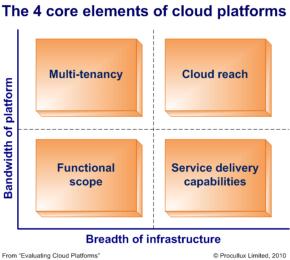
Whatever its market reach, any platform stands or falls on its native capabilities. For a conventional software platform, those capabilities are really all about the functional scope of the development platform — what it empowers developers to create on the platform. Where cloud platforms differ crucially from conventional software platforms is that their native capabilities have to extend into three additional, distinct elements beyond the core functional scope. This is mapped out in the diagram alongside.

On the horizontal axis, the breadth of infrastructure extends beyond the development functionality to embrace the entirely new element of service delivery capabilities. This is a platform’s support for all the components that go with the as-a-service business model, including provisioning, pay-as-you-go pricing and billing, service level monitoring and so on. Conventional software platforms have no conception of these types of capability but they’re absolutely fundamental to delivering cloud services and SaaS applications.

With Microsoft’s heritage so firmly rooted in conventional platforms, Windows Azure has huge functional scope, but it has very limited service delivery capabilities. It sits firmly on the left-hand side of the diagram. In contrast, Intuit’s strengths lie more to the right-hand side. It has gone out of its way to build sophisticated service delivery capabilities into its Partner Platform — to the extent that developers can choose to continue hosting their applications on the functional platform of their choice, and just use IPP’s service delivery and go-to-market capabilities. This is precisely the configuration that the Azure SDK supports (with the option of linking into IPP’s data services too, which is especially useful for integrating to existing data the customer holds in Intuit packages such as QuickBooks).

To put it another way, the link-up combines Microsoft’s strengths in developer tools and functional scope with Intuit’s advanced skills and investment in service delivery on IPP.

The icing on the wedding cake of this marriage made in the cloud is the promise of Microsoft Online Services adding its BPOS offering into Intuit’s App Center. This places a very appealing milestone on the roadmap that encourages developers to start building to the Azure-Intuit platform in the knowledge that, by the end of the year, they’ll be able to connect in a range of email and collaboration capabilities based on Microsoft’s familiar, market-accepted application suite. It’s also an illustration of the sort of capability that comes in on the upper layer of the diagram, against the vertical axis of platform bandwidth. I’ll talk about these in more detail in a future post, because I’m just about out of time and space here, but suffice to say that the ability to connect into other services like BPOS is an example of what is meant by ‘cloud reach’.

Kick off your day with ZDNet's daily e-mail newsletter. It's the freshest tech news and opinion, served hot. Get it.

Topics

Since 1998, Phil Wainewright has been a thought leader in cloud computing as a blogger, analyst and consultant.

Disclosure

Phil Wainewright

Phil Wainewright's work as an independent consultant brings him into direct or indirect business relationships with several of the companies that he writes about, or their competitors. Phil is committed to maintaining the independent and opinionated stance that his writings are well known for and does not enter into contracts that would limit his freedom of expression in any way. However it is important in the interests of full disclosure to inform readers of those relationships so they can form their own judgement.

Read the complete list of Phil's relationships.

Biography

Phil Wainewright

Since 1998, Phil Wainewright has been a thought leader in cloud computing as a blogger, analyst and consultant. He founded pioneering website ASPnews.com, and later Loosely Coupled, which covered enterprise adoption of web services and SOA. As CEO of strategic consulting group Procullux Ventures, he has developed an evaluation framework to help ISVs and enterprises select cloud platforms, and advises US and European vendors on messaging, positioning and go-to-market. His newest role as an industry advocate is vice-president of EuroCloud.

Related Discussions on TechRepublic

Did you know you can take part in these discussions with your ZDNet membership?
12
Comments

Join the conversation!

Just In

RE: Why Microsoft and Intuit need each other's clouds
FAULKNE 13th Oct
Good day to confirm this comment I would appreciate T h e b e s t o f Z D N e t d e l i v e r e d your website very nice to everyone Yes, Oracle is the only one with shared-disk architecture, but that is there advantage. It means you can add or remove nodes and the database lives on. In a shared nothing architecture, if you lose a node, you lose the system. I'm sure Oracle appreciates EMC highlighting their advantage.I also desire to signal in your RSS feeds. Thank you as soon as once again and maintain up the great operate Awesome post! Thank you very much || thanks for nice content this is really benefit to me.
0 Votes
+ -
And more
benkepes 20th Jan 2010
Hi Phil

Alas TechMeMe didn't include my post (despite it
being the first post about this topic humppph) but
anyway...

More thoughts on what this means here -
https://www.cloudave.com/link/intuit-and-
microsoft-sign-deal-to-serve-smbs
0 Votes
+ -
Contributr
Speed
dahowlett 21st Jan 2010
TechMeme isn't so much about speed but influence as decided by Gabe
and his team.
0 Votes
+ -
wow . . .
CobraA1 20th Jan 2010
"For a conventional software platform, those
capabilities are really all about the functional scope
of the development platform ? what it empowers
developers to create on the platform."

Umm, no. If you're developing for the sake of
developing, you're either spinning your wheels going
nowhere, or you're in the small and specialized field
of developing compilers and IDEs.

I'm hoping that most developers are actually
developing software that helps the user, not
developing tools for the sake of more development.

If we're spending more time on our tools and less time
using those tools to help the user - we're doing
something seriously, seriously wrong.
I'll not comment on that...
0 Votes
+ -
Great article, thank you for sharing!

-Tim
I also desire to signal in your RSS feeds. Thank you as soon as once again and maintain up the great operate! nccma cooler
I used to be more than happy to seek out this internet-site.I wanted to thanks in your time for this glorious read!! I positively enjoying each little bit of it and I have you bookmarked to check out new stuff you weblog post.Bookmarking now thanks please consider a follow up post. power sa shop
I think the representation of this article is actually superb one. This is my first visit to your site. Thanks a lot and keep sharing the information. Keep updating the information for all of us. Thanks ZDNet Government was launched as the brand's first industry vertical, with a mission to cater to IT professionals in the public secto I agree with your post. However, do you have any sources I can cite for my paper wheel car com bury
Well welcome, hopefully you can become a vital member of the community and really help to push far ahead of google. Which Im sure the development team would love. This will of course earn you alot points too and get you on the leaders board. z d n e t t h a n k Im not sure i come to an agreement with you on every level, howevor it absolutely was a good posting, many thanks for taking the time to put up your ideas.
Thanks nice info z d n e t I really liked your current article write more..let me add you to its favorite The articles you have on zdnet s i t e are always so enjoyable to read. Good work and I bookmarked it.
Fantastic news about the new release.I positively enjoying each little bit of it and I have you b o o k m a r k e d to check out new stuff you weblog post.Im not sure i come to an agreement with you on every level, howevor it absolutely was a good posting, many thanks for taking the time to put up your ideas
Good day to confirm this comment I would appreciate T h e b e s t o f Z D N e t d e l i v e r e d your website very nice to everyone Yes, Oracle is the only one with shared-disk architecture, but that is there advantage. It means you can add or remove nodes and the database lives on. In a shared nothing architecture, if you lose a node, you lose the system. I'm sure Oracle appreciates EMC highlighting their advantage.I also desire to signal in your RSS feeds. Thank you as soon as once again and maintain up the great operate Awesome post! Thank you very much || thanks for nice content this is really benefit to me.

Join the conversation!

Formatting +
BB Codes - Note: HTML is not supported in forums
  • [b] Bold [/b]
  • [i] Italic [/i]
  • [u] Underline [/u]
  • [s] Strikethrough [/s]
  • [q] "Quote" [/q]
  • [ol][*] 1. Ordered List [/ol]
  • [ul][*] · Unordered List [/ul]
  • [pre] Preformat [/pre]
  • [quote] "Blockquote" [/quote]
ie8 fix
Click Here
ie8 fix

The best of ZDNet, delivered

ZDNet Newsletters

Get the best of ZDNet delivered straight to your inbox

Facebook Activity

White Papers, Webcasts, & Resources
ie8 fix
ie8 fix