i feel compelled to add a clarification about betas: while MS beta software has been typicaly so incredibly buggy over the last 10 years that instead of releasing subsequent betas (Beta 9 anyone?), they started changing build nomenclature to Release Candidates (progressing through 1, 2 and sometimes 3 iterations before going RTM), and even recently 500MB updates for MS SharePoint were christened "Infrastructure Update" instead of Service Pack 2. My thinking is there is internal policy that prohibits releasing more than 1 Service Pack per product per year, so whoever has the ungrateful job of publishing such gargantuan updates, must prove own creativity with coming up with a new bizarre term. They no longer release Alphas. Betas took over what everyone used to call Alpha builds, and Release Candidate took over what was more stable build known as Beta. The amount of chaos it introduces on MS Technet in terms of downloading patches (depending on if you used Beta, RC, or RTM, or RTM + SP1 etc.) is undescribable. Recently they started forcing users to give them email address, to which they will send a message with a link to a password protected .zip file, including that password in the email. For products as complex as SharePoint, Project Server, PerformancePoint Server and Portfolio Server, this is the dumbest possible strategy to deliver fixes to users as quickly as possible. Plus you yourself must find out the sequence of applying fixes. it's a mess that no one at MS seems to have a grip on, and no one cares how difficult it is to patch a server using their implementation. in terms of brainless implementations of functionality for end users, MS Technet and patch system functioning steals hours of my time to research KBs and get the right patches (imagine requesting fixes and getting 24 emails, each with download link to a .zip and its own password).
on the other hand, i wholeheartedly and honestly admint any beta Web product from Google I ever used (though never utilizing 100% of its functonality) was extremely stable.
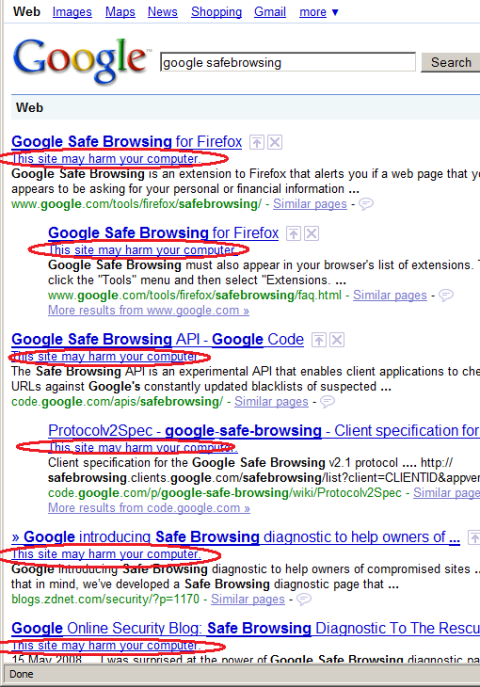
if Google had this "this site can harm your computer" feature online even for a full week, it would not make me more furious about MS patch management for end users and IT pros. it would only cause a small inconvenience, because i always use Google to find a specific patch/KB article on MS site, because MS's search technology and helpfulness of the MS patch website is worth less than the famous chair lobbied towards people knowing search technoogy and leaving MS for Google, knowing well that MS search is dead meat (you never get the result you want as the 1st link, contrary to Google) and by the way learning informal company departure procedures.
Let's face it and sum up in two points:
- MS has search technology, but has no "find" technology. in this area innovation has been dead for more than a decade.
Massive and effective search implementations for terabytes of content (SharePoint, Search Server, other), deployed to client sites are usually done by MS "instant response team" consisting of field-hardened MS consultants; you can't do this yourself by using multi-thousand pages of offical documentation.
- MS has been losing a grip on patch management of ultra-complex server software (versions for 32- and 64-bit platform, multi-language) and their "search technology" will pull them down.
Questions about specific problems and patches are answered on MSDN forums by MS employees in a way that is either formulaic ("here, i'll copy and paste some official documentation", equivalent to "did you power-cycle your cable modem?") or simply not-applicable answer, proving they don't even know their own products well. They're smart people, just unhelpful or confused, or both. Sometimes the solution can be found only on some obscure and outdated blogs from MS MVPs or other MS technology enthusiasts, of course finding them using Google. At least Google employs Web usability testing; MS only presents online surveys to which i can say over and over: your site is useless like during 10 prior online surveys, couldn't find what i was looking for, get a clue at long last. Your KB system will tumble in 2-3 years. you may have made record sales on SharePoint licenses, but guess who will be patching them and who will tell the CIOs (and then CEOs) why the custom application broke after deploying the patch.
In the past i've had the "pleasure" of administering Sun Solaris and Linux servers, and it was much easier than with MS patching now, so no one can't call me a MS fanatic. i like working with solutions that get the job done most reliably and quickly, no matter what the brand is. MS is not such a solution provider now. Even MS sales guys who conned my CIO into buying 3rd party package months ago, now go out empty handed because the IT staff implementing the package b*tched so much and so loudly, the CIO got the message.
the final thought is: i (and perhaps thousands of other it pros) wouldn't be able to effectively manage patching MS servers if Google did not exist. we'd be browsing through heaps of KB articles for patches for products that are not pushed via WSUS. competition, if it results in better products, is always welcome. Windows Vista and MS Ribbon are not.