Google: Microsoft IIS 'twice as often' serving malware

Summary: Research from Google's new anti-malware team suggests that Microsoft's IIS server features "twice as often" as a server firing drive-by malware downloads.
Researchers in Google's new anti-malware team found that Microsoft's IIS (Internet Information Services) server software was being used to launch drive-by malware downloads more than any other server type.
The statistics come from a Google examination of 70,000 domains that have been either distributing malware or have been responsible for hosting browser exploits.
"Compared to our sample of servers across the Internet, Microsoft IIS features twice as often (49% vs. 23%) as a malware distributing server," says Google malware researcher Nagendra Modadugu.
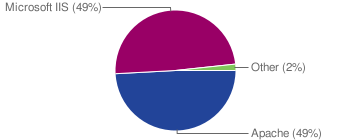
Web server software distribution across malicious servers.
Microsoft IIS and the open-source Apache server account for about 90 percent of all server software distribution across the Internet but the Google numbers show these are the two servers serving up almost all (98%) of all malware.Modadugu makes it clear that not all of these dirty servers were hijacked by attackers, stressing that it is very likely that some servers are configured to serve up exploits by malware authors.Modadugu also offers a glimpse into the geographic location of these malicious servers, highlighting the fact that a lot of dirty IIS servers are in places that are known to be hotbeds for software piracy (China and South Korea). Because Microsoft does not offer security patches for some pirated software, these servers are more likely to be vulnerable to a remote compromise/takeover.
See Modadugu's blog entry for a deeper look at the numbers. Techmeme discussion.
Kick off your day with ZDNet's daily email newsletter. It's the freshest tech news and opinion, served hot. Get it.
Talkback
Why would this be a surprise?
Learning to understand data.
One possible conclusion is that in S. Korea and China where piracy runs rampant the IIS servers are not fully patched and there for more likely targets for malware. In countries where piracy is less prevelent and IIS is more likely to be patched then the servers are less likely to host malware.
That being said a patched IIS server is safer then Apache. There is your suprise oh logicless one!
Twice as many Apache Servers in the US
It would reveal that both Apache and IIS
It tells us that you cannot conclude ...
Definitely not much
Speculation is possible - and sometimes fun - but it is still just speculation....
Hmm - maybe the US numbers on Apache are because it's free, and malware people are trying to maximise profits? And maybe it's harder to pirate IIS here (undetected/reacted to) ?? Who can tell - the people doing it aren't here informing us :)
Apache is more secure
Get the facts- MS solutions are chosen for their lower initial cost to acquire. The TCO of them often is among the highest out there. Same as buying a Yugo. Cheap to buy but nickel and dimes you to death. Same with MS.
By what metric?
Can you provide something other than "because I say so"?
Facts please
In 4 years that IIS 6 has been out, there have only been 3 critial security flaws. Apache has had over 20 in the last 3 years.
That may not say one is better than the other but at least it's evidence.
We chucked Apache....
More likely...
What?
What does the "IT " in your name stand for?
Read the source.
It also says in the underlying article that Apache also serves up 49% of the maleware. I'm not sure what this guy was reading when he wrote the article.
It should be surprising....
Statistics and spelling.
Missing numbers
Go Windows! Virus for the people!
The wrath of Ou will be visited on you...
What I find more interesting is the assertion that many servers are set up delibrately for drive-by insertion and that a lot of these are IIS servers. Wouldn't Apache be a lot cheaper or does the malware depend on IIS/Windows interaction that Apache cannot provide?
Which version of apache out numbers IIS 3:1?
My point is that "Apache" is fairly generic compared to "IIS". It runs on a multitude of hardware/software platforms. There are three majory code bases (1.x,2.0,2.2). Contrast this with IIS which primarily runs on x86/Windows and is limited to 5.0/6.0
Which just goes to show...
:o)